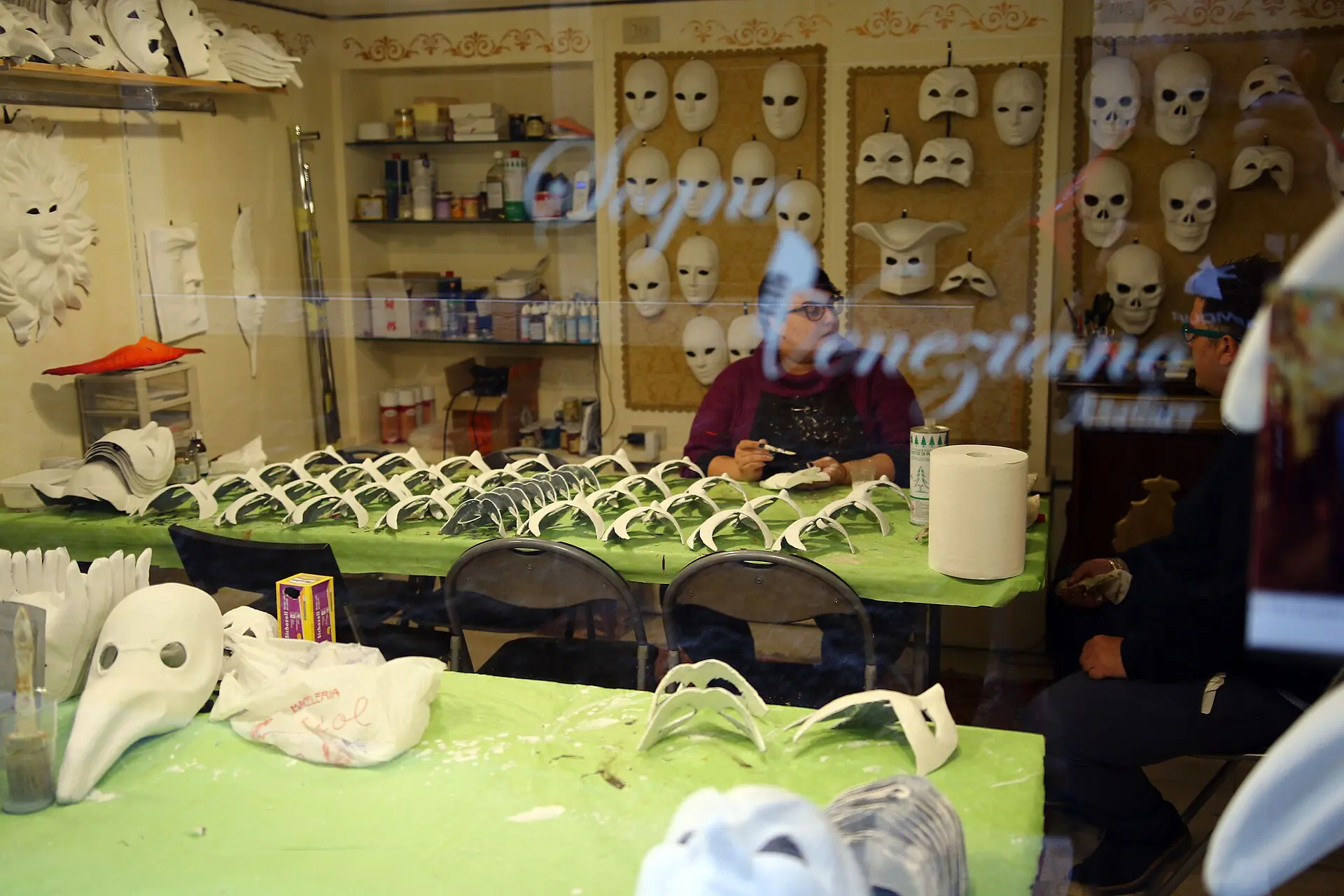
What happens when the last traditional craftsman in a Venetian workshop retires? Sometimes an apprentice takes over. Sometimes the business is sold, the tools are dispersed, or the premises become something else. The result depends on training, rent, demand, and the ability to make skilled work financially viable. Venice’s future as a living city is tied to these decisions, from Murano glass furnaces to boatyards, textile studios, and restoration workshops.
By Igor Scomparin, licensed Venice guide since 1997.
When the last key turns in the lock
A Venetian workshop can disappear quietly. There may be no announcement, no closing ceremony, and no sign that the shop once held generations of practical knowledge. A master retires, the lease ends, and the tools are moved away. For a traveler, one more storefront has changed. For the city, the loss can be more consequential: an address where skills were taught, repairs were made, and neighbors exchanged advice no longer performs those functions. The central question is not whether Venice can keep selling beautiful objects. It is whether the people capable of making and maintaining them can keep working here.
What counts as a traditional workshop?
A traditional Venetian workshop is not necessarily a centuries-old business or a room filled with antique equipment. The defining characteristic is skilled production or repair, with knowledge acquired through practice. Glassmaking, oar making, textile work, printing, jewelry, bookbinding, restoration, and boat maintenance have different histories and economic models. Some serve visitors; others primarily serve residents, churches, or other businesses. Treating all workshops as souvenir shops obscures the distinction between a functioning craft economy and a retail display.
Why retirement is a turning point
When an experienced maker retires, several assets must be transferred separately. Tools may have financial value, but the ability to use them safely and well is learned over time. Supplier relationships, knowledge of materials, and trust with customers can be difficult to pass on. The premises may belong to a landlord with no interest in preserving the trade. A successful succession therefore needs a capable successor, a workable business model, and a place to operate. Missing any one of these can end the enterprise.
The apprenticeship problem
Craft knowledge is often embodied: a worker learns by watching, attempting, failing, and receiving corrections. A glassmaker learns how material behaves at the furnace; a woodworker learns to judge grain and moisture; a restorer learns when intervention would cause more harm than good. Video tutorials can preserve demonstrations, but they do not replace years of supervised practice. Training also costs money because an apprentice initially produces less than an experienced worker. Small workshops may struggle to finance that learning period.
A successor needs a living
It is easy to say that young people should save old trades. The harder question is whether the work can pay a sustainable income. A prospective successor must cover rent, insurance, utilities, equipment, taxes, and personal living expenses. Even strong artistic ability does not guarantee steady orders. If the only profitable market is inexpensive souvenirs, an ambitious maker may face pressure to simplify production. A viable succession must address economics rather than rely on romantic appeals to tradition.
The premises are part of the craft
Workshops are not interchangeable commercial spaces. A furnace needs specialized infrastructure and safety measures. A boatyard needs water access and room to maneuver hulls. A print studio needs stable surfaces and storage; a restorer may need controlled conditions and secure premises. Moving a workshop can disrupt suppliers and customers even when the craftsperson stays in Venice. Losing the original space may therefore mean losing a business model, not merely changing an address.
Rent and competing uses
A ground-floor space suitable for a workshop may also appeal to retailers or hospitality businesses. Different uses can support very different rents, and a craft business may not generate revenue per square foot comparable to high-volume commerce. Property owners have legitimate financial concerns, while residents may value the social benefits of keeping production nearby. The tension cannot be resolved by declaring one group virtuous and another harmful. It requires examining leases, local planning, demand, and the practical needs of each trade.
What tourists buy, and what they sustain
Visitors can support workshops through purchases, but spending alone does not guarantee that a craft survives. A cheaply made object with a Venetian label may produce little local skilled employment. A genuine handmade piece usually reflects labor, training, materials, and overhead. Travelers should ask where an object was made and who made it, without expecting every artisan to provide a lengthy demonstration. The most useful purchases are those that match personal interest and a realistic appreciation of skilled work.
Murano glass: fame and vulnerability
Murano glass is internationally recognized, yet the island’s glass industry includes very different businesses and production methods. Furnaces require energy, specialized workers, maintenance, and safety investment. Some makers focus on artistic pieces; others produce lighting, tableware, or components. A workshop closing can mean the loss of a specific technique or team, even if glass remains widely available in stores. Visitors should not confuse the visibility of Murano-branded merchandise with the health of every local furnace.
The furnace cannot wait for a tourist
A glass workshop’s schedule follows production needs, not simply visitor demand. Furnaces and skilled teams require coordinated work. A demonstration arranged for visitors can be educational, but it may show only a small part of a complex process. A buyer interested in craftsmanship should ask about the maker’s actual work, techniques, and materials. Treating glassmaking as a continuous performance for sightseeing groups can distort what industrial and artistic production really involves.
Glass beads and intangible heritage
The art of glass bead making is recognized on UNESCO’s Representative List of the Intangible Cultural Heritage of Humanity through a multinational inscription involving Italy and France. The recognition concerns skills, knowledge, and communities rather than a blanket guarantee of commercial survival. Venetian bead traditions include specialized techniques and networks of makers. Their future depends on transmission and demand, not simply on the existence of a prestigious label. UNESCO recognition can raise awareness, but it cannot train a successor by itself.
The squeri and the working lagoon
A squero is a boatyard, historically associated with building and repairing wooden boats. Such spaces depend on direct access to water and knowledge of hulls, timber, and local conditions. A gondola or other traditional vessel is not merely a decorative symbol: it is an engineered object that must perform safely. When a skilled boatbuilder retires without a successor, owners may lose a trusted source of maintenance as well as a maker of new boats. The consequences reach into the everyday functioning of the lagoon.
Why boatbuilding is hard to relocate
A conventional shop can sometimes move to another street. A boatyard needs an appropriate shoreline, access for vessels, storage, and permission for its activities. In Venice, those requirements can sharply limit alternatives. A successor who inherits tools but cannot secure suitable premises may be unable to continue. This is a useful example of why protecting a craft requires thinking about urban infrastructure as well as artistic skill.
Oars and forcole
A forcola, the distinctive Venetian oarlock, is shaped for the movements and demands of rowing. Making one requires understanding wood, balance, boat type, and the rower’s technique. The object is beautiful enough to appear in galleries, but its form begins with use. A workshop producing functional forcole must maintain contact with the people who row. Without that working relationship, a tradition risks becoming a decorative style disconnected from the skills that gave it meaning.
Textiles beyond the shop window
Venetian textile traditions encompass weaving, design, furnishing, and restoration. Historic fabrics can require specialist knowledge of looms, patterns, fibers, and finishing. Some workshops supply interiors or conservation projects rather than tourists. A textile business may therefore be invisible to casual visitors even while contributing to the city’s heritage economy. Succession can be especially difficult when specialized machinery and long training periods make entry expensive.
Bookbinding, paper, and print
Venice’s history as a center of publishing gives special resonance to contemporary paper crafts. Bookbinders and printers may work with materials and techniques that demand patience and precise hand skills. Their customer base can include artists, collectors, institutions, and residents. When a maker retires, customers may lose a repair or bespoke service that cannot be replaced by an ordinary retail purchase. A city’s craft heritage includes these practical services, not only objects designed for display.
Restoration as an invisible craft
Conservation and restoration are among the most consequential forms of skilled work in a historic city. Stone, plaster, wood, paintings, and textiles require different expertise. Responsible restoration is guided by evidence, documentation, and professional standards; it is not simply making an old object look new. The transfer of knowledge matters because inappropriate repairs can damage irreplaceable material. Training and continuity support Venice’s built heritage as surely as the preservation of monuments themselves.
Women in the workshop economy
Accounts of Venetian craftsmanship often foreground male masters, especially in boatbuilding and glass furnaces. Women have also participated in textile work, beadmaking, design, trade, and other skilled activities. Some labor was poorly recorded or performed within households and family enterprises. A modern succession strategy should avoid assuming that the next master must resemble the previous one. Broader access to training and ownership can help crafts adapt without erasing their history.
The family business dilemma
A family name on a storefront can suggest continuity, but children do not necessarily want to enter the same profession. Their decisions may reflect working hours, financial uncertainty, education, or personal ambitions. Expecting a son or daughter to inherit a workshop out of duty can be unfair. A business may survive better through an unrelated apprentice, partnership, or cooperative arrangement. Preserving a tradition should not require limiting the choices of the next generation.
A maker may want to retire
Preservation campaigns sometimes speak as if retiring artisans owe the city indefinite labor. They do not. A master may have worked for decades and deserves the option to stop. The challenge belongs to the wider system: how to document techniques, build apprenticeships, and create viable succession routes before retirement becomes urgent. Respecting the maker as a person is essential to any credible plan for protecting the craft.
Why training needs time
An apprenticeship is not a single workshop experience sold as a tourist activity. The learner must repeat tasks, develop judgment, and understand errors. Some skills can be acquired relatively quickly, while others take years. A useful training program should define competencies and offer real work under supervision. Short demonstrations can inspire interest, but they should not be presented as equivalent to professional preparation.
Schools, associations, and networks
Vocational schools, professional associations, museums, foundations, and local institutions can all help preserve craft knowledge. Their roles differ: some teach, some document, some promote exhibitions, and some support businesses. Effective collaboration would connect education with paid work and access to premises. A course without employment opportunities may create enthusiasm but no lasting successor. Conversely, a workshop with orders but no trainees may still close when its owner retires.
Documenting what cannot be written down
Archiving tools, patterns, oral histories, and demonstrations can preserve valuable evidence. Yet some knowledge depends on touch, timing, and immediate feedback. A written description of a furnace operation cannot fully convey the judgment required at high temperatures. Documentation should complement practical training rather than substitute for it. The best archives also record ordinary work processes, not only polished finished objects.
The cost of energy and materials
Traditional crafts can depend on energy-intensive equipment or specialized raw materials. Prices can fluctuate, affecting whether small producers can offer competitive work. Customers may see only the final price tag without understanding the costs behind it. A viable workshop needs purchasing power, predictable orders, and the ability to price skilled labor honestly. Public admiration is not a substitute for a functioning balance sheet.
Competition and authenticity
Imported goods and industrial production can imitate traditional Venetian styles at lower prices. Mass production is not inherently illegitimate, but problems arise when buyers are misled about origin or technique. Genuine makers need ways to communicate what distinguishes their work without turning every purchase into a complicated certification exercise. Clear labeling, trustworthy retailers, and informed visitors can help customers choose according to their priorities.
What a workshop visit should look like
A responsible visit begins by asking whether the workshop welcomes visitors and whether a reservation is needed. Production may be interrupted by safety rules, deadlines, or customer work. A genuine maker should not be expected to stop for an unpaid demonstration simply because a traveler is curious. If an experience includes a fee, understand what it covers. Respect for working time is part of supporting craftsmanship.
How to ask better questions
Instead of asking only how old a shop is, ask what the maker produces, what materials are used, how long training takes, and whether the workshop repairs objects as well as selling them. These questions reveal a craft’s practical life. They also avoid assuming that the oldest-looking interior contains the most authentic work. A young maker using contemporary tools can be carrying forward a traditional skill in a serious way.
The value of repair
Repair is an overlooked part of craft sustainability. A workshop that maintains boats, textiles, furniture, or household objects helps keep materials in use. This can reduce waste and preserve skills that are not visible in souvenir markets. For residents, access to reliable repair services may matter more than the availability of decorative products. A city loses practical resilience when these businesses disappear.
Craft and the resident population
A workshop needs workers who can reach it, suppliers who can deliver, and customers who use its services. Housing pressures and demographic change can affect all three. The fate of traditional crafts is therefore linked to the wider question of whether Venice can remain a functioning residential city. A craft cannot be preserved only as a brand if the everyday community that supports it continues to shrink.
The tourist economy is not one thing
Tourism can provide valuable demand for high-quality handmade objects and educational visits. It can also create pressure for rapid sales, standardized products, and high rents. Both effects can exist at once. The challenge is to encourage forms of visitor spending that sustain skilled employment rather than assume tourism is entirely beneficial or entirely destructive. The details differ between a glass furnace, a boatyard, and a bookbinding studio.
Private experiences and honest interpretation
A private guide can help visitors understand the difference between a working atelier, a showroom, and a demonstration venue. The best experience is not necessarily the most elaborate one. A short, well-arranged conversation with a maker may be more valuable than a long stop that disrupts production. Tour Leader Venice emphasizes locally informed visits, but specific workshop access should always be confirmed rather than promised without agreement.
Why November can be useful
November often allows a slower pace of exploration, but individual workshops follow their own schedules and may close for production, holidays, or personal reasons. A quieter street does not guarantee that a maker is available. Travelers should arrange appointments where appropriate and accept that some businesses are not visitor attractions. The season can be rewarding for thoughtful conversations if expectations are realistic.
A succession plan before the final year
The most promising moment to plan succession is before a master is ready to retire. That allows time to identify trainees, transfer customer relationships, document specialized processes, and negotiate premises. Waiting until the final months can leave too little room for a successor to build competence or financing. A practical plan treats succession as a multi-year business process rather than a last-minute heritage campaign.
Possible models for continuity
A successor might buy the business, enter a partnership, lease equipment, or join a cooperative. Some workshops may share premises or specialist machinery. No model fits every craft. A glass furnace has different needs from a paper studio, and a boatyard faces distinct land-use constraints. What matters is matching the legal and financial structure to the work, rather than imposing one romantic vision of the family workshop.
What local government can and cannot do
Municipal policies may influence planning, premises, permits, and support programs, but public authorities cannot guarantee customers or skilled successors. Any intervention involves trade-offs and finite resources. A useful debate asks which workshops provide irreplaceable services, which barriers can realistically be reduced, and how outcomes will be measured. Broad promises to save tradition mean little without practical implementation.
What cultural institutions can contribute
Museums and foundations can commission work, record techniques, support exhibitions, and connect makers with audiences. Their purchasing and conservation needs may create meaningful demand. Yet a craft displayed behind glass is not necessarily a craft practiced in the city. Institutions can be most useful when their activities lead to paid production, professional training, and durable relationships with working makers.
The buyer’s role
Travelers cannot solve Venice’s economic challenges through a single purchase, but they can make informed choices. Buy from makers or credible retailers when possible, ask about origin, and value quality over quantity. If you do not intend to purchase, respect the workshop’s time. Supporting craftsmanship can also mean commissioning repair, attending a paid educational visit, or recommending a genuine maker to someone who needs their work.
What not to romanticize
Traditional workshops may be beautiful, but they can also involve physically demanding labor, unpredictable income, safety risks, and long hours. Preserving the craft should not mean preserving every difficult condition under which it was historically practiced. Younger workers may reasonably seek safer equipment, fairer pay, and better work-life balance. Tradition can survive through adaptation; insisting that nothing change may make succession less likely.
The difference between a product and a practice
A shop can continue selling a recognizable Venetian product long after local production has stopped. Conversely, a skilled craftsperson may work in a modest modern space with little decorative appeal. The survival of a tradition is better measured by people actively making, repairing, teaching, and innovating than by the number of picturesque storefronts. This distinction should guide both visitor choices and heritage policy.
An honest future for Venetian crafts
Some workshops will close, and not every historic business can or should remain unchanged forever. The important question is whether the city retains enough skilled people, suitable spaces, and economic demand for the traditions to evolve. Success may look like a young maker adopting new tools while preserving essential techniques, or a partnership that transfers knowledge outside a family line. Continuity is a living process, not a museum display.
A final walk through the city
On your next walk through Venice, notice doors that open onto workshops rather than souvenir displays. Listen for tools, watch deliveries, and remember that production often happens out of sight. Do not enter uninvited, but remain curious about the work behind the finished object. When a master retires, Venice risks losing a relationship between skill, place, and community. Protecting that relationship is a more meaningful goal than simply preserving a romantic image.
Related reading from Tour Leader Venice
For a wider perspective, read how Venice can protect its living traditions. Discover the UNESCO-recognized craft of Venetian glass beads, and explore places to experience authentic Venetian craftsmanship.
More to explore in Venice
For additional context, explore Murano’s working glassmaking traditions; how Venice became a glassmaking center; a guide to Venetian makers. These stories expand on the places, people, and traditions discussed above.
Frequently Asked Questions
Why are traditional workshops closing in Venice?
There is no single cause. Retirement without successors, expensive premises, training costs, changing demand, and operating expenses can all affect whether a workshop continues.
Can tourists visit real artisan workshops in Venice?
Some workshops welcome visits by appointment, while others focus on production and do not accept drop-ins. Ask in advance, respect safety rules, and be prepared to pay for organized experiences.
How can travelers help preserve Venetian craftsmanship?
Choose genuine locally made work when possible, ask about its maker and origin, respect workshop time, and support paid demonstrations or commissions that benefit skilled producers.