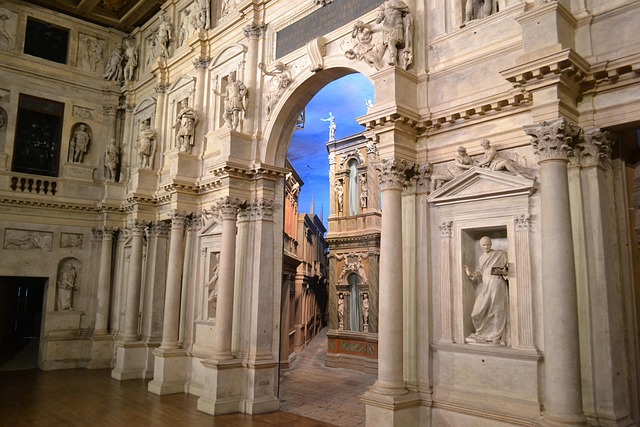
You enter through a tall archway cut into a medieval wall, cross the courtyard of what used to be a fortress and prison, pass down a narrow hallway, and then, without any real warning, step directly into Ancient Rome. That’s not a figure of speech. Andrea Palladio’s final work, completed after his death by his student Vincenzo Scamozzi, remains the oldest surviving indoor theatre in the world in its original form, and walking into it for the first time is still, four and a half centuries later, a genuinely disorienting piece of architectural theater in its own right.
A Final Commission From His Own Society
In 1580, at 72 years old, Palladio received his last major commission: a permanent, purpose-built theatre for the Accademia Olimpica, a cultural and scientific society founded in Vicenza in 1555, bringing together members across a genuinely wide mix of social classes to pursue shared humanist and scientific interests. Palladio wasn’t simply hired for this project; he was a member of the Accademia himself, designing a theatre for a community he personally belonged to, which may explain something of the project’s unusual ambition. The commission was formalized in February 1580, and construction began that May.
The site chosen for the theatre was itself a piece of layered Vicentine history: the grounds of an old medieval castle that had previously served the city as a fortress and, later, a prison. Visitors still enter today exactly as they would have in the 1580s, through a tall archway cut directly into the surviving medieval wall, crossing what was once a fortress courtyard before reaching the theatre itself, a sequence that makes the eventual reveal, stepping from a genuinely medieval stone courtyard into what appears to be a fully realized ancient Roman theatre, feel almost deliberately staged.
Palladio Died Before Seeing It Finished
Palladio did not live to see his final design realized. He died suddenly on August 19, 1580, just three months after construction began, and oversight of the project passed to his son Silla, who worked alongside the Accademia to see the building through to completion, formally handing the finished theatre over to the city in 1583.
Even the theatre’s inaugural production changed after Palladio’s death. The Accademia had originally planned to open the space with a pastoral comedy written by a member named Fabio Pace, a choice that would have called for scenery depicting open countryside. In 1583, the Accademia changed course entirely, deciding instead to stage Sophocles’ tragedy Oedipus Rex, a decision with real architectural consequences: a play set in the ancient city of Thebes required scenography depicting city streets rather than landscape, and the Accademia found itself purchasing additional adjoining property specifically to accommodate the deeper, more elaborate stage perspective the new production would require.
Building a Roman Theatre From Memory and Vitruvius
Palladio’s design drew directly on the ancient Roman theatre tradition as described by the Roman architect and engineer Vitruvius, whose surviving treatise on architecture Palladio had studied closely throughout his career, alongside the ruined Roman theatres he had personally measured and sketched during his youthful study trips to Rome. The result is an elliptical, tiered seating area, the cavea, rising in stone steps and framed by a tall colonnade, its entablature topped with a frieze and, remarkably, roughly eighty individual statues, portraits of actual Accademia members reimagined as classical, toga-draped figures, standing watch over the audience from niches around the theatre’s upper edge.
The site itself forced one genuine compromise on Palladio’s classical ambitions: a full Roman theatre traditionally used a semicircular seating arrangement, but the available space inside the old fortress walls wasn’t large enough to accommodate one, so Palladio adapted his design into a half-ellipse instead, a practical solution to a real physical constraint that nonetheless preserves the essential visual and acoustic logic of the ancient model it draws from.
Facing the seating area stands the scaenae frons, the elaborate stage facade, built across two architectural orders and opened by a grand central arch, the Porta Regia, flanked by additional doorways, all populated with more statues and carved bas-relief panels set into aedicules and niches. Taken purely as architecture, independent of anything staged in front of it, the scaenae frons is considered one of Palladio’s most confidently classical designs, columns, arches, and proportion assembled with the same rigorous discipline that defines his villas and palazzi across the Veneto.
Scamozzi’s Trick: Seven Streets That Aren’t Really There
What actually happens behind that grand stage facade is where the Teatro Olimpico becomes something genuinely unprecedented, and where credit shifts decisively from Palladio to his successor. Vincenzo Scamozzi, tasked with completing construction and designing the stage set the Accademia’s new choice of Oedipus Rex required, built something no theatre anywhere had attempted before: a permanent, three-dimensional architectural set depicting seven distinct streets of the ancient city of Thebes, visible through the five openings of the proscenium, each street receding dramatically into the distance using a carefully engineered forced perspective.
The illusion is genuinely, disorientingly effective. Each of those seven “streets” is, in physical reality, only a few meters deep, built from wood and stucco finished to resemble stone and marble, with buildings scaled down and angled specifically to trick the eye into perceiving far greater depth than actually exists. It’s widely credited as the first true use of perspective scenography in Renaissance theatre, and the effect impressed the Accademia so completely that what was originally conceived as production-specific scenery for a single play became a permanent, structural part of the theatre itself, never removed or replaced, and still standing today as, quite possibly, the oldest surviving stage set anywhere in the world. Scholars still debate exactly how much of the design should be credited to Scamozzi independently versus drawings potentially left behind by Palladio’s own son Silla, but there’s little dispute that the finished result represents a genuine leap beyond anything Palladio himself had built.
The Odeo and Antiodeo: The Rooms You Pass Through First
Before reaching the theatre itself, visitors pass through two additional rooms Scamozzi also designed as part of the complex: the Odeo, the hall where the Accademia’s own meetings were held, later decorated with frescoes by the painter Francesco Maffei around 1637 depicting divinities and allegorical figures; and the Antiodeo, decorated with a monochrome frieze completed around 1595 that carries genuine historical documentary value, depicting the theatrical productions the Accademia had staged before the Teatro Olimpico existed, including works like Amor Costante and Sophonisba, along with other civic events and performances held around the city in the preceding decades. A further hallway carries a series of bas-reliefs illustrating stories of Hercules, by the sculptor Ruggero Bascapè, adding another decorative layer to the sequence of spaces visitors move through before reaching the theatre’s main auditorium.
Opening Night: A Play That Ran Until Dawn
The Teatro Olimpico officially opened on March 3, 1585, during Carnival season, with the long-planned staging of Sophocles’ Oedipus Rex, its music specially composed for the occasion by Andrea Gabrielli, one of the leading Venetian composers of the era. It was, by every surviving account, a genuinely major civic event: thousands of spectators attended, drawn from Vicenza and well beyond, and the performance itself didn’t actually begin until roughly one o’clock in the morning, continuing until close to five, an epic, exhausting theatrical evening that some attendees reportedly found less than fully satisfying by the time it finally concluded. Whatever the audience’s stamina by dawn, the building itself had made its point decisively: Vicenza now possessed a permanent theatre unlike anything else built in Europe since antiquity, and news of it spread quickly, first to Venice and then across the rest of Italy.
The Oldest Surviving Indoor Theatre in the World
The Teatro Olimpico holds a genuinely rare distinction: it’s widely recognized as the first permanent, fully covered theatre built in the modern era, and it remains one of only three Renaissance theatres still standing anywhere in the world, alongside the Teatro all’Antica in Sabbioneta and the Teatro Farnese in Parma, both built somewhat later and both directly influenced by what Palladio and Scamozzi had accomplished in Vicenza first. Remarkably, the theatre still hosts occasional live performances today, making it one of the only buildings of its age anywhere in the world still used, at least on special occasions, for the exact purpose it was originally built for.
Part of Vicenza’s UNESCO Story
The Teatro Olimpico is one of the original 23 buildings included when Vicenza’s historic center first earned UNESCO World Heritage status in 1994, standing alongside the Basilica Palladiana and the palazzi lining Corso Palladio as one of the clearest single demonstrations of Palladio’s mature architectural achievement, and, in this specific case, of the way his final vision was carried forward and completed by the student who inherited it.
Visiting the Teatro Olimpico Today
The Teatro Olimpico sits on Piazza Matteotti, near the top of Corso Palladio, Vicenza’s main street, making it an easy, natural stop to combine with the Basilica Palladiana and a walk through the city’s historic center. Entry includes access to the Odeo and Antiodeo along the way to the main auditorium, and the sequence, medieval fortress courtyard to Renaissance rooms to ancient Roman theatre, works best experienced without rushing, since much of the building’s effect depends on that deliberate, layered reveal.
Plan your visit: Our full guide, Vicenza and UNESCO: The Complete Guide to the City Andrea Palladio Built, covers how to combine the Teatro Olimpico with the Basilica Palladiana and La Rotonda in a single Vicenza day, and private transfers to Vicenza and other Veneto destinations handle the logistics from Venice.
Frequently Asked Questions
Did Palladio live to see the Teatro Olimpico completed?
No. Palladio died on August 19, 1580, just three months after construction began. His son Silla oversaw the remaining work, and the theatre was formally handed over to the city in 1583, with Vincenzo Scamozzi completing the auditorium and designing the theatre’s famous permanent stage set for its 1585 opening.
Is the stage set inside the Teatro Olimpico original?
Yes. The elaborate wooden and stucco stage set depicting seven forced-perspective streets of ancient Thebes, designed by Vincenzo Scamozzi for the theatre’s 1585 opening production of Oedipus Rex, was never removed and remains in place today, widely considered the oldest surviving stage set anywhere in the world.
Why is the Teatro Olimpico considered such a significant building?
It’s widely recognized as the first permanent, fully covered theatre built in the modern era, one of only three Renaissance theatres still standing anywhere in the world, and the site of the first true use of forced-perspective scenography in theatre history. It remains part of Vicenza’s UNESCO World Heritage listing as one of the city’s original Palladian buildings.