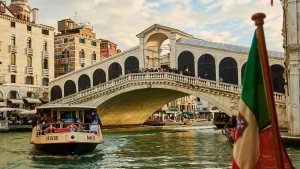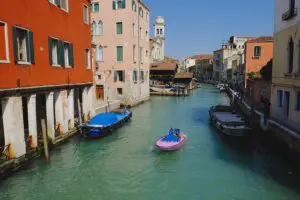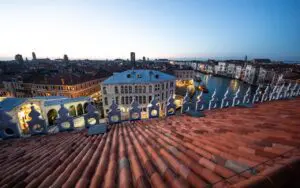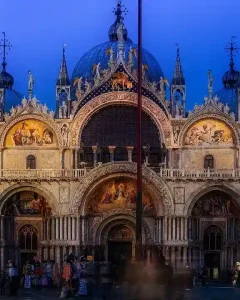
Stand at the right spot on the Grand Canal and you can watch four centuries of Venetian taste go by without moving your feet — a lace-like Gothic facade, then a few doors down, something calmer, heavier, and unmistakably classical. That second style is Venetian Renaissance, and it marks a genuine turning point in how the city thought about its own architecture: a deliberate, confident move away from pointed arches and decorative filigree toward the round arches, columns, and disciplined symmetry of ancient Rome. Once you know what separates the two, Venice’s most famous stretch of water starts to read less like a jumble of pretty facades and more like a timeline.
How to Actually Tell Renaissance From Gothic
The quickest tell is the window. Venetian Gothic loves the pointed ogival arch, grouped windows, and a busy, top-heavy decorative band across the piano nobile. Venetian Renaissance replaces that with the round arch, borrowed directly from ancient Roman precedent, along with classical columns, entablatures, and a much stronger sense of horizontal order — architects working in this style favored measured proportion, tight symmetry, and a genuinely classical vocabulary applied to the facade, a conscious rejection of Gothic ornament in favor of Roman restraint.
You’ll also notice the material handling changes. Renaissance facades tend to organize their floors into clearly separated horizontal registers — often with rustication (deliberately roughened stone blocks) on the ground floor giving way to smoother, more refined stonework above — rather than the continuous vertical rhythm of Gothic tracery. It’s architecture that wants to look engineered and rational rather than woven and organic, and that shift in mood is really the whole story of why Venice moved on from Gothic in the first place.
Palazzo Corner della Ca’ Grande — Venice’s Answer to Rome
Along the Grand Canal near the Accademia, directly across from the Peggy Guggenheim Collection, stands the palace most historians treat as the definitive statement of Venetian High Renaissance architecture. Palazzo Corner della Ca’ Grande was designed by Jacopo Sansovino after a 1532 fire destroyed the previous Corner family residence, and it was one of the architect’s first major commissions in Venice. The Corner family’s choice of style was pointedly symbolic — they claimed descent from the ancient Roman Cornelia clan, and a facade built from the vocabulary of Roman classical architecture was a direct, visible assertion of Venice’s own claim to be a kind of “new Rome.”
The design followed a tripartite plan, with the ground floor holding the water gate and entrance hall flanked by storerooms once used for the wheat, sugar, and cotton the Corner family imported from their estates in Cyprus. Its design likely drew inspiration from Bramante’s Palazzo Caprino in Rome, pairing engaged Doric columns with a full classical entablature — and subsequent Venetian palaces spent decades elaborating on Sansovino’s formula without ever quite surpassing it. The palace has served an unbroken civic function since the 19th century, first as an Austrian administrative seat and today as the residence of Venice’s prefect.
The Two Palazzi Grimani — A Family, Two Architects, Two Very Different Buildings
Confusingly for visitors, Venice has two separate palaces belonging to the powerful Grimani family, and both are genuinely worth knowing apart.
Palazzo Grimani di San Luca, on the Grand Canal in San Marco, was built in the mid-16th century for the procurator Gerolamo Grimani by the architect Michele Sanmicheli, and completed after his death by Gian Giacomo de’ Grigi. Its facade is organized into three sectors framed by Corinthian columns, deliberately evoking the form of an ancient Roman triumphal arch — subtler than Sansovino’s Corner palace, but unmistakably speaking the same classical language. The building later became influential well beyond Venice: American architect Stanford White modeled his early-1900s design for the Tiffany and Company Building on Fifth Avenue in New York directly on this facade, a genuinely remarkable afterlife for a 16th-century Venetian palace.
Palazzo Grimani di Santa Maria Formosa, tucked away from the Grand Canal in Castello, has been converted into a museum and is considered one of Venice’s finest preserved 16th-century interiors, housing the Grimani family’s original collection of ancient sculptures and artifacts alongside remarkable frescoed rooms. The Cardinal’s Apartment and the Tribuna are particularly notable spaces within the palace, and because it sits well off the main tourist circuit, it offers a noticeably calmer, more intimate visiting experience than Venice’s more famous museums. Unlike the Corner and San Luca palaces, this one you can actually walk inside — a genuine advantage if you want to experience Renaissance grandeur up close rather than just admire it from a passing boat.
Palazzo Gussoni Grimani Della Vida — The Palace That Lost Its Tintoretto
Further up the Grand Canal in Cannaregio sits a Renaissance palace with a genuinely poignant footnote. Built in the mid-16th century by a branch of the Gussoni family and attributed to Michele Sanmicheli, the palace’s facade was originally decorated with frescoes by Tintoretto himself, depicting allegories of Dawn and Dusk. Those frescoes are long gone now, worn away by centuries of salt air and weather — a fate that befell an enormous amount of exterior fresco decoration across Venice, since the city’s humid, saline climate is brutal on painted plaster exposed to the elements. The palace changed hands again in 1816, purchased by the Jewish family Dalla Vida, whose name it still carries today. It’s a good reminder, walking past any Venetian facade that looks plain or under-decorated today, that many of these buildings were once considerably more colorful than what survives to be seen now.
Two Renaissance Landmarks You’ve Already Read About Here
If Renaissance Venice is capturing your imagination, two more essential stops are already covered elsewhere on this site in full depth: Ca’ Vendramin Calergi, the Codussi-designed Grand Canal palace where Wagner spent his final months, and Palazzo Labia, with its extraordinary Tiepolo fresco cycle — both are part of my Cannaregio walking guide. I’d rather send you there for the full story than repeat it in miniature here.
Seeing the Shift for Yourself
The real pleasure of understanding this style isn’t memorizing which architect built what — it’s training your eye to catch the transition as you move along the Grand Canal, watching pointed Gothic arches give way, block by block, to round Roman ones, and realizing that shift represents an entire city consciously rewriting its own architectural identity, palace by palace, over the better part of a century.
That’s exactly the kind of detail that turns a boat ride down the Grand Canal from sightseeing into something closer to reading a very slow, very beautiful history book. If a private route built around Venice’s architectural evolution — Gothic, Renaissance, and beyond — sounds like your kind of morning, get in touch directly and I’ll design it around exactly what interests you. And for a full-day change of scenery after tracing classical columns along the canal, a private day trip to the Prosecco Hills is a beautiful way to round out the trip.
How can I tell a Renaissance palace apart from a Gothic one in Venice?
Look at the windows and arches: Gothic palaces use tall, pointed ogival arches grouped in decorative rows, while Renaissance palaces use round Roman-style arches, classical columns, and a more restrained, symmetrical, horizontally organized facade.
Can you go inside any of Venice’s Renaissance palaces?
Yes — Palazzo Grimani di Santa Maria Formosa in Castello is open as a museum and is one of the best-preserved Renaissance interiors in the city, with original frescoes and the Grimani family’s sculpture collection on display.
Why did Venice move from Gothic to Renaissance architecture?
Venetian patrician families increasingly wanted their palaces to assert a connection to ancient Rome’s prestige and classical learning, and architects like Jacopo Sansovino and Michele Sanmicheli, trained in the classical vocabulary developing in Rome and Florence, brought that style directly into the city’s most important commissions.