Which fish still live in the Venetian Lagoon, and which are disappearing? The lagoon remains home to a diverse fish community, including gobies, sand smelts, mullets, sole, and European eel, alongside marine species that use its shallow waters seasonally. But warming, habitat changes, invasive organisms, and pressure on migratory species are altering this ecosystem. European eel is a particular conservation concern, while studies have found declines in some cold-associated fish components. It would be misleading to declare every familiar lagoon fish endangered without species-specific evidence.
In this research-based guide, we distinguish fish that have been documented in scientific surveys from species facing proven wider conservation problems. We also explain the vital role of seagrass, tidal mudflats, salt marshes, and the changing connection to the Adriatic Sea.
A lagoon that is also a nursery
Venice is not surrounded by a uniform basin of seawater. Its shallow flats, marsh channels, eelgrass beds, mud bottoms, and tidal inlets create a mosaic of habitats. Many fish use different parts of that mosaic at different stages of life. Juveniles of marine species may find food and shelter in shallow areas before moving toward the Adriatic. Resident species can spend much more of their lives inside the lagoon. That distinction matters because the survival of a species is not measured by whether a visitor happens to see it near the Rialto Bridge.
An important caution applies to every comparison: abundance is not the same as presence. Finding one specimen confirms that a species was detected under particular conditions, but it does not establish that the population is stable. Conversely, failing to detect it during one visit is not proof of local extinction. Scientists need repeated observations and consistent methods before making strong claims about trends.
What the research actually counts
A widely cited survey of shallow-water fish in 2001 recorded 25,177 individuals belonging to 43 species and 21 families across three sampling areas. This was a specific scientific sample, not a complete census of every fish in the lagoon. Its strength was comparing different habitats and seasons with standardized fishing methods. The authors found important differences among sites, showing why a single net or a single day’s catch cannot represent the entire ecosystem. This is the foundation for a careful discussion of what thrives and what may be under pressure.
The lagoon’s geography also matters. Conditions near the open Adriatic can differ substantially from those in inner channels, sheltered marshes, and shallow flats. Salinity, temperature, bottom type, and tidal exchange change over short distances. Any account that treats the entire lagoon as one uniform fish habitat will miss the mechanisms that make it biologically interesting.
The lagoon’s four familiar fish families
In the 2001 survey, gobies, sand smelts, mullets, and soles dominated the sampled shallow-water assemblages. These groups are important because they occupy different niches. Some live close to the bottom; others move through open shallows or use the lagoon seasonally. Their presence tells us that the lagoon still supports a complex food web rather than a single iconic species. But being common in a historical sample is not proof of abundance today. Monitoring must continue to determine whether their numbers and distribution are changing.
For visitors, this is a reason to look more carefully rather than to expect a dramatic wildlife spectacle. Most ecological processes are subtle: young fish moving through shallow water, vegetation holding sediment, or seasonal changes in the animals caught by fishers. Those small processes ultimately support the larger cultural and natural landscape.
Gobies: small fish with a large role
Gobies are easy to overlook because many are small and live close to the bottom. The 2001 survey recorded black goby, Gobius niger, and grass goby, Zosterisessor ophiocephalus, at all three sites. These fish are associated with the lagoon’s shallow habitats and help connect bottom-dwelling invertebrates with larger predators. Their ecological importance cannot be judged by market price or size. Habitat change, vegetation loss, and altered water conditions can affect the places where they feed and reproduce. A healthy lagoon needs its less glamorous species.
An important caution applies to every comparison: abundance is not the same as presence. Finding one specimen confirms that a species was detected under particular conditions, but it does not establish that the population is stable. Conversely, failing to detect it during one visit is not proof of local extinction. Scientists need repeated observations and consistent methods before making strong claims about trends.
The grass goby and underwater meadows
The grass goby is especially useful for understanding the connection between fish and submerged vegetation. Scientific work on Venice’s shallow habitats found that seagrass beds are important spawning grounds for a specialized resident fish community. The relationship is more nuanced than simply saying that all young fish grow in seagrass. Some unvegetated mud habitats also have a strong nursery role. Protecting habitat diversity is therefore more important than favoring one photogenic landscape. A change in plant cover can alter the fish community even when the water still appears open and navigable.
The lagoon’s geography also matters. Conditions near the open Adriatic can differ substantially from those in inner channels, sheltered marshes, and shallow flats. Salinity, temperature, bottom type, and tidal exchange change over short distances. Any account that treats the entire lagoon as one uniform fish habitat will miss the mechanisms that make it biologically interesting.
Sand smelts and the changing shallows
The big-scale sand smelt, Atherina boyeri, appeared across the three study sites. This small fish is part of the lagoon’s food web and can be important prey for other animals. Its presence also reminds us that fish communities include species rarely featured on restaurant menus. Scientific monitoring can detect shifts in such populations before those changes become obvious to visitors. A reduction in one prey species may have effects that extend to birds and larger fish. That is why biodiversity research counts more than commercially valuable catches.
For visitors, this is a reason to look more carefully rather than to expect a dramatic wildlife spectacle. Most ecological processes are subtle: young fish moving through shallow water, vegetation holding sediment, or seasonal changes in the animals caught by fishers. Those small processes ultimately support the larger cultural and natural landscape.
Mullets: adaptable but not invulnerable
Mullets are among the fish groups strongly associated with lagoon waters. The 2001 study recorded thinlip and other mullets in its samples. They move through different salinity and habitat conditions, which can help them use a varied coastal environment. Yet adaptability is not immunity. Changes in water quality, food resources, fishing pressure, and access to shallow habitats can affect their populations. It would be inaccurate to claim that every mullet species is thriving equally today. The appropriate conclusion is that mullets are established components of the lagoon community whose trends require species-specific evidence.
An important caution applies to every comparison: abundance is not the same as presence. Finding one specimen confirms that a species was detected under particular conditions, but it does not establish that the population is stable. Conversely, failing to detect it during one visit is not proof of local extinction. Scientists need repeated observations and consistent methods before making strong claims about trends.
Sole on the lagoon floor
Common sole was another fish recorded across all three sampling sites in the earlier survey. Its bottom-oriented lifestyle makes the quality of sediment and shallow habitats particularly relevant. A flatfish may be invisible from a boat, but it belongs to the same living system as the marshes and tidal channels tourists admire. Researchers studying lagoon assemblages have emphasized the influence of substrate, temperature, salinity, and hydrology. Those variables help explain why fish are not evenly distributed. A species found near a marine inlet may use the inner lagoon differently.
The lagoon’s geography also matters. Conditions near the open Adriatic can differ substantially from those in inner channels, sheltered marshes, and shallow flats. Salinity, temperature, bottom type, and tidal exchange change over short distances. Any account that treats the entire lagoon as one uniform fish habitat will miss the mechanisms that make it biologically interesting.
Sea bass and sea bream as visitors
Sea bass and sea bream are familiar names to travelers who enjoy northern Adriatic seafood. Coastal lagoons can function as feeding or nursery environments for marine migrants, depending on species and season. However, a restaurant serving branzino or orata does not prove that the fish was caught in the Venice Lagoon. Fish sold locally may come from other waters or aquaculture. Readers should separate the ecological question of lagoon habitat use from the commercial question of seafood origin. Ask sellers where a fish was caught rather than assuming local provenance.
For visitors, this is a reason to look more carefully rather than to expect a dramatic wildlife spectacle. Most ecological processes are subtle: young fish moving through shallow water, vegetation holding sediment, or seasonal changes in the animals caught by fishers. Those small processes ultimately support the larger cultural and natural landscape.
European eel: the clearest conservation warning
The European eel, Anguilla anguilla, was documented in the Venice Lagoon’s historical fish surveys. Unlike many common lagoon species, it also has a well-established international conservation concern. Its complicated life cycle connects European inland and coastal waters with the Atlantic Ocean. Threats across that migration include barriers, habitat degradation, exploitation, and wider environmental changes. A lagoon sighting does not cancel out the species’ serious conservation status. The eel illustrates why a fish can remain present locally while its broader population faces a long-term crisis.
An important caution applies to every comparison: abundance is not the same as presence. Finding one specimen confirms that a species was detected under particular conditions, but it does not establish that the population is stable. Conversely, failing to detect it during one visit is not proof of local extinction. Scientists need repeated observations and consistent methods before making strong claims about trends.
Why an eel’s life is difficult to protect
Eels do not spend their entire lives in one manageable patch of water. Their migrations connect habitats governed by different authorities and exposed to different pressures. Conservation therefore requires coordination beyond Venice. Improving one lagoon channel may help, but it cannot by itself reverse all the causes of decline. This is a useful corrective to simplistic stories about disappearing fish. Some problems are local, others regional or global. Effective action depends on identifying which life stage and which pressure matter most rather than relying on nostalgia about former catches.
The lagoon’s geography also matters. Conditions near the open Adriatic can differ substantially from those in inner channels, sheltered marshes, and shallow flats. Salinity, temperature, bottom type, and tidal exchange change over short distances. Any account that treats the entire lagoon as one uniform fish habitat will miss the mechanisms that make it biologically interesting.
Which fish are disappearing?
The headline invites a dramatic list of species supposedly vanishing from Venice. The evidence requires more care. Scientific studies have documented shifts in assemblages and declines among fish associated with cooler conditions, but that does not justify declaring every familiar fish endangered within the lagoon. An older study of artisanal fisheries reported reduced abundance of cold-latitude species over the preceding decade. That is a meaningful signal, not a current species-by-species extinction inventory. For individual fish, the correct wording may be declining, vulnerable, locally less frequent, or insufficiently monitored.
For visitors, this is a reason to look more carefully rather than to expect a dramatic wildlife spectacle. Most ecological processes are subtle: young fish moving through shallow water, vegetation holding sediment, or seasonal changes in the animals caught by fishers. Those small processes ultimately support the larger cultural and natural landscape.
Warming water changes the rules
The lagoon is sensitive to temperature because it is shallow and exchanges water with the Adriatic. Research into artisanal fisheries has identified vulnerability to climatic warming and changes in the composition of catches. Warm conditions may favor some organisms while placing stress on others. The response is not identical for every fish. Species differ in thermal tolerance, migration timing, and habitat needs. A changing community may still contain many fish, but not necessarily the same balance as before. Biodiversity is about composition and ecological relationships, not just the total number of animals.
An important caution applies to every comparison: abundance is not the same as presence. Finding one specimen confirms that a species was detected under particular conditions, but it does not establish that the population is stable. Conversely, failing to detect it during one visit is not proof of local extinction. Scientists need repeated observations and consistent methods before making strong claims about trends.
A 2025 warning from seaweeds
A 2025 scientific study documented a striking shift in Venice’s macroalgae, with cold-adapted forms declining and warm-adapted, often non-native algae becoming more prominent. These are algae, not fish, and the study must not be misrepresented as direct proof that particular fish species have disappeared. Nevertheless, vegetation is habitat. Changes in plant communities can affect shelter, food, oxygen conditions, and spawning areas. The ecological message is that warming reshapes the setting in which fish live. Protecting fish means understanding changes across the wider underwater community.
The lagoon’s geography also matters. Conditions near the open Adriatic can differ substantially from those in inner channels, sheltered marshes, and shallow flats. Salinity, temperature, bottom type, and tidal exchange change over short distances. Any account that treats the entire lagoon as one uniform fish habitat will miss the mechanisms that make it biologically interesting.
Seagrass is not just scenery
Seagrass meadows help stabilize sediment and support important ecological functions. Research in the Venice Lagoon has shown that their role varies with location and fish life history. Some shallow mud flats function as nursery grounds for marine migrants, while seagrass may be especially important for spawning resident specialists. That nuance is crucial. Restoration should not assume that replacing every habitat with vegetation will benefit every species. Conservation must protect a mosaic of shallow environments. A productive lagoon needs multiple types of bottom, connected by tidal water movement.
For visitors, this is a reason to look more carefully rather than to expect a dramatic wildlife spectacle. Most ecological processes are subtle: young fish moving through shallow water, vegetation holding sediment, or seasonal changes in the animals caught by fishers. Those small processes ultimately support the larger cultural and natural landscape.
What damaged underwater meadows
Scientific work has described past losses of seagrass associated with nutrient enrichment, intensive clam harvesting, and other disturbances. Some areas later experienced ecological recovery and restoration efforts. This history shows both the fragility and resilience of the system. A meadow may disappear from one site while recovering elsewhere. It also warns against presenting the lagoon as either completely destroyed or fully restored. Environmental change is spatially uneven. Monitoring specific sites and comparing them over time is more useful than declaring the entire lagoon healthy or unhealthy.
An important caution applies to every comparison: abundance is not the same as presence. Finding one specimen confirms that a species was detected under particular conditions, but it does not establish that the population is stable. Conversely, failing to detect it during one visit is not proof of local extinction. Scientists need repeated observations and consistent methods before making strong claims about trends.
Restoration is already happening
Projects including LIFE SeResto and newer restoration initiatives have worked with submerged vegetation in the Venetian Lagoon. ISPRA describes LIFE REGROWTH, launched in July 2026, as an effort to restore aquatic plants along salt-marsh edges and improve nursery areas for fish and invertebrates. These are practical interventions, but their ultimate ecological results require monitoring. A project announcement is not evidence that fish populations have already recovered. The value lies in rebuilding habitat and measuring whether it supports the species that need it.
The lagoon’s geography also matters. Conditions near the open Adriatic can differ substantially from those in inner channels, sheltered marshes, and shallow flats. Salinity, temperature, bottom type, and tidal exchange change over short distances. Any account that treats the entire lagoon as one uniform fish habitat will miss the mechanisms that make it biologically interesting.
The invader that is not a fish
In January 2026, Italy’s National Institute of Oceanography and Experimental Geophysics reported research on Mnemiopsis leidyi, an invasive comb jelly present in the lagoon. It is not a fish and should not be described as one. The concern is ecological: this gelatinous predator can affect food-web dynamics, and its seasonal blooms may become more favorable under certain warming conditions. Researchers identified a potential threat requiring targeted monitoring. That is more precise than claiming it has already eliminated the lagoon’s fish. The distinction between risk and documented loss matters.
For visitors, this is a reason to look more carefully rather than to expect a dramatic wildlife spectacle. Most ecological processes are subtle: young fish moving through shallow water, vegetation holding sediment, or seasonal changes in the animals caught by fishers. Those small processes ultimately support the larger cultural and natural landscape.
The blue crab and wider food-web change
The Atlantic blue crab has attracted attention in northern Adriatic coastal waters because of its effects on shellfish and fisheries. It is a crustacean, not a fish, and its impact should not be confused with a direct census of fish declines. Still, invasive species can alter prey availability and relationships within the ecosystem. Their presence complicates fisheries management, especially when environmental conditions are changing at the same time. A responsible article recognizes these connections without assigning every ecological problem to one conspicuous invader.
An important caution applies to every comparison: abundance is not the same as presence. Finding one specimen confirms that a species was detected under particular conditions, but it does not establish that the population is stable. Conversely, failing to detect it during one visit is not proof of local extinction. Scientists need repeated observations and consistent methods before making strong claims about trends.
The role of fishing traditions
Fishing is part of the lagoon’s cultural identity, from small-scale gear to the seasonal rhythms of local catches. Traditional knowledge can reveal long-term observations about species, weather, and habitats. But memories of abundant catches are not standardized population measurements. Scientific surveys and fishers’ experience are most useful when examined together. A decline in landings may reflect fewer fish, different effort, changed regulations, markets, or several factors at once. Understanding those differences protects both ecological accuracy and the livelihoods of people who depend on the lagoon.
The lagoon’s geography also matters. Conditions near the open Adriatic can differ substantially from those in inner channels, sheltered marshes, and shallow flats. Salinity, temperature, bottom type, and tidal exchange change over short distances. Any account that treats the entire lagoon as one uniform fish habitat will miss the mechanisms that make it biologically interesting.
Why fish-market displays are misleading
The Rialto fish market offers a vivid introduction to Venice’s seafood culture. Yet its stalls are not a biological survey of the lagoon. Fish and shellfish can arrive from other parts of the Adriatic, elsewhere in Italy, or aquaculture. The presence of a species on ice says little about its current abundance in nearby channels. Visitors interested in provenance should ask clear questions about origin and catch method. For the everyday shopping context, see how Venetians shop for food today.
For visitors, this is a reason to look more carefully rather than to expect a dramatic wildlife spectacle. Most ecological processes are subtle: young fish moving through shallow water, vegetation holding sediment, or seasonal changes in the animals caught by fishers. Those small processes ultimately support the larger cultural and natural landscape.
The science of environmental DNA
A 2022 study used environmental DNA, or eDNA, to investigate spatial and seasonal patterns in the Venice Lagoon’s fish community. Organisms leave genetic traces in water, allowing researchers to detect signals of species presence without relying only on nets. This method can broaden monitoring, but detection does not automatically provide a precise count of living individuals. Water movement, seasonal variation, and sampling design affect interpretation. Used alongside conventional surveys, eDNA can improve the evidence available to conservation managers. It is particularly valuable in a dynamic ecosystem connected to the sea.
An important caution applies to every comparison: abundance is not the same as presence. Finding one specimen confirms that a species was detected under particular conditions, but it does not establish that the population is stable. Conversely, failing to detect it during one visit is not proof of local extinction. Scientists need repeated observations and consistent methods before making strong claims about trends.
Why seasonal sampling matters
Fish communities change across the year. Some species migrate, others reproduce or use shallow habitats during particular stages, and water conditions vary with weather and tides. A survey conducted only in summer may miss species present in winter. Likewise, a quiet-looking channel in November is not necessarily biologically empty. The 2001 survey deliberately covered multiple months, while later research has explored seasonal patterns through DNA methods. Long-term comparisons require consistent sampling because differences in methods can resemble changes in nature when they are actually changes in observation.
The lagoon’s geography also matters. Conditions near the open Adriatic can differ substantially from those in inner channels, sheltered marshes, and shallow flats. Salinity, temperature, bottom type, and tidal exchange change over short distances. Any account that treats the entire lagoon as one uniform fish habitat will miss the mechanisms that make it biologically interesting.
The MOSE question
The MOSE flood barriers protect Venice from exceptional high tides by temporarily separating the lagoon from the Adriatic during closures. Researchers have raised questions about how more frequent or longer closures under future sea-level conditions could influence water exchange and migrating organisms. The 2022 eDNA study specifically recommended biodiversity monitoring in this context. That is a research concern, not proof that MOSE has already caused a named fish species to disappear. Effective management needs to consider flood protection and ecological connectivity together rather than pretending that either goal can simply be ignored.
For visitors, this is a reason to look more carefully rather than to expect a dramatic wildlife spectacle. Most ecological processes are subtle: young fish moving through shallow water, vegetation holding sediment, or seasonal changes in the animals caught by fishers. Those small processes ultimately support the larger cultural and natural landscape.
What a healthy lagoon looks like
A healthy lagoon is not one where every species has the same abundance in every season. It is a dynamic environment with gradients of salinity, temperature, depth, and sediment. Some fish are residents, some migrants, and some appear only occasionally. Healthy function includes successful reproduction, accessible nursery habitats, connected channels, and a diverse food web. Managers need multiple indicators rather than one dramatic number. The question is whether the ecosystem can continue supporting its characteristic communities while adapting to pressures that humans can reduce or manage.
An important caution applies to every comparison: abundance is not the same as presence. Finding one specimen confirms that a species was detected under particular conditions, but it does not establish that the population is stable. Conversely, failing to detect it during one visit is not proof of local extinction. Scientists need repeated observations and consistent methods before making strong claims about trends.
What visitors can responsibly observe
You do not need to catch fish to appreciate the lagoon’s ecology. From an authorized boat route, notice shallow flats, salt marshes, tidal channels, and changes in vegetation. Those landscapes indicate the variety of habitats that fish may use. Avoid entering protected areas, disturbing fishing gear, or assuming that wildlife will appear on demand. A private lagoon experience can emphasize ecological interpretation without promising rare sightings. For a broader introduction, read our guide to wildlife in the Venetian Lagoon.
The lagoon’s geography also matters. Conditions near the open Adriatic can differ substantially from those in inner channels, sheltered marshes, and shallow flats. Salinity, temperature, bottom type, and tidal exchange change over short distances. Any account that treats the entire lagoon as one uniform fish habitat will miss the mechanisms that make it biologically interesting.
Why low tide reveals a different story
At low tide, exposed mud and salt-marsh edges reveal the shape of habitats that disappear beneath water a few hours later. These areas can be important for invertebrates and the wider food web. But fish use them differently depending on tidal stage and access to channels. A dramatic low-tide photograph is not evidence of ecological collapse. The lagoon is meant to change with the tides. Our article on what low tide reveals about Venice explains the physical landscape behind this rhythm.
For visitors, this is a reason to look more carefully rather than to expect a dramatic wildlife spectacle. Most ecological processes are subtle: young fish moving through shallow water, vegetation holding sediment, or seasonal changes in the animals caught by fishers. Those small processes ultimately support the larger cultural and natural landscape.
The difference between fish and shellfish
Travel writing sometimes groups all lagoon seafood together, but fish, mollusks, and crustaceans have different life histories and conservation issues. Clams, oysters, cuttlefish, crabs, and finfish should not be treated as interchangeable species. A discussion of oyster restoration, for example, cannot be used as evidence that eel populations have recovered. For a complementary story about a different part of the ecosystem, see the history and revival of lagoon oysters. Clear biological categories make environmental stories more trustworthy.
An important caution applies to every comparison: abundance is not the same as presence. Finding one specimen confirms that a species was detected under particular conditions, but it does not establish that the population is stable. Conversely, failing to detect it during one visit is not proof of local extinction. Scientists need repeated observations and consistent methods before making strong claims about trends.
The strongest warning is about change
The most defensible conclusion is not that the Venice Lagoon has lost all its fish. It still supports a diverse community, documented by conventional surveys and newer genetic methods. The warning is that composition, habitats, and the conditions sustaining fish are changing. European eel faces major conservation pressure beyond Venice, cold-associated components of fisheries have shown vulnerability, and underwater vegetation is being reorganized by warming and other disturbances. These signals justify serious attention without sensationalizing extinction. Accurate language is a conservation tool because it helps readers understand what evidence can and cannot prove.
The lagoon’s geography also matters. Conditions near the open Adriatic can differ substantially from those in inner channels, sheltered marshes, and shallow flats. Salinity, temperature, bottom type, and tidal exchange change over short distances. Any account that treats the entire lagoon as one uniform fish habitat will miss the mechanisms that make it biologically interesting.
What happens next
The lagoon’s future will depend on water quality, habitat restoration, fisheries management, climate adaptation, and careful monitoring. Researchers need to track species across seasons and sites while considering the movements of fish between the lagoon and the Adriatic. Local fishers and conservation institutions can contribute different forms of knowledge. For travelers, the first step is recognizing that the water around Venice is a living ecosystem rather than empty space between monuments. Igor Scomparin, a licensed guide since 1997, and the Tour Leader Venice team encourage visitors to explore that story respectfully, without inventing sightings or claiming unsupported population statistics.
For visitors, this is a reason to look more carefully rather than to expect a dramatic wildlife spectacle. Most ecological processes are subtle: young fish moving through shallow water, vegetation holding sediment, or seasonal changes in the animals caught by fishers. Those small processes ultimately support the larger cultural and natural landscape.
Frequently Asked Questions About Venetian Lagoon Fish
What fish species live in the Venice Lagoon?
Scientific surveys have documented gobies, sand smelts, mullets, sole, European eel, and numerous other species. Some are residents, while others use the lagoon seasonally as a nursery or feeding area.
Are fish disappearing from the Venetian Lagoon?
The fish community is changing, and research has found vulnerability and declines among some cold-associated components. European eel faces serious conservation pressures across its wider range. However, there is no sound basis for declaring every lagoon fish species locally extinct.
How can Venice protect its lagoon fish?
Protecting diverse shallow habitats, restoring seagrass, managing fishing and water quality, and monitoring climate-related changes can help sustain fish populations. Long-term scientific surveys are essential for measuring results.
Scientific Sources and Image Credit
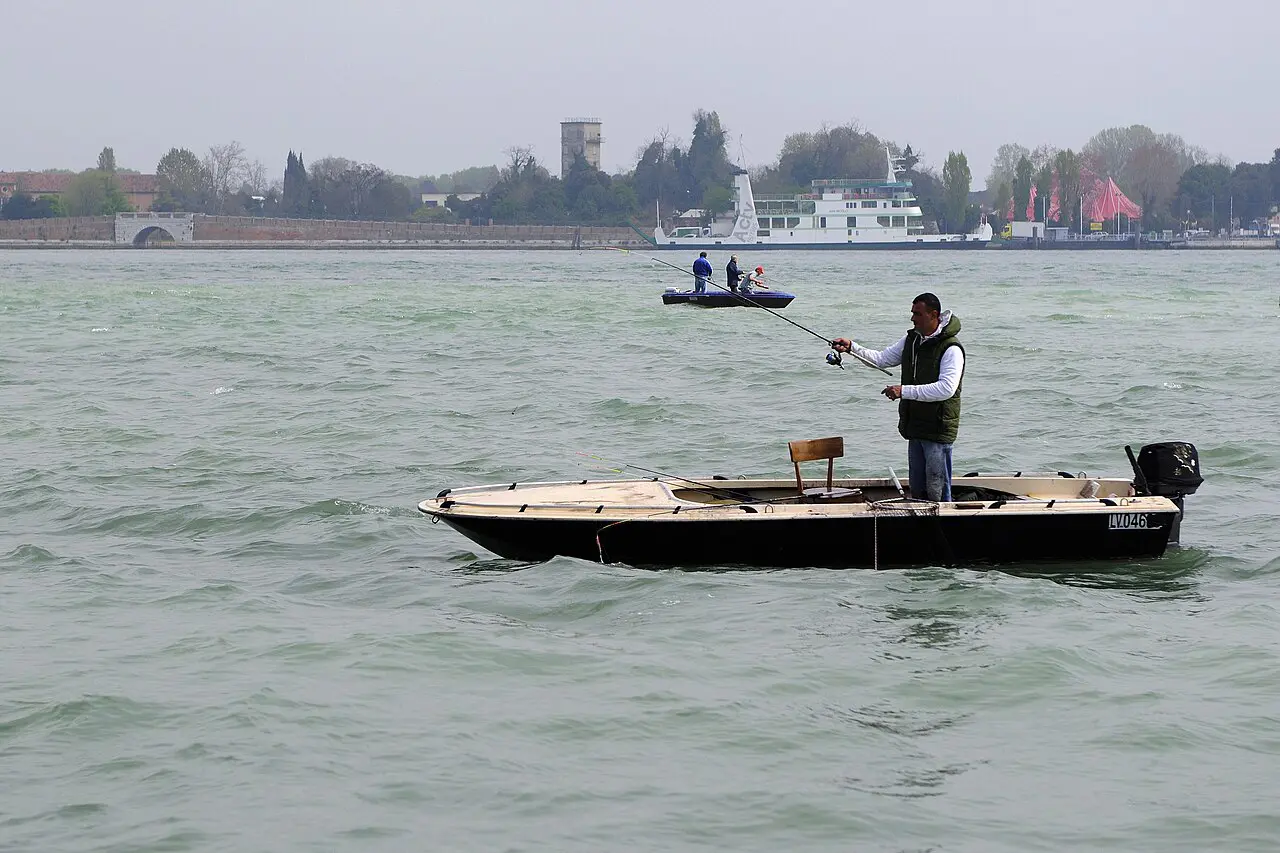
Research sources: Fish assemblages of Venice Lagoon shallow waters (2004); Use of shallow water habitats by fish assemblages (2006); Vulnerability of artisanal fisheries to climate change; Environmental DNA and Venice Lagoon fish (2022); Climate-related macroalgal changes (2025); OGS on the invasive comb jelly (2026); and ISPRA LIFE REGROWTH. Featured photo: Fishing in the Lagoon, Son of Groucho, CC BY 2.0, via Wikimedia Commons.