An artistic journey between Venice and Murano, where centuries of glassmaking tradition meet the imagination of a new generation.
Venice has long been home to artists and master craftspeople.
For centuries, painters, sculptors, architects, and master craftsmen have transformed this lagoon city into one of the world’s greatest cultural treasures.
But the artistic story of Venice is far from finished.
Beyond the magnificent paintings of the Renaissance, the glittering mosaics of St. Mark’s Basilica, and the legendary glass furnaces of Murano, a new generation of Venetian artists continues to explore the relationship between tradition and contemporary creativity.
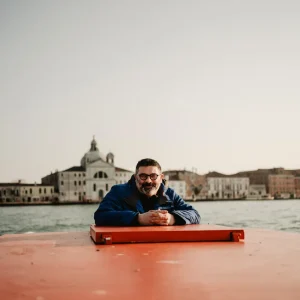
Among them is Riccardo Toso Borella, a Venetian artist whose work combines Murano glass, 24-karat gold leaf, and an ancient engraving technique known as Graffito.
His hand-engraved works bring together history, technical mastery, symbolism, and contemporary imagination.
Through his artistic practice and his gallery, BIBE Art Gallery & Lab, Riccardo offers a perspective on what it means to be a Venetian artist today.
His story is also the story of a family whose connection to Murano’s artistic heritage stretches back centuries.
For travelers interested in Venetian art, his hand-engraved pieces offer a chance to see how an artist working today uses a technique that has nearly disappeared.
A Venetian Artist with Murano in His DNA
Born in Venice in 1997, Riccardo Toso Borella grew up on the island of Murano, a place internationally celebrated for its glassmaking heritage.
For centuries, Murano has also been home to skilled decorators, engravers, painters, mirror makers, and artisans who have developed highly specialized techniques.
Riccardo belongs to this tradition.
His family, the Toso Borella, has deep historical roots on the island. Over generations, family members became known for their expertise in glass decoration and the elaborate frames associated with Venetian mirrors.
These traditions were passed down through generations through observation, practice, and patience.
For Riccardo, that relationship began at home.
His father, Marco Toso Borella, is himself an accomplished artist who played an important role in reviving the family’s decorative glass tradition during the late twentieth century.
Growing up surrounded by this artistic environment, Riccardo developed an early fascination with drawing, creativity, and the possibilities of glass.
According to the family’s historical account, he created his first work on glass at just seven years old.
What began as childhood curiosity eventually became a serious artistic vocation.
Today, Riccardo represents a new chapter in this Venetian family story.
He is developing his own artistic language while remaining deeply connected to the knowledge inherited from his ancestors.
The Toso Borella Family: Centuries of Venetian Artistic Heritage
To understand Riccardo’s art, it helps to understand the history of Murano.
The island has been associated with glassmaking for centuries, developing a specialized artistic culture that helped make Venetian glass famous throughout Europe and beyond.
Over time, individual families became custodians of particular skills and techniques.
Knowledge was often transmitted within workshops and households, with younger generations learning directly from experienced masters.
The Toso Borella family belongs to this world.
Historical records place the broader Toso family on Murano as far back as the fourteenth century. The Toso coat of arms appears in Murano’s Libro d’Oro.
The family’s artistic heritage includes painting on glass, decorative techniques, and the creation of elaborate Venetian mirror frames.
Among the notable figures in the family history were Angelo and Francesco Toso Borella. Francesco was self-taught and helped pioneer Graffito in the second half of the nineteenth century.
Following the Second World War, some of these artistic practices became less prominent as family activities shifted toward other crafts.
Then, during the 1970s, Marco Toso Borella began rediscovering and revitalizing the family’s artistic tradition.
His work helped bring renewed attention to the expressive possibilities of painting and engraving on glass.
Marco explored their potential as a medium for ambitious artistic compositions.
Riccardo grew up in the presence of this revival.
He witnessed firsthand the dedication required to master a demanding technique and the importance of studying historical art before attempting to create something new.
At around eighteen, Riccardo began practicing under his father’s supervision, learning a technique that demanded patience and precision.
It demanded discipline, precision, historical knowledge, and countless hours of practice.
In 2023, Riccardo established his own artistic business, continuing the family tradition while developing an increasingly independent creative identity.
The relationship between father and son remains an important part of his artistic story.
What Is Gold Glass? Discovering the Ancient Art of Graffito
The technique is central to Riccardo Toso Borella’s work.
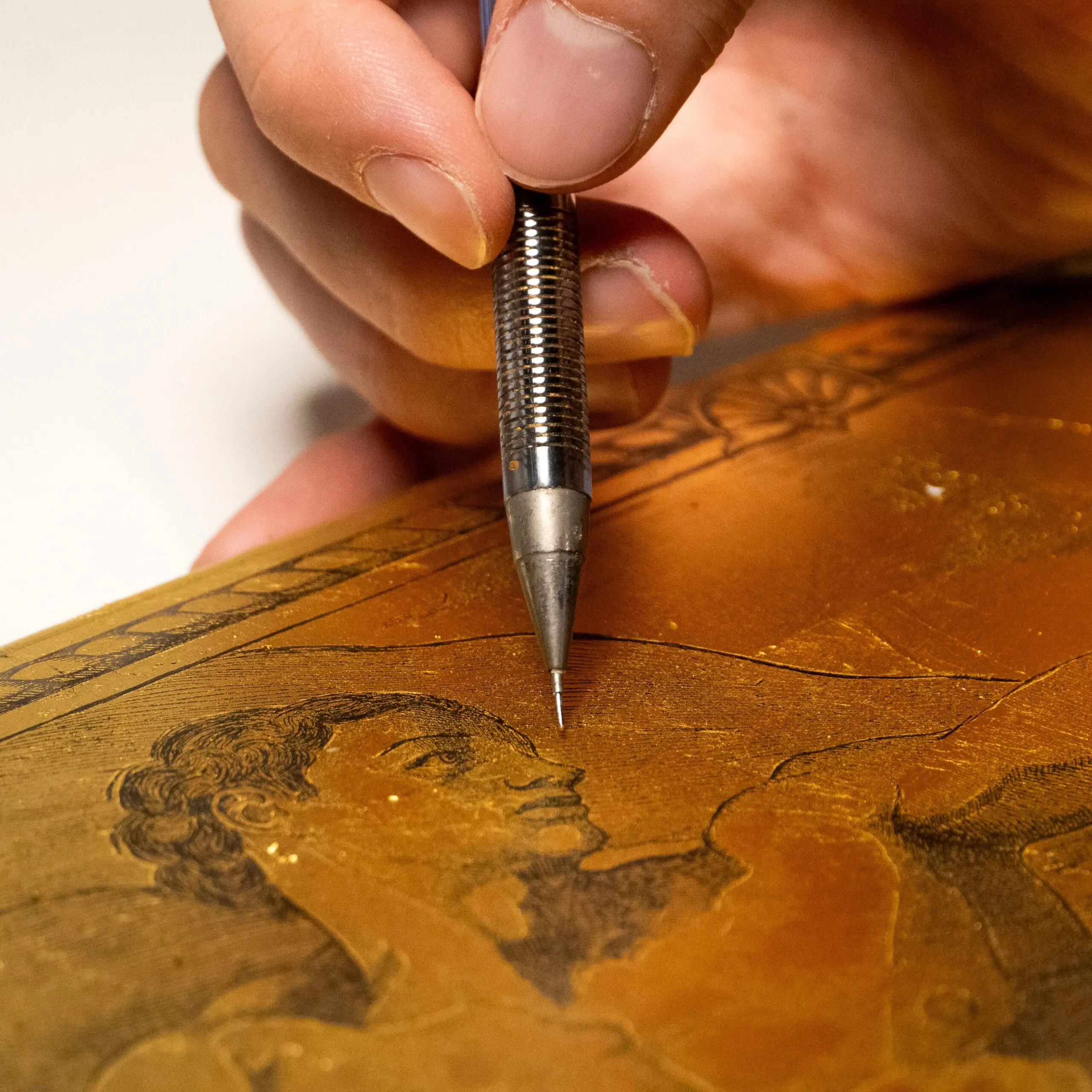
Known as Graffito on gold glass, it involves the precise engraving of gold leaf applied to glass.
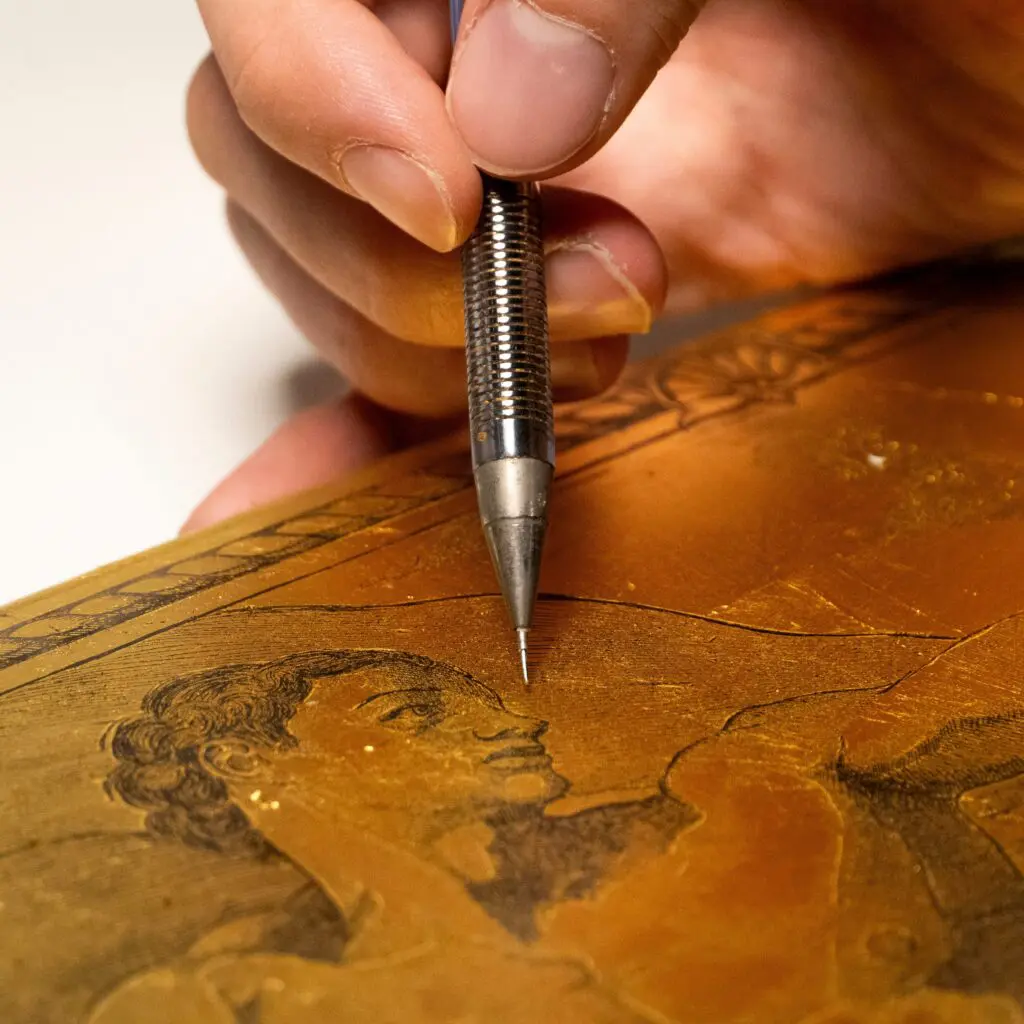
Riccardo prepares the glass with an adhesive made from an oily essence and a flux. He lets the coating rest until it makes a characteristic sound when lightly touched, a stage known as “singing glass.” He applies the gold leaf and engraves it with a needle.
The work is fired at 550 °C. The oily essence evaporates, and the flux bonds the gold to the glass. The bond is durable enough that some Roman examples of gold glass survive intact. A single piece usually takes several weeks, and some take months.
Fine lines, intricate patterns, carefully developed shadows, and complex compositions emerge from the relationship between gold and glass.
Depending on the design, the finished work can resemble an engraving, a painting, an illuminated manuscript, or a contemporary visual artwork.
Yet its appearance is entirely distinctive.
Gold interacts with light in a way that ordinary pigments cannot.
As the viewer moves, subtle reflections change the visual character of the composition.
The transparent and reflective qualities of glass add another dimension.
What initially appears to be a flat image can reveal surprising depth and complexity.
This is part of the fascination of Riccardo’s artistic practice.
He uses a material traditionally associated with luxury and decoration to explore subjects that are often intellectual, symbolic, and emotionally challenging.
An Artistic Technique with Ancient Roots
The history of gold glass reaches far beyond modern Venice.
Examples of ancient gold-glass objects survive from the Roman world, while later artistic traditions developed in connection with Byzantine culture.
Venice’s historical relationship with Byzantium helped establish an environment in which glass, gold, and sophisticated decorative arts flourished.
The glittering mosaics of Venetian churches offer a powerful reminder of the city’s longstanding fascination with golden surfaces and reflected light.
Riccardo’s technique belongs to this broader artistic heritage, even though his works are distinctly contemporary.
He takes an ancient visual language and uses it to communicate ideas relevant to the modern world.
That connection between past and present is central to his artistic identity.
The Skill Behind Every Engraved Line
At first glance, some of Riccardo’s works may resemble finely detailed drawings.
Look more closely, however, and the complexity of his technique becomes apparent.
Creating convincing images through engraving requires an exceptional understanding of line, contrast, and visual perception.
Unlike a painter who can build shadows using different colors of pigment, Riccardo often relies on the density, direction, and relationship of engraved marks.
One of his distinctive abilities is the use of hatching, a technique in which closely arranged lines create the impression of shading, texture, and three-dimensional form.
By carefully varying the placement and concentration of these marks, he can suggest the softness of skin, the folds of fabric, dramatic lighting, or the contours of a human face.
It is a demanding process.
Every mark contributes to the final composition.
The artist must think not only about what the image represents, but also about how light will interact with the engraved gold.
The technical challenge increases when working with compositions inspired by historical paintings and engravings.
Riccardo’s ability to translate complex images into the language of gold glass demonstrates a rare combination of artistic sensitivity and manual precision.
It also reveals the importance of his education.
An Artist Educated in Restoration and Art History
Riccardo’s artistic development has been shaped by formal studies as well as years of practice with his father.
He trained as a restoration technician at the International University of Art in Venice. In his first year, which focused on wooden supports and their decoration, he received the scholarship awarded to the top student.
At Venice’s Benedetto Marcello Conservatory, he studied jazz piano and earned admission to the three-year degree program. He studied voice informally at Venice’s Giuseppe Verdi Academy and sang for years in choirs conducted by his father.
At Ca’ Foscari University of Venice, he graduated with honors in Conservation and Management of Cultural Heritage, with a concentration in art history. He also earned two merit scholarships there.
His university research focused on the wooden decorative panels of the lost Scuola Grande di San Giovanni Battista dei Battuti of Murano.
This educational background is particularly important when looking at his artwork.
Riccardo approaches historical images with the understanding of someone who has studied their composition, symbolism, and cultural context.
He is interested not only in how an artwork was made, but also in why it was created and what it communicates.
That intellectual curiosity helps distinguish his practice from purely decorative glass production.
His works invite viewers to consider subjects such as memory, identity, perception, illusion, and the relationship between historical imagery and contemporary experience.
The result is art that rewards careful observation.
Riccardo Toso Borella’s Masterpieces: Where Murano Glass Becomes Contemporary Art
A visit to Riccardo’s artistic world reveals an impressive variety of subjects.
Some works draw inspiration from celebrated figures in European art history.
Others explore contemporary symbolism and the contradictions of modern society.
Together, they demonstrate the expressive potential of Murano glass and engraved gold.
Hell, 1953 – A Monumental Contemporary Composition
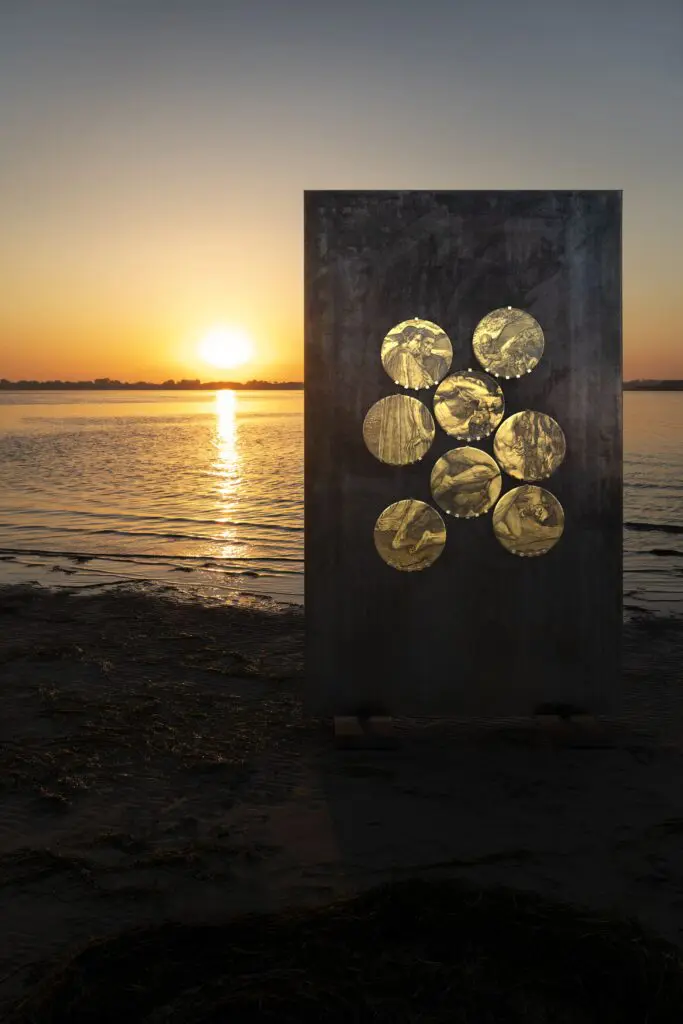
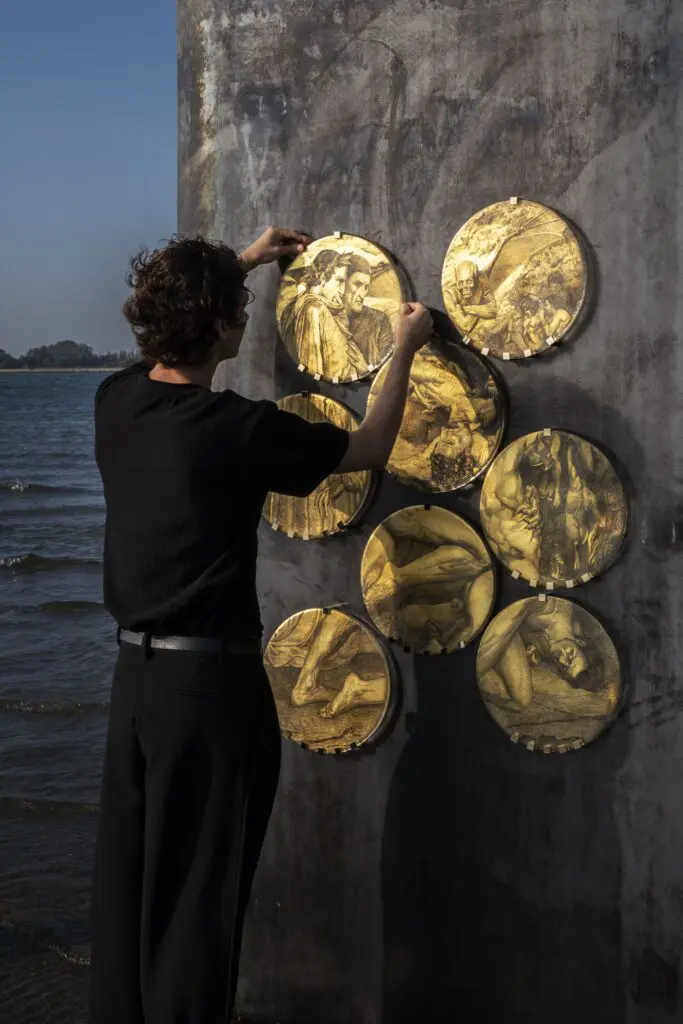
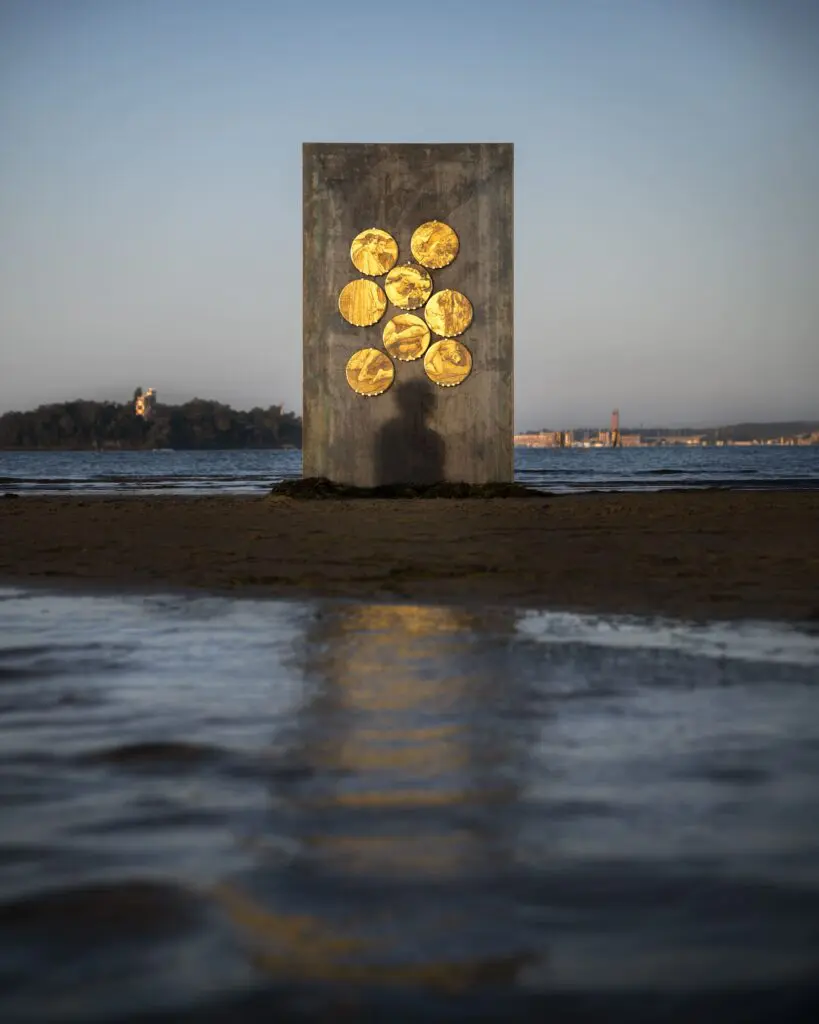
Among Riccardo’s most ambitious documented works is Hell, 1953, dated 2025–2026.
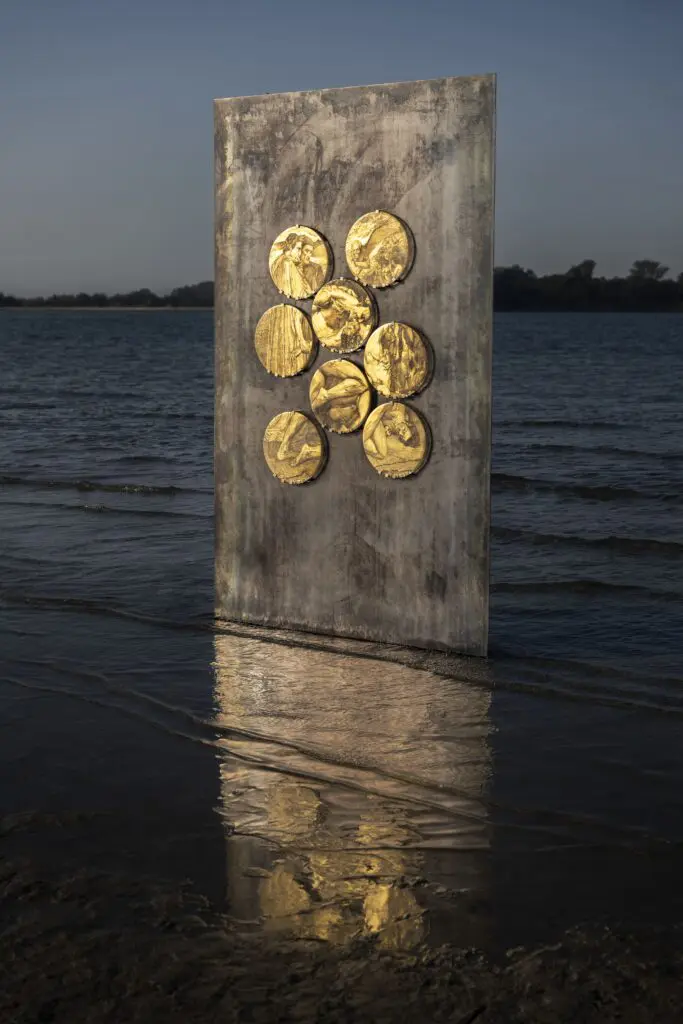
Measuring approximately 250 by 150 centimeters, the piece combines Murano glass and 24-karat gold leaf with a corten steel panel.
The composition takes its starting point from William-Adolphe Bouguereau’s Dante and Virgil in Hell. Riccardo gives the two damned souls the faces of Adolf Hitler and Joseph Stalin. Like Dante, who judged figures of his own time, Riccardo uses the scene to ask who bears responsibility.
His self-portrait in the background turns the question toward the viewer: “What about us?” A poem by Riccardo completes the work.
Gold suggests permanence and value. Glass introduces fragility, reflection, and transparency. Corten steel contributes an industrial, earthy presence.
Medusa Petrified – Reimagining a Classical Icon
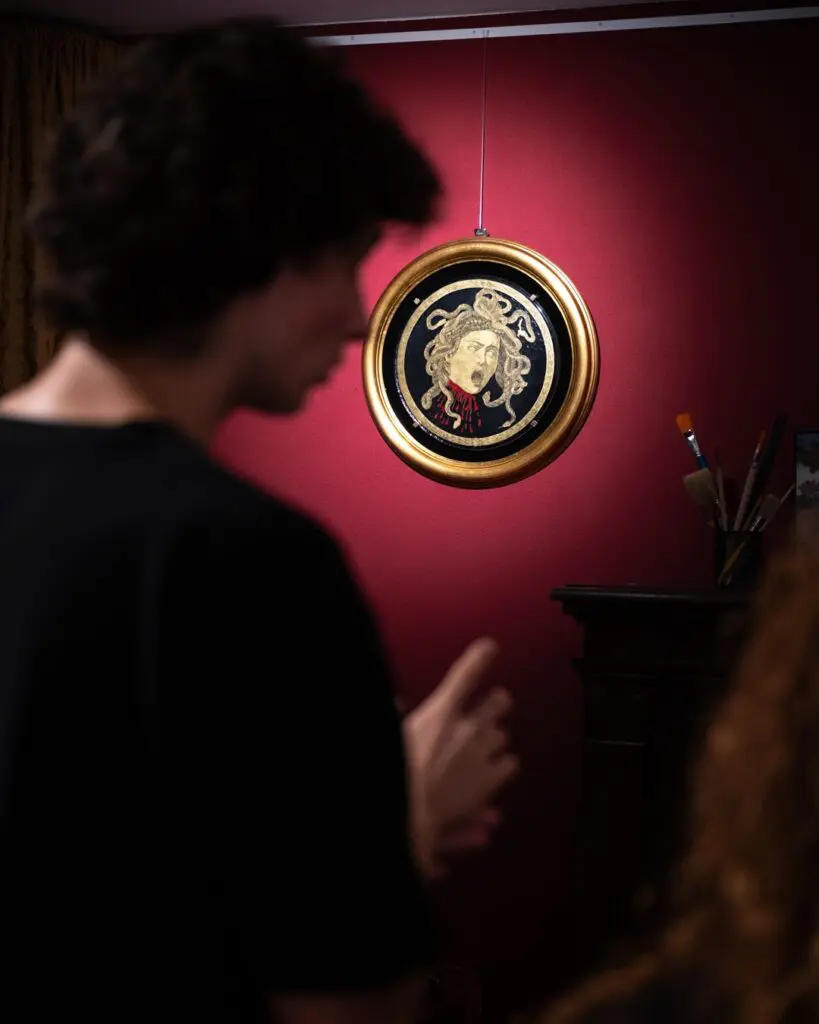
Another striking work is Medusa Petrified, created in 2024.
The piece measures approximately 34 centimeters in diameter and combines Murano glass, 24-karat gold leaf, and glass enamels.
Medusa has fascinated artists for centuries.
Her image appears throughout classical mythology and has inspired some of the most memorable works in European art history.
Riccardo’s interest in this subject also connects with his broader engagement with historical imagery.
In 2024, he produced a glass work inspired by Caravaggio’s famous depiction of Medusa for the Mazzega Glass Factory in Murano.
The challenge of translating such a dramatic subject into engraved gold is considerable.
Facial expression, movement, shadows, and emotional intensity must all be conveyed through a technique with its own limitations and possibilities.
For Riccardo, Caravaggio’s image petrified Medusa in the eyes of later generations, turning her into a monument to her own myth.
An Icon of Venice – A New Interpretation of Venetian Identity
Created in 2025, An Icon of Venice measures 60 × 40 centimeters (60 wide by 40 high, in landscape format) and uses Murano glass and 24-karat gold leaf.
Riccardo revisits Canaletto’s view of the Basin of San Marco and adds a crane carrying the banner “TAX THE RICH TO GIVE BACK TO THE PLANET,” raised during Jeff Bezos’s 2025 wedding in Venice.
The intrusion changes how we read the familiar view. The work asks what happens when a city becomes little more than a view and loses its own vision. In the artist’s words, “A city with vision looks to the future. A city without it follows the script.”
The Nightmare… of Europa – Mythology Meets Contemporary Vision
Created in 2026, The Nightmare… of Europa is a circular work measuring approximately 34 centimeters in diameter.
It combines Murano glass with 24-karat gold leaf.
Riccardo brings together two subjects from European painting. One is the abduction of Europa, painted by Veronese and Tiepolo. The other is Henry Fuseli’s The Nightmare.
Zeus no longer shares Europa’s bed, and monsters invade her dreams. An infernal horse appears behind a curtain painted with the EU flag. The work leaves Europa asleep and asks whether she will ever wake up.
A.Icon – Art, Symbols, and the Contemporary World
Also dated 2026, A.Icon is a circular gold-glass work measuring approximately 34 centimeters in diameter.
The work began with a 2024 AI-generated reconstruction of the face of Jesus from the Shroud of Turin. Behind Christ appears New York, which Riccardo uses as an emblem of the modern world.
The image passes through the history of icons and relics, digital reconstruction using AI, and finally the artist’s hand. At each stage, someone or something shapes the face we see. What, then, are we looking at?
Cerca Trova – Leonardo’s Lost Battle of Anghiari
Created in 2024, Cerca Trova is a circular composition combining Murano glass, 24-karat gold leaf, and glass enamels.
The work explores Leonardo da Vinci’s lost Battle of Anghiari and the enigmatic “CERCA TROVA” inscription on a flag in the fresco Giorgio Vasari painted in its place. On the reverse of the glass, the inscription reads in mirror image. On the gold front, Riccardo depicts Leonardo’s lost battle scene.
From Caravaggio to Don Quixote: Reinterpreting the Great Masters
Riccardo’s artistic abilities are also evident in works inspired by some of the most celebrated figures in European cultural history.
In 2024, he created a Triumph Vase for the Mazzega Glass Factory in Murano.
The decoration drew inspiration from an engraving by Gustave Doré depicting Don Quixote’s first adventure.
The project was especially interesting because it brought together the three-dimensional tradition of decorative glass objects and the sophisticated visual language of engraved gold.
Doré’s engravings are celebrated for their dramatic compositions, elaborate detail, and handling of light and shadow.
Translating that visual richness into gold glass requires exceptional control.
Riccardo’s work demonstrates how a historical image can be interpreted through a completely different material while retaining its expressive character.
His engagement with Caravaggio’s Medusa presents a similar challenge.
Caravaggio is famous for his revolutionary treatment of light, shadow, and psychological intensity.
Riccardo’s ability to translate such effects into engraved lines reveals the technical sophistication of his practice.
In these works, Riccardo uses what he learned from studying the masters to develop new compositions in engraved gold.
BIBE Art Gallery & Lab: Discover Riccardo’s Artistic World in Venice
Riccardo opened BIBE Art Gallery & Lab in 2025 as both a working studio and a gallery for his art.
Located in the Cannaregio district of Venice, the gallery represents the meeting point between the artist’s Murano heritage and his contemporary practice.
Although it contains important historical landmarks, it also retains a strong sense of everyday Venetian life.
Beyond its busy thoroughfares, quieter streets and canals reveal a city of local businesses, artisan workshops, neighborhood restaurants, and residential communities.
It is an appropriate setting for an artist whose work explores the relationship between historical tradition and contemporary identity.
At BIBE, visitors can see how the engraved lines and reflections change as they move in front of each piece.
For art enthusiasts, collectors, and travelers who appreciate exceptional craftsmanship, Riccardo’s creations offer an introduction to a specialized Venetian artistic tradition.
The gallery also provides a starting point for discovering the artist’s broader body of work and learning about his approach to creating original pieces.
BIBE Art Gallery & Lab
Cannaregio 2432/A, Venice, Italy
Official website: https://bibe.art/
Riccardo’s recent events include TRANSCENDENCES: Emergence from Bubbles at The Venice Glass Week on September 14, 2026, and Atelier Aperti during Radar Venezia in October 2026.
Contemporary Venetian Art and the Future of Murano Glass
Murano glass is one of the most recognizable symbols of Venice. Riccardo’s work shows how a skill passed down within a family can develop into a medium for contemporary art. Family knowledge, formal education, and historical research all inform the subjects he chooses and how he interprets them.
Graffito on gold glass is now rare. Riccardo believes he may be the only artist of his generation practicing it anywhere in the world. Each piece is made by hand, and the time required to engrave it is visible in details such as the lines that model a face or the marks that give folds of fabric their depth.
Venice’s working studios offer visitors a chance to see how these skills are used today. In Cannaregio, a visit to BIBE can sit alongside time spent exploring the neighborhood’s historic streets, canals, and workshops.
Can You Commission a Personalized Work of Art?
Riccardo accepts commissions on any subject, including deeply personal themes. He speaks directly with clients about what they have in mind and develops a proposal through preparatory sketches and studies. You can start the conversation through BIBE’s Create your own artwork page.
Experience the Artistic Soul of Venice with Tour Leader Venice
At Tour Leader Venice, we believe that some of the most memorable travel experiences come from discovering the people who keep the city’s traditions alive.
For visitors interested in art, craftsmanship, and Venetian culture, we can design private experiences that combine historic Cannaregio, contemporary Venetian art, Murano, and visits to local artisans.
On request, Tour Leader Venice can include a visit to BIBE Art Gallery & Lab in your private tour. The visit lasts at least 30 minutes. Riccardo explains the history of the technique, shares his family’s story, and introduces his works. You’ll also watch him engrave the gold leaf live.
Frequently Asked Questions
Who is Riccardo Toso Borella?
Riccardo Toso Borella is a contemporary Venetian artist born in 1997 and raised on the island of Murano. He specializes in an ancient gold-glass engraving technique known as Graffito, combining Murano glass, 24-karat gold leaf, and detailed artistic compositions. His work reflects both his family’s centuries-old artistic heritage and his personal contemporary vision.
What makes Riccardo Toso Borella’s Murano glass art unique?
His artwork uses a specialized technique involving precise engraving on gold leaf applied to glass. Through meticulous linework and hatching, he creates complex images, shadows, and visual effects. His works often explore historical, mythological, and contemporary subjects, bringing together traditional craftsmanship and conceptual art.
Where can visitors discover Riccardo Toso Borella’s artwork in Venice?
Visitors can explore his work at BIBE Art Gallery & Lab, at Cannaregio 2432/A in Venice. On request, Tour Leader Venice can include a studio visit of at least 30 minutes in a private tour, with a live gold-leaf engraving demonstration by Riccardo.
Can I commission an artwork from Riccardo Toso Borella?
Yes. Riccardo creates commissioned works on any subject, including deeply personal themes. He speaks directly with clients to understand their ideas and develops a proposal through preparatory sketches and studies. Get in touch through BIBE’s Create your own artwork page.