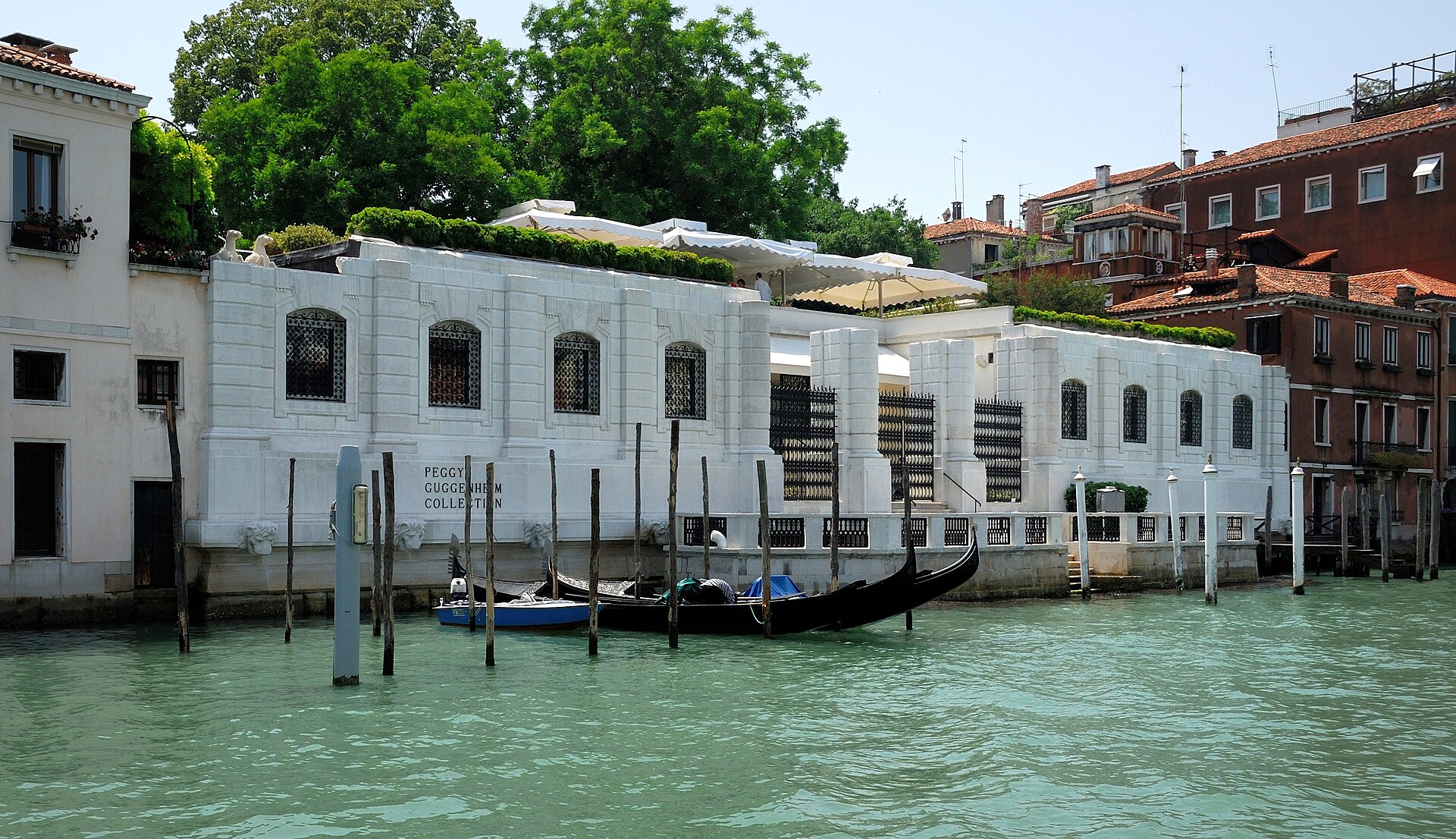
October 19, 2026, is the last scheduled day in Venice for Peggy Guggenheim in London: The Making of a Collector. This major exhibition at the Peggy Guggenheim Collection explores the collector’s first gallery, Guggenheim Jeune, and the experimental art world of London in 1938–39. For travelers interested in art, history, and the stories behind Venice’s museums, the final day is an unusually timely opportunity.
Why the final day matters
October 19, 2026, is the announced closing date of Peggy Guggenheim in London: The Making of a Collector at the Peggy Guggenheim Collection in Venice. The exhibition opened on April 25 and examines the brief but decisive London chapter of a woman most visitors associate with her home on the Grand Canal. That change of perspective is the reason to go: it shows Peggy before Venice, before her collection became an institution, and before the mythology surrounding her life obscured the practical decisions of a daring young gallery owner.
The final day is not a special event unless the museum announces one. It is simply the last scheduled opportunity to see this particular selection of loans and historical connections in Venice. That makes advance planning sensible. Visitors should confirm the museum’s latest notice and ticket conditions rather than assuming that a late-afternoon arrival will leave enough time to appreciate the exhibition.
The woman before the legend
Peggy Guggenheim is often introduced through famous names: Picasso, Pollock, Ernst, Duchamp, and the great movements of twentieth-century art. Such lists are useful, but they risk presenting her collecting career as inevitable. In reality, she learned by making choices, asking questions, listening to artists and friends, and taking risks in an unsettled European cultural world.
The London exhibition asks visitors to return to that formative period. Its subject is not only the artworks Peggy eventually owned, but the environment in which she began to develop an eye. This is an important distinction for anyone interested in how taste is formed. Collections do not appear fully assembled. They grow through relationships, opportunities, mistakes, and a willingness to see value where others may not yet recognize it.
A London gallery called Guggenheim Jeune
In January 1938, Peggy opened Guggenheim Jeune in London. It operated until June 1939, an exceptionally short life for an enterprise that would become so influential in accounts of modern art. The gallery brought avant-garde work to audiences at a moment when abstraction and Surrealism still provoked confusion and disagreement.
Imagine entering a commercial gallery in the late 1930s and encountering unfamiliar visual languages. Some paintings rejected recognizable subjects; some sculptures unsettled traditional expectations of form; collage turned fragments of everyday material into art. Guggenheim Jeune offered a setting where such experiments could be considered seriously. The new Venice exhibition reconstructs that intellectual atmosphere rather than merely celebrating the later prestige of the collector.
Eighteen months of extraordinary ambition
The gallery was active for approximately eighteen months. Within that brief period, it organized more than twenty exhibitions. This compressed schedule helps explain Peggy’s remarkable exposure to different artists, techniques, and ideas. Running a gallery was an education conducted in public, with financial and reputational consequences.
The pace also offers a useful lesson to travelers. Rather than approaching the Venice exhibition as a list of famous names to tick off, think of each display as part of a developing conversation. What might a visitor in 1938 have found new or unsettling? Which ideas were competing for attention? Asking those questions can make works that are now canonical feel experimental again.
The importance of Marcel Duchamp
Marcel Duchamp played a significant role in Peggy Guggenheim’s artistic education and network. He helped connect her with artists and ideas that were reshaping modern art. For visitors, this relationship reveals the importance of informed conversation in collecting: taste can be sharpened through dialogue rather than inherited as a fixed personal trait.
Duchamp’s broader career challenged assumptions about what could count as an artwork. That spirit matters when looking at the London years. Peggy’s willingness to consider unconventional objects and artistic practices was not merely a preference for novelty. It was part of a cultural shift in which artists and their supporters were questioning the boundaries of art itself.
Mary Reynolds and the wider circle
The museum identifies Mary Reynolds among the figures who helped shape Peggy’s vision. Reynolds is associated with the artistic and literary networks surrounding modernism, including inventive approaches to bookbinding. Her presence in this history is a reminder that the avant-garde was not confined to painters working alone in studios.
Collectors, poets, designers, publishers, and patrons contributed to a shared cultural environment. A museum exhibition can make those connections visible through works, documents, and historical context. When looking at an object, consider the network that allowed it to be made, exhibited, discussed, and preserved. That network is often as revealing as the signature on the artwork.
Samuel Beckett and cross-disciplinary modernism
Samuel Beckett is another name highlighted in the exhibition’s historical framework. His association with Peggy’s circle points to a moment when literature, performance, and visual art were not sealed off from one another. The same appetite for experiment could cross several creative fields.
This context helps explain why the exhibition is relevant even to visitors who do not consider themselves modern-art specialists. It tells a story about a cultural community responding to a changing world. Think about the conversations that may have happened around exhibitions, books, and performances, without assuming that every artist shared one philosophy or that personal connections automatically explain the meaning of individual works.
Abstraction as a new visual language
Abstract art asks viewers to attend to form, color, rhythm, and structure without depending on recognizable scenes. In the 1930s, such work could feel startling to audiences accustomed to conventional representation. Peggy’s London gallery helped give these approaches a public platform.
The Venice exhibition includes works connected with artists associated with abstraction, including Vasily Kandinsky and Piet Mondrian. Rather than treating them as textbook examples, look for their differences. One composition may feel dynamic and improvisational, another rigorously ordered. Abstraction is not a single style. It is a field of experiments with the possibilities of visual experience.
Kandinsky’s London milestone
Among Guggenheim Jeune’s notable achievements was the first solo exhibition of Vasily Kandinsky in London. Today his name appears in virtually every major account of abstract art. At the time, presenting his work to a new audience was a consequential act of advocacy.
This is the kind of detail that makes the exhibition worth visiting. It shifts attention from the later market value of a painting to the moment when its public reception was uncertain. A gallery owner had to decide that an unfamiliar artistic language deserved attention. When standing before a work from this era, try to imagine encountering it without decades of museum endorsement.
Surrealism and the unexpected
Surrealism challenged ordinary logic through unexpected combinations, dreamlike imagery, and experiments with the unconscious. Its influence spread across painting, sculpture, photography, and writing. Guggenheim Jeune provided opportunities for audiences to encounter artists working in or around this movement.
The exhibition’s historical context includes figures such as Salvador Dalí and Eileen Agar. Their approaches should not be flattened into one formula. Surrealism could be theatrical, humorous, disturbing, or quietly poetic. Look for the way an artist transforms a familiar object or image. Then consider how the gallery setting itself might have intensified the sense of surprise for an audience seeing such work for the first time.
Collage as an artistic revolution
One of Guggenheim Jeune’s important initiatives was the first group exhibition devoted to collage in the United Kingdom. Collage may now seem familiar, but its artistic implications were radical. Fragments from different contexts could be cut, combined, and made to speak in new ways.
This history is especially accessible to visitors who enjoy material detail. Look at the relationship between surface and image, between something manufactured and something altered by an artist. Collage asks whether meaning comes from the individual fragment or from its new neighbors. That question echoes through many forms of twentieth-century art, including practices far beyond paper.
Sculpture that challenged convention
The London gallery also presented a contemporary sculpture exhibition that attracted controversy. Sculpture was changing rapidly, moving beyond inherited expectations of monumental figures and polished academic forms. Artists experimented with abstraction, new relationships to space, and different materials.
Names associated with the Venice exhibition include Barbara Hepworth and Henry Moore, whose approaches helped reshape British modern sculpture. Study the balance between solid and empty space, the suggestion of the body, and the relationship between object and viewer. A sculpture changes as you move around it; give yourself permission to look from several angles rather than settling for one photograph.
Women artists and overlooked histories
One of the exhibition’s valuable opportunities is to encounter women artists whose contributions have not always received equal attention in familiar histories of modernism. Eileen Agar, Rita Kernn-Larsen, Sophie Taeuber-Arp, and Barbara Hepworth appear among the artists named in the museum’s account of the exhibition.
Do not treat them as a separate decorative footnote to the careers of better-known men. Consider their artistic decisions on their own terms. What kinds of form, material, or imagery did they explore? How did their work participate in the wider experiments of the period? A thoughtful museum visit can help correct the imbalance created when a complex movement is reduced to a few celebrity names.
The approach of war
The years 1938 and 1939 were marked by profound political instability in Europe. The rise of authoritarianism and the approach of war shaped the circumstances in which artists lived and worked. An avant-garde gallery was therefore not operating in a neutral cultural bubble.
The exhibition’s story gains depth when placed against that background. Artists and collectors faced questions of movement, safety, livelihood, and cultural survival. It would be simplistic to read every artwork as a direct political statement, but equally misleading to ignore the historical pressures surrounding its creation and exhibition. The brief life of Guggenheim Jeune belongs to that unsettled moment.
From London to the wider world
The Venice presentation is the first stop of a traveling exhibition. The museum lists the Royal Academy of Arts in London as the next venue, from November 21, 2026, to March 14, 2027, followed by the Guggenheim in New York from April 16 through September 12, 2027.
This itinerary offers an elegant geographical narrative. An exhibition about Peggy’s London beginnings is presented in the city that became her home, then returns to London and later crosses the Atlantic. For American travelers, the New York stop may provide a future opportunity, but the Venetian setting gives the story a particularly personal dimension: it unfolds inside the institution built around her own collection.
Why Venice is the right setting
The Peggy Guggenheim Collection occupies Palazzo Venier dei Leoni on the Grand Canal, a building intimately associated with the collector’s life in Venice. Unlike a vast encyclopedic museum, it offers an experience in which architecture, biography, and art remain closely connected.
The unfinished palazzo and its gardens create a scale that feels almost domestic. That atmosphere is not merely charming. It helps visitors understand how art can be part of everyday living, conversation, and hospitality. A temporary exhibition about Peggy’s first gallery is particularly resonant here because it reveals the professional beginnings behind the more familiar story of her Venetian home.
The permanent collection beyond the exhibition
The special exhibition is only one reason to visit. The permanent collection includes major works associated with European modernism and American Abstract Expressionism. Artists such as Jackson Pollock, Max Ernst, and many others help trace the evolution of Peggy’s interests beyond her London experiment.
Allow enough time for both experiences. The temporary exhibition explains a formative chapter; the permanent collection shows what her sustained commitment to modern art helped make possible. Moving between them is more rewarding than rushing through the galleries simply to say you have seen the famous names. Look for continuities in taste and moments when her interests expanded in unexpected directions.
Jackson Pollock and American connections
American visitors often arrive with particular curiosity about Jackson Pollock. Peggy’s support was important to his early career, and his work helps connect European avant-garde experiments with developments in the United States. That transatlantic dimension is one of the collection’s strengths.
The London exhibition precedes the most famous chapters of that story. It provides an opportunity to understand Peggy as someone who learned to recognize experimentation before later reputations were secure. Rather than reading her career backward from Pollock’s fame, consider how the London years helped create the confidence and network that made subsequent decisions possible.
A museum with a human scale
The Peggy Guggenheim Collection can feel more intimate than visitors expect. The rooms invite close looking, while the garden and waterfront create natural pauses. Yet popularity can make even a modest-sized museum feel crowded at busy times.
The practical answer is to prioritize. Choose a handful of works to study carefully rather than trying to inspect every label. Spend time with the temporary exhibition while it is still on view, then return to the permanent collection. A meaningful visit depends less on the number of masterpieces encountered than on the attention you bring to them.
How to plan October 19
The museum lists regular hours of 10 a.m. to 6 p.m. and notes that its ticket office closes at 5 p.m. It is normally closed on Tuesdays, but October 19, 2026, falls on a Monday. These details make the final scheduled day a viable visit, subject to any last-minute changes announced by the institution.
Book in advance if a particular entry time matters to your itinerary. Avoid arriving near closing with the expectation of seeing both the temporary exhibition and the permanent collection. A late visit may still be enjoyable, but it leaves little room for reflection. The museum’s official website is the authoritative source for updated admission rules.
The free afternoon presentation
The museum’s public program advertises a complimentary fifteen-minute presentation about the temporary exhibition at 4 p.m. on days the museum is open during the exhibition period. This is included with admission, according to the published program.
For a visitor on the final day, such a talk may offer an accessible introduction to Guggenheim Jeune. Confirm that the presentation is operating as scheduled, and remember that a short talk cannot replace time with the artworks. It works best as a supplement to independent observation rather than as the only interpretive experience.
Tickets without confusion
Tour Leader Venice maintains a page for Peggy Guggenheim Collection tickets. You can consult its Peggy Guggenheim Collection ticket information when organizing a visit. Check the actual booking conditions, availability, and included services before purchase.
The museum also sells tickets through its own official channels. Compare the details carefully, particularly when booking for a family, a visitor with accessibility needs, or someone eligible for a concession. The most useful ticket is the one that matches your real plans, not necessarily the one advertised with the most dramatic promise.
Finding the museum in Dorsoduro
Palazzo Venier dei Leoni is in Dorsoduro, one of Venice’s most rewarding districts for a slow walk. The museum is near the Grand Canal and within walking distance of other important cultural sites, although exact routes depend on bridges and your starting point.
Allow extra time if coming from the railway station or from a hotel on the opposite side of the city. Venice is compact on a map but not always quick to cross. The best route may involve a vaporetto, a longer walk, or a combination of the two. Check the current ACTV services and use the museum’s official visitor directions.
A neighborhood worth exploring
Dorsoduro offers a valuable change of pace after the galleries. Nearby streets reveal a Venice of small bridges, residential façades, workshops, and waterside views. The district also contains other major art institutions, making it possible to build a culturally rich day without constantly crossing the city.
The key is restraint. Do not schedule three large museums back-to-back unless you genuinely enjoy sustained gallery visits. A walk, a coffee, or a quiet pause can help the works settle in your memory. For travelers seeking a deeper understanding of Venice, the transition between museum and neighborhood is part of the experience rather than wasted time.
Pairing modern art with Venetian painting
One appealing contrast is to explore the modernist collection and then visit the Gallerie dell’Accademia, where Venetian painting provides a very different account of the city’s artistic identity. The two institutions illuminate separate traditions and historical moments.
Tour Leader Venice has a Gallerie dell’Accademia ticket page for visitors considering that combination. If you choose both museums in one day, leave a break between them. Art becomes more memorable when you have time to compare what you have seen instead of immediately absorbing another dense sequence of galleries.
What to look for in the exhibition
Begin with the exhibition’s central question: how did Peggy become a collector? Notice the variety of artistic approaches and the historical relationships among them. Look for contrasts between abstraction and Surrealism, between painting and sculpture, and between established names and artists whose reputations deserve renewed attention.
If labels identify works connected with specific Guggenheim Jeune exhibitions, consider what those original presentations might have meant in 1938 or 1939. Try to separate what you know today from what a London audience might have known then. That mental exercise restores uncertainty and discovery to artworks that can otherwise feel overly familiar.
How to read an unfamiliar artwork
Start with description rather than judgment. What materials are visible? How is the composition organized? Where does your eye travel first? Does the work suggest movement, stillness, humor, or unease? These questions can open a conversation even when the image does not represent a recognizable subject.
Only after looking should you turn to the wall label. Historical context can enrich your response, but it need not replace it. You may disagree with a curatorial interpretation or notice something it does not mention. A museum visit is most rewarding when expertise and personal observation work together.
A thoughtful visit with children
Families can enjoy modern art without turning the experience into a classroom test. Ask younger visitors to choose a shape, find an unexpected combination, or imagine what an abstract work might sound like. Short, playful observations can create real engagement.
Be mindful of attention spans and the museum’s rules. Some works may be delicate or displayed in crowded rooms. Rather than trying to see everything, select a few highlights and leave time for the garden. The goal is to create curiosity, not exhaustion. Check the museum’s current family guidance before your visit.
Accessibility and pacing
Visitors with limited mobility should check the museum’s official accessibility information before traveling. Historic Venice presents challenges beyond the museum itself, including bridges and routes that may require careful planning.
When organizing a private itinerary, consider the whole journey from hotel to entrance and onward to the next stop. A seemingly convenient combination of attractions may involve more walking than expected. This is an area where realistic local planning can make a substantial difference. Never assume that a route is step-free merely because the destinations appear close together.
A local guide’s way of looking
A useful approach is to connect the works with the city in which they are now displayed. Peggy’s story links London, Paris, New York, and Venice, while the museum’s physical setting reflects the extraordinary way modern art entered a historic lagoon city.
Tour Leader Venice’s local perspective, informed by Igor Scomparin’s work as a licensed guide since 1997, can help visitors build a day that respects both art and practical geography. The purpose is not to rush between highlights but to create time for a meaningful encounter with the museum and its neighborhood.
Beyond the famous names
A list of celebrated artists is an efficient marketing device, but it does not explain how artistic movements develop. The exhibition is strongest when understood as a network of decisions and relationships. Some artists were already established, others were still seeking recognition, and their work entered a public conversation through exhibitions.
Give particular attention to artists you did not know before arriving. Ask what they contributed and why their work might have challenged expectations. Discovering one unfamiliar artist can be more memorable than taking photographs of five famous signatures. That curiosity reflects the spirit of the gallery’s original experiment.
Why this story matters now
The story of Guggenheim Jeune raises questions that remain relevant to today’s cultural world. Who decides which artists receive attention? How do galleries take risks? What role do friendship, money, taste, and public debate play in building artistic reputations?
These questions are especially timely during a Venice season filled with contemporary art. Visitors moving between historic collections and Biennale installations may notice that the mechanisms of discovery and recognition have changed, but the underlying tensions have not disappeared. Peggy’s London years offer a human-scale case study in the making of cultural history.
After October 19
The museum’s published schedule sends the exhibition to London’s Royal Academy of Arts and later to the Guggenheim in New York. Visitors who miss the Venetian closing date can consult those institutions for details of the subsequent presentations.
The permanent Peggy Guggenheim Collection in Venice remains an important destination after the temporary show ends. Do not confuse the exhibition’s closing date with the museum closing. If your trip falls later in October, you can still visit the permanent collection, subject to the museum’s regular schedule. This distinction is essential when planning around a time-sensitive event.
A final thought
Peggy Guggenheim in London: The Making of a Collector is compelling because it looks past the familiar legend toward the years of uncertainty and experiment that helped create it. A small London gallery, active for less than two years, became an important chapter in the story of modern art.
If you are in Venice on October 19, the exhibition’s final scheduled day offers a chance to see that chapter in the city Peggy later made her home. Give the visit time, pay attention to the less familiar artists, and let the story continue beyond the museum into Dorsoduro. The richest travel experiences often begin with a question rather than a checklist.
More Venice stories to explore
Continue with hidden historical details that reveal Venice’s character, discover Venice’s overlooked women artisans, and learn how Venice works without cars. For verified dates and visitor details, consult the official exhibition page.
Explore related Venice stories
To put this subject into a wider Venetian context, explore the art and architecture of the Biennale’s Giardini, contemporary sculpture at the Italian Pavilion and Venice’s historic Scuole Grandi. Each offers a complementary perspective on the city’s history, daily life, or cultural heritage.
Discover connected Venice stories
Explore . These articles offer additional historical and cultural perspectives.
Frequently Asked Questions
When does Peggy Guggenheim in London close in Venice?
The exhibition’s last scheduled day at the Peggy Guggenheim Collection is Monday, October 19, 2026. Confirm any updates on the museum’s official website.
Can I visit the Peggy Guggenheim Collection after October 19, 2026?
Yes. October 19 is the announced end of this temporary exhibition, not the closure of the museum’s permanent collection. Check the museum’s regular hours before visiting.
Where can I buy tickets for the Peggy Guggenheim Collection in Venice?
Check the museum’s official ticketing website or Tour Leader Venice’s Peggy Guggenheim ticket page. Verify the date, admission type, and conditions before purchasing.