Not Mooring Posts — A Recognition System
These poles are called pali da casada, and here’s the detail that surprises almost everyone: despite standing at the water’s edge outside palace doors, they were never actually meant for tying up boats. They were designed to help gondoliers recognize a specific house, salon, or casino at a glance — a purely visual signal, not a functional mooring point. Before Venice organized its buildings into the confusing sestiere-based numbering system it still uses today, this was, in effect, an address system built entirely out of color and pattern.
Each pole originally carried an oil lamp at its top, which illuminated the water entrance at night, and many still keep a carved, flame-shaped ornament called a cappellozzo where that lamp once sat — a stylized echo of a light source that hasn’t actually burned in centuries.
Reading the Colors
Once you know to look, the pattern becomes obvious, and slightly addictive to spot. Every palazzo settled on its own distinct color combination — some poles run red and white with a white cap, others turquoise and white, others blue and orange with gold trim — and no two noble families used quite the same scheme. This wasn’t decoration for its own sake; the striped poles were specifically a privilege of the Venetian patrician class, marking the water entrances of aristocratic palaces in a way that instantly separated a noble household from an ordinary one.
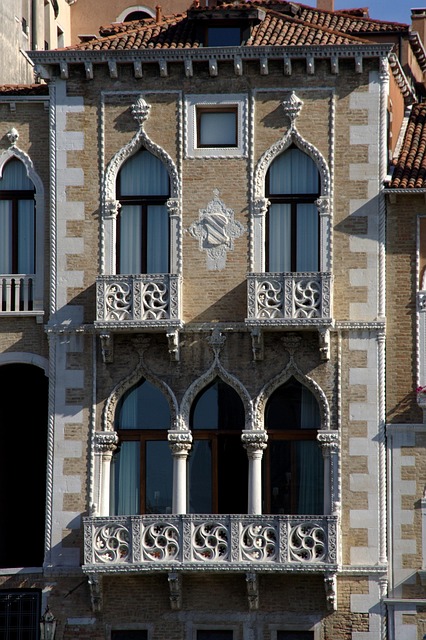
One of the most famous surviving examples belongs to a name you’ll already recognize if you’ve walked past Ca’ Foscari: the historic Foscari family’s color was red, and their distinctive red-and-white striped poles with white caps remain some of the most easily identifiable in the city, while the poles outside Palazzo Contarini Fasan on the Grand Canal are often cited as among the most exquisite examples still standing.
A Vanishing Craft
What I find most affecting about the pali da casada isn’t the history — it’s that making them is still, barely, a living trade rather than a museum piece. A handful of workshops remain among the last producers of genuine wooden pali in Venice, and the process is entirely manual: the timber, typically oak, chestnut, or acacia, is shaped by hand into a rounded form over roughly two days, then hand-painted, with a cord used to guide the spiral stripe into a perfectly even line. It’s a slow, specific skill, and like so many Venetian trades, it’s fighting a losing battle against modern materials — aging wooden poles across the city are increasingly being replaced with plastic ones as the traditional wood becomes harder to source and maintain.
Not to Be Confused With Briccole
It’s worth being clear about what pali da casada are not, because visitors often conflate them with the lagoon’s other wooden poles. The plain, unstriped poles you see marking the navigable channels out in the open lagoon are briccole, an entirely separate system with an entirely separate job — warning boat pilots where deep water ends, not identifying a specific family. I’ve written separately about briccole and the centuries-old regulations governing their placement in the lagoon; the pali da casada are their aristocratic, ornamental cousin, confined almost entirely to the Grand Canal and the city’s grandest facades.
Why This Detail Changes How You See the Grand Canal
Once a guest learns to read the poles, a boat ride down the Grand Canal stops being a parade of pretty facades and starts becoming something closer to a family register — each striped pole announcing, in color, exactly whose water door you’re passing. It’s a small thing, and it’s exactly the kind of small thing that a passing vaporetto ride won’t teach you, but a private boat tour timed to linger at the right palaces will.
If details like this — the ones hiding in plain sight along the Grand Canal — are what you want your Venice trip built around, that’s precisely the texture I bring to a private Venice tour. Get in touch and I’ll build a route around exactly this kind of story.
Can you still tie a boat to a pali da casada?
No — despite their prominent position at palace water entrances, these poles were never functional mooring points; they were a visual house-identification system for gondoliers, not a place to secure a boat.
How is a pali da casada different from a briccola?
A briccola is a plain, unstriped pole (or cluster of poles) marking navigable channels out in the open lagoon, while a pali da casada is a striped, family-colored pole positioned at a specific palace’s water entrance on the Grand Canal or a smaller canal.
Are pali da casada still being made today?
Yes, though the craft is fading — only a small number of Venetian workshops still hand-shape and hand-paint these poles from wood, and many are gradually being replaced with plastic alternatives.