I’ve been taking American travelers to Padua for almost thirty years, and I still remember the first time I stood in the Scrovegni Chapel with a group and watched all six of them go completely silent. Not the polite silence people perform in museums. The real kind — the kind where nobody knows what to say because what’s in front of them is bigger than small talk.
That’s what Padua does to people who come expecting a quick stopover on the way to somewhere else. They arrive thinking they’re seeing “the Giotto chapel,” check a box, and leave. They discover instead a city that holds two separate UNESCO World Heritage designations, one of them protecting not a single building but eight buildings scattered across four different corners of the historic center, and the other protecting a garden that has been growing continuously, on the same plot of land, since the Venetian Republic planted it in 1545.
Most people — including, I’ll be honest, most tour guides — don’t actually know what Padua’s UNESCO status covers. They know “Giotto” and they know “old university.” That’s about a tenth of the story. This article is the other nine-tenths: what’s actually protected, why it matters, what each site looks like when you’re standing in it, and how to see the ones that reward the effort without wasting a day on the ones that don’t.
I get asked constantly, by American clients planning a Venice trip, whether Padua is “worth the extra day.” I understand the hesitation — every itinerary has a finite number of days, and Venice alone can absorb a week without exhausting itself. But I’ve never had a client regret adding Padua once they understood what was actually there. The hesitation almost always comes from not knowing, which is exactly the gap this article is meant to close.
I’m going to walk through this the way I’d walk through it with a client standing next to me — starting with the frescoes, moving through the university and its two extraordinary interiors, and finishing in the garden that started it all, in the scientific sense. Along the way I’ll tell you which parts are essential, which are genuinely skippable, and where the crowds are and aren’t, because that’s the information that actually changes your day.
Padua in Thirty Seconds, for People Who’ve Never Been
Padua — Padova to Italians — sits about 25 to 40 minutes west of Venice by train, close enough that it’s usually sold as a day trip and far enough that it has an entirely different personality. Venice is built on water and lives on tourism. Padua is built on solid ground and lives, first and foremost, as a university city. It has one of the oldest universities in continuous operation in the world, founded in 1222, and roughly 60,000 students currently enrolled in a city of about 210,000 people. That ratio matters. It’s why Padua doesn’t feel like a museum the way parts of Venice or Florence can. It feels like a city that has treasures embedded in the middle of ordinary daily life — students eating lunch on the steps of a 700-year-old palace, cyclists cutting through squares that have been market squares since the Middle Ages.
Padua holds two UNESCO World Heritage Site inscriptions, and they’re worth separating clearly because people conflate them constantly:
- Padua’s Fourteenth-Century Fresco Cycles (also known by its nomination name, Padova Urbs Picta, Latin for “the painted city”), inscribed in 2021. This is a serial site — a single UNESCO listing that covers eight separate buildings across the city, unified by the fresco cycles painted inside them between 1302 and 1397.
- The Botanical Garden of Padua (Orto Botanico di Padova), inscribed in 1997 as the world’s oldest university botanical garden still on its original site.
Two different listings, two different centuries of Padua’s history, two completely different reasons to visit. I’ll take them in turn, but I’m also going to cover the university’s Anatomical Theatre and Galileo’s teaching chair, because even though they aren’t formally part of either UNESCO inscription, they’re arguably the single most requested “hidden gem” experience I organize in Padua, and no guide to this city is complete without them.
A Little Context: Padua Before Any of This Was Painted
It’s worth spending a minute on why a city this size ended up with this much concentrated heritage, because it isn’t an accident of geography.
Padua’s own founding legend claims it was established by the Trojan prince Antenor after the fall of Troy — Virgil even mentions the story in the Aeneid — and while that’s myth rather than history, Padua genuinely is one of the oldest urban settlements in northern Italy, with a documented history stretching back to the Roman Republic, when it was known as Patavium and was, by some Roman accounts, one of the wealthiest cities in Italy outside Rome itself. The Roman historian Livy, one of antiquity’s great chroniclers, was born here.
By the medieval period, Padua had become an independent city-state (a comune), wealthy enough from trade and agriculture to fund ambitious civic and religious building projects — which is exactly the economic and political environment that produced the Palazzo della Ragione, a wealthy banking family able to commission an entire private chapel from the leading painter of the age, and, in 1222, an entire university. The city’s independence ended in 1405, when Padua came under the control of the Republic of Venice, a rule that lasted almost four centuries until Venice itself fell to Napoleon in 1797. That Venetian period is exactly when the Botanical Garden was founded — a Venetian state decree, not a Paduan one — and it’s a good reminder that even at the height of Venice’s maritime power, its mainland university city was quietly producing some of the most important scientific work happening anywhere in Europe.
Understanding that sequence — independent medieval city-state, then four centuries under Venetian rule — explains a detail visitors often ask about: why does the Basilica of Saint Anthony’s roofline, with its cluster of domes, so closely echo St. Mark’s Basilica in Venice? It isn’t coincidence. It’s a visual statement of connection between the two cities, built in an era when Padua and Venice’s fortunes were becoming permanently intertwined.
Part One: Padova Urbs Picta — Understanding the 2021 UNESCO Listing
Here’s the piece almost nobody explains properly: the Scrovegni Chapel is not, by itself, a UNESCO World Heritage Site. It’s one component — the most famous component, and the one that started the whole process — of a much larger nomination that UNESCO formally inscribed in July 2021 as “Padua’s Fourteenth-Century Fresco Cycles,” becoming Italy’s 58th World Heritage property.
The nomination groups eight buildings into four geographic clusters across the historic center:
- Cluster 1: The Scrovegni Chapel and the adjoining Church of the Eremitani
- Cluster 2: The Palazzo della Ragione, the Carraresi Palace (Reggia Carrarese), the Baptistery of the Cathedral, and the piazzas connecting them
- Cluster 3: The complex of buildings associated with the Basilica of Saint Anthony
- Cluster 4: The Oratory of San Michele (with the nearby Oratory of San Giorgio also included in the protected complex)
What ties these eight sites together isn’t just that they’re old, or that they’re all in Padua. It’s that between 1302 and 1397, a specific group of artists — Giotto, then Guariento di Arpo, Giusto de’ Menabuoi, Altichiero da Zevio, Jacopo Avanzi, and Jacopo da Verona — used Padua as a laboratory for a genuinely new way of painting. UNESCO’s own justification for the listing points to a handful of specific innovations: a new way of rendering three-dimensional space on a flat wall, a new capacity to paint human emotion with psychological realism rather than symbolic flatness, and, notably, the documentation of significant female patrons commissioning major religious art — unusual for the period.
Put simply: this is the birthplace, in painting, of something recognizably human. Before Giotto arrived in Padua in 1302, European religious painting was mostly Byzantine in spirit — gold backgrounds, stylized figures, faces that convey status rather than feeling. Giotto’s angels in the Scrovegni Chapel weep with their whole bodies. His figures have weight. They occupy space the way real bodies occupy space. It’s not an exaggeration to say that the visual language Western art would use for the next 600 years — light, shadow, gesture, individualized faces — starts appearing, fully formed, on the walls of a private family chapel in Padua at the beginning of the fourteenth century.
I want to walk through each cluster, because most visitors — even art-history-minded ones — only ever see the Scrovegni Chapel and never realize the rest of the site is standing a ten-minute walk away.
Cluster One: The Scrovegni Chapel and the Church of the Eremitani
This is the cluster everyone comes for, and it deserves every bit of the reputation.
The Scrovegni Chapel (Cappella degli Scrovegni)
The chapel was commissioned around 1303 by Enrico Scrovegni, a wealthy Paduan banker, and there’s a story worth knowing before you walk in, because it changes how you read the frescoes. Enrico’s father, Reginaldo Scrovegni, was a moneylender notorious enough for usury that Dante placed him in the seventh circle of Hell, in the Inferno, among the usurers. Enrico built the chapel — and dedicated it to the Virgin of Charity — at least partly as an act of public penance, buying land next to the ruins of a Roman arena and constructing a private family chapel meant to visually and spiritually cleanse the family name.
He hired Giotto di Bondone, already established as one of the leading painters in Italy, and gave him the entire interior — every wall, the whole barrel-vaulted ceiling — as a single continuous surface. Giotto and his workshop covered it in roughly 40 narrative scenes depicting the lives of Joachim and Anna (Mary’s parents), the life of the Virgin Mary, and the life and Passion of Christ, arranged in horizontal bands that read left to right, top to bottom, like an illuminated manuscript blown up to architectural scale. The ceiling itself is painted a deep lapis-lazuli blue and scattered with gold stars — a night sky enclosing the entire narrative below it.
What makes people go quiet isn’t the scale, though the scale helps. It’s specific moments. The Lamentation of Christ, where a line of angels overhead contort in grief — genuinely twisted, agonized poses, not decorative gestures — while Mary cradles her son’s body and the other mourners lean into the scene with an intimacy that reads as completely modern. The Kiss of Judas, where Judas’s face is pressed almost against Christ’s, and Christ looks back at him not with shock but with something closer to sorrowful recognition. The famous Expulsion of the Money-Changers from the Temple, which some scholars read as Giotto’s — or Enrico’s — subtle commentary on the family’s own commercial history.
On the entrance wall, facing the altar, is a Last Judgment that includes a small painted figure of Enrico Scrovegni himself, kneeling and offering a model of the chapel to the Virgin Mary — placing his own act of patronage directly into the theology of salvation and judgment.
A technical note worth knowing, because it explains why these frescoes have survived in such vivid condition: Giotto worked in true fresco (buon fresco), applying pigment directly onto wet plaster so that the color bonds chemically with the wall itself as it dries, rather than sitting on top of it as a coating that can flake away. This method demanded that each section be planned and painted in a single working day — art historians can still identify the individual daily work sections, called giornate, in the plaster of the Scrovegni ceiling, essentially a day-by-day record of how Giotto and his assistants moved across the chapel over roughly two years of work. It’s a technique that leaves almost no room for correction, which makes the confidence and consistency of the figures even more remarkable once you know how unforgiving the medium is.
Giotto himself was already a celebrated figure by the time he arrived in Padua — Dante references him directly in the Purgatorio, written not long afterward, as the painter who had already eclipsed his own teacher Cimabue in fame — but the Scrovegni Chapel is generally considered the single most complete and best-preserved expression of his mature style anywhere in Italy, more so even than his other major surviving works in Assisi and Florence. Everything that later painters — Masaccio, and eventually the full flowering of the Renaissance a century later — would build on in terms of spatial depth, weight, and human emotion has an identifiable starting point on these walls.
Visiting logistics — read this before you plan anything else in Padua:
The chapel is one of the most tightly controlled museum visits in Italy, and it’s the single most common thing people get wrong when planning a Padua day trip. To protect the frescoes from humidity and pollution, the chapel operates on a timed-entry system: visitors pass first through a sealed, climate-controlled antechamber for 15 minutes (this stabilizes the air you’re carrying in with you), and are then admitted into the chapel itself for a strictly enforced visit — usually around 15 to 20 minutes depending on the current booking system, occasionally longer for pre-booked extended slots. Groups are kept small. You cannot simply walk up and buy a ticket for the next available slot in high season; time slots regularly sell out days or weeks in advance, especially in spring and early autumn.
If there is exactly one piece of advice I give every American client planning Padua independently, it’s this: book Scrovegni Chapel tickets before you book anything else about your day, including your train. Everything else in Padua is flexible. The chapel is not.
The Church of the Eremitani
Immediately next to the chapel — genuinely a two-minute walk — is the Church of the Eremitani, a 13th-century Augustinian church that most Scrovegni visitors walk straight past, which is a mistake. It houses its own major fourteenth-century fresco cycle in the Ovetari Chapel, largely by Andrea Mantegna, one of the most important early Renaissance painters. Tragically, Allied bombing in 1944 destroyed most of the chapel’s frescoes; what survives has been painstakingly reconstructed using surviving fragments and photographic documentation, and it’s still an extraordinary, and quietly moving, thing to see — partly for the art, partly for what it represents about restoration and loss. Because almost nobody schedules time for it, you’ll often have it to yourself even in high season.
Cluster Two: Palazzo della Ragione, the Carraresi Palace, and the Baptistery
This cluster sits at the historic and geographic heart of the city, around Piazza delle Erbe and Piazza della Frutta, and it’s where Padua’s civic and political history is most visible.
Palazzo della Ragione
Built starting in 1218 as the seat of Padua’s civic and judicial authority, the Palazzo della Ragione is, structurally, one of the largest medieval halls in Europe not supported by internal columns — a single vast covered space known as the Salone, roughly 80 meters long, capped by a wooden hull-shaped roof that looks, from certain angles, like an upturned ship. Local legend holds that the roof was built by shipwrights, which is why it resembles a hull; whether or not that’s literally true, the effect is striking.
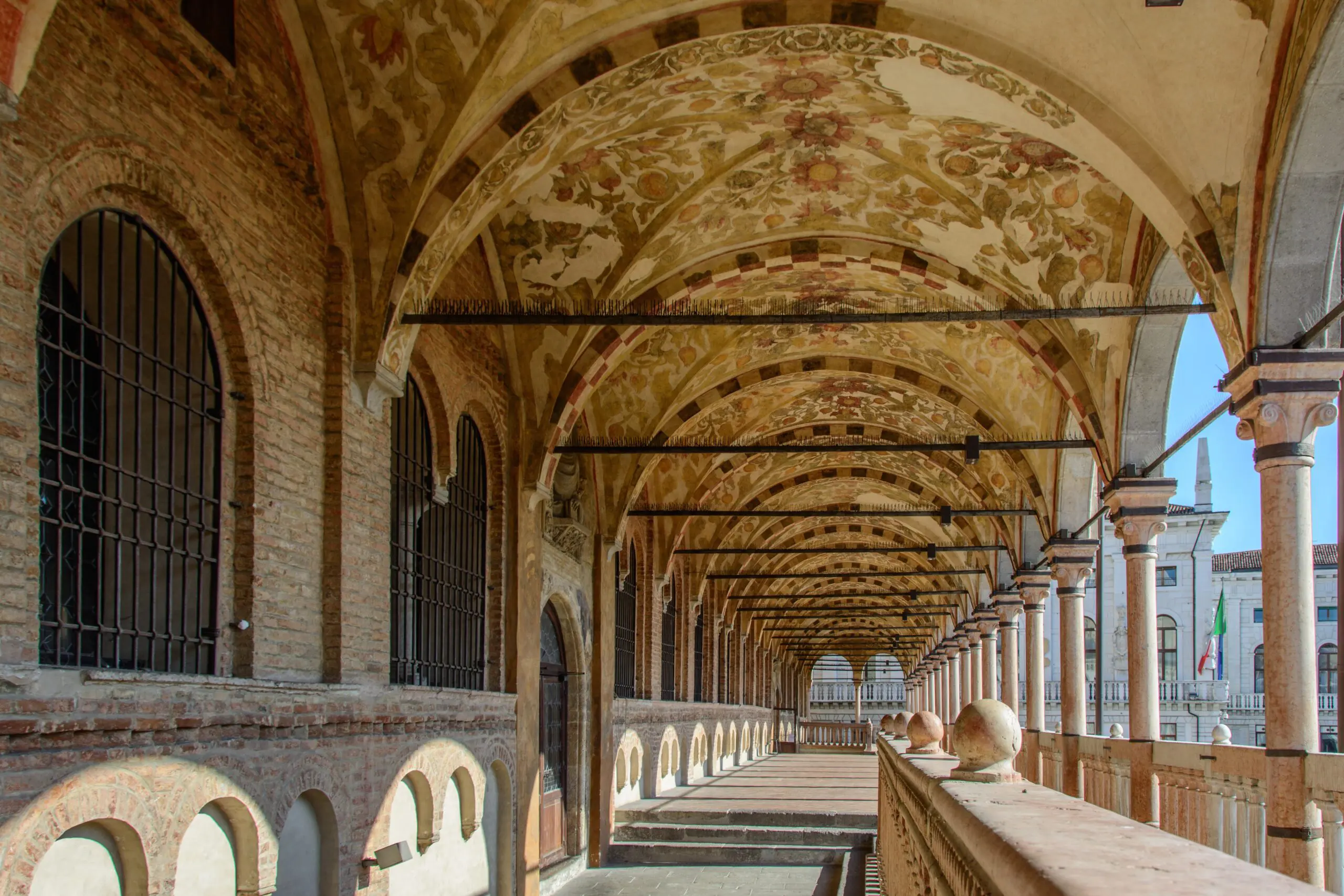
The interior walls are covered in a monumental fresco cycle — well over 300 individual panels — depicting an astrological and allegorical program: signs of the zodiac, the months, planetary influences, moral allegories of virtue and vice, all originally overseen in concept by the astrologer and physician Pietro d’Abano in the early 14th century, though the surviving frescoes today are largely a later repainting after a 1420 fire, executed in the same spirit as the original scheme. Justice, in the medieval Paduan worldview, was administered underneath the visible order of the cosmos — the frescoes were a constant reminder to judges and litigants below that human law operated inside a much larger, watching system.
At one end of the Salone stands a large wooden horse — a 15th-century sculpture built for a joust and pageant, later moved indoors, and now something of an unofficial mascot for the building. At the other end, a massive stone slab known as the Pietra del Vituperio (“Stone of Vituperation”) is where, in medieval Padua, debtors who couldn’t pay were made to sit publicly, sometimes stripped, as a form of public humiliation before being formally declared bankrupt and exiled from the city — a genuinely brutal piece of medieval civic punishment, and a good reminder that this building’s frescoed ceiling sat above some very unglamorous business.
Downstairs is still a market. This is the detail that makes the Palazzo della Ragione different from almost every other historic monument you’ll visit in Italy: the ground floor arcades have functioned as Padua’s central food market for roughly 800 years, and they still do. Cheese counters, butchers, produce stalls, wine shops — it’s a living, working market, not a recreation. You can buy lunch ingredients directly underneath a UNESCO World Heritage fresco cycle.
Piazza delle Erbe and Piazza della Frutta, the twin squares flanking the palazzo, are themselves part of the protected setting — this is a case where UNESCO recognition extends beyond a single building’s walls into the historic urban fabric around it, since the visual and functional relationship between the palazzo and its market squares is part of what’s being protected.
The Carraresi Palace (Reggia Carrarese)
The Carraresi were the ruling family of Padua through much of the 14th century, before the city fell under Venetian control in 1405, and their palace preserves a smaller but still remarkable fresco cycle from that period, including work attributed to Guariento di Arpo, one of the six core Urbs Picta artists. It’s less visited than the Palazzo della Ragione, largely because access has historically been more limited and it’s often seen only as part of guided visits rather than general walk-in access — which, again, is exactly the kind of detail an independent traveler researching online tends to miss, and exactly the kind of access issue a private local guide exists to solve. The Carraresi were eventually deposed when Venice absorbed Padua into its mainland territories in 1405, and their palace is one of the few surviving physical reminders that, before Venetian rule, Padua was its own independent seat of power with its own court, its own ambitions, and its own artistic patronage — a fact that’s easy to forget once you’re standing in a city so thoroughly shaped by centuries of Venetian influence afterward.
The Baptistery of the Cathedral
Just steps from the Duomo, Padua’s Baptistery is small on the outside and overwhelming on the inside — every surface, dome included, covered by Giusto de’ Menabuoi’s fresco cycle from the 1370s, one of the most complete and best-preserved fresco programs of the entire fourteenth century in Italy. The dome alone contains hundreds of figures arranged in concentric circles around a central Christ Pantocrator. Unlike the Scrovegni Chapel, the Baptistery has no timed-entry restriction and a much smaller ticket price, and it’s routinely — unfairly — treated as an afterthought. I send clients here specifically when Scrovegni tickets are sold out for their travel dates, because in terms of sheer painted surface density, the Baptistery arguably out-frescoes the chapel that gets all the attention.
Cluster Three: The Basilica of Saint Anthony
Padua’s spiritual center is the Basilica di Sant’Antonio — locals call it simply Il Santo, “the Saint,” because in Padua no other name is needed. Construction began shortly after the death of Saint Anthony of Padua in 1231, and the building that resulted is a genuinely unusual architectural hybrid: eight domes rising above the roofline in a shape that deliberately echoes St. Mark’s Basilica in Venice, combined with Romanesque, Gothic, and Byzantine elements layered on top of each other across more than a century of construction.
Saint Anthony was, and remains, one of the most widely venerated saints in the Catholic world — patron saint of lost things, among other associations — and the basilica has functioned as a major pilgrimage destination continuously since the 13th century. Inside, the fourteenth-century fresco cycles that earn the complex its place in the Urbs Picta listing sit alongside later additions: bronze reliefs by Donatello, whose equestrian statue of the condottiero Gattamelata stands in the piazza outside the basilica — the first large bronze equestrian monument cast in Italy since antiquity, and a genuinely important piece of early Renaissance sculpture in its own right.
The saint’s tomb, in the Chapel of the Arca, is where the pilgrimage energy of the place is most visible — visitors and pilgrims regularly touch the tomb and leave written prayers and photographs, a tradition that’s been continuous for nearly 800 years. Golden relief panels around the tomb depict miracles attributed to Anthony.
If you’re in Padua on June 13th, the Feast of Saint Anthony fills the streets around the basilica with candles, music, and a genuinely large public celebration — worth knowing about if your travel dates happen to align, and worth avoiding if you’re hoping for a quiet visit. Even outside the feast day, the basilica sees a steady flow of pilgrims year-round, many arriving specifically to pray at the tomb rather than to sightsee, which gives the space a genuinely different atmosphere from the more purely artistic experience of the Scrovegni Chapel or the Baptistery — it’s worth entering with that in mind, and being mindful of the quiet, devotional purpose the building still actively serves for many of the people standing next to you.
Cluster Four: The Oratory of San Michele and the Oratory of San Giorgio
The smallest and least-visited cluster, and honestly the one I only recommend to clients who’ve already done the major sites and want to go deeper. The Oratory of San Michele preserves a fresco cycle by Jacopo da Verona from 1397 — the latest work chronologically included in the whole Urbs Picta nomination, marking the closing bracket of the century-long painting tradition the UNESCO listing protects. The nearby Oratory of San Giorgio, adjoining the Basilica of Saint Anthony complex, contains frescoes by Altichiero da Zevio and Jacopo Avanzi. Both are small, quiet, rarely crowded, and genuinely rewarding if fresco painting has gotten under your skin by this point in the day — which, if you’ve done the chapel and the Baptistery already, it probably has.
Part Two: The University of Padua — Freedom, Galileo, and the Birth of Modern Anatomy
The University of Padua isn’t part of either UNESCO inscription, but leaving it out of a Padua guide would be like writing about Florence and skipping the Uffizi. Founded in 1222 — making it one of the oldest universities in the world still operating continuously — it was established, notably, as an act of academic rebellion: a group of students and professors left the University of Bologna in protest over restrictions on academic freedom and founded a new institution in Padua instead.
That founding spirit became the university’s defining identity, formalized in its motto: Universa Universis Patavina Libertas — “Paduan freedom is universal for all.” Under Venetian rule from 1405 onward, the university became known specifically for religious tolerance and freedom of thought unusual for the period — it admitted Protestant students at a time when Catholic universities elsewhere in Europe generally would not, and it became a magnet for scholars across confessional and national lines.
Galileo Galilei taught here from 1592 to 1610 — eighteen years, which he himself later described as the happiest and most fruitful period of his life. It was during his Padua years that Galileo made his major improvements to the telescope and began the astronomical observations that would eventually put him in conflict with the Catholic Church. He wasn’t yet the controversial figure he’d become in Rome; in Padua, under Venetian protection and academic freedom, he was simply a working professor of mathematics.
The university also produced Elena Cornaro Piscopia, who in 1678 became the first woman in the world to receive a university degree — a doctorate in philosophy, awarded here after she’d been blocked from pursuing a theology degree specifically because she was a woman. And it was in Padua that Andreas Vesalius, teaching anatomy in the 1530s and 40s, produced De humani corporis fabrica (1543), the work that overturned more than a thousand years of anatomical dogma inherited from the ancient physician Galen, by insisting that anatomy be taught through direct human dissection rather than from received texts. Padua, quite simply, is where modern anatomical science begins.
All of this happened inside one building.
Palazzo del Bo: The Historic Heart of the University
The university’s historic seat is the Palazzo del Bo (the name comes from an ox — “bo” in the Paduan dialect — that stood as the sign of an inn originally occupying the site). Today it’s a functioning administrative building — the university’s rector still has offices here, and degree ceremonies still take place inside — but a section of it is open to the public through guided visits, and it contains two of the most quietly extraordinary rooms in Italy.
Galileo’s Lectern
Inside the university’s Aula Magna (Great Hall), preserved and protected behind glass, stands the wooden lectern — the cattedra — from which Galileo Galilei lectured to his students. Standing in front of it is a strange, specific kind of experience, different from the emotional impact of the Scrovegni frescoes. It’s not overwhelming; it’s intimate. This is a piece of furniture a real person stood behind, week after week, for eighteen years, teaching mathematics and astronomy to Venetian and international students, some years before that same mind reoriented humanity’s understanding of its place in the universe. The hall itself is covered with the coats of arms of centuries of graduating students — a visual record, literal and physical, of who studied here across five hundred years.
The Anatomical Theatre (Teatro Anatomico)
If the Scrovegni Chapel is Padua’s essential art stop, the Teatro Anatomico is its essential science stop, and in my experience it surprises first-time visitors more than almost anything else in the city, precisely because so few people arrive knowing it exists.
Built in 1594 under the direction of anatomist Girolamo Fabrici d’Acquapendente, it’s the oldest surviving permanent anatomical theatre in the world — the first purpose-built, permanent structure anywhere designed specifically for teaching human anatomy through public dissection. Before this, anatomical demonstrations across Europe were conducted in temporary wooden structures assembled and disassembled as needed. Padua’s theatre was different: a small, steeply raked, funnel-shaped wooden amphitheatre, oval in plan, rising through six narrow tiers around a tiny central dissection floor, all of it carved from dark walnut wood, lit originally by candlelight and the natural light of a single lantern skylight above.
Students packed into those tiers — standing, not seated, because there wasn’t room for seating — craning over a wooden railing to watch professors demonstrate human anatomy directly on cadavers, at a time when this kind of direct observation was still controversial and, in many parts of Europe, restricted or forbidden. The theatre could reportedly hold a couple hundred students at capacity, all crammed into a space that today feels almost impossibly small and steep — you look down into it and feel a slight vertigo, a physical sense of how intense and claustrophobic those sessions must have been.
This is where the modern discipline of human anatomy, as an observational, evidence-based science rather than an inherited text, effectively took its permanent institutional form. William Harvey, who later discovered the circulation of blood, studied at Padua and would almost certainly have attended demonstrations in this theatre or its predecessor.
Access to the Palazzo del Bo, the Aula Magna, and the Anatomical Theatre is by guided tour only, run through the university itself, in scheduled groups at fixed times — you cannot simply walk in. Group sizes are limited and slots do sell out, particularly in the busier travel months, so this is very much in the same category as the Scrovegni Chapel: something to book ahead rather than assume you can walk up and join.
It’s worth understanding why this specific building matters so much to the history of science, beyond simply being old. Before Andreas Vesalius arrived in Padua to teach anatomy in the 1530s, European medical education was still built almost entirely around the texts of Galen, a Greek physician working thirteen centuries earlier whose anatomical descriptions were based largely on the dissection of animals — pigs, dogs, Barbary macaques — rather than humans, and which had simply been accepted as authoritative for over a millennium without being seriously re-checked against an actual human body. Vesalius’s insight, radical for the period, was that a professor should perform the dissection himself, in front of students, and describe only what was actually visible — not what tradition said should be there. This was controversial enough that human dissection for teaching purposes was still restricted in much of Europe, and Padua’s relative intellectual freedom under Venetian rule is part of why this kind of direct, evidence-based anatomical teaching was able to take root here specifically.
The permanent theatre built in 1594, a generation after Vesalius, formalized that teaching method into architecture — a building whose entire design exists to let a large group of students observe a single dissection from a good angle. It became the model other European universities copied when they built their own anatomical theatres over the following century, which is part of why UNESCO and historians of science treat it as such a significant site even though it isn’t formally part of either of Padua’s World Heritage inscriptions: this modest wooden funnel of a room is where the modern convention of teaching medicine through direct observation of the human body, rather than through inherited authority, took its first permanent institutional shape.
Part Three: The Botanical Garden — Padua’s Other, Older UNESCO Site
Most visitors doing Padua as a rushed day trip never make it here, which is honestly the biggest missed opportunity in the city, because the Orto Botanico di Padova is not a minor add-on. It’s Padua’s second, separate UNESCO World Heritage Site, inscribed in 1997, nearly a quarter-century before the fresco cycles received their own listing.
Why It’s UNESCO-Protected
The garden was founded in 1545 by decree of the Venetian Republic, established specifically as a teaching garden for the university’s medical faculty — a place to grow, identify, and study medicinal plants (the simples, in the language of the period) so that pharmacy and medical students could learn to correctly recognize the plants their entire pharmacological training depended on, rather than relying on illustrations or written descriptions that were often wrong or ambiguous. Misidentifying a medicinal plant, in an era when plant-based remedies were the basis of nearly all medicine, could genuinely kill a patient. The garden solved that problem by putting the real, living plants in front of students.
It is the oldest university botanical garden in the world still located on its original site — other early botanical gardens either moved, were absorbed into other institutions, or ceased operating, but Padua’s has been continuously cultivated on the same plot of land, inside the same basic geometric structure, for nearly 480 years. UNESCO’s inscription specifically recognizes it as the birthplace of the modern botanical garden as an institution — the model that essentially every later university botanical garden and public botanical garden in the world derives from.
The Layout and What to See
The garden’s original core is a perfect circle — a deliberate Renaissance design choice, reflecting the era’s belief in geometric harmony between human order and the natural world — divided into quadrants by intersecting paths, with the whole circular garden itself enclosed within a square, surrounded by a decorative stone and wrought-iron balustrade added in the 18th century. It’s an unusually beautiful piece of garden architecture quite apart from what’s actually growing in it.
The garden today covers roughly 22,000 square meters and holds more than 6,000 plant species and specimens, including:
- The historic medicinal plant beds — the original functional core of the garden, still organized by the same teaching logic that founded it in 1545, growing many of the same or related species used in early modern pharmacology.
- A large historic magnolia, planted in the 18th century, considered one of the oldest magnolia trees in Europe and a genuine living link to the garden’s early modern history.
- A dwarf palm, planted in 1585, famous specifically because Goethe saw it during his own visit to the garden in 1786 and used it as a key piece of evidence in his botanical writing on plant morphology — it’s sometimes referred to, informally, as “Goethe’s Palm,” and it’s still alive, now housed in its own dedicated protective structure.
- A modern glasshouse complex, the Giardino della Biodiversità (Garden of Biodiversity), opened in 2014, which recreates several distinct climate zones — tropical, subtropical, temperate, arid — under a striking contemporary glass structure, letting the garden continue its founding mission of housing plants that couldn’t otherwise survive Padua’s climate.
- The historic herbarium, one of the largest and oldest in Europe, holding well over a million dried, catalogued plant specimens accumulated since the sixteenth century — an active scientific research resource, not a museum display.
Walking through it after a morning spent in the intensity of the Scrovegni Chapel or the dark, steep wooden theatre of the anatomy hall is genuinely one of the best pacing decisions you can make with a Padua day. It’s quiet, it’s outdoors, it’s shaded, and it slows the day down at exactly the point where most visitors are starting to feel museum fatigue.
There’s also a direct link between the garden and the anatomy theatre worth knowing, because it connects the two halves of this article: both were founded by the same university, within about fifty years of each other, and both represent the same underlying shift in how knowledge was pursued in sixteenth-century Padua — away from received authority (ancient texts, inherited descriptions) and toward direct, first-hand observation. Vesalius insisted students watch a real dissection instead of reading Galen’s description of one. The Botanical Garden’s founders insisted medical students examine a real, living plant instead of relying on an illustrated herbal that might have been copied and re-copied with errors for a hundred years. It’s the same intellectual revolution, playing out in two different disciplines, on the same university campus, within the same two generations.
How Padua’s UNESCO Status Compares to the Rest of the Veneto
The Veneto region holds nine separate UNESCO World Heritage Site inscriptions in total, and it’s worth placing Padua’s two within that wider context, because it helps explain what makes Padua’s case distinctive. Venice and its Lagoon (inscribed 1987) protects an entire urban and lagoon ecosystem. Vicenza and the Palladian Villas of the Veneto (1994/1996) protects the architectural legacy of a single architect, Andrea Palladio, across dozens of scattered sites. Verona’s historic center (2000) protects a continuously layered city stretching from Roman times through the Renaissance. The Dolomites (2009) is a natural, geological site, not a cultural one at all. Padua’s two inscriptions are different again from all of these: one protects a specific, tightly bounded artistic moment — a single century of fresco painting across eight buildings — and the other protects a single institution’s founding site, essentially uninterrupted, for nearly five hundred years. Where Venice’s UNESCO status is about the survival of an entire way of building a city on water, Padua’s is about the survival of two very specific, very concentrated bursts of human achievement: one artistic, one scientific, both still physically standing exactly where they happened.
The Rest of Padua: What Sits Outside the UNESCO Boundaries but Shouldn’t Be Skipped
None of the following carries a UNESCO designation, but leaving them out of a full-day Padua itinerary would be a mistake, and I want to be honest about that rather than pretending the UNESCO sites are the whole city.
Caffè Pedrocchi, open since 1831, is known locally as “the café without doors” because for much of its history it operated around the clock, welcoming students, revolutionaries, and intellectuals at any hour without ever closing. It became a genuine center of 19th-century political and philosophical life in the city — patriots plotting Italian unification met here as much as poets and professors did. The building’s neoclassical architecture and its historic upstairs rooms, decorated in a mix of period styles, are worth a look even if you’re not stopping for coffee, though you should stop for coffee — the house specialty, topped with mint cream and cocoa, is a genuine local institution.
Prato della Valle, just south of the historic center, is one of the largest public squares in Europe — a former Roman theater site, transformed in the late eighteenth century into an elliptical island park ringed by a canal and surrounded by 78 statues of historical figures connected to Padua. It’s a good late-afternoon stop: locals use it for picnics, evening walks, and weekend markets, and the statues reflected in the surrounding canal water are particularly striking around sunset.
Piazza dei Signori, with its astronomical clock tower dating to 1344, is where the local aperitivo culture concentrates in the early evening — and worth knowing that the Spritz, now internationally famous as a Venetian drink, is claimed locally as a Paduan invention, which makes for a good argument over a glass of it at the end of the day.
What to eat: Padua’s food culture sits between Venice’s lagoon-based cooking and the heartier flavors of the inland Veneto countryside. Look for bigoli al ragù d’anatra — a thick, rustic pasta in duck ragù — and risotto al radicchio, made with the bitter red chicory grown throughout the region. Tiramisù, while more strongly associated with nearby Treviso, appears on menus throughout Padua as well, and pairing a slice with a glass of sweet Recioto wine is a genuinely good way to end a meal here. The Colli Euganei — the volcanic hills visible on the horizon south of the city — produce their own DOC wines, and several trattorias near the university and market squares pour them by the glass.
Best time of year to visit: Spring (April–June) and early autumn (September–October) are the strongest windows — mild weather for walking, and the university is in session, which means the city has its full energy rather than the quieter, more subdued feel it takes on during summer break. July and August bring heat that makes the un-shaded stretches between sites genuinely uncomfortable by midday, though the Scrovegni Chapel and university interiors are all indoors and climate-controlled or naturally cool. Winter is quiet, sometimes atmospheric, and the one season where Scrovegni Chapel booking pressure eases noticeably — worth considering if flexibility matters more to you than warm weather.
Planning an Actual Day: How the Pieces Fit Together
Given everything above, here’s the honest logistics conversation I have with clients.
Getting there: High-speed and regional trains run from Venice Santa Lucia to Padova Centrale every 20 to 30 minutes, with a journey time between roughly 25 and 50 minutes depending on the service. It’s one of the easiest, most frequent rail connections in the Veneto — there’s essentially no reason to worry about missing your window home. From Padova Centrale, the historic center is walkable (about 15–20 minutes to the Scrovegni Chapel) or a short tram ride.
The scheduling problem: Both of Padua’s genuinely essential timed-access experiences — the Scrovegni Chapel and the university’s Anatomical Theatre / Aula Magna guided tour — require advance booking with fixed entry slots, and neither is flexible about walk-ins, especially between roughly April and October. If you try to build a Padua day trip the way you’d build a Verona or Vicenza day trip — buy the train ticket, show up, figure it out — you will very likely miss the Scrovegni Chapel, the single most important thing in the city, simply because the slots were gone. This is the single most common planning mistake I see with independent American travelers researching Padua from home, and it’s avoidable with about ten minutes of advance booking.
A realistic one-day structure, assuming a morning train from Venice:
- Morning: Scrovegni Chapel (pre-booked slot) → Church of the Eremitani (right next door, five minutes)
- Late morning: Walk to Piazza delle Erbe / Piazza della Frutta → Palazzo della Ragione and its still-functioning market
- Coffee break: Caffè Pedrocchi
- Midday: University of Padua guided visit — Palazzo del Bo, Aula Magna, Galileo’s lectern, the Anatomical Theatre (pre-booked slot)
- Lunch: a trattoria near the university or market squares
- Afternoon: Basilica of Saint Anthony, then the Botanical Garden (a genuinely peaceful way to close out the museum-heavy part of the day)
- Late afternoon: Prato della Valle, or an aperitivo in Piazza dei Signori, before the train back to Venice
That’s a full, well-paced day, and it’s realistically achievable — but it depends entirely on having those two bookable time slots locked in before you leave Venice that morning.
Where a private guide actually earns its cost in Padua specifically: independent visitors routinely underestimate two things — how strict and how easy to miss the Scrovegni Chapel’s booking window is, and how much richer the Palazzo della Ragione, the Baptistery, and the university buildings become with someone connecting the fourteenth-century fresco program to what you’re actually looking at, panel by panel. Padua rewards context more than almost any other city in the Veneto, precisely because so much of what matters here — an astrological ceiling, a wooden lectern, a circular garden layout — needs someone to explain why it was built that way before it means anything at all.
We build Padua into our Walled Towns & Palladio Tour, combining the Basilica of Saint Anthony and the city’s historic core with the broader architectural story of the Veneto’s walled towns, and we handle the advance ticketing for the Scrovegni Chapel and the university visits so your day isn’t built around hoping a slot is still open when you arrive. For travelers who want to pair Padua with the region’s food and wine culture, our Flavors of Veneto Tour includes time in the Botanical Garden and the historic market squares. And if you’re staying in Venice and want the whole day handled door to door, we arrange private transfers so you’re not managing train schedules on top of museum bookings.
Who This Trip Is For — and Who It Isn’t
I try to be honest about this with clients rather than selling every destination as universally perfect, because it isn’t, and Padua isn’t either.
Padua rewards: art history enthusiasts, anyone with a serious interest in the history of science or medicine, travelers who want depth over spectacle, and people who are tired of crowds and want a genuinely Italian city that isn’t performing tourism for a living. If the idea of standing where Galileo lectured, or seeing the exact wooden theatre where modern anatomy was born, genuinely excites you, Padua will be one of the best days of your Italy trip.
Padua will disappoint: travelers who want postcard Italy — canals, gondolas, that specific romantic Venice atmosphere — because Padua doesn’t offer that and isn’t trying to. It also isn’t a great fit for a rushed half-day; because the two essential sites require pre-booked timed entry, trying to squeeze Padua into two or three hours between other commitments usually means missing the Scrovegni Chapel entirely, which defeats much of the point of coming.
If what you actually want is more Venice, more water, more gondola — stay in Venice. If you want to understand where an entire epoch of European art and, separately, an entire epoch of European science each took a decisive turn, and you’re willing to book two things in advance, Padua delivers on both in a single day more completely than almost anywhere else in Italy.
I’ve brought retired professors, honeymooning couples, curious teenagers, and people who told me flatly at breakfast that they “don’t really do museums” through this same sequence of rooms, and I’ve watched all of them land on the same reaction in front of Galileo’s lectern or under Giotto’s ceiling: a kind of quiet recalculation of what they thought this day was going to be. That’s the thing about Padua that no amount of reading about it quite prepares you for. It isn’t a city that impresses you with size or spectacle. It’s a city that impresses you with proximity — the sense that you’re standing exactly where something genuinely important happened, close enough to touch it, with almost none of the crowd you’d expect around something this significant.
Insider Tips from Someone Who’s Done This Trip More Times Than I Can Count
A few last, specific things that don’t fit neatly into the sections above but genuinely change how your day goes:
- Book the Scrovegni Chapel morning slot if you have a choice. Light and crowd levels both favor an early visit, and it lets you build the rest of your day around it rather than working backward from an afternoon reservation.
- Bring a light scarf or cover-up. The Basilica of Saint Anthony, the Baptistery, and the Eremitani are active religious sites with modest-dress expectations, same as anywhere in Italy.
- Wear real walking shoes. Padua’s historic center is flatter than Venice’s but considerably larger, and the porticoed streets — while wonderful in rain or midday sun — mean a lot of uneven, centuries-old paving underfoot.
- The market inside the Palazzo della Ragione is a genuinely good lunch stop, not just a photo opportunity. Buy cheese, cured meat, and bread directly from the stalls and eat it in one of the nearby piazzas — it’s one of the more memorable low-cost lunches you’ll have anywhere in the Veneto.
- Don’t skip the Baptistery because the Scrovegni Chapel already felt like “the fresco stop.” It has no timed-entry restriction, costs far less, and in terms of painted surface density, it’s arguably the more overwhelming of the two.
- If you only have half a day, prioritize in this order: Scrovegni Chapel, Palazzo della Ragione, university visit (if you can get a slot), Botanical Garden. The Basilica of Saint Anthony and Prato della Valle are the first things to cut if time runs short — not because they’re not worthwhile, but because the first four are irreplaceable and the last two are more forgiving to see quickly or skip on a future visit.
FAQs
Do I need to book the Scrovegni Chapel and the Anatomical Theatre in advance, or can I buy tickets on the day?
Book both in advance whenever possible. The Scrovegni Chapel operates on a strict timed-entry system with limited daily capacity to protect Giotto’s frescoes, and slots regularly sell out days or weeks ahead, especially between April and October. The University of Padua’s Anatomical Theatre and Aula Magna are accessible only through scheduled guided tours with limited group sizes, which also fill up in peak season. Walk-in availability for either is unreliable at best.
Is the Scrovegni Chapel the same thing as Padua’s UNESCO World Heritage Site?
No — and this is the most common misunderstanding about Padua’s heritage status. The chapel is one of eight buildings included in a single 2021 UNESCO listing called “Padua’s Fourteenth-Century Fresco Cycles” (Padova Urbs Picta), which also covers the Church of the Eremitani, the Palazzo della Ragione, the Carraresi Palace, the Baptistery of the Cathedral, the complex around the Basilica of Saint Anthony, and the Oratories of San Michele and San Giorgio. The Botanical Garden of Padua is a separate, earlier UNESCO World Heritage Site, inscribed in 1997.
How much time do I need to see Padua’s main UNESCO and university sites properly?
A full day, ideally arriving on an early train from Venice. The Scrovegni Chapel visit itself is brief — usually 15 to 20 minutes plus a mandatory 15-minute climate-stabilization period beforehand — but a day that also covers the Palazzo della Ragione, the university’s Palazzo del Bo and Anatomical Theatre, the Basilica of Saint Anthony, and the Botanical Garden realistically fills six to eight hours. Trying to compress it into a half-day usually means sacrificing the Botanical Garden or the university visit, which are two of the most rewarding parts of the trip.