Venice artisan workshops offer a deeper way to discover the city than a conventional souvenir-shopping route. From Murano glass and Burano lace to textiles, bookbinding, marbled paper, and mask making, Venetian craftsmanship connects historic trade with the skills of working people today. This October guide explains what to look for, how to plan a respectful visit, and how American travelers can distinguish genuine making from retail theater.
Why Venetian craftsmanship deserves a different kind of itinerary
Venice’s reputation for luxury was built over centuries by people who understood materials, trade, technique, and the demanding conditions of the lagoon. The city exported glass, textiles, printed books, and finely worked objects long before the language of luxury shopping became familiar. Yet the most interesting question for a modern visitor is not simply what to buy. It is who makes an object, how it is made, and whether the knowledge behind it is being passed on.
A meaningful artisan visit is therefore closer to cultural interpretation than to a shopping excursion. You might examine the tension of threads on an old loom, watch a glassworker control heat, or learn why a paper marbler must prepare a bath before adding pigment. None of these moments requires an expensive purchase. They require time, permission, and a willingness to distinguish a working studio from a shop arranged to resemble one.
What October changes—and what it does not
October can be an appealing month for exploring Venetian craft because the strongest summer heat has usually eased and walking between neighborhoods may feel more comfortable. However, October is not automatically quiet. International exhibitions, school holidays, cruise traffic, and weekends can produce crowded routes. Rain and acqua alta conditions are also possible. Plan a craft-focused day around confirmed appointments rather than assumptions about seasonal tranquility.
The advantage of an October visit is flexibility of mood: a morning spent inside a studio can pair beautifully with an afternoon walk through streets where craftsmanship once shaped the economy. A workshop appointment should remain the anchor. Leave space around it for a neighborhood café, a church interior if open, or an unhurried walk. Avoid advertising an unverified October festival or special demonstration as though it were guaranteed.
The difference between an artisan, a showroom, and a demonstration
An independent artisan makes or meaningfully transforms the work being sold, even if collaborators help with particular stages. A showroom may present beautiful pieces made elsewhere, and a demonstration can be educational without representing the full production process. These categories overlap. A respected workshop may operate a retail space; a shopkeeper may be an excellent interpreter of local craft. The key is clarity rather than suspicion.
Ask whether the person you meet makes the objects on display, where production happens, and which steps can be observed. Some processes are unsafe or impractical for visitors to witness. A glass furnace may be too hot to approach, while a textile workshop may protect delicate equipment and works in progress. A truthful explanation of limits is often a better sign than a theatrical promise to show everything.
Murano glass: skill beyond the souvenir
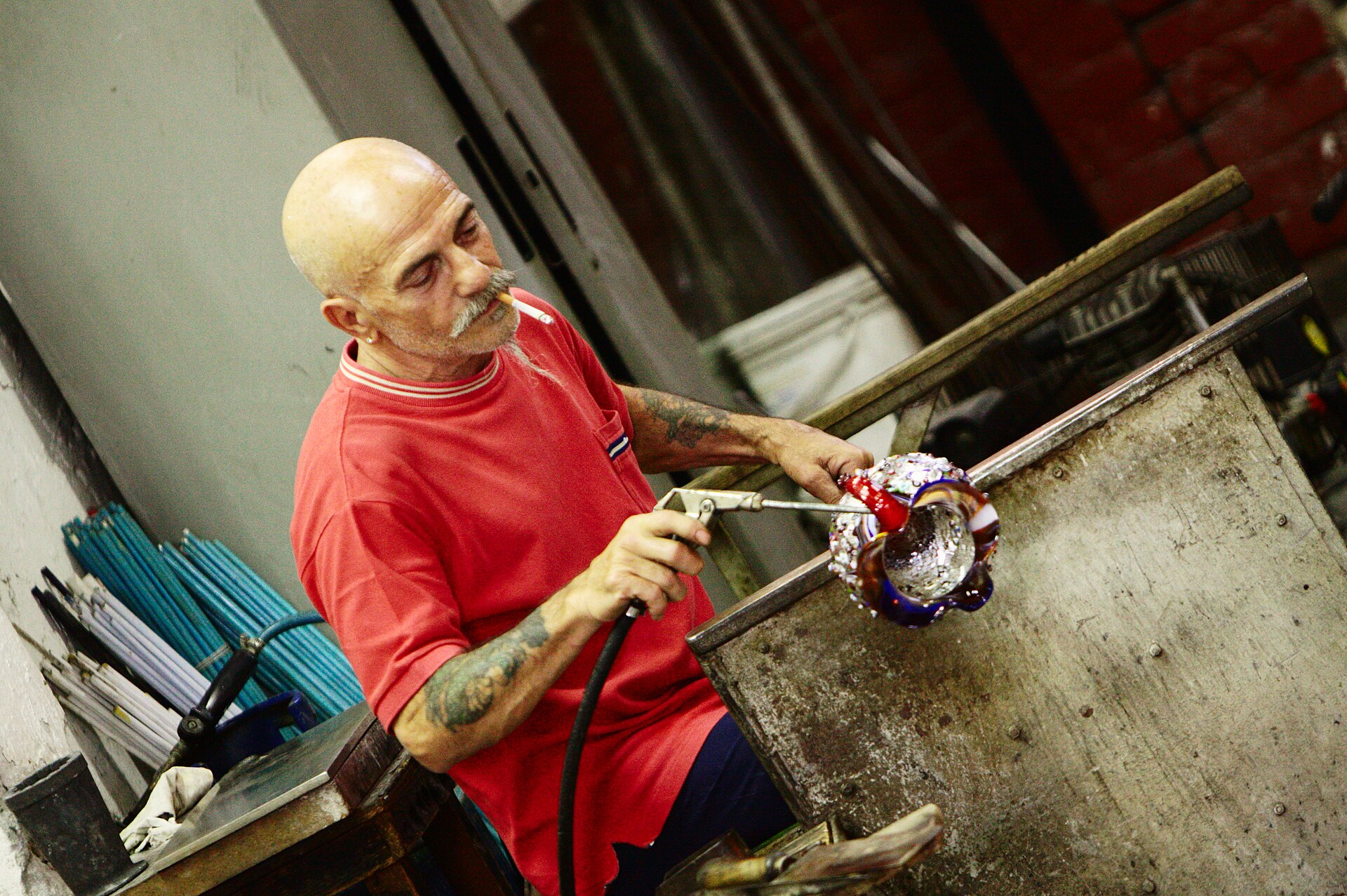
Murano’s glassmaking identity grew through the Republic’s regulation and concentration of furnaces on the island, particularly from the late thirteenth century. The history is richer than the familiar image of a master producing a small animal before an audience. Glassmaking involves furnace management, design, chemistry, teamwork, and the coordination of movements at temperatures that leave little room for hesitation.
When considering a visit, distinguish a brief furnace demonstration from an appointment that includes discussion of design and production. Both can have value, but they are different experiences. Ask whether you will meet a glass master, a designer, a gallery representative, or several members of the team. If you are interested in collecting, discuss the artist, technique, date, and documentation associated with the individual work rather than relying on a generic label.
How to evaluate Murano glass without pretending to be an expert
Authenticity is not something most travelers can determine by weight or color alone. Murano glass comes in many forms, and excellent work can look deceptively simple. Instead of memorizing unreliable tricks, seek clear information about the producer, origin, and materials. Ask for a written invoice describing the item and its maker. If a shop offers certificates, understand who issued them and exactly what they certify.
Price should be considered alongside labor, complexity, artistic authorship, and scale. A small object can be technically demanding, while a large decorative piece is not automatically exceptional. If you are shipping to the United States, request details about packing, insurance, customs paperwork, and what happens if the item arrives damaged. A beautiful purchase should not become an avoidable logistical problem after your vacation.
Lace in Burano: a craft measured in patience
Burano’s lace tradition invites a different kind of attention. Unlike the dramatic spectacle of a hot glass furnace, fine needle lace can be almost silent. Its beauty comes from disciplined hand movements, careful planning, and extraordinary patience. Historic Burano lace became associated with sophisticated European taste, but the survival of the tradition depends on teaching skills that cannot be learned in an afternoon.
Visitors should avoid assuming that every lace item displayed on the island was made by hand locally. Ask whether the work is handmade, machine-made, vintage, or produced elsewhere. A genuine explanation of the technique can be more revealing than a quick sales pitch. If you see someone working, ask before photographing their hands or workspace. A respectful conversation helps preserve the distinction between a living skill and a picturesque performance.
Why lace is worth seeing even if you do not shop
Lace offers an unusually direct way to understand the value of time. A finished piece may appear light and effortless, but the labor is often intensive. Learning how patterns are constructed changes the way you look at textiles in churches, paintings, and historic portraits. What first seems decorative becomes evidence of status, trade, domestic labor, and technical imagination.
Burano is also a residential island. Its colorful houses are not public exhibits, and narrow passages can be disrupted by groups stopping for photographs. Combine any craft visit with a considerate walk, keeping doorways clear and speaking quietly near homes. If your schedule allows only a short stop, choose one good conversation about lace rather than trying to photograph every picturesque corner.
Venetian textiles: the intelligence of the loom
Silk, velvet, and patterned fabrics played important roles in Venice’s commercial and artistic history. Textiles were portable wealth: they could be traded, gifted, worn, or used to transform interiors. The city developed strong connections to eastern Mediterranean commerce and European markets, creating an environment in which sophisticated weaving and design flourished.
A historic textile workshop can reveal the relationship between pattern and machinery. Watching a loom, or even examining it at rest, makes clear that woven designs are engineered as well as imagined. Ask how long it takes to set up a pattern, how designs are recorded, and which stages remain manual. Access to active workshops is often by appointment, and some spaces are not suitable for casual drop-ins.
A closer look at velvet and brocade
Velvet is not merely a soft surface. Its pile, structure, and handling influence the way light moves across the fabric. Brocade introduces another layer of complexity through patterned weaving, sometimes using contrasting or metallic-looking threads. Historic Venetian interiors and ceremonial dress made use of such materials because texture and light could communicate status before a word was spoken.
For a visitor, the most rewarding comparison is between a fabric seen in a museum or palace and a technique explained in a workshop. You begin to understand why certain rooms were furnished with textiles and why conservation is demanding. Do not touch historic fabric unless expressly invited. Even clean hands can transfer oils, and delicate threads may not tolerate handling.
Venetian paper marbling: color controlled on water
Paper marbling is a particularly approachable craft for travelers interested in process. Pigments are floated and manipulated on a prepared liquid surface before the design is transferred to paper. The result can appear spontaneous, but successful marbling depends on preparation, viscosity, color behavior, and the maker’s experience. Small changes in movement produce distinctive patterns.
A workshop session may let visitors try a simple design, although formats vary and should be confirmed in advance. Ask whether the activity is a demonstration, a hands-on class, or a visit to a working studio. Also ask how long the finished paper needs to dry and whether it can be safely packed for the journey home. For families, the tactile and visual nature of marbling can be appealing, provided the workshop accepts the children’s ages.
Bookbinding and the city’s printing heritage
Venice was one of Europe’s great centers of printing and publishing. The history of books here involves not only famous printers and scholars but also paper suppliers, binders, illustrators, and sellers. A handmade notebook can connect today’s traveler to that broader world, even though contemporary artisan production is not identical to Renaissance printing.
When visiting a bindery, look at the way signatures are folded, sewn, and attached to covers. Ask about paper grain, adhesives, cloth, leather, and the difference between decorative binding and structural repair. A responsible maker will also explain the limits of their work: conserving an antique book is not the same as making a new journal. Buying a well-made notebook can be a practical souvenir whose value comes from construction rather than branding.
Masks: tradition, theater, and modern reinvention
Venetian masks are inseparable from the city’s modern tourist imagery, yet their history connects to Carnival, performance, disguise, and changing social conventions. Not every mask in a shop represents an uninterrupted centuries-old design. Some are contemporary interpretations, and that creative reinvention can be legitimate when honestly described.
Ask what materials are used. Papier-mâché, leather, fabric, and molded industrial products have different processes and price points. A studio that shows how a mask is formed, dried, painted, and finished offers a clearer understanding than a shop filled with objects whose origin is unexplained. If you want to wear a mask at an event, consider comfort, visibility, and whether the venue has specific rules.
Gold leaf, decorative painting, and restoration
Venice’s churches and palaces contain surfaces that were designed to shimmer: gilded frames, painted ceilings, carved wood, and ornamental details. Contemporary craftspeople may work in decorative painting, gilding, frame making, or restoration-related trades. These are highly specialized fields, and the public rarely sees all the stages behind a finished surface.
A visit should distinguish new decorative production from the conservation of historic objects. Conservation follows professional standards and may involve documentation, testing, and institutional oversight. Travelers should not assume that a craft demonstration provides access to protected restoration work. Instead, ask how materials behave over time and why humidity, salt, and light are significant in the Venetian environment.
Jewelry and metalwork: looking beyond a familiar motif
Venetian jewelry may incorporate glass, metal, engraving, or contemporary design. A gondola-shaped pendant or lion motif is not inherently local craftsmanship; it may simply be a design reference. If the object matters to you, ask who designed it, where the components were produced, and what work was completed in Venice.
Small studios can offer meaningful conversations about casting, finishing, stone setting, and design, but access depends on the maker’s schedule. Some tools and processes are hazardous, and an artisan may prefer to explain them through samples rather than live demonstrations. A thoughtful visitor respects these boundaries and values the explanation rather than demanding a performance.
Why ‘Made in Venice’ needs a precise question
Labels can compress complicated supply chains into a few attractive words. An object might be designed in Venice, assembled there from imported parts, produced elsewhere for a Venetian retailer, or made entirely in a local workshop. These distinctions are not necessarily signs of deception, but they matter when your goal is to support local production.
The most useful question is simple: which stages were carried out here, and by whom? Follow it with questions about the material’s origin and whether the maker signs or documents the work. The answer may reveal a fascinating collaboration across the Veneto region or a small network of specialist suppliers. Good craftsmanship often involves cooperation, not a single romantic figure doing everything alone.
What a real workshop visit feels like
Working studios are not always polished. They may contain tools, unfinished pieces, protective equipment, storage shelves, and worktables covered in evidence of experiments. The person making the work may have limited time to talk because production deadlines are real. A successful visit acknowledges that you are entering someone’s workplace.
Arrive punctually, follow instructions, and keep bags away from equipment. Ask whether photography is allowed, especially if prototypes or private commissions are visible. If you are traveling with children, confirm the minimum age and supervision rules. The best conversations often emerge from specific observations: why a tool has that shape, why a material is chosen, or which part of the process is most difficult to teach.
How to arrange an artisan appointment
Begin with the craft you genuinely care about rather than collecting a list of famous names. If you are interested in glass, describe whether you want a furnace demonstration, a design conversation, or a gallery visit. For textiles, clarify whether you hope to see a loom operating. For marbling, say whether you prefer to observe or participate. These distinctions help an organizer request a suitable appointment.
Provide your travel date, group size, language preference, and any mobility requirements. Workshops may close on Sundays, holidays, or for private commissions, and availability can change at short notice. Never treat an online shop’s listed hours as proof that its production space is open to visitors. A confirmed appointment should specify the meeting place, approximate duration, and any participation or admission cost.
Where to explore: San Polo and Santa Croce
The central districts of San Polo and Santa Croce contain a mix of commercial history, residential streets, and small businesses. Their proximity to Rialto makes them practical for a walking itinerary, but the busiest market approaches can be crowded. Move a few streets away and the pace often changes noticeably.
A craft-focused walk here can explore the relationship between trade, storage, transport, and the everyday services that supported merchants. Do not assume every historic shopfront is still used for its original trade. Part of Venice’s story is adaptation: workshops relocate, commercial spaces change function, and older architectural forms acquire new lives.
Where to explore: Dorsoduro and its creative atmosphere
Dorsoduro is often associated with museums, galleries, and university life, but its value for a craft itinerary lies in the contrast between major cultural institutions and smaller streets. A carefully paced visit might combine a studio appointment with time to examine façades, bridges, and the relationship between art and domestic architecture.
Do not treat an entire neighborhood as a guaranteed artisan district. Workshops come and go, and opening hours are individual. The practical approach is to secure one real appointment, then plan a walk around it. This keeps the itinerary rooted in actual access rather than vague promises about hidden studios.
Where to explore: Cannaregio and Castello
Cannaregio and Castello reward travelers who want to understand Venice as a lived-in city. Residential squares, local shops, and working waterways sit alongside major churches and historic buildings. A private guide can explain how the city’s economy extended far beyond the monumental core.
These districts are also home to people whose routines should not be disrupted by tourism. Keep groups small, do not enter private courtyards, and avoid photographing residents without permission. A meaningful visit is not a hunt for secret locations. It is an opportunity to understand ordinary places with the attention normally reserved for famous monuments.
Murano as an island, not just a furnace stop
Murano has its own streets, churches, waterways, and residential life. Treating it solely as a quick demonstration followed by a showroom visit reduces the island to a single industry. A more thoughtful itinerary leaves time to understand why glass production became concentrated there and how contemporary makers balance tradition with changing markets.
Transport logistics deserve care. Public vaporetto journeys may involve waiting, transfers, and crowded boarding areas. A private boat can simplify movement, but access to individual docks depends on permissions and conditions. For visitors with limited mobility, discuss steps and boarding points before deciding that an island excursion is suitable.
How long should a craft itinerary last?
A focused two-hour walk may be enough for one studio appointment and a nearby neighborhood introduction. Three or four hours allows more context, perhaps combining a demonstration with a short historical route. A full-day itinerary might include an island visit, lunch, and a second craft, but the additional travel time must be counted honestly.
The mistake is to schedule four workshops as though they were museum galleries that can be entered at any moment. Makers work to production schedules, and demonstrations require setup and explanation. One deep encounter can be more memorable than several hurried visits. When time is limited, choose quality of access over the number of stops.
What to budget for and what may cost extra
Artisan experiences vary widely in price. Some retail demonstrations are offered without a separate admission charge, while private workshops, specialist guides, hands-on classes, and boat transportation may involve fees. Free entry should not automatically be treated as a bargain: the experience may be connected to an expectation of shopping.
Ask for a clear written outline of inclusions. Does the price cover the guide, materials, workshop fee, finished object, transport, and shipping? Are cancellations possible if the artisan is unavailable? Is there a minimum group size? Transparent terms help American travelers compare experiences that may look similar online but operate very differently in practice.
Buying something meaningful and getting it home
A good souvenir should carry a story you can explain. Before buying fragile glass, ask about professional packing and international shipping. For textiles, discuss care instructions and exposure to sunlight. For paper, consider humidity and how to prevent creasing in luggage. If you are purchasing a valuable piece, retain invoices and any documentation supplied by the maker.
Travelers returning to the United States should check current U.S. Customs and Border Protection rules rather than relying on a shop’s informal advice about duties or declarations. For valuable objects, confirm insurance and delivery arrangements in writing. The artisan’s responsibility and the shipping company’s responsibility may differ, and those distinctions matter if damage occurs.
Photography etiquette in a studio
Photography can be a wonderful way to remember a craft encounter, but the studio is not a public photo set. Ask before photographing people, machinery, unfinished commissions, or proprietary designs. Some makers welcome a short video of a demonstration; others may restrict recording for safety, privacy, or commercial reasons.
Avoid using flash near delicate materials or distracting a craftsperson during a dangerous process. If you plan to post images on social media, ask how the maker prefers to be credited. A photograph that identifies the artisan and accurately describes the process is more valuable than a generic caption claiming to have discovered a secret workshop.
Craftsmanship, sustainability, and the living city
Supporting local makers can help sustain skills and small businesses, but sustainability claims should be specific. A handmade product is not automatically low-impact, and energy-intensive processes such as glassmaking have real environmental costs. The more useful discussion concerns longevity, repairability, transparent production, and the survival of specialized knowledge.
Venice’s economic future depends in part on whether residents can continue to work in the historic center and lagoon islands. Visitors contribute most meaningfully when they pay fairly for expertise, respect workshop schedules, and choose experiences that explain the work rather than turning artisans into entertainment. That attitude supports a living city instead of treating it as a decorative backdrop.
How local guiding experience changes the visit
Tour Leader Venice’s perspective is informed by local professional guiding, including Igor Scomparin’s experience as a licensed guide since 1997. The practical benefit is an understanding that a workshop visit depends on real people, neighborhood geography, transport, and the rhythms of the city. A well-planned itinerary needs more than a list of attractive addresses.
A guide should be willing to explain when a particular studio is not accessible, when a boat transfer is inefficient, or when an appointment would leave too little time to appreciate the craft. This kind of candid advice may sound less glamorous than a promise of unlimited hidden access, but it is more respectful of both visitors and makers.
A sample half-day centered on a single craft
Begin with a neighborhood walk that introduces the historic trade networks behind Venetian production. Notice the relationship between waterways and ground-floor commercial spaces. Continue to a confirmed artisan appointment, leaving enough time for questions about technique, materials, and the maker’s career. Finish with a relaxed stop nearby rather than another compulsory shopping visit.
The route should be chosen after the appointment is confirmed. If the studio is on Murano, the half-day must include realistic boat transfers. If it is in central Venice, walking may be more sensible. The key is to let the actual craft encounter determine the geography, not the other way around.
A sample full day for curious travelers
A full day could pair a mainland Venice workshop with an island-based tradition, but only if travel time and availability make the combination comfortable. For example, visitors interested in textiles and glass might learn about woven surfaces in the morning, pause for lunch, and spend the afternoon examining glass production on Murano.
This is an illustrative framework, not a promise that specific workshops are open or can be booked on the same date. Build in time for boarding, weather changes, and breaks. If a demonstration is canceled, a thoughtful alternative may be a museum or neighborhood walk connected to the same craft rather than a rushed substitute chosen simply to fill the schedule.
The questions worth asking before you book
Ask whether the experience takes place in an active workshop or a retail showroom; who will lead it; whether it includes hands-on participation; and how many other visitors will attend. Confirm the duration, meeting point, language, accessibility, photography rules, and cancellation terms. If you hope to buy a piece, ask whether purchases are optional and how shipping is handled.
These questions do not diminish the romance of Venetian craftsmanship. They make the encounter more meaningful. A maker who can explain their process and its limits is offering something more valuable than a scripted spectacle: a glimpse of the decisions and discipline that transform raw materials into lasting objects.
The real luxury is attention
The most compelling Venetian objects are not necessarily the most expensive or the most elaborate. A well-bound book, a thoughtfully designed glass vessel, a piece of lace, or a patterned fabric can reveal years of accumulated knowledge. Their value becomes clearer when you understand the labor behind them and the setting in which they are made.
Venice has always been a city of exchange and adaptation. Its makers inherited techniques, experimented with new designs, and responded to customers far beyond the lagoon. A craft-focused visit in October should honor that history without pretending that the city is frozen in the past. Leave with a better question about how something was made, and you will have discovered a side of Venice that no ordinary shopping list can capture.
Continue exploring Venice
For related local history, read the overlooked details that reveal Venice’s story, explore how everyday Venice works without cars, and learn about the women who shaped Venetian craftsmanship. For a private itinerary designed around your interests, contact Tour Leader Venice.
Frequently Asked Questions
Do Venice artisan workshops require reservations?
Many working studios and private demonstrations require advance arrangements. Confirm the maker, meeting point, duration, fees, and whether the visit is a workshop, showroom, or hands-on class.
How can I tell whether a Venetian souvenir is genuinely locally made?
Ask who made it, where production took place, and which steps were completed locally. Request an invoice or maker documentation when appropriate; appearance alone is not a reliable test.
Can I visit Murano glassmakers and other Venetian artisans in one day?
It may be possible with confirmed appointments and realistic travel time. Prioritize one or two crafts rather than rushing between multiple studios and islands.