October on Sant’Erasmo: a working island, not an autumn postcard
On an October morning, Sant’Erasmo can seem impossibly far from the Venice most visitors know. The horizon is low, the buildings are scattered, and fields occupy spaces where the historic center would be packed with stone façades. There is no need to imagine a romanticized harvest scene: the reality is more compelling. This is an inhabited agricultural island, where seasonal decisions have practical consequences for growers and where the lagoon is part of the working landscape.
If you want to understand Sant’Erasmo in harvest season, begin with one important distinction. The island’s famous purple artichokes are primarily a spring story. October is not the month to arrive expecting the celebrated first-cut castraure. Instead, autumn offers a way to see how a market-garden island works outside its best-known crop’s peak. Depending on individual farms, the weather, and the year, fields may be cultivated, prepared, resting, or planted with vegetables suited to cooler conditions. No responsible guide can promise a particular harvest on a particular date without speaking to a grower.
That is what makes an October visit valuable. Rather than collecting a picture of a famous ingredient, you can look at the broader agricultural system: the flat terrain, drainage channels, cultivated plots, changing soil conditions, access roads, and the boats that connect this rural place with the rest of Venice. It is a lesson in how a city surrounded by salt water has maintained a relationship with cultivated land.
This article concentrates on the autumn landscape and the agricultural calendar, not on general sightseeing, island history, or a list of attractions. For the broader introduction, our guide to Sant’Erasmo as Venice’s garden island covers the island’s identity and relationship with the city. Here we follow the changing season, and we ask what a visitor can realistically observe without turning somebody else’s workplace into a tourist performance.
The island behind Venice’s market stalls
The story of Sant’Erasmo is not separate from Venice’s history. The historic city has always depended on networks beyond its dense urban core: mainland fields, fishing grounds, waterways, ports, and lagoon islands. Sant’Erasmo became associated with vegetable cultivation because it offers something the stone city cannot: extensive land for growing food within the lagoon itself.
The island lies in the northern lagoon, within reach of Venice but different in scale and texture. Instead of closely spaced palaces, you encounter fields, modest buildings, vegetation, and long views. Its geography helps explain why people have cultivated it, but geography alone is not destiny. Agriculture also requires people willing to manage soil, water, crops, tools, transport, and economic risk.
A photograph of an artichoke field is a useful introduction, but it can mislead if presented as the whole agricultural story. Growers do not spend twelve months doing the same task. They make choices about planting, harvesting, protecting crops, maintaining ditches, and preparing land. The work changes with the season, and the agricultural landscape changes with it.
The best way to approach Sant’Erasmo is to recognize the fields as private working spaces, even when they are visible from a public road. Visitors may admire them from accessible routes, but should not enter plots, pick produce, or assume that a farmer has time to provide an explanation. If you want to meet a producer or arrange a tasting, make a specific appointment through an authorized contact.
That simple courtesy makes a difference. It allows the island to remain a place of work rather than an attraction that must continually explain itself to outsiders.
What harvest season really means in October
The phrase harvest season suggests baskets overflowing with ripe produce. On Sant’Erasmo, October is more complex. Harvesting can overlap with planting, field preparation, maintenance, and planning for the next part of the agricultural year. What is happening in one field may be completely different from what is happening in the next.
Vegetable farming does not follow a single calendar for an entire island. Crop choices vary between growers and depend on soil conditions, demand, weather, labor, and cultivation methods. A mild autumn can produce different results from a wet or unusually cool one. Even the same crop may be at a different stage on neighboring plots.
Visitors should therefore resist making a shopping list of vegetables they expect to see growing. Seasonal greens, brassicas, squash, and other vegetables may be associated with autumn agriculture in the Veneto, but that does not mean each is cultivated on Sant’Erasmo or ready for harvest on the day of your visit. The accurate question is not “Which October vegetables does every farmer grow?” but “What does the agricultural landscape tell us about seasonal work?”
Look for the physical signs of transition. A recently worked field may show dark soil and neat rows. Another may retain vegetation from an earlier crop. A ditch may have been cleared to help manage water. Farm buildings and access tracks reveal the infrastructure that supports work long before anything reaches a restaurant menu.
The seasonal story is richer when it includes what is not being harvested. An empty-looking field is not necessarily abandoned; it may be resting, awaiting planting, or part of a rotation. Without direct information from the farmer, the precise explanation remains uncertain. That uncertainty is worth respecting rather than replacing with a picturesque invention.
The purple artichoke belongs to a different moment
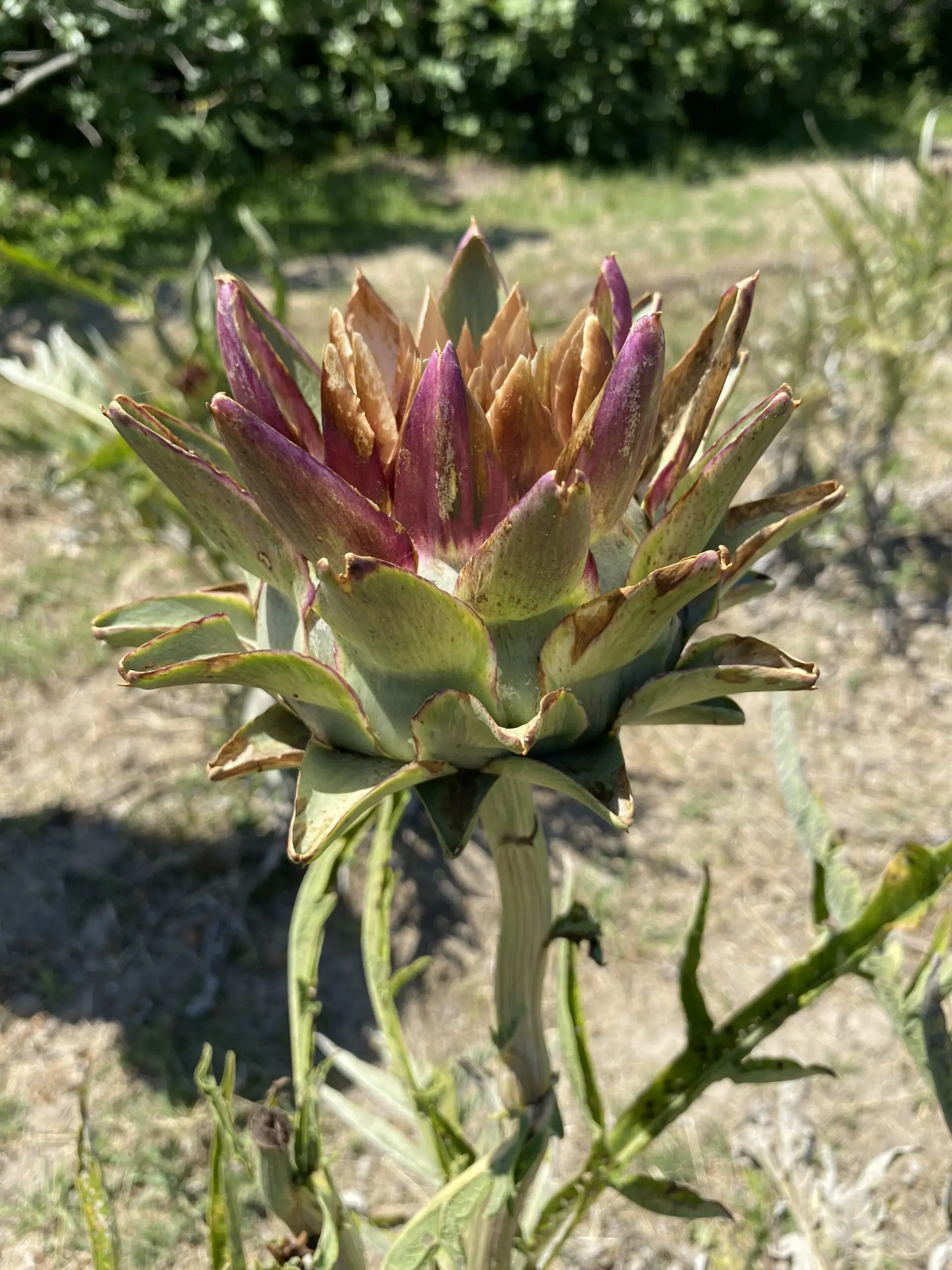
Sant’Erasmo’s best-known agricultural emblem is the violet artichoke. Its association with the island is well established, and the prized early buds known as castraure are strongly linked to spring. They are often described as a distinctive local delicacy, with a short period of availability that attracts interest from cooks and food lovers.
October travelers should know this before setting out. A photograph taken in May may show beautiful artichoke fields, but it is not documentary evidence of an October harvest. A restaurant may serve preserved preparations or other artichokes at different times of year, yet that does not make fresh castraure an autumn crop.
This distinction also helps explain why seasonal tourism can be misleading. Visitors read that Sant’Erasmo is famous for artichokes and imagine they will see them at any time. The island’s agricultural identity persists year-round, but individual products do not. October is a chance to look beyond the famous ingredient and appreciate the agricultural cycle that supports the island.
The real featured photograph accompanying this article was taken in May, not October. It accurately depicts Sant’Erasmo’s cultivated land and artichoke plantations, but it must not be mistaken for a photograph of the October 2026 harvest. That disclosure matters, especially in a story about seasonality.
If your principal goal is to see the first artichokes being harvested, plan around the appropriate spring season and verify timing with a local producer. If your goal is to understand the quieter agricultural landscape of the lagoon, October can be rewarding on its own terms.
Why water management is part of farming
The first thing many visitors notice on Sant’Erasmo is how close the fields are to the water. That proximity shapes agriculture in ways that are easy to miss if you only look at the crops. Drainage channels and ditches are not decorative elements. They are part of the system that helps growers manage water in low-lying terrain.
Scientific research on small farmers in the Venetian Lagoon has documented the importance of water and drainage infrastructure on Sant’Erasmo and nearby Vignole. Fieldwork involving local farms describes a landscape where ditches, canals, and agricultural practices interact. This is a more useful starting point than the simplistic claim that lagoon soil is either magically fertile or hopelessly salty.
Salt exposure, groundwater, rainfall, drainage, and soil management can all matter, but their effects vary by location and conditions. It would be inaccurate to suggest that every field has identical soil or that every grower uses the same technique. Some details are best understood through the experience of the people actually cultivating the land.
For visitors, the visible evidence is modest but revealing. Notice how the fields are organized in relation to channels and tracks. Consider where water goes after heavy rain. Observe the distance between cultivated plots and the surrounding lagoon. These are questions that turn a quiet landscape into a working system.
The practical lesson extends beyond agriculture. Venice’s relationship with water is not only about gondolas, tides, and spectacular views. On the lagoon islands, water also affects the ordinary work of producing food. Understanding that relationship changes how you see the entire region.
Soil, salt, and the temptation of simple explanations
It is common to hear that vegetables grown near the lagoon taste distinctive because of the soil and salty air. Local identity and growing conditions certainly matter, but food quality is not explained by one romantic phrase. Variety, cultivation, freshness, weather, handling, and cooking all contribute to what reaches the table.
Sant’Erasmo’s agricultural land is not one uniform substance. Soil conditions and drainage can vary across plots, and farmers adapt their practices accordingly. Research on lagoon agriculture emphasizes adaptation rather than a single universal method. That is why sweeping statements about “the secret mineral soil” should be treated cautiously unless supported by specific evidence.
For a visitor, it is more interesting to think about the choices that make farming possible. How is a field prepared? How does a grower respond after prolonged rain? What happens when conditions make a crop less reliable? These questions acknowledge skill and labor, not just geography.
October provides a particularly useful moment for such observations because the season is changing. A field that looked productive in summer may be at another stage of its cycle. The same landscape can be a place of harvesting, maintenance, or preparation. Agricultural time is not organized around the visitor’s arrival.
If you are lucky enough to speak with a farmer who has agreed to a visit, ask about their own experience rather than assuming you already know the answer. A specific explanation from a producer is more valuable than an invented anecdote about what every family on the island supposedly does.
A rural landscape inside a maritime city
The contrast between Sant’Erasmo and central Venice is one of the lagoon’s most striking experiences. The historic center is a compact urban environment, built around canals, bridges, and dense blocks. Sant’Erasmo offers long lines of sight, fields, and a slower visual rhythm. Both belong to Venice.
That contrast has cultural significance. Visitors often imagine Venice as an isolated city of stone, disconnected from land. In reality, the Republic and the modern city depended on surrounding territories and networks of production. Food arrived from the mainland and the lagoon, and maritime transport connected different parts of daily life.
Sant’Erasmo is a reminder that the lagoon is not empty water between tourist islands. It contains inhabited places, ecological habitats, agricultural land, transport routes, and historic structures. Each has its own relationship with the wider city.
The quietness of the island should not be confused with a lack of activity. Work may happen out of sight or at times when visitors are not present. A road that looks deserted in the afternoon may have been used for deliveries or farm work earlier in the day. An apparently empty field may represent a planned stage of cultivation.
A respectful visit makes room for these realities. You do not need to find a staged harvest or an open farm shop to understand the island. The landscape itself can tell a story, provided you look carefully and avoid claiming more than you can verify.
October light and the appearance of the fields
October changes the visual character of Sant’Erasmo. As the sun follows a lower path through the sky, shadows lengthen and the light can emphasize the texture of cultivated land. Clouds may soften the contrast between fields and buildings, while clear afternoons can give the landscape a warmer appearance.
The effect is not guaranteed. October can be bright, gray, windy, or wet. It is better to plan for changeable conditions than to promise a particular golden-hour scene. A low horizon makes weather especially visible, and an exposed stretch of road can feel colder than the same temperature would in a sheltered Venetian street.
For photography, the island rewards a different approach from central Venice. Instead of looking for famous palaces, consider patterns: rows of cultivation, a ditch beside a field, a narrow road, a distant boat, or the boundary between land and water. These details show how the place functions.
Avoid entering fields for a better composition. Use public roads and paths, and be careful not to block vehicles or agricultural access. Drone use is subject to applicable aviation and local restrictions; do not assume that a rural-looking island is unrestricted airspace.
A photograph that includes the ordinary infrastructure of farming may be more honest and more interesting than one that removes every practical detail to create a timeless fantasy. Sant’Erasmo is beautiful precisely because it is a real working landscape.
From island fields to Venetian kitchens
The link between agriculture and cuisine is central to Sant’Erasmo’s identity, but it is easy to oversimplify. Not every vegetable served in Venice comes from the island, and not every seasonal dish can be traced to a particular farm. Restaurants buy through different suppliers, and produce may come from the lagoon, the wider Veneto, or elsewhere.
What Sant’Erasmo represents is the possibility of a close relationship between growers and the urban table. Its agricultural history reminds us that Venetian cuisine is not only seafood. Vegetables, legumes, grains, and seasonal ingredients belong to the region’s food culture as well.
In October, menus may feature pumpkin, mushrooms, leafy vegetables, beans, polenta, and other comforting preparations. These foods reflect the broader Veneto season, but their presence on a menu does not prove Sant’Erasmo origin. If provenance matters to you, ask the restaurant directly and accept that staff may not always have precise farm-level information.
That distinction protects both stories from duplication. One is about eating in Venice; the other is about understanding an island that helps explain why seasonality matters in the first place.
What a market can and cannot reveal
A visit to a Venetian produce market can be a useful complement to Sant’Erasmo, but it should not be treated as a transparent map of the island’s farms. Stalls may carry goods from many places. Labels, suppliers, and availability vary, and not every item on display is locally grown.
The most useful approach is to ask specific questions politely. Where did these vegetables come from? Are they from the lagoon or the mainland? What is particularly good today? Vendors are working, often under time pressure, so keep questions concise and be ready to buy if you are genuinely interested.
It is also worth distinguishing the experience of a market from that of a farm. A market shows produce after harvesting, sorting, and transport. For a close look at the city end of that relationship, read our account of Rialto Market before sunrise. The island shows the landscape and infrastructure behind production. Together they offer a fuller understanding, but neither can replace a conversation with a grower about agricultural practice.
For a separate practical guide, see our article on Venice’s local food markets beyond souvenir shopping. It provides market-focused context rather than repeating the island’s agricultural story.
Do not assume that a particular market will have Sant’Erasmo produce on a particular October morning. The supply depends on season, producers, and distribution. Honest uncertainty is part of shopping seasonally.
The work visitors rarely see
A photograph of a field records a place, but not the full labor behind it. Farming includes decisions and tasks that are difficult to capture in a travel image: planning crops, checking soil, maintaining drainage, repairing equipment, managing weather risk, arranging transport, and finding buyers.
On a lagoon island, logistics add another layer. Materials and produce must move within a geography shaped by water and limited connections. That does not mean every farm uses the same transport arrangements. It means that moving goods is part of the economic reality, not a detail to be edited out of the story.
Tourists sometimes look for the moment of harvest as if it were the only authentic agricultural activity. Yet preparation and maintenance can be just as revealing. A cleared ditch or newly worked plot may tell you more about the season than a carefully arranged basket of vegetables.
There is also the question of economic sustainability. Small-scale farming can face pressure from labor costs, weather variability, market competition, and the challenge of maintaining a viable business. It would be inappropriate to claim specific losses or trends for individual Sant’Erasmo farms without current evidence, but the broader pressures are worth acknowledging.
The island’s agricultural identity survives through the choices of people who work there. Respect for that work begins with not treating it as free entertainment.
The lagoon’s wider agricultural geography
Sant’Erasmo is the best-known garden island, but it is not the only place where the lagoon’s relationship with cultivation can be explored. Vignole has an agricultural history, while Mazzorbo is associated with a different combination of settlement, vineyards, and lagoon landscape. These places should not be treated as interchangeable.
Each island has its own access arrangements, resident community, and physical character. A traveler interested in agriculture may enjoy comparing them, but doing so requires realistic planning. Public transport connections are not always designed around a visitor’s wish to visit several islands quickly.
The wider Veneto is also essential to understanding Venice’s food. Mainland farms supply a vast range of produce, and regional cooking draws on ingredients that do not originate on the lagoon islands. Acknowledging this does not diminish Sant’Erasmo; it places it in a more accurate network.
For travelers considering a broader lagoon day, our guide to Murano, Mazzorbo, and Burano</a explains how neighboring island experiences differ. Sant'Erasmo deserves its own time rather than being squeezed into an itinerary designed for glass workshops and brightly colored houses.
A meaningful agricultural visit is not about covering the maximum number of islands. It is about understanding one place well enough to recognize its distinct role.
How to reach Sant’Erasmo in October
Sant’Erasmo is served by ACTV’s line 13, commonly accessed from the Fondamente Nove area in Venice. Stops on the island and service patterns should be checked against the operator’s current timetable. Do not rely on an old screenshot or assume that departures are frequent enough for a spontaneous short visit.
Allow time for the journey and for the walk between the landing and the area you want to explore. The island is long and relatively spread out. A destination that looks close on a map may require more walking than expected. There are no continuous arcades or dense clusters of cafés like those in central Venice.
Check the return journey before you set out. This is particularly important in October, when daylight hours shorten and weather can change. If your schedule is tight, an island visit may not be the best use of a spare hour. Plan a generous half-day rather than a rushed detour.
Tickets, validation procedures, accessibility conditions, and service changes should be verified through official ACTV information. Wind or other operational issues can affect travel. A private boat may offer more flexibility in some circumstances, but it remains subject to weather, navigation rules, and safe boarding conditions.
A practical detail that travelers often underestimate is the distance between transport and experience. Reaching Sant’Erasmo is only the beginning; appreciating the agricultural landscape takes time on foot.
Walking respectfully beside the fields
The island’s appeal lies in its open landscape, but that does not make all land publicly accessible. Stay on public roads and authorized paths. Do not enter fields, open gates, climb fences, or collect vegetables. Agricultural land is private property and a workplace.
Footwear matters. After rain, paths and roadside surfaces can be wet or muddy, and the island is more exposed than many parts of the historic center. Wear shoes with reliable grip and clothing suited to wind. In cool weather, a waterproof outer layer is more useful than an elaborate outfit chosen for photographs.
Bring water and any essentials you need. Services may be limited or have seasonal opening hours, and you should not assume that a café, restaurant, or shop will be open exactly when you arrive. Public restrooms and accessible facilities should also be checked in advance if they are important to your group.
If you encounter farm machinery or vehicles, give them space. Avoid stopping in the middle of a road to photograph a field. If you see workers, a friendly greeting is appropriate, but do not interrupt their work or photograph them closely without consent.
The goal is to be a considerate visitor to a lived-in island. The most memorable part of the trip may be the quiet view across a field, not an organized activity.
What October visitors should not expect
Sant’Erasmo is not a guaranteed harvest festival, and it is not an open-air museum of agriculture. You should not expect every farm to welcome visitors, every crop to be visible, or every field to be in production at the same time.
Do not expect spring artichoke harvesting in October. Do not assume that an image of ripe vegetables proves they were photographed on the island that month. Do not plan around an unverified tasting or farm visit. If an experience matters to your trip, arrange it in advance and confirm what is actually included.
The island also does not offer the dense concentration of tourist services found on Murano or Burano. This is part of its appeal, but it means that visitors need to plan transport, food, and walking time more carefully.
Weather can change the experience. Wind across open fields may feel stronger than expected, and rain can make a long walk unpleasant. Check the forecast and avoid visiting during severe-weather warnings. If conditions are poor, postpone rather than treating a difficult journey as proof of adventurous travel.
Perhaps most importantly, do not expect Sant’Erasmo to provide a theatrical version of rural Venice. Its value is precisely that agriculture continues as ordinary work, not as a performance staged for visitors.
A realistic half-day plan
Start by checking the ACTV line 13 timetable and selecting a return departure that leaves you enough time to explore without rushing. Depart from Venice with appropriate clothing, comfortable shoes, and a clear idea of which part of the island you want to see.
On arrival, spend the first part of your visit simply observing the landscape. Notice the scale of the fields, the roads, the water channels, and the relationship between cultivated land and the lagoon. Avoid trying to identify every crop from a distance; instead, look for evidence of how land is organized and maintained.
If you have arranged a farm visit with a producer, follow the agreed time and instructions. If you have not, keep your exploration to public areas. A spontaneous visit should be treated as a landscape walk, not as an invitation to enter working property.
Allow time to stop and photograph the scenery without blocking roads. Then return toward your chosen landing well before the scheduled boat. Island travel is more comfortable when you have a margin for delays and changing conditions.
Back in Venice, you might complete the experience with a seasonal meal or a visit to a food market on a separate day. That connection between landscape and table is the point of the excursion, but it should be made thoughtfully rather than by assuming that every vegetable served in town came from Sant’Erasmo.
The Festa del Mosto and the importance of checking dates
Sant’Erasmo is associated with the Festa del Mosto, a local celebration traditionally linked to the grape must season in autumn. It is part of the island’s cultural calendar, but visitors should not assume a specific date, program, or public access arrangement without checking current local announcements.
A festival can be an enjoyable way to encounter community traditions, yet it offers a different experience from a quiet agricultural walk. Events bring visitors and activity, while an ordinary weekday may be much calmer. Neither is more authentic; they simply reveal different aspects of island life.
If you are planning around the festival, confirm the 2026 schedule with reliable local organizers and transport providers. Check whether any activities require booking and whether the event is affected by weather. Avoid relying on dates from previous years, which may be repeated online long after they have become outdated.
The festival’s connection to grape must also reminds us that harvest is not synonymous with vegetables alone. The wider Venetian and Veneto landscape includes traditions linked to vineyards and seasonal food preparation. But do not infer from a festival’s name that every field on Sant’Erasmo is a vineyard.
For travelers interested in culture, the best approach is to combine curiosity with verification. A local event is meaningful because it belongs to a community, not because it fills a gap in a tourist itinerary.
A note on food provenance and honest storytelling
Travel writing often turns agricultural landscapes into tidy stories: the farmer harvests a vegetable at dawn, a boat carries it to Rialto, and a chef serves it at lunch. Such a sequence is possible in principle, but it should not be presented as a documented daily routine without evidence.
Real supply chains vary. Some growers may sell directly; others use different buyers or distribution arrangements. Restaurants may source from multiple producers. Weather, availability, pricing, and transport all affect what happens. A specific claim about a particular farm or restaurant should be checked with the people involved.
The same standard applies to photography. A real image from Sant’Erasmo is preferable to an invented scene, but its date and subject must be accurately described. This article’s featured photograph is a real view of artichoke plantations taken in May 2015. It documents the island’s agricultural landscape, not an October harvest. That is why the caption makes the distinction explicit.
For travelers, provenance is an invitation to ask better questions. Rather than demanding a romantic farm-to-table story, ask what is seasonal, where a product came from, and how it was prepared. A clear, modest answer is more valuable than a dramatic but unverifiable narrative.
This approach is also more respectful to growers. Their work is complex enough without having to fit a travel writer’s expectations.
Why a quiet agricultural island matters to Venice
The future of Venice is often discussed in terms of visitor numbers, housing, high water, and the survival of traditional trades. Agriculture belongs in that conversation too. Sant’Erasmo reminds us that the lagoon contains productive land and people whose livelihoods are connected to the city’s wider economy and identity.
An agricultural landscape is maintained through ongoing decisions. Fields do not remain cultivated simply because a destination brochure calls the island the Garden of Venice. Someone must invest time, labor, and resources in keeping them productive. The same is true of ditches, access routes, and the relationships that allow produce to reach buyers.
This is not a claim that every field is thriving or that every farm faces the same difficulties. It is an argument for seeing agriculture as part of contemporary Venetian life, rather than a picturesque remnant of the past.
Visitors can contribute modestly by behaving respectfully, using legitimate local services, and choosing experiences that compensate the people involved. But tourism is not a substitute for agricultural policy or a solution to every economic challenge. A thoughtful visitor should recognize the limits of their role.
The lasting value of Sant’Erasmo is that it complicates the familiar image of Venice. The city is not only palaces and canals. It is also fields, soil, water management, work, and food.
Final thoughts: the autumn island worth understanding
October on Sant’Erasmo is not about finding a secret harvest that other tourists have missed. It is about noticing the agricultural calendar after the celebrated spring artichokes, when the island’s fields continue through their varied cycles of production, preparation, and rest.
The low horizon, drainage channels, roads, cultivated plots, and surrounding lagoon reveal a landscape shaped by work. A visit can be rewarding without entering a farm or witnessing a harvest. The key is to approach the island with realistic expectations and respect for the people who live and work there.
If you want a broad introduction to Sant’Erasmo, begin with the existing garden-island guide. If you want to understand October, pay attention to what changes with the season and what remains constant: the need to manage water, care for land, and connect the lagoon to Venice’s food culture.
Leave enough time for the journey. Check transport and weather. Ask permission before entering private spaces. And remember that the quietest landscape in the lagoon may also be one of its hardest-working.
Frequently Asked Questions
What is harvested on Sant’Erasmo in October?
October work varies by farm, crop and weather, and may include harvesting, planting and preparing fields. Do not expect the famous castraure artichokes: their prized first harvest belongs to spring. Ask individual growers about current seasonal produce.
Can tourists visit farms on Sant’Erasmo in October?
You can explore public roads and authorized paths, but farms are private workplaces. Arrange a visit or tasting directly with a producer in advance and do not enter fields or pick vegetables without permission.
How do I get to Sant’Erasmo from Venice in October?
ACTV line 13 serves Sant’Erasmo from the Fondamente Nove area. Check the current timetable, island stops and return services before traveling. Allow several hours, as fields and points of interest are spread out and weather can change.
Featured photograph: an authentic violet artichoke from Sant’Erasmo, photographed June 28, 2021 by Antonella Dalle Zotte, via Wikimedia Commons, licensed under CC BY-SA 4.0. The image shows the island’s signature crop, not an October harvest.