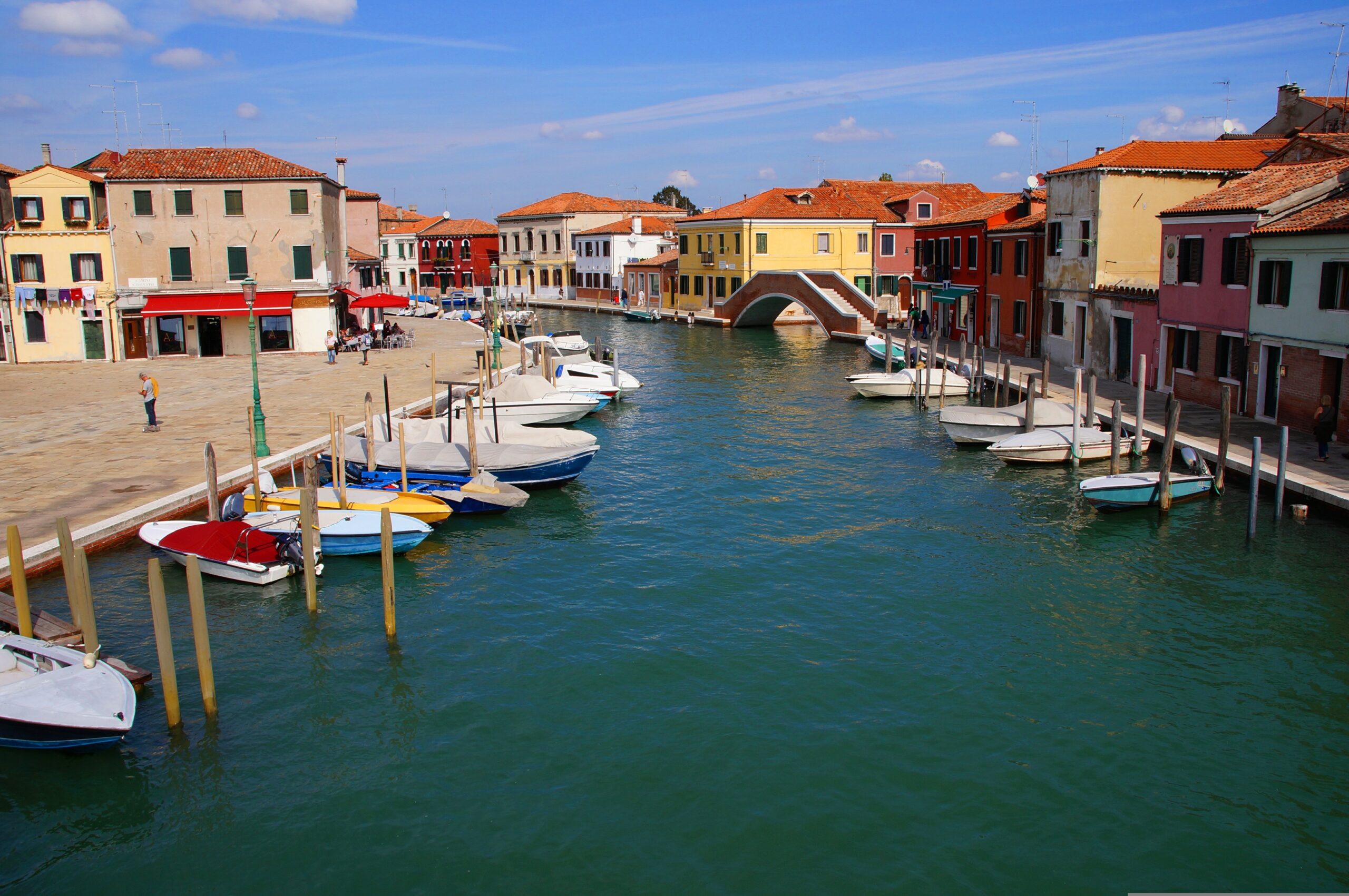
Most visitors think the UNESCO listing means Venice, the historic center, full stop. It doesn’t. When UNESCO inscribed “Venice and its Lagoon” as a World Heritage Site in 1987, it protected an entire living ecosystem, the city, yes, but also the barrier islands, the salt marshes, and every inhabited island scattered across roughly 550 square kilometers of shallow water, including three places most first-time visitors barely know exist by name: Murano, Mazzorbo, and Burano. I send more repeat guests back to these three islands than to almost anywhere else in the lagoon, and it’s rarely because of a single monument. It’s because together they show a side of Venice, quieter, more working-class, more genuinely lived-in, that the historic center simply can’t offer anymore.
Why the Lagoon Is Part of the UNESCO Listing at All
It’s worth understanding why UNESCO protected the water, not just the buildings. Venice only exists because of a thousand years of careful, constant engineering: diverted rivers, dredged channels, and managed tides that keep the lagoon from either silting into solid land or eroding into open sea. The inhabited islands beyond the city center, Murano, Burano, Torcello, Mazzorbo, and several smaller ones, developed their own distinct identities within that same fragile system, each shaped by a different relationship to the water: Murano built around industry, Burano around fishing, Mazzorbo around agriculture. Seeing all three in a single day isn’t just efficient sightseeing; it’s genuinely the clearest way to understand what “Venice and its Lagoon” actually means as a UNESCO site, rather than treating the phrase as a formality attached to the city center alone.
Murano: The Island Built on Fire
Murano sits just over a mile north of Venice, and it’s been the center of European glassmaking for more than seven hundred years, ever since the Venetian Republic ordered every glass furnace relocated there in 1291, officially to reduce fire risk in a city built almost entirely of wood. What most visitors don’t expect is how genuinely functional the island still feels: wider canals than central Venice, quieter streets, and everyday life continuing alongside working furnaces rather than existing purely for tourists.
The real value of Murano isn’t a quick photo of a glass shop window; it’s watching the actual process. A furnace demonstration, glass pulled molten from a 1,000-degree flame, shaped in seconds by a master who’s usually been doing this since adolescence, is one of the few genuinely unscripted craft experiences left in the entire lagoon. I always tell guests: if a shop won’t show you exactly where a piece was made, walk somewhere else.
See it firsthand: Murano Workshop and Visit – Discover the Art of Glassblowing puts you directly in front of a working furnace with a private boat ride included.
Mazzorbo: The Island Almost No One Crosses Into
Here’s a detail that surprises most guests: Mazzorbo sits directly connected to Burano by a small wooden footbridge, a three-minute walk, and yet the overwhelming majority of Burano’s visitors never cross it. They photograph the bridge from Burano’s side and turn back. That’s a genuine shame, because Mazzorbo is arguably the most authentic, least-touched island left in the entire northern lagoon.
Home to perhaps 300 permanent residents today, Mazzorbo feels like rural Venice rather than tourist Venice: vineyards, vegetable gardens supplying Venice’s own markets, quiet footpaths, and the nearly 800-year-old Church of Santa Caterina, one of the oldest surviving churches in the entire lagoon. Its most famous resident, in a sense, is the Venissa vineyard, which has spent years reviving Dorona, an ancient Venetian grape variety that had nearly disappeared, grown on vines that literally sit behind tidal walls to survive the lagoon’s periodic flooding. No souvenir stalls, no rush, just the sound of church bells and water. If Burano is Venice at its most photogenic, Mazzorbo is Venice at its most honest.
Read more: Mazzorbo: Venice’s Quiet Neighbor and the Church That Time Forgot covers the island’s history and the Venissa vineyard in full.
Burano: Color, Craft, and a Story Behind Every House
Burano is the island most people already recognize from photographs, even if they don’t know its name: canals lined with houses painted in impossibly bright raspberry, pistachio, lemon, and sky-blue. The popular explanation, that fishermen painted their homes in bold colors so they could spot their way home through lagoon fog, has real historical grounding, and today the specific palette is genuinely regulated; residents need permission to repaint, and must choose from an approved color list, which is part of why the effect still looks so intentional rather than accidental.
Burano’s other defining tradition is lace. For centuries, Burano lace has been made entirely by hand, a slow, exacting needlework craft passed down through generations of women on the island, and it remains one of the most significant surviving handicraft traditions anywhere in the Veneto. A small Lace Museum in Piazza Galuppi walks through the technique and its history, and legitimate artisan studios around the island still work in full view, an increasingly rare thing given how much “Burano lace” sold near the vaporetto stop is actually machine-made elsewhere. Look up while you’re there, too: the Campanile di San Martino leans at a genuinely dramatic angle, Burano’s own quieter answer to Pisa, and it houses a rare Tiepolo painting inside.
The honest trade-off with Burano is timing. It’s small, and by midday in high season it can feel considerably more crowded than its size can comfortably absorb. Early morning or late afternoon completely changes the experience, quieter canals, better light for photos, and enough breathing room to actually watch a lace artisan work rather than squeezing past a tour group.
Read more: Burano and Torcello: The Full Lagoon Experience covers both islands in depth, and if you’re trying to decide how to prioritize your time, Murano, Burano, or Mazzorbo? Which Island Is Right for You breaks down what each island actually offers, honestly, without hype.
Getting There: Public Vaporetto vs. a Private Guide
You can absolutely visit all three islands independently. Vaporetto Line 12 runs from Fondamente Nove, on Venice’s northern edge, out to Murano, then Mazzorbo, then Burano, and on to Torcello, roughly 45 minutes to reach Burano at the far end. It’s inexpensive and genuinely functional, provided you’re comfortable navigating schedules and standing-room crowds during peak hours.
Where a private guide changes the day is in the details a public ferry timetable can’t offer: timing your Murano furnace visit around the specific demonstration schedule rather than the boat schedule, reaching Burano in that early-morning or late-afternoon window when it’s actually calm, and, most importantly, making sure Mazzorbo doesn’t get skipped entirely, which is exactly what happens to most independent travelers running against the clock. A guide also means a private boat rather than a public vaporetto, which lets you glide through quieter channels between islands instead of the more congested main route, and gives you a working narrative connecting all three islands into a single, coherent story rather than three disconnected stops.
The full lagoon in one day: Venice Tour of the Lagoon – Discover the Hidden Gems covers Murano, Burano, and Mazzorbo with a local guide and private boat throughout.
Want more time and Torcello too? Unforgettable 6-Hour Island-Hopping Excursion extends the day to include Torcello, the lagoon’s oldest and quietest island, alongside Murano and Burano.
Planning Your Visit
My honest advice, the same thing I tell every guest booking a lagoon day: don’t try to see all four major islands, Murano, Mazzorbo, Burano, and Torcello, in a rushed half-day. Three meaningful stops with real time to actually look around consistently beats four rushed ones. If you only have a few hours, prioritize Murano for craft and history, and Burano paired with Mazzorbo for color and calm in the same visit, since they sit a three-minute walk apart and offer such a genuine contrast in mood. Go early if you can; the lagoon’s light is best in the first hours after sunrise, before the day’s crowds and boat traffic build, and it’s the same light that makes Mazzorbo’s vineyards and Burano’s canals look the way they do in every photo that convinced you to come here in the first place.
Frequently Asked Questions
Can I visit Murano, Mazzorbo, and Burano in one day?
Yes, and it’s the most common way guests experience the northern lagoon. A full day, by public vaporetto or private boat, comfortably covers all three, with time left over for Torcello if you extend to a longer excursion.
Why do so few visitors go to Mazzorbo if it’s right next to Burano?
Mostly because it’s easy to miss. Most Burano visitors photograph the wooden footbridge to Mazzorbo without crossing it, assuming an island this accessible and close to the crowds can’t be worth a special stop, when in fact its quiet, rural character is exactly what makes it worth the three-minute walk.
Is it better to visit the lagoon islands by public vaporetto or with a private guide?
Both work. The public vaporetto (Line 12 from Fondamente Nove) is affordable and reliable for independent travelers comfortable with schedules and crowds. A private guide adds a coordinated route, better timing around each island’s quiet hours, a private boat instead of a public ferry, and someone to make sure Mazzorbo doesn’t get skipped, along with the historical context connecting all three islands into one story.