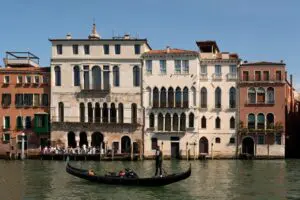
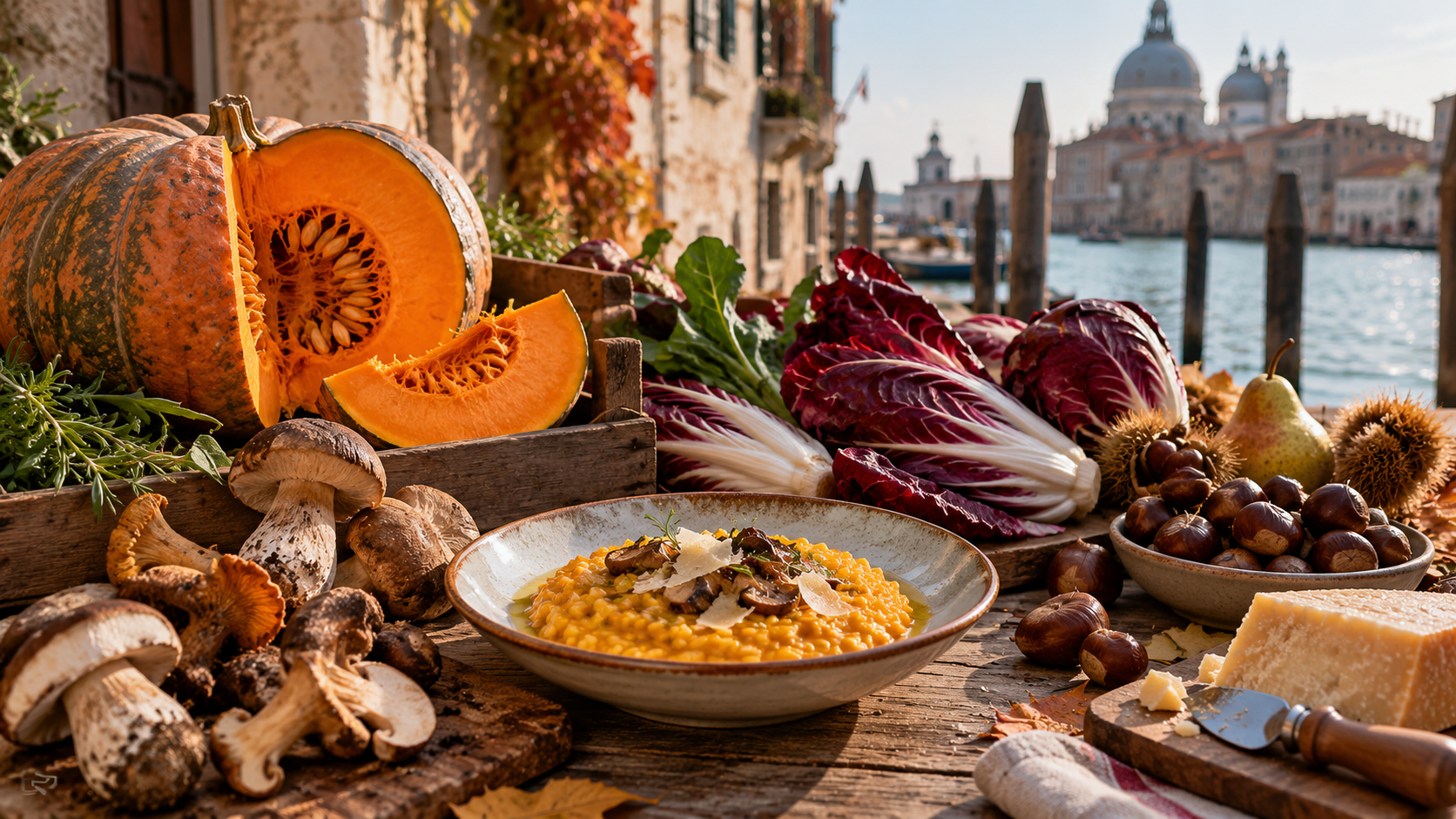
October in Venice tastes different from summer. The days shorten, restaurant tables move indoors when the weather turns, and the food begins to reflect a landscape that reaches far beyond the city’s canals. Pumpkins, mushrooms, chestnuts, beans, apples, pears, and the first autumn greens appear alongside the fish and shellfish of the northern Adriatic. On a good menu, you can sense the season without seeing the word “autumn” printed anywhere.
For visitors wondering what Venetians eat in October, the answer is not one famous dish. It is a way of choosing: what looks good at the market, what the weather invites you to eat, what a cook has received that morning, and which recipes make sense at this moment of the year. Expect warming risottos, carefully prepared seafood, polenta, vegetables from the Veneto mainland and lagoon islands, and modest desserts that suit a cool afternoon. You can still order the Venetian classics, of course. But the most interesting meal often begins with asking what is seasonal today.
This guide is specifically about Venetian autumn food in October, rather than an all-season list of traditional dishes. It explains what to look for, what not to assume, and how to plan a memorable food day in Venice without relying on invented “local secrets” or fixed restaurant recommendations that may quickly become outdated.
October is a transition, not a single menu
It is tempting to imagine Venice switching from summer to winter on October 1. Real kitchens do not work that way. Early October can still feel surprisingly mild. Some late-summer vegetables may linger; on other days a damp breeze makes a bowl of soup sound much more attractive than a plate of chilled seafood. The precise rhythm changes with rainfall, temperatures, fishing conditions, harvest timing, and what suppliers can deliver.
That variability is the first useful thing to understand about seasonal eating here. A restaurant that changes a few dishes regularly may be responding more honestly to the season than one offering a long, permanent menu decorated with pictures of every famous Venetian specialty. A short list does not automatically guarantee quality, but it gives a kitchen room to respond to ingredients rather than force ingredients into a predetermined list.
Venice also has more than one food geography. The historic center has its fishmongers, neighborhood shops, restaurants, and bacari. The lagoon has fishing traditions and agricultural islands. The mainland contributes produce from the wider Veneto, including fields, orchards, and the hills farther north. Food that Venetians consider local need not have grown within sight of St. Mark’s Campanile. Understanding those connections makes the city more interesting—and your choices at lunch more informed.
Start at Rialto, but look rather than hunt for a checklist
Rialto is an obvious place to begin because the market brings Venice’s food story into focus. The fruit and vegetable stalls can show the overlap between the last warm-weather harvests and the arrival of cooler-season produce. Depending on the week, look for different varieties of squash, mushrooms, grapes, pears, apples, and leafy greens. At the fish market, the display reflects fishing seasons, weather, supply chains, and the day’s catch rather than a tourist’s expectation of what “Venetian seafood” ought to look like.
Do not arrive expecting every ingredient named in this article to be on display. Market availability is not a guarantee, and a photograph taken one October does not establish what will be available the next. The value of the visit is learning to notice changes. Which vegetables dominate the stalls? Are mushrooms abundant or scarce? What fish are being sold whole? Which products are labeled with a place of origin? A market visit becomes more rewarding when it starts with observation rather than a shopping list copied from a travel blog.
Timing matters, too. Food markets are working places. Some vendors may be setting up while others are already serving residents, and activity varies by day. The famous Rialto fish market is generally not a Sunday or Monday shopping destination; always confirm current operating arrangements before planning around it. If you want to understand the working rhythm rather than simply photograph a display, our separate account of the Rialto Market before sunrise explores the market’s early hours and the people behind them.
One practical courtesy is easily overlooked: never handle delicate produce or fish without the vendor’s invitation. Point, ask, and let the person behind the stall choose and weigh it. If you do not speak Italian, a friendly greeting and a simple question go a long way. “Che cosa è di stagione?” means “What is in season?” You may receive an answer that is more useful than anything printed on a restaurant menu.
Pumpkin: the quiet star of the Venetian autumn table
October is a wonderful month to notice pumpkin and winter squash. In Italian, zucca covers a family of varieties with different textures and sweetness. Some are dense and intensely colored; others are softer or more watery. A cook’s choice matters. The best result depends on matching the variety to the recipe rather than treating every orange squash as interchangeable.
You might encounter pumpkin in a risotto, a soup, a baked vegetable dish, or a filling. The sweetness works especially well when balanced with savory ingredients: a little aged cheese, onion, herbs, or the deep flavor of a carefully prepared broth. In a good pumpkin risotto, the rice should still have texture. It should not resemble a bowl of purée with grains floating inside. The pumpkin gives body and warmth without erasing the character of the rice.
Visitors sometimes expect pumpkin ravioli everywhere in northern Italy during autumn. Filled pasta with squash is associated with several regional traditions, particularly beyond Venice. You may find it here, but it is not necessary to call every pumpkin pasta dish an ancient Venetian specialty. That distinction matters: Venice has always absorbed ingredients and ideas from its neighbors, and the most honest menus acknowledge the wider culinary landscape rather than inventing a lagoon origin for everything.
If you see crema di zucca, ask whether it is a soup and what accompanies it. Some versions are simple, with olive oil and a restrained garnish. Others include croutons, cheese, or contrasting vegetables. On a damp October evening, a carefully made bowl can be more satisfying than an elaborate dish ordered simply because it is famous.
Mushrooms: earthy flavors after the first autumn rains
Autumn mushrooms bring a different register to the Venetian table: earthiness, aroma, and a sense of the wooded mainland beyond the lagoon. Porcini are the best-known example, but availability and price can vary significantly. Wild mushrooms are not automatically local, and not every mushroom offered in October was picked nearby that morning. If origin matters to you, ask.
One of the most appealing ways to eat mushrooms is with risotto. A properly cooked risotto takes attention. The grains should remain distinct, the texture should be fluid rather than stiff, and the mushroom flavor should come through without excessive cream. A mushroom sauce over polenta is another satisfying combination, especially when the polenta is served warm and soft.
There is also a lesson in restraint. An enormous menu offering porcini in every conceivable preparation throughout the year may rely on frozen or dried supplies. That is not necessarily a culinary crime: dried porcini can be excellent and are used deliberately for their concentrated aroma. The important thing is transparency. “Seasonal” should describe the ingredient’s real context, not merely decorate a menu.
For a traveler, mushrooms are a reason to look at the daily specials. If the server mentions a mushroom risotto that was not printed on the menu, ask about it. If there is no mushroom dish that day, do not force the issue. October eating is about responding to what is good, not proving that you consumed every item on an autumn checklist.
Radicchio: understand the calendar before ordering
Radicchio is one of the Veneto’s most recognizable vegetables, but it deserves a little nuance. The region grows several types, with different shapes, colors, bitterness, and growing calendars. The celebrated late-season red radicchio of Treviso is not simply an early-October crop waiting in every field. Its distinctive production process and winter association mean that an October menu should not automatically promise the famous late variety at its peak.
Earlier radicchio varieties and other chicories can be available in autumn. They can be grilled, dressed with olive oil, folded into risotto, or served alongside richer dishes. Bitterness is part of their appeal. Rather than masking it with heavy sauces, good cooks use fat, acidity, and gentle cooking to create balance. A plate of grilled radicchio may seem austere until you taste how its sharpness cuts through a rich main course.
When a restaurant advertises “Treviso radicchio” in early October, it is worth asking which variety is being used. That is not an accusation; it is a useful conversation. Different varieties are suitable at different times, and the origin of a vegetable is more meaningful than a fashionable name on the menu.
This is a good example of why precise seasonal writing matters. Telling readers that every October restaurant serves peak late Treviso radicchio would be easy—and misleading. A more reliable rule is to ask what variety is fresh now and how the kitchen prepares it.
Polenta: the comfort food that belongs to the region
Polenta is one of the great anchors of northern Italian cooking, including the Veneto. It can be creamy and spoonable, firm enough to slice, or grilled to develop a crisp surface. Its value is not glamour. It provides a comforting foundation for flavors that might otherwise be too salty, intense, or rich on their own.
In Venice, polenta often appears alongside fish, seafood preparations, or meat. The pairing of creamy polenta with a savory sauce can feel especially appropriate as evenings cool. The cornmeal itself may vary in color and texture; white polenta has a particular place in Venetian food culture, though yellow versions are common too.
It is useful to distinguish a thoughtfully cooked polenta from a generic side dish. A good version tastes of corn, has a pleasant texture, and supports the main ingredient. A poor one can be bland or rubbery. If a restaurant serves a traditional preparation with polenta, notice whether the two parts of the dish actually belong together.
Visitors who are unfamiliar with polenta sometimes assume it is a substitute for pasta. It is better understood on its own terms. It is a staple with a long regional history, adaptable enough for humble everyday meals and carefully composed restaurant dishes alike. In October, its warmth feels particularly welcome.
Fish and seafood: seasonal does not mean predictable
Venice’s relationship with fish is older and more complicated than the tourist image of a seafood platter beside a canal. The city is connected to the lagoon, the northern Adriatic, fish markets, working boats, and generations of cooks who learned to respect what was available. But today’s seafood supply is not confined to fish caught a few minutes from the restaurant. Modern distribution means that origin, sustainability, freshness, and seasonality should be considered separately.
October can be an interesting month for fish dishes, yet it would be irresponsible to promise that a particular species will be landed on a particular day. Weather can limit fishing; regulations and biological cycles affect availability; restaurants may buy from several suppliers. If you care about eating local catch, ask which fish is fresh and where it comes from. A thoughtful restaurant should be able to explain at least the basics.
Look for preparations that allow the fish to remain recognizable. Grilled or baked fish with seasonal vegetables can reveal more about ingredient quality than a plate covered in a heavy sauce. A simple fish soup, when made carefully, offers another autumn-friendly choice. It may combine different species and aromatics, and its character can change from kitchen to kitchen.
Classic Venetian dishes remain worth trying in October even when they are not exclusively autumnal. Sarde in saor, for example, uses sardines with onions and a sweet-sour balance that reflects Venice’s culinary history. Baccalà mantecato is another familiar preparation, made from preserved fish rather than a same-day lagoon catch. Neither should be misrepresented as a special October harvest. They belong to the city’s broader food identity. For their background and preparation, see our guide to traditional Venetian dishes including sarde in saor and baccalà.
Some visitors are curious about lagoon delicacies with very specific seasonal windows. Soft-shell crabs, for instance, require careful distinctions between local species, molting cycles, and availability. Do not assume that a dish associated with spring is necessarily available in October, or that any soft-shell crab on a menu has come from the lagoon. Ask before ordering. Curiosity is a better guide than certainty.
Risotto in October: why the texture matters
Risotto deserves its own discussion because it is both one of the pleasures of northern Italian cooking and one of the dishes most easily misunderstood by travelers. The word describes a cooking method, not a single recipe. The rice is cooked gradually with liquid, releasing starch while retaining a gentle bite. When prepared well, it has movement on the plate. It should be creamy without depending on a pool of cream.
In October, risotto can become a stage for mushrooms, pumpkin, radicchio, or seafood. The ingredient should lead the choice. If a kitchen is offering a mushroom risotto because excellent mushrooms arrived, that is more convincing than a menu carrying twenty different risottos year-round. Some restaurants prepare risotto for a minimum of two people, because cooking it to order requires time and attention. Check before ordering, especially if one person in your party has dietary restrictions.
Ask whether the broth is vegetable, meat, or fish based if you are vegetarian or have allergies. A dish labeled with vegetables may still be prepared with meat stock. Cheese and butter are also common finishing ingredients. If you avoid dairy, request clarification rather than assuming a vegetable risotto is vegan.
Give the kitchen time. A well-made risotto is rarely the ideal order when you have ten minutes before a museum entry slot or train departure. In Venice, the practical side of eating well is inseparable from the culinary side. A leisurely lunch works best when you have actually allowed time for it.
Beans, soups, and the food of ordinary homes
Travel writing often concentrates on the most photogenic dishes. Yet an October meal can be built around ingredients that would look modest in a glossy restaurant photograph: beans, onions, seasonal vegetables, and broth. These are the ingredients of satisfying everyday cooking, where flavor comes from patience rather than spectacle.
Pasta e fasioi, a regional form of pasta and beans, is a particularly good example of comfort food. Recipes vary across households and restaurants. Some are thick enough to eat with a spoon that nearly stands upright; others are looser. The beans may be partly blended to create body, and the pasta can take different shapes. The dish is not exclusive to October, but its warmth and substance suit the season.
Vegetable soups can be equally rewarding. Ask what has gone into the pot. A menu’s simple “minestrone” may conceal a thoughtful combination of seasonal vegetables, or it may be a generic offering. The name alone tells you little. What matters is whether the vegetables retain character and whether the broth tastes like something a cook has cared about.
For families traveling with children, these dishes are often easier to share than a succession of complicated seafood plates. They also offer a different view of Venetian cuisine: not every local meal is a special-occasion banquet. A city becomes more understandable when you notice what people might eat on an ordinary working day.
Chestnuts, apples, pears, and the sweeter side of autumn
October brings a shift in the flavors associated with afternoon snacks and desserts. Chestnuts are one of the recognizable signs of autumn across northern Italy. Roasted chestnuts can be comforting on a cool day, though street-vendor presence varies and should never be assumed at a particular corner. They are a seasonal pleasure, not a uniquely Venetian invention.
Apples and pears from the wider region also become attractive choices. You might find them baked, incorporated into cakes, or served simply. The most appealing autumn desserts are often less elaborate than the photographs on tourist menus suggest. A slice of homemade-style cake and a coffee can be an excellent pause between neighborhoods.
Venice also has traditional biscuits and pastries that can be enjoyed throughout the year. The important distinction is between a food that belongs to Venetian tradition and a food that is specifically in season. A bakery may offer a wonderful local biscuit in October without that biscuit being an “October specialty.” Good food writing should not manufacture seasonal exclusivity where none exists.
For American travelers, there is another useful comparison: Italian pumpkin desserts are not automatically equivalent to pumpkin pie. You may encounter pumpkin in savory preparations more often than in the spiced desserts familiar from the United States. Enjoy that difference rather than searching for a Venetian version of an American fall menu.
What to drink with an October meal
Wine choices need not become a complicated exercise. The Veneto produces a broad range of wines, from lively whites to reds that suit heartier food. A crisp white can complement seafood; a medium-bodied red may work with mushrooms or richer vegetable dishes. But pairing rules are not laws. Personal preference and the actual preparation matter more than a rigid formula.
Ask for a glass of house wine if the restaurant takes its selection seriously, or request a recommendation from the server. There is no need to choose the most expensive bottle to have a good experience. Equally, a small glass of wine is not a requirement for an authentic Venetian meal. Sparkling water, still water, and alcohol-free options are perfectly reasonable choices.
Venice’s bacaro culture often includes small glasses of wine with cicchetti, the city’s celebrated bar snacks. October is a pleasant time for a short stop indoors when the weather is damp. Yet a bacaro is not automatically a full restaurant, and a plate of snacks is not always a balanced lunch. Think of it as one possible part of the day rather than a compulsory ritual.
Menus and drinking habits vary between neighborhoods, businesses, and generations. The best experience comes from reading the room: some places are suited to a quick standing drink, while others invite you to sit and order a proper meal. Neither is more “real” simply because a travel influencer says so.
How to recognize a genuinely seasonal menu
There is no foolproof test for authenticity, but several questions can help. Does the menu change? Are the day’s specials explained clearly? Can the staff identify the origin of important ingredients? Are seasonal vegetables treated as real dishes rather than decorative afterthoughts? Is the restaurant honest when something is unavailable?
Be cautious with menus that promise every regional specialty every day of the year. A long menu is not automatically bad, and a short menu is not automatically good, but the kitchen’s ability to explain its ingredients is revealing. When a restaurant tells you that a particular fish has not arrived or a certain vegetable is not yet at its best, that honesty can be a positive sign.
Photographs outside the door are not a reliable quality rating by themselves. Nor is the language spoken by other guests. Venice is an international city, and excellent restaurants serve visitors as well as residents. Judge the cooking, clarity, hospitality, and attention to ingredients rather than relying on stereotypes about who should be sitting at the next table.
Price is another area where expectations need care. Seafood prices may depend on species, weight, and market conditions. Some fish dishes are priced by weight rather than by portion. Before ordering, ask whether the displayed price is per person, per serving, or per 100 grams. Confirm the approximate total for a whole fish. That simple conversation prevents misunderstandings and lets you enjoy the meal.
Look at the posted menu before sitting down. Check cover charges and service information, and do not assume that bread, water, or a view of a canal is included. A restaurant can be expensive and worthwhile, inexpensive and excellent, or disappointing at any price. Clarity is more useful than blanket judgments.
The local logistics that make a food day better
One practical insight often missing from Venice food guides is that geography changes your appetite and your schedule. A restaurant that looks close on a map may require several bridges, a crowded route, or a detour around a canal. In October rain, a ten-minute walk can feel longer, especially with children, older travelers, or anyone with limited mobility.
Plan lunch around the neighborhood you will actually be exploring rather than building the entire day around a single fashionable restaurant on the opposite side of the city. If you are visiting Cannaregio in the morning, it may make more sense to eat there than to cross the Grand Canal just because a list recommends a table near San Marco. If your afternoon includes a timed museum entrance, allow enough time for service and walking.
Reservations are useful for popular sit-down restaurants, especially at dinner and on weekends. But do not reserve every food stop so tightly that the day becomes a series of deadlines. A bakery pause, a market observation, and an unhurried lunch can create a more memorable experience than racing between five addresses.
Weather matters. October can bring rain and occasional high-water conditions. The presence of acqua alta is not guaranteed on a particular date, and its effects depend on tide levels and location. If a restaurant is reached by a low-lying route, ask about access when conditions are unusual. Comfortable shoes with reliable grip are more important than a fashionable outfit for a wet day of bridges and paving stones.
Visitors staying in Mestre or arriving by train should also consider travel time. Venice’s food culture is best enjoyed when you are not constantly watching the clock. A lunch planned just before departure may be better kept simple. Save a carefully prepared risotto for a day when the kitchen can give it the attention it deserves.
A realistic October food day in Venice
Morning: market observations and coffee
Begin with coffee and a simple breakfast, then explore the market if it is operating that day. Look for seasonal produce rather than treating the visit as a photo assignment. Notice what is abundant and ask one question about origin or preparation. If the fish market is closed, adapt. There are still neighborhood shops and streets worth exploring, and a closed market should not spoil the day.
Lunch: one seasonal ingredient, prepared well
Choose a restaurant that can explain its specials. A pumpkin or mushroom risotto might be the right choice, but so could fresh fish with vegetables or a bowl of beans and pasta. Resist ordering five famous dishes just to check them off a list. A balanced meal with one outstanding seasonal ingredient often teaches you more.
Afternoon: a small sweet pause
Walk through a quieter neighborhood and stop for a coffee or seasonal dessert. If the weather is pleasant, continue exploring on foot. If it rains, a sheltered café can be part of the experience rather than an interruption. Venice changes character when you allow the day to slow down.
Evening: a warmer, more relaxed table
For dinner, consider a comforting vegetable starter, a seafood main course, or a polenta-based dish. Ask what is fresh rather than ordering by reputation alone. Leave room for conversation. A memorable Venetian meal is not only about what arrives on the plate; it is also about the pace of the evening and the pleasure of being somewhere you have time to notice.
Vegetarian, vegan, gluten-free, and allergy-aware eating
October’s vegetable abundance can make Venice appealing for vegetarians, but do not assume that every vegetable-based dish is vegetarian. Risotto may use meat or fish stock. Soups may contain animal-based broth. Cheese can appear as a finishing ingredient even when it is not prominent in the menu description.
Vegan travelers should ask about butter, cheese, eggs, and broth, and should not rely on the word “vegetable” alone. A simple plate of grilled vegetables may be vegan, but a risotto with pumpkin may not be. Restaurants vary in their willingness and ability to adapt dishes; advance communication is often the easiest route.
For gluten-free travelers, polenta and rice may seem promising, but cross-contact and sauces require attention. Pasta e fasioi generally contains pasta and therefore gluten unless specially prepared. Fried foods may share equipment. Ask the restaurant directly about its procedures rather than assuming a dish is safe because its main ingredient is naturally gluten-free.
Seafood allergies require particular care in a city where fish, shellfish, and shared kitchen equipment are common. Tell the restaurant clearly about the allergy before ordering, and ask whether it can accommodate the requirement safely. For severe allergies, advance planning is especially important. A beautiful seasonal menu is never worth compromising health.
Families with children can simplify matters by ordering dishes that are easy to understand and share. Soup, polenta, pasta, and carefully prepared vegetables may work well, depending on the child. You do not need to make every meal an adventurous tasting session. Let curiosity develop naturally.
Three mistakes visitors make when eating in Venice in October
Mistake one: confusing traditional with seasonal
Some dishes are deeply Venetian but available year-round. Others are seasonal but shared with the wider Veneto or northern Italy. A dish does not become more authentic because a menu claims it has been eaten only in October for centuries. Ask what makes it special now. Sometimes the answer is an ingredient; sometimes it is simply excellent cooking.
Mistake two: treating all radicchio and all seafood as interchangeable
Different varieties of radicchio have different calendars. Fish species have different supply and conservation considerations. A menu that names an ingredient precisely is more informative than one using a prestigious label loosely. You do not need to become a food historian, but a little curiosity protects you from misleading descriptions.
Mistake three: planning around a single “must-eat” address
Restaurants change ownership, chefs, menus, hours, and reservation policies. A place praised last year may be different this year. Build your food day around a neighborhood and a style of eating, with a few flexible options. That approach is more resilient when the weather turns or a restaurant is unexpectedly full.
Why the lagoon and the mainland both belong on the plate
One of the most interesting things about Venetian autumn food is that it tells a story of connections. Venice is famous for its relationship with water, but it has always depended on land as well. Agricultural islands, mainland farms, fishing communities, merchants, and transport networks have shaped what people eat. The city’s food cannot be reduced to seafood any more than its history can be reduced to gondolas.
Autumn makes that relationship especially visible. The lagoon provides a particular setting for fishing and small-scale agriculture, while the Veneto mainland contributes mushrooms, vegetables, fruit, and wine. What arrives on a plate is often the result of several landscapes meeting in one kitchen. The best way to appreciate it is not to insist that every ingredient be grown within the city limits, but to understand where it comes from and why it suits the season.
There is a subtle distinction between “local” and “nearby.” An ingredient may come from a farm outside the lagoon and still be part of a longstanding regional food culture. Conversely, an item sold in Venice may have traveled much farther. Neither fact should be hidden. Asking about provenance is not a demand for perfection; it is a way of taking the food seriously.
For another season’s comparison, our guide to what Venetians eat in spring shows how dramatically the market’s character can change as the year turns. October is not simply spring with cooler temperatures. It has its own ingredients, textures, and pace.
A note on authenticity—and on eating like a Venetian
“Eat like a local” is one of travel writing’s most overused promises. Venetians do not all eat the same thing. People have different budgets, schedules, dietary needs, family backgrounds, and favorite places. Some cook at home; some buy lunch between appointments; some enjoy modern restaurants; others return to familiar dishes. The city is a living community, not a culinary museum.
That is why this guide avoids claiming that there is one secret October menu known only to residents. There is no such menu. What exists is a set of habits worth learning: follow the season, ask about ingredients, understand the region, respect the people working in markets and kitchens, and make room for meals that are simple rather than spectacular.
Tour Leader Venice’s perspective is shaped by the everyday geography of the city and the lagoon, and by the practical experience of guiding visitors through Venice since 1997. That perspective is especially useful when it helps travelers avoid an unnecessary crossing, choose a more comfortable route in wet weather, or understand why a particular dish belongs to a season. It does not require inventing conversations with chefs or pretending that every restaurant has been personally inspected.
The most memorable discovery may be surprisingly small: a beautifully cooked bitter vegetable, a spoonful of warm polenta, a risotto that tastes of fresh mushrooms, or a vendor explaining why one squash is better than another. Those are experiences that connect the visitor to a real place rather than a collection of tourist clichés.
October food checklist: what to look for, not what to demand
- Squash and pumpkin: especially in soups, risottos, and vegetable preparations.
- Mushrooms: ask about freshness and origin; enjoy them with rice or polenta.
- Early autumn chicories: learn which radicchio variety is actually available.
- Seasonal fruit: apples, pears, grapes, and chestnuts when available.
- Beans and soups: simple, warming dishes suited to cooler days.
- Fish and seafood: ask what is fresh and where it was sourced.
- Polenta: a versatile regional staple that pairs well with autumn flavors.
- Daily specials: often the best place to discover what the kitchen is excited about.
Think of this list as a conversation starter. If one ingredient is absent, that does not mean you have missed the season. The whole point of seasonal eating is to welcome what is available rather than demand what is not.
Final thoughts: let October choose the menu
Venice in October is not a quieter copy of summer. Its changing light, shorter evenings, and sometimes unpredictable weather invite a different pace. The food reflects that transition. Pumpkin and mushrooms bring warmth; chicories introduce bitterness; polenta and beans offer comfort; fish and seafood remind you that this remains a city shaped by water. The best dishes make sense because of where you are and when you are visiting.
For travelers who want to eat well, the most useful advice is also the simplest: look at the market, ask what is fresh, choose a restaurant that can explain its cooking, and allow enough time to enjoy the result. You do not need an endless list of famous dishes or a promise of a secret table. You need curiosity, a little flexibility, and an appetite for a city whose food story reaches from the lagoon to the mainland.
That is what makes October rewarding. The seasonal flavors most visitors miss are not necessarily rare or expensive. They are the ones that belong naturally to the day.
Frequently Asked Questions
What food is in season in Venice in October?
October often brings pumpkin and squash, mushrooms, apples, pears, chestnuts, beans, and early autumn greens to Venetian and Veneto kitchens. Fish availability varies with fishing conditions and supply. Ask restaurants about daily specials rather than assuming every ingredient will be available throughout the month.
Is October a good month for food lovers visiting Venice?
Yes. October offers a transition toward warmer risottos, soups, polenta, and seasonal vegetables while Venetian seafood classics remain widely represented. Market visits and flexible restaurant choices can be especially rewarding, though individual ingredients depend on the weather and harvest.
Where should I eat seasonal Venetian food in October?
Start by exploring the Rialto area when its market is open, then choose a restaurant with a focused menu and clearly explained daily specials. Ask about the origin of vegetables and fish, check current opening hours, and reserve ahead for popular dinner spots. A good seasonal meal does not have to be near a major monument.