By Igor Scomparin, licensed Venice guide since 1997.
In Minor Keys, the Venice Biennale 2026 theme, is an invitation to consider how art creates relationships, attention, and emotional space. It is not simply a synonym for sadness, a requirement that every artwork be physically small, or a claim that some artists matter less. Developed by Koyo Kouoh, the 61st International Art Exhibition runs from May 9 through November 22, 2026. October visitors can explore the central exhibition at the Giardini and Arsenale while keeping its curatorial framework distinct from individual national presentations.
For an American traveler, the title offers a useful doorway into an event that can otherwise feel enormous. You do not need a degree in contemporary art or a list of the most talked-about installations. You need a few good questions and a willingness to distinguish what an artwork shows from what you bring to it. This article focuses on interpreting the theme; it complements, rather than replaces, a route or ticket guide.
What the official introduction establishes
Kouoh’s introduction uses music as a metaphor and emphasizes sensory, emotional, and relational encounters with art. It allows room for joy and consolation as well as difficult feelings. The exhibition was realized after her death in May 2025 by the team she had chosen. These are the foundations of the published framework, not details a visitor should reconstruct from rumor or an isolated image.
Read the official introduction by Koyo Kouoh and her team if you want the curatorial argument in its own voice. The questions that follow are our suggestions for approaching that argument. They are not official interpretations of every participating work. That distinction lets you remain curious without confusing a travel guide’s reading with the curator’s exact claims.
Why a theme is a lens rather than an answer key
A theme helps an exhibition establish relationships among works that may differ in materials, geography, age, and scale. It does not usually function like a quiz with one correct interpretation for each room. If you enter searching for proof of the title everywhere, you can miss what makes an individual artist’s work particular. Begin with the encounter, then ask whether the larger framework helps you see more.
Think of the title as a lens you can bring into focus and occasionally set aside. A sculpture may interest you because of its surface or construction before any broader idea becomes clear. A film may introduce a place or voice unfamiliar to you. Those initial responses are valuable. The curatorial lens becomes useful when it creates a connection, not when it replaces your observation with a slogan.
Does minor mean less important?
In everyday English, minor can suggest something secondary. Applied too literally, that meaning produces an unhelpful hierarchy before you have looked at the art. An unfamiliar artist is not necessarily a lesser artist, and a practice outside a famous museum circuit is not automatically peripheral to the community in which it operates. Reputation and significance do not always follow the same map.
A useful visitor question is therefore: important to whom, and in what setting? A work might emerge from a shared practice, a local institution, or a relationship that is not immediately visible in the gallery. Read its context without assuming that an international exhibition has created its value from nothing. It may be bringing an existing artistic world into a new conversation.
Does a musical metaphor require musical knowledge?
You can approach a musical metaphor without identifying a scale or reading notation. Listen to how ordinary language uses rhythm, tone, resonance, or harmony to describe relationships. A room can feel abrupt or measured; two works can seem to respond to one another. These are analogies rather than technical diagnoses. They give you ways to articulate an experience without pretending that a sculpture literally operates like a song.
If you do have musical training, resist making it a gatekeeping test. An exhibition title can expand beyond a strict definition, and visitors bring different associations. Someone may connect the phrase with a personal memory of listening rather than formal theory. The value lies in whether the metaphor opens attention, not whether every response passes a music examination.
Why melancholy is only one possible response
A title associated with a quieter musical register may lead visitors to expect a uniformly somber exhibition. That expectation can flatten the experience before it begins. Art can address difficult histories while also making room for wit, tenderness, beauty, or companionship. The presence of one mood does not cancel another. Notice shifts rather than treating every room as a variation on sadness.
Your own emotional response may also change over the course of a day. An image that first seems playful can become unsettling when you learn its context. A demanding work may leave you feeling unexpectedly energized. Describe that movement instead of forcing it into an approved mood. A layered response is often more revealing than a quick decision that a work is either uplifting or depressing.
Small scale and quiet attention are different things
An artwork does not have to be tiny to invite intimate attention. A large installation may contain a detail that changes how you understand its whole environment. A small object can be visually forceful or deliberately confrontational. Scale, intensity, and intimacy are separate qualities, and conflating them can lead you to overlook the way a work actually addresses its audience.
Try describing each quality independently. How much space does it occupy? How strongly does it compete for your attention? Does it create a sense of personal proximity, or keep you at a distance? These questions turn a vague impression into something you can discuss. They also help you avoid assuming that the title dictates one physical style throughout the exhibition.
Who creates the relationship in a room?
A gallery encounter includes more than an object and a viewer. Placement, light, captions, neighboring works, and the paths available through a room all shape the experience. Consider which relationships appear to belong to the artwork and which arise from exhibition design. You may notice that a view from a doorway makes two works seem connected, while standing close emphasizes their differences.
Do not immediately decide that every proximity is a deliberate symbolic statement. Some arrangements respond to space, conservation, or visitor movement. Nevertheless, noticing how a room guides attention is useful. It reminds you that exhibitions are constructed experiences. You can appreciate that construction and ask questions about it without reducing the artists’ work to a curator’s illustration.
The difference between listening and agreeing
Giving a work attentive consideration does not require agreeing with its premise. You can understand an argument, recognize skilled construction, and still have questions or objections. Contemporary art is not made more approachable by pretending every visitor must emerge with the same conclusion. The more useful goal is to know what you are responding to and why.
When something troubles you, identify whether the issue concerns the work itself, its explanation, or an assumption you brought into the room. Perhaps an image seems generalized until its specific context becomes clear. Perhaps the explanation claims more than the visible work supports. Those are productive distinctions. They make criticism precise and leave room for further learning.
Seeing an artist before seeing a category
Exhibition language can identify a region, community, tradition, or generation. Such information may be essential, but it should not swallow the individual practice. Two artists associated with the same place can make radically different choices. Avoid expecting a single object to represent a whole country, or a personal story to stand for every experience within a community.
Notice the artist’s specific decisions: materials chosen, images arranged, techniques used, and the relationship between work and explanation. Ask what distinguishes this practice from others you have encountered. That attention helps you move beyond broad categories while retaining the context that makes a work intelligible. Both specificity and context are needed; neither is a shortcut around the other.
Material can carry an argument without a slogan
A surface may reveal labor, reuse, repair, fragility, or resistance. Before asking what an object symbolizes, look at how it is made. Are joins exposed? Do marks of handling remain? Has the artist combined materials that behave differently? These observations can offer a grounded way into a work whose language initially feels difficult.
Be cautious about assigning a universal meaning to a material. Fabric does not always mean domestic life, and metal does not always mean industry or power. Context matters. Read what the artist or exhibition explains, then return to the physical object. If your interpretation changes, note the detail that caused the change. This makes looking an active process rather than a search for familiar symbols.
Handwork and artistic judgment
Visitors often find visible handwork reassuring because they can recognize skill. That response is understandable, especially in a city associated with craft. Yet technical labor alone does not explain an artwork’s choices or significance. A perfectly finished object can raise different questions from a deliberately rough one. Do not assume polish is the only evidence of care.
Ask what a technique allows the artist to do. Does it create repetition, variation, portability, or collaboration? Does it preserve traces of individual decisions? These questions respect making without reducing art to a demonstration of difficulty. They also help you recognize that a modest-looking object can involve a thoughtful process, while a spectacular effect may depend on extensive teamwork.
Time changes what is available to notice
Some works unfold through moving images, sound, or live actions. Others remain still but reward repeated attention. The time you give them affects the evidence available for interpretation. A thirty-second impression of a film is not the same as watching its full sequence, and an initial glance at a complex surface may miss its organization.
You cannot give everything unlimited time. Make deliberate choices instead. If a work matters to you, learn its stated duration and decide whether to stay. If you leave early, keep that limit in mind when discussing it. An honest account of a partial encounter is more useful than a confident verdict built from a moment that may not represent the whole.
Reading a caption without surrendering your judgment
Captions can identify a person, place, historical event, or process you would not otherwise recognize. They are indispensable when context changes meaning. Read them with attention to the difference between factual information and interpretation. A date or material list performs a different role from a claim about what a viewer should experience.
If a text feels dense, extract one concrete question rather than trying to memorize its vocabulary. Who made the work? What was its original context? Which process shaped it? Return to the object with that question. You are allowed to find a text unpersuasive, but first establish what it actually says. Misreading a label can create a disagreement with an argument nobody has made.
Memory, evidence, and the temptation to invent a story
Art dealing with memory may make an ordinary object seem charged with an absent person or event. That feeling can be powerful, but it is not documentary evidence by itself. Distinguish the history provided by the artist from the associations that arise in your mind. A worn surface does not prove a particular biography, and a familiar image may have a context very different from your first guess.
This discipline also improves travel in Venice. Visitors regularly encounter buildings or details that invite attractive stories. Good interpretation acknowledges what is documented and what remains uncertain. At an exhibition, the same habit protects both the artist’s specificity and your freedom to respond. You can describe an association honestly without presenting it as a verified fact.
Community is more specific than togetherness
When a work involves collaboration or collective practice, ask how that relationship functions. Who contributes decisions, resources, labor, or knowledge? Is the group named? Does the exhibition explain how the work exists beyond its presentation in Venice? General praise for community can sound warm while concealing the actual people and arrangements involved.
You may not find every answer in a wall text. That absence can become a question for further reading rather than a reason to invent a harmonious story. Collaboration can involve negotiation and unequal conditions as well as generosity. Paying attention to those possibilities respects the complexity of artistic work and makes a relational theme more concrete.
Can rest be part of a serious cultural day?
A pause can change your capacity to notice. After several dense rooms, information begins to blur and each new work may feel less distinctive. Resting is a practical response to that limit, not a failure of enthusiasm. Choose a permitted place to sit or stand aside, drink water where allowed, and give your eyes a break from labels and screens.
That pause may also clarify which encounter mattered most. Instead of immediately checking a list of remaining attractions, ask what you remember without looking at your photographs. A shape, sound, phrase, or unresolved question can guide the next part of your visit. Let your attention recover before making the assumption that a difficult room was simply uninteresting.
The central exhibition and national pavilions
The Biennale brings together the centrally curated international exhibition, national participations, and other associated presentations. These are related structures, not one uninterrupted authorial voice. If you encounter an installation in a national pavilion, establish its artist and curator before assuming it expresses Kouoh’s central proposition in a direct way.
For the physical setting, consult our guide to the Giardini’s exhibition landscape. Here the interpretive benefit is clear: contrasts become meaningful when you know what you are comparing. A national project may ask a different question or adopt a different tone. That difference need not be resolved into a single message to make the day coherent.
Why the Arsenale changes the encounter
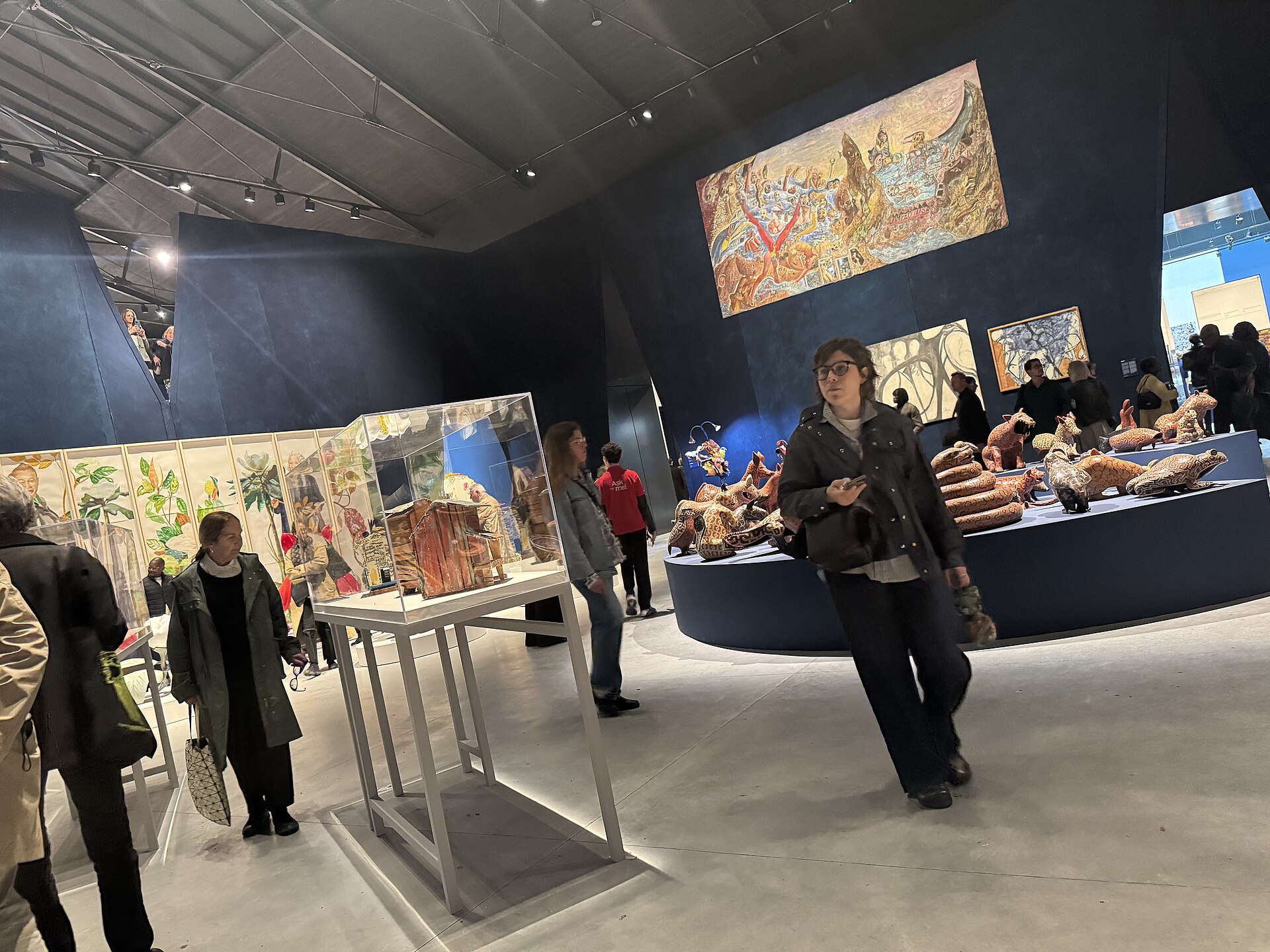
Large exhibition spaces affect the way bodies, objects, and movement relate. In one room, a work may be encountered at close range; in another, you may see it first across a substantial distance. Notice how the physical setting shapes anticipation. Does a sequence encourage you forward, or do you find yourself returning to an earlier view?
Our article on the Arsenale’s architecture and working history provides complementary context. Use that history to understand the venue without assuming it supplies the meaning of every artwork installed there. Temporary exhibitions can engage with a building, ignore parts of it, or transform how it feels. The relationship deserves observation on its own terms.
Historic art can sharpen your contemporary questions
A separate visit to a historic collection can make you notice what contemporary exhibition conventions take for granted. Frames, room sequence, ownership, patronage, and the survival of objects all influence the histories museums tell. Ask how those arrangements compare with an installation that depends on temporary materials or an action that cannot simply be hung on a wall.
For travelers building that contrast into another day, Tour Leader Venice offers an Accademia Gallery ticket page. This is a separate museum booking, not Biennale admission. Leave time between major visits. Comparison becomes more useful when you can remember a few works clearly rather than accumulating galleries until everything merges.
A modern collection offers another perspective
Contemporary art does not emerge without precedents, but a modern collection should not be treated as a simple key that unlocks every new work. Artists can inherit, revise, challenge, or bypass earlier conventions. Looking at a painting and a present-day installation side by side in memory may reveal differences in how the viewer is addressed, even when their materials have little in common.
Tour Leader Venice’s Peggy Guggenheim Collection ticket information can help you plan that complementary visit. Check the date-specific booking details and museum program. The purpose is to broaden your questions, not to make a single trip cover an entire history of art. One carefully chosen comparison can be enough.
Discussing the theme with a travel companion
Try a conversation that begins with evidence. Each person can choose one detail and explain why it held their attention. Then ask whether the exhibition’s title changed that response. This creates room for different impressions without requiring either person to deliver a lecture. An unexpected disagreement can reveal aspects of the work one of you had overlooked.
Avoid beginning with a competition over who understood the art better. Someone may have noticed construction while another followed sound or language. Those forms of attention can complement one another. If you disagree about an interpretation, return to the specific work or text rather than making a general claim about what contemporary art always does.
Families can work with questions rather than definitions
For children or teenagers, ask manageable questions about an actual encounter: what changed when you moved, which material surprised you, or what you would ask the artist. Avoid turning the title into a vocabulary test. A young visitor may notice a visual or spatial relationship that adults miss because they are preoccupied with explanation.
Check content guidance for individual presentations and choose according to your family’s interests and comfort. A general exhibition framework does not guarantee that every work is suitable for every age. Keep the visit selective, include breaks, and let children contribute choices. Curiosity is more likely to survive when the day allows agency instead of demanding constant attention.
A local detail: preserve attention by counting the return journey
One practical lesson from planning visits in Venice is that the journey home belongs in the itinerary from the beginning. Standing through several exhibition rooms, then crossing numerous bridges or waiting for a boat, can consume the energy you expected to use in the final hour. Straight-line distances on a map do not describe that effort.
Tour Leader Venice’s local perspective, informed by Igor Scomparin’s licensed guiding work since 1997, treats route, boarding point, and pace as cultural planning. Choose a manageable return and leave breathing room before dinner. If you want another way to engage with the city afterward, our guide to Venice’s small historical clues encourages a shorter, more attentive walk.
October comfort supports interpretation
Exhibition visits combine indoor spaces with outdoor movement. Check the forecast and dress in layers so that weather does not dominate your attention. For example, a 13°C (55°F) breezy morning and a 21°C (70°F) sheltered afternoon suggest different clothing needs; these are packing examples, not a forecast for your visit.
Carry only what you can comfortably manage under the organizer’s bag rules. Plan water and meal breaks, and check current accessibility information if standing, stairs, sound, or lighting affects your experience. An interpretive guide cannot replace those details. The point of careful preparation is to make it easier to stay with an artwork when it genuinely interests you.
Keep a record of questions, not only photographs
A useful note can be very short: the artist’s name, one observed detail, and one question you want to revisit. That record preserves the difference between the work and your interpretation. It also helps you research accurately after the trip. Photographs alone can leave you with a striking image and no reliable memory of its title or context.
Follow photography rules and keep your phone from obstructing other visitors. If an image is permitted, record why you took it. Did it show a join, a spatial relationship, or a detail you could not describe? Deliberate documentation supports attention. Constant recording can make an exhibition feel like material collected for later rather than an experience happening now.
What to take away from In Minor Keys
The most useful response to a large thematic exhibition may be one changed question. You might think differently about artistic importance, the role of a material, the meaning of collaboration, or the time a work asks from its audience. You do not need to finish with a verdict on every presentation. Selectivity can produce a more substantial memory than exhaustive coverage.
Before visiting, confirm dates, access, and tickets through La Biennale’s official exhibition information. Once inside, let the theme offer possibilities without becoming a rulebook. Look closely, read carefully, identify your own interpretations as such, and keep room for uncertainty. Venice’s 2026 exhibition can become an encounter with other people’s artistic worlds and with the habits through which you enter them.
Frequently Asked Questions
What does In Minor Keys mean at Venice Biennale 2026?
Koyo Kouoh’s title uses a musical metaphor to invite sensory, emotional, and relational encounters with art. It does not simply mean sadness, physically small artworks, or artists of lesser importance. Read the official introduction for the full curatorial framework.
Do all national pavilions follow the In Minor Keys theme?
National participations have their own artists, curators, and projects. They share the Biennale framework but should not automatically be read as direct illustrations of the central international exhibition’s theme.
When can I visit In Minor Keys in Venice?
The announced public run is May 9 through November 22, 2026. Check La Biennale’s current site hours, ticket conditions, and individual venue notices before your visit.