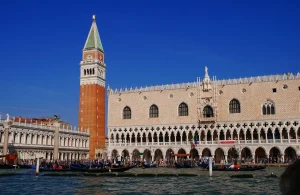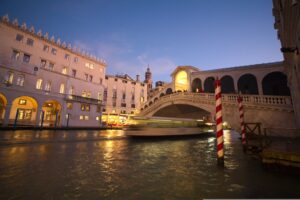
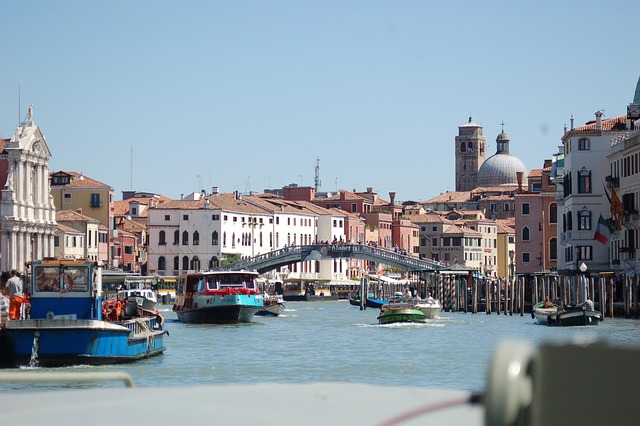
Most visitors leave Venice having seen St. Mark’s, ridden a gondola down the Grand Canal, and photographed the Bridge of Sighs. They leave, in other words, having seen the Venice that Venice wants tourists to see — the postcard version, polished for six centuries of visitors.
But I’ve spent thirty years walking this city as a licensed guide, and the Venice I love isn’t the postcard. It’s the Venice hiding in plain sight: a bridge where rival gangs beat each other bloody for sport, a statue that Venetians once used the way we use social media today, a stretch of water so cursed by disease that it’s still illegal to set foot on it. These five places won’t show up on a first-timer’s checklist. They’re the places that reveal what this city actually was — pragmatic, brutal, inventive, and far stranger than the romance novels suggest.
1. Poveglia — The Island Venice Used to Bury Its Fear
If you take the vaporetto toward the Lido, you’ll pass a small, overgrown island that most tourists never ask about. That’s Poveglia, and for centuries it was where Venice sent the people it was too afraid to keep.
The island’s story starts peacefully enough — a refuge founded in 421 CE for people fleeing invasions, then home to a modest farming and fishing community. That ended abruptly in the 14th century. During the war with Genoa in 1379, Venice emptied the island and fortified it, relocating its residents to Giudecca.
Then came the plague. Venice, as one of Europe’s busiest trading ports, was constantly exposed to disease arriving on incoming ships — the word “quarantine” itself comes from the Venetian dialect for “forty days,” the waiting period ships were required to observe offshore. Poveglia became one link in that system: from 1793 until 1814, it operated as a lazaretto, a quarantine station, and every foreign vessel had to stop there for inspection before entering the city. Sailors showing signs of infection were quarantined on the island — for many, it was a one-way trip.
The scale is hard to comprehend today. Some estimates suggest the island held over 160,000 infected people over its history as a quarantine site — enough that locals still say roughly half the soil is made of human remains. Later, in the 20th century, the island took on a second dark chapter: a psychiatric hospital operated there until it was dismantled in 1946, followed by a long-term care facility that closed in 1968. Today Poveglia sits abandoned. You can’t land there without special permission — it’s officially closed to tourism — but seeing it from the water, knowing what it carried, changes how you see the lagoon around it.
2. Ponte delle Tette — Where the Republic Regulated Desire
In the sestiere of San Polo, a small, unremarkable bridge crosses a quiet canal near the parish of San Cassiano. Its name translates, bluntly, to the “Bridge of Breasts” — and the story behind it says a lot about how pragmatically Venice governed even its most delicate problems.
By the early 1400s, Venice’s sex trade had grown enormous — one estimate put the number of women working in the trade in the city at over ten thousand. Rather than ban it, the Republic regulated it: in 1412, authorities confined the trade to the Carampane district around San Cassiano, effectively creating an official red-light zone. Women working there faced a curfew, could not work on religious holidays, and could only leave the district on Saturdays wearing a yellow scarf for identification.
The bridge’s specific name comes from what happened next. By the 16th century, Venetian authorities grew concerned about the spread of homosexuality among young men and, in response, permitted the women of Carampane to display themselves bare-breasted from windows and balconies near this bridge to draw male attention back toward heterosexual commerce. It’s a strange, almost bureaucratic solution to what the Republic saw as a social problem — and the bridge has carried the name ever since. Even Casanova was said to have been a regular visitor to the district.
3. Ponte dei Pugni — The Bridge Built for Brawling
Near Campo San Barnaba in Dorsoduro, a modest stone bridge crosses the Rio di San Barnaba. Look down at its walkway and you’ll notice four white marble footprints set into the stone — restored in 2005, they mark the starting positions for a very different kind of Venetian tradition: organized fistfighting.
Starting around 1600, rival Venetian factions — the Nicolotti and the Castellani — met each autumn on bridges across the city for what were called the guerre dei pugni, the “wars of the fists.” From September to Christmas, these clans gathered on rail-less bridges and fought with the simple goal of throwing their opponents into the canal below. The tradition had darker roots — earlier fights had used sharpened sticks, and legend holds that a 1585 battle, once weapons ran out, turned into a bare-knuckle brawl that gave rise to the fist-only tradition that followed.
It didn’t end well. The tradition was finally shut down in the early 18th century after a violent 1705 clash escalated into a bloodbath involving knives and stones. Spectators reportedly threw roof tiles down onto the fighters, and the brawl grew so chaotic that no one noticed a nearby church had caught fire. Today, the Ponte dei Pugni is one of the prettiest, quietest corners of Dorsoduro — locals shop for produce at the floating market barge beside it, with no hint of the violence the stones beneath their feet once witnessed.
4. Campo dei Mori — The Statue Venice Used Like a Newspaper
Tucked into Cannaregio, past the Ghetto, is a small square lined with four weathered stone statues built into the walls. Locals call it Campo dei Mori, and its centerpiece, a turbaned figure with a crude iron nose, has one of the best stories in the city.
The statues are popularly said to depict the Mastelli brothers — merchants, possibly named Rioba, Sandi, and Afani, who according to legend arrived in Venice from the Peloponnese in the 12th century. One local legend claims the brothers defrauded a devout Venetian widow, who cursed them by praying to Santa Maria Maddalena — and the three were turned to stone as a warning to anyone who saw them.
The most famous of the three, known as Sior Antonio Rioba, became something remarkable over the following centuries: a kind of living bulletin board. Much like Rome’s famous “talking statue” Pasquino, Venetians for generations attached anonymous notes to the statue — often satirical or scandalous commentary on current events and public figures. By 1848, the statue had even lent its name to a satirical newspaper. Its nose, lost sometime in the 19th century, was replaced with a rough piece of iron, and a new legend grew up around it: rub the nose, and you’ll bring yourself luck.
Just around the corner stands another quiet piece of history: the Gothic house where Tintoretto lived from 1574 until his death in 1598, its facade still decorated with a fourth Mastelli statue.
5. The Ghetto — Where Venice Gave the World a Word It Wishes It Hadn’t
Every language that uses the word “ghetto” is, whether it knows it or not, referencing Venice. The word — and the concept — was born here, in Cannaregio, in 1516.
On March 19, 1516, the Venetian government decreed the segregation of the city’s Jewish population into a small, enclosed area. Venice wasn’t the first city to confine its Jewish residents to a single quarter — but it was the first to lock the gates at night. The area was chosen deliberately: surrounded on all sides by canals and connected to the rest of the city by only two bridges, it was easy to seal off. Jewish residents were themselves required to pay the wages of the Christian guards stationed at the gates that locked them in.
The name itself likely comes from the site’s earlier use: the word “ghetto” predates the segregation and was originally connected to the iron foundries that once operated in the district. Despite the hardship, the community that grew here became extraordinary — against a backdrop of poverty and confinement, the Venice Ghetto became the vibrant heart of Jewish cultural life in Europe during the 16th and 17th centuries. It stood for nearly three centuries: Napoleon’s forces tore down the Ghetto’s gates in 1797, finally ending the legal segregation. Walk through Cannaregio today and you’ll find five synagogues still standing, the oldest dating to 1528 — a living neighborhood, not a museum, carrying one of the heaviest and most consequential histories in the city.
Can you actually visit Poveglia Island?
No — Poveglia is officially closed to the public and requires special permission to land on. Most visitors see it from the water, either on a private boat tour or while passing on the vaporetto route to the Lido.
Is the Ponte dei Pugni story something a guide can show me in person?
Yes. The marble footprints marking the fighters’ starting positions are still visible on the bridge itself, near Campo San Barnaba in Dorsoduro — it’s a natural stop on a walking route through that neighborhood.
Are these five places included in a typical group tour?
Rarely. Group and platform tours tend to stick to a handful of headline sights on a fixed schedule. Stories like these are better suited to a private, flexible walk built around what genuinely interests you.