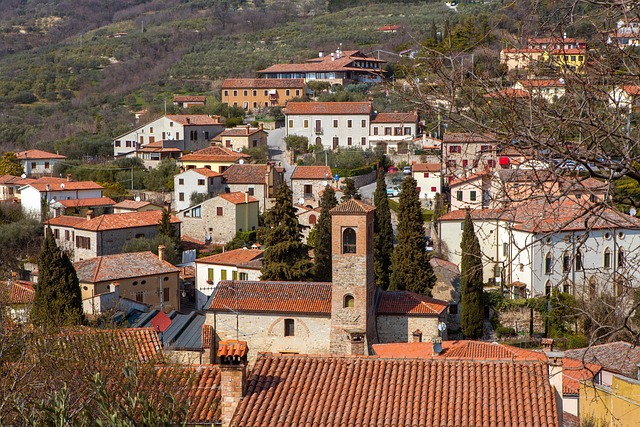
Tucked into the volcanic folds of the Euganean Hills south of Padua, Arquà Petrarca is the kind of place that makes you understand, almost immediately upon arriving, exactly why one of the most celebrated writers in the history of the Italian language chose to spend his final years here rather than in any of the grander cities that would gladly have hosted him. It’s a genuinely small village, home to under two thousand residents, and it carries its literary fame with a quiet, unhurried confidence that feels entirely appropriate for the man who put it on the map.
A Village Older Than Its Famous Guest
Human settlement in this stretch of the Euganean Hills predates Petrarch by well over two thousand years. Archaeological finds confirm occupation here dating back to the Bronze Age, followed by the ancient Eneti people, before the area came under Roman control during the reign of Augustus. The village’s first documented castle reference dates to 985 AD, and during the medieval commune period of the 12th and 13th centuries, Arquà, then simply known by that shorter name, became a favored retreat for the Carraresi family, the powerful dynasty that ruled Padua and its surrounding territory before eventually falling to Venetian control.
Why Petrarch Came, and Why He Stayed
Francesco Petrarca, known to English speakers as Petrarch, one of the towering figures of Italian humanism and among the fathers of the modern Italian literary language, first connected to this specific corner of the Euganean Hills in 1365, when he took up a position as a canon in nearby Monselice. In 1369, Francesco “il Vecchio” da Carrara, the ruling lord of Padua, granted Petrarch a plot of land in Arquà, and the poet, drawn to the area’s genuine tranquility, oversaw the restoration of what would become his final home.
Petrarch’s own description of the landscape survives in his writing, and it captures precisely what still makes the village so appealing today: vast forests of chestnut, beech, ash, and oak covering the surrounding slopes, alongside the wine, olive, and almond cultivation that together shaped what he called the area’s suggestive, distinctly Arquà-specific character. He died in the village on July 19, 1374, a single day before his seventieth birthday, according to popular local account found still at his writing desk, and he was buried in a striking tomb of red Verona marble, standing today in the square that now bears his name, directly beside the parish church.
The House Where He Actually Lived
Petrarch’s home, Casa del Petrarca, still stands a short walk from the village center, surrounded by its own garden overlooking the Euganean Hills, and remains one of the best-preserved literary house museums anywhere in Italy. The 14th-century building holds original furnishings and manuscripts, and its current museum layout is organized into several distinct thematic sections: an exploration of the iconography surrounding Petrarch and Laura, the woman whose unattainable love inspired much of his most celebrated poetry; the history of Arquà and its surrounding territory; the story of Petrarch’s own tomb; and, perhaps most charming of all, a section built around the house’s historic visitor registers, guestbooks in which centuries of admirers, scholars, and literary pilgrims have recorded their own visits, a genuinely unbroken written record of the site’s ongoing cultural pull across hundreds of years.
When Living Near Petrarch Became Fashionable
Petrarch’s choice of Arquà as his final home had a lasting effect on the village’s own physical development. Through the 15th and 16th centuries, as the Venetian Republic’s influence over the Paduan countryside deepened, noble families from both Venice and Padua began building villas in and around Arquà, drawn specifically by the prestige of settling in the same village the great poet had once called home. The Contarini, Badoer, Cavalli, Pisani, Capodivacca, Sanbonifacio, Santorini, Borromeo, Dottori, Oddo, and Zabarella families all left their mark, and their surviving villas and palazzi still anchor the village’s well-preserved medieval and Renaissance streetscape today, a genuine architectural record of just how much cultural capital a single poet’s reputation could generate for the small village fortunate enough to have hosted him.
Walking the Village: Two Piazzas and a Loggia
Arquà Petrarca organizes itself around two small squares connected by the village’s characteristic stone lanes and ramps climbing between its lower and upper sections. Piazza Petrarca holds the poet’s own tomb, standing in the churchyard adjacent to the Church of Santa Maria Assunta, which houses a valuable canvas depicting the Ascension by the Venetian painter Palma il Giovane. A short walk uphill, Piazza San Marco anchors the village’s upper section, home to the Oratory of the Holy Trinity, a place Petrarch himself is said to have regularly visited to pray, holding a 17th-century wooden altar alongside a second altarpiece also by Palma il Giovane. Directly annexed to the Oratory stands the Loggia dei Vicari, its walls decorated with the painted coats of arms of the noble Paduan rectors who once governed the area, a small but genuinely striking piece of civic heraldry. Elsewhere in the village, structures like the Venetian Gothic Palazzo Contarini on Piazza Roma and the historic Casa Strozzi round out a streetscape that feels, walking through it, remarkably unchanged from the centuries when Venetian and Paduan nobility first arrived seeking their own small share of Petrarch’s reflected literary glory.
A Village Recognized for Staying Exactly as It Is
Arquà Petrarca’s careful preservation has earned it genuine national recognition well beyond its literary fame. It’s a member of I Borghi più Belli d’Italia, the official association of Italy’s most beautiful villages, and was named the second most beautiful village in the entire country in 2017. The village also holds the Bandiera Arancione, the Orange Flag, awarded by the Touring Club Italiano to small towns demonstrating genuine excellence across tourism, hospitality, and environmental care, and carries the additional designation of Città dell’Olio, an Oil Town, recognizing its continued tradition of olive cultivation.
The Fruit That Gave Italian Its Happiest Idiom
Beyond olives, honey, and chestnuts, Arquà Petrarca’s agricultural identity carries one genuinely delightful local specialty: the giuggiola, or jujube, a small fruit cultivated across this part of the Euganean Hills and traditionally transformed into a sweet, syrupy liqueur known as brodo di giuggiole. That liqueur gave rise to one of the most charming idioms in the entire Italian language: “andare in brodo di giuggiole,” literally “to go into jujube broth,” a phrase still used across Italy today to describe someone overcome with sheer delight, a linguistic legacy from this small village that’s genuinely outlasted most people’s awareness of where the expression actually originated.
A Living Landscape, Not Just a Literary Shrine
Arquà Petrarca sits inside the Euganean Hills Regional Park, itself proclaimed a UNESCO Biosphere Reserve under the Man and the Biosphere Programme in 2024, adding a genuine layer of contemporary environmental recognition to the village’s long-standing historical and literary significance. The surrounding hills also connect to an older, more specifically archaeological layer of UNESCO recognition: several prehistoric pile-dwelling sites scattered across the Euganean Hills, including the Laghetto della Costa near Arquà itself, form part of the broader “Prehistoric Pile Dwellings around the Alps” World Heritage listing, meaning a single afternoon in this landscape can move from Bronze Age settlement traces to a 14th-century poet’s tomb to a 21st-century environmental designation without ever leaving the same small stretch of hillside.
Visiting Arquà Petrarca
Arquà Petrarca sits comfortably within reach of Padua, Monselice, and Este, and makes a genuinely rewarding half-day or full-day addition to a broader Euganean Hills itinerary, easily combined with the nearby thermal spa towns of Montegrotto Terme and Abano Terme for travelers who want to pair Petrarch’s literary legacy with a proper afternoon of relaxation. The village itself is compact enough to explore thoroughly in two to three hours, though its genuinely unhurried atmosphere rewards travelers willing to slow down and simply wander its stone lanes rather than rushing through a fixed checklist of sights.
Plan your visit: Padua Day Trip from Venice: Why Visit and What to See covers how to combine Padua’s UNESCO highlights with a wider Euganean Hills excursion, and reaching out through our customized private tours page lets us build a dedicated itinerary including Arquà Petrarca and the surrounding thermal towns.
Frequently Asked Questions
Why is the village called “Arquà Petrarca,” and not just “Arquà”?
The village’s original name was simply Arquà. It officially added “Petrarca” to its name in 1868, in permanent tribute to the poet Francesco Petrarca, who spent the final years of his life there and remains buried in the village’s main square.
Can I visit the house where Petrarch actually lived?
Yes. Casa del Petrarca, the 14th-century house where the poet spent his final years, is preserved today as a museum, holding original furnishings, manuscripts, and historic visitor registers, surrounded by its own garden overlooking the Euganean Hills.
How far is Arquà Petrarca from Padua and Venice, and how much time should I plan?
Arquà Petrarca sits within easy reach of Padua and the wider Euganean Hills, making it a natural half-day or full-day addition to a Padua-based itinerary from Venice. The village itself takes about two to three hours to explore thoroughly, though it pairs naturally with nearby thermal towns like Montegrotto Terme and Abano Terme for a longer day.