1. The patron saint smuggled home in a barrel of pork
Every great city needs a patron saint, and in the early 9th century, Venice decided it needed a better one than it had. So in 828, two Venetian merchants sailed to Alexandria, Egypt, with a plan: steal the body of St Mark the Evangelist and bring it home.
The relics were under Muslim rule at the time, and removing Christian relics from Egypt was forbidden — customs officials inspected outgoing cargo specifically to prevent it. According to the legend, the merchants packed the saint’s remains beneath layers of salted pork before loading them onto the ship. When officials searched the cargo and lifted the lid on a chest full of pork, they recoiled in disgust and waved the shipment through without digging further. The relics reached Venice, and legend adds one more flourish: during the voyage home, a storm nearly sank the ship, until St Mark himself is said to have appeared and warned the sailors of the danger ahead, saving the vessel.
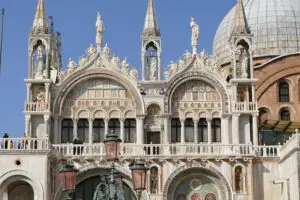
That theft is the entire reason St Mark’s Basilica exists — it was built specifically to house those relics, and the story is depicted in a 13th-century mosaic above the basilica’s left entrance door, so you can see the legend illustrated exactly where you’re standing.
2. The columns you’re not supposed to walk between
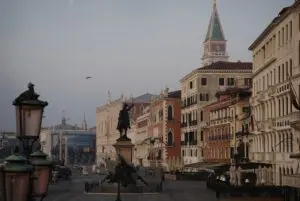
Stand in the Piazzetta, the small square between St Mark’s Square and the lagoon, and you’ll see two tall granite columns facing the water — one topped with the winged lion of St Mark, the other with a statue of St Theodore standing on a crocodile. Watch a Venetian walk past, and you’ll notice something: they go around, never through the gap between them.
The columns arrived from the eastern Mediterranean in the 12th century — legend says there were originally three, but one was lost overboard into the lagoon during unloading and was never recovered. Once the remaining two were finally erected, the space between them eventually became Venice’s site for public executions, with the condemned facing the square, backs to the water, the clock tower the last thing they saw. That grim association is exactly why the superstition took hold, and why it still quietly persists today — Venetians simply don’t cut through that gap, even now, even without quite explaining why to visitors who ask.
3. The bridge that promises eternal love — and used to promise the opposite
The Bridge of Sighs connects the Doge’s Palace to what was once the city’s prison, an enclosed limestone passage built in the early 1600s. Its name comes from the sighs prisoners supposedly let out while crossing it — their last glimpse of Venice, framed through small barred windows, before disappearing into a cell.
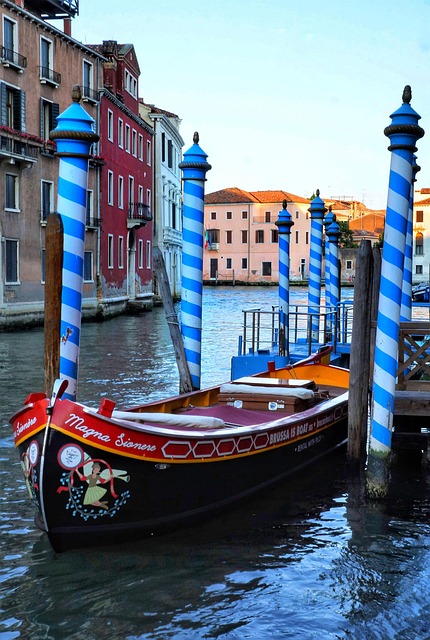
Somewhere along the way, that melancholy story flipped entirely into a romantic one. Modern legend holds that if two lovers kiss in a gondola passing beneath the bridge at exactly sunset, as the bells of St Mark’s Campanile toll, their love is sealed for eternity. Gondoliers know the legend well and will often angle their timing toward it deliberately — which is exactly why, at golden hour, you’ll see gondolas quietly queuing near the bridge, each one waiting its turn for the same moment.
Is the story of St Mark’s relics being smuggled in pork actually true?
It’s a legend recorded in medieval texts, not a verified historical fact — but it’s the story Venice has told about itself for over a thousand years, and it’s depicted in a mosaic on the basilica itself.
Why do Venetians avoid walking between the two columns in the Piazzetta?
The space between them was historically used for public executions, and the superstition against walking through it has persisted among locals for centuries.
Do you actually need to kiss under the Bridge of Sighs at sunset for the legend to “work”?
That’s the tradition — a kiss at sunset as St Mark’s bells toll is said to guarantee eternal love. It’s a relatively modern romantic legend, but gondoliers take it seriously enough to time their routes around it.