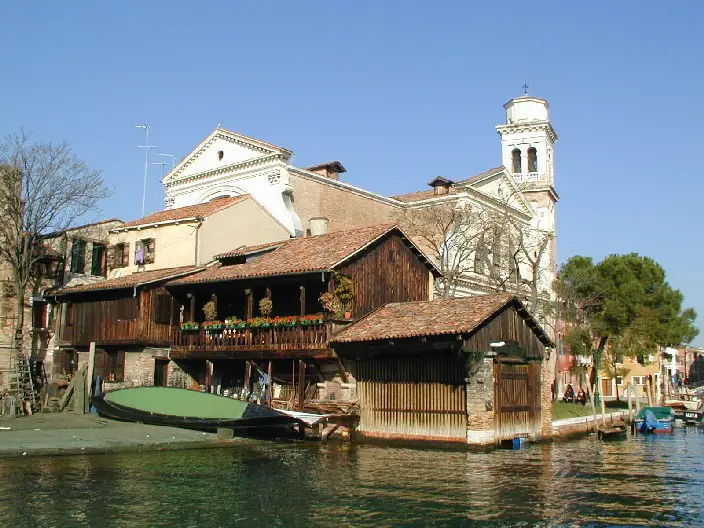
Why is it so difficult to find the next generation of Venetian gondola builders? The problem is not simply a lack of interest in traditional boats. Learning to build and maintain a working gondola takes sustained training, specialized supervision, suitable waterfront space, tools, materials, and enough paying work to make the profession viable. Venice’s remaining squeri are working businesses, not museums, and succession depends on whether a young craftsperson can realistically earn a living there.
This article looks beyond the familiar postcard image of a gondola workshop to examine apprenticeship, skill transfer, repair work, the economics of training, and what visitors can do to respect an active craft. It is deliberately different from our existing articles about how gondolas are built and where to see traditional boatyards.
A future decided in the workshop, not on the canal
Venice’s gondolas look timeless from a bridge. Inside a working boatyard, however, every wooden hull is the result of decisions about labor, training, space, tools, materials, and money. The future of the craft depends less on the number of tourists photographing gondolas than on whether someone can learn to build and repair them professionally.
A squero is a working environment, not an open-air demonstration designed around visitors. Experienced builders have deadlines and clients. An apprentice must become useful within that demanding routine. The most important question is therefore not whether a young person admires the tradition, but whether there is a viable route from curiosity to competence.
This article follows that route and the obstacles along it. It does not repeat our existing technical explanation of how a gondola is assembled. Instead, it asks what kind of future a skilled young worker could realistically build in Venice.
Why succession is different from preserving a monument
A restored church can be conserved by protecting its structure and commissioning specialist work when needed. A living boatbuilding tradition is different. Its knowledge must pass between people, repeatedly, through projects that carry real consequences for paying customers.
Plans and photographs are valuable, but they cannot fully communicate how wood behaves under a tool, how a hull changes during a repair, or how to recognize a problem before it becomes expensive. Much of the craft is judgment developed by watching, trying, correcting, and trying again.
That makes succession an economic question as much as a cultural one. A workshop must remain active long enough to teach, and a learner must have a reason to remain in the trade after the first enthusiasm fades.
What an apprentice actually has to learn
A beginner does not start by independently designing a gondola. Foundational skills include safe handling of tools, measuring accurately, preparing timber, understanding joints, recognizing defects, and maintaining a clean and organized working area.
As confidence develops, the learner can observe how individual components contribute to the behavior of a complete boat. A piece that looks simple in isolation may matter enormously once installed. Accuracy is learned through repetition rather than a single impressive demonstration.
There is no universal checklist that applies to every Venetian boatyard. Each shop has its own methods, equipment, and division of labor. The principle is shared: competence develops through supervised work on real boats, not through a weekend tourist experience.
The difference between a carpenter and a boatbuilder
General carpentry skills provide an important foundation, but a traditional boatbuilder must think in three dimensions about a vessel that will float, move, carry weight, and experience constant exposure to water.
The work requires an understanding of curvature, structural relationships, repair history, and how the boat will be used. The goal is not merely to produce beautiful timber surfaces. It is to deliver a dependable working craft.
A talented furniture maker could bring useful experience into a squero, yet still need substantial time to learn the particular demands of Venetian boats. The specialization is one reason training cannot be reduced to a short generic woodworking course.
Why an experienced master is not automatically a teacher
Exceptional craftsmanship and effective instruction are related but different abilities. A master may perform an operation almost instinctively after decades of practice, while a beginner needs each stage explained and demonstrated slowly.
Teaching can interrupt productive work. It requires patience, supervision, and a willingness to allow mistakes within safe limits. If a workshop operates with very little spare capacity, training may feel like a burden even when the owner wants the tradition to continue.
An effective apprenticeship therefore needs a structure that recognizes the master’s time as well as the learner’s effort. Cultural admiration alone does not pay for hours spent correcting work.
The economics of the first year
In the early stages, an apprentice may contribute less productive output than the time required for supervision. That imbalance creates a difficult question: who pays for training before the worker can perform valuable tasks independently?
Possible models include employment, formal apprenticeship contracts, training partnerships, and other arrangements permitted by Italian labor law. Their suitability depends on the individual’s age, qualifications, the employer, and current regulations. This article cannot promise that any particular workshop offers a position.
For the craft to survive, both sides need a realistic arrangement. A young person needs income and professional development. A small boatyard needs the financial capacity to teach without compromising safety or customer commitments.
A profession with a long learning curve
Visitors sometimes imagine that a talented learner could become a master after watching a handful of builds. Traditional craft rarely works that way. The relevant measure is not how many videos someone has seen but how many different problems they have solved under guidance.
Repair work is especially instructive because it reveals what happens to a boat after years of use. A new build demonstrates design intentions; maintenance exposes wear, stresses, and the practical compromises made over a working life.
An apprentice who stays long enough to experience both gains a more complete understanding. That is another reason short placements, while potentially valuable introductions, cannot substitute for sustained professional practice.
The role of repair work
A gondola is not simply built, sold, and forgotten. Its working life involves inspection, maintenance, adjustments, and repairs. These activities can create recurring demand for skilled labor, although the volume and profitability vary between businesses.
For a learner, repairs offer an education in consequences. They show which components wear, how owners use their boats, and what happens when water, impact, or time affect a structure. Such observations help turn theoretical knowledge into judgment.
A workshop that handles maintenance alongside new construction may provide varied learning opportunities. But that diversity also demands flexibility: the day’s priority may be an urgent customer repair rather than the task an apprentice hoped to practice.
The specialized tools of a squero
Hand tools are often among the most visually memorable features of a traditional workshop. Yet their importance lies in the relationship between tool, material, and worker. Knowing when to use a particular implement is as important as owning it.
Tools need maintenance and correct handling. Some techniques can be taught through demonstration; others require repeated practice before movements become precise and efficient. Safety is not an optional extra to the romantic image of craft.
A visitor should resist the temptation to handle tools or enter a working area without permission. The workshop is an industrial setting on a smaller scale, with the same need for attention and professional boundaries.
Materials are a business problem
Traditional wooden boats require appropriate timber and other materials, obtained at prices and qualities that a builder can manage. Availability, drying, storage, and waste all influence production decisions.
It is easy to romanticize a pile of timber as evidence of a centuries-old tradition. To the workshop owner, that pile represents capital tied up in stock, storage space, and future work. An apprentice must eventually understand these costs, not only the craftsmanship.
Responsible writing should avoid claiming that every squero uses an identical list of woods or that material prices are fixed. Individual specifications, supply chains, and restoration requirements can differ. What matters is that material knowledge and financial judgment are inseparable.
Space is part of the craft
A boatyard needs more than a bench. It requires room for hulls, timber, tools, repairs, movement, and access to the water. Venice’s historic urban fabric makes suitable working premises distinctive and potentially difficult to replace.
A picturesque location can be attractive to visitors while creating practical constraints for a business. Deliveries, noise, storage, and access must be managed alongside neighboring residents and other uses of the waterfront.
When a workshop closes, the loss is not just a skilled person. It may also be the loss of a rare site configured for boatbuilding. Finding another room is not necessarily equivalent to finding another squero.
The waterfront is not a museum backdrop
The famous sloping working areas of some squeri reflect the practical need to move boats between land and water. The architecture is tied to the work itself, not merely to Venice’s visual charm.
That practical function can conflict with the visitor’s desire for an uninterrupted photograph. A working boatyard needs clear access and room for movement. Spectators crowding a gate or bridge can make ordinary tasks more difficult.
The respectful approach is to admire the scene from a public place without blocking access, and to enter only through an explicitly arranged visit. Preserving craft includes respecting the conditions under which it is practiced.
Why young Venetians may choose other careers
A young person considering boatbuilding must compare it with other possible careers. Income, training time, physical demands, long-term prospects, and housing costs all matter. The romance of working with wood cannot remove those considerations.
The choice is especially complicated in a city where living and commuting arrangements may be difficult. A person who loves Venice may still decide that another occupation offers more stability. It would be unfair to describe that decision as a lack of respect for tradition.
The important question is how to make skilled work a credible professional option. That may require better information about career pathways, predictable contracts, and practical support rather than simply asking young people to preserve the past.
The physical demands of boatbuilding
Traditional boatbuilding involves lifting, bending, standing, repetitive motions, and working around equipment and timber. Modern safety standards and suitable tools matter, but the occupation remains physically demanding.
An apprentice should understand that the work is not a continuous sequence of artistic moments. It includes cleaning, preparation, careful repetition, and tasks that are less photogenic than shaping a curved component.
Respect for craftsmanship begins by recognizing it as labor. A skilled builder is not performing a picturesque ritual for visitors; the builder is producing and maintaining equipment on which another professional may depend.
From enthusiasm to a career
A first visit to a squero may inspire a young person to explore the trade. The next step, however, should be to investigate actual training and employment possibilities rather than assuming that every workshop accepts apprentices.
Professional education in woodworking or marine trades may provide relevant foundations, but the best pathway depends on current local opportunities. Schools, employers, and regional training authorities are the right sources for available programs and qualifications.
An article can explain the questions to ask: What skills are required? Is there paid training? Who supervises it? What safety preparation is needed? How does a learner progress toward independent work? Those questions are more useful than an invented apprenticeship advertisement.
The importance of a paying customer
A living craft survives when people commission and maintain its products. Gondoliers and other boat owners are not simply subjects for photographs; they are professional customers whose requirements shape workshop activity.
Customers need reliable workmanship, realistic deadlines, and transparent costs. The relationship between builder and owner may continue over many years through maintenance and repair. This continuity supports the transfer of practical knowledge.
A craft sustained only by demonstrations for visitors would be a different activity from professional boatbuilding. Tourism can contribute attention and sometimes revenue, but it cannot replace the need for working boats and satisfied owners.
Why prices cannot be reduced to one figure
Online articles sometimes offer a single dramatic price for a gondola as though every vessel and contract were identical. In reality, cost depends on specifications, materials, labor, fittings, finishing, and market conditions.
A responsible comparison must also distinguish the price of a completed boat from the cost of maintaining it over time. An apprentice eventually needs to understand estimates, purchasing, and the relationship between hours worked and the value delivered.
Rather than inventing a current quote, prospective customers should speak with the builder. For travelers, the lesson is that a gondola represents a significant professional investment, not merely a decorative object.
The craft includes more than the hull
The gondola is part of a larger ecosystem of specialized work. Fittings, metal components, decoration, upholstery, oars, and other elements may involve different skills and craftspeople.
The exact division of labor depends on the boat and the workshop. A single builder need not personally produce every component. Understanding these relationships helps reveal how vulnerable a craft network can become when one specialist retires.
A successor to a boatyard therefore needs professional contacts as well as technical skills. Preserving the tradition may mean maintaining a network of suppliers and collaborators, not simply inheriting a collection of tools.
The remèr and the builder
A remèr traditionally specializes in oars and related wooden components, including the distinctive fórcola used to control a Venetian rowing boat. That expertise is related to, but not identical with, the work of a gondola hull builder.
The distinction matters because visitors often speak about all boat-related artisans as though they practice one trade. Each specialization has its own learning curve, tools, and professional demands.
When discussing succession, it is better to ask which particular skill is at risk. A shortage of qualified hull builders and a shortage of expert oar makers are different problems, even though both affect Venetian rowing culture.
Learning to see an imperfect curve
One of the least visible forms of expertise is the ability to recognize a subtle problem before it becomes obvious. A master may notice a curve, joint, or alignment that looks acceptable to an inexperienced observer but will create difficulties later.
This judgment develops through comparison and feedback. It is hard to transfer through written instructions alone because the learner must understand what to look for, what it means, and when an adjustment is necessary.
The value of apprenticeship lies partly in gaining access to that practiced eye. It is a relationship in which mistakes become lessons while a responsible expert still protects the quality of the final boat.
Technology and tradition are not enemies
Modern measuring tools, documentation, and appropriate equipment can support traditional craftsmanship. Using them does not automatically make the work less authentic. The essential question is whether the knowledge and quality of the finished boat are maintained.
Digital records may help preserve dimensions, repair histories, or photographs of unusual components. They can also make training clearer. Yet they cannot fully replace the experience of shaping materials and judging results in a real workshop.
The most productive discussion is not whether every historical method must remain unchanged. It is how new tools can support a craft whose value rests on specialized understanding.
Could tourism help train apprentices?
Visitors are interested in seeing traditional workshops, and carefully managed visits may create opportunities for education and additional income. But a workshop must decide whether public access fits its schedule, safety requirements, and business model.
A tour that interrupts production or turns workers into performers may be counterproductive. Good visits are arranged in advance, respect the work, and explain the economic realities rather than offering a staged imitation.
Tour Leader Venice favors small, private experiences where permission and availability can be confirmed. A visitor should never assume that an attractive squero is open for spontaneous entry or that a fee guarantees access to an active build.
What a respectful workshop visit looks like
A useful visit starts with the understanding that production takes priority. The builder may be working on a repair rather than a new gondola, and that is not a disappointment. Repairs often reveal more about the real trade than a polished finished boat.
Questions about training, materials, customer relationships, and maintenance can be more revealing than asking how many gondolas the workshop produces in a year. The answer may vary, and not every owner will wish to disclose commercial details.
Photography should be requested rather than assumed, particularly when workers, customers, or unfinished projects are involved. A good encounter leaves the workshop no less able to carry out its work.
San Trovaso as a visible reminder
The Squero di San Trovaso in Dorsoduro is among Venice’s most recognizable boatyard views. Its waterside setting makes the trade visible to passersby, which can encourage curiosity about wooden boatbuilding.
The view is not a promise of admission or a guarantee that a gondola will be under construction at the moment of arrival. It is a working site, and operations change from day to day.
For the mechanics and history of a squero, see our introduction to Venetian gondola boatyards. This article instead asks who will do the work in the next generation.
What existing articles already explain
Our earlier article Inside a Venetian Squero explores the construction process and the heritage of the workshop. Readers looking for technical context should begin there.
We have also written about Venice’s remaining traditional gondola workshops. Rather than repeating those descriptions, this feature concentrates on succession: training, income, time, and the practical conditions required to keep the profession viable.
Those distinctions matter for readers and search engines alike. A useful series should answer different questions instead of presenting the same basic facts under several headlines.
A wider challenge for Venetian artisans
Gondola building is not the only craft facing questions about succession. Textile workers, glass artisans, restorers, and other specialists must also balance traditional knowledge with the economics of contemporary Venice.
The obstacles are not identical, but recurring themes include premises, demand, training time, and the difficulty of converting enthusiasm into stable work. Our companion piece explores what happens when a Venetian master craftsman retires.
A useful local policy discussion would distinguish between preserving buildings, supporting businesses, and training people. Each requires different tools, and success in one does not automatically guarantee success in the others.
What would make succession more realistic
A sustainable path needs capable teachers, willing learners, suitable premises, steady demand, and financially credible training arrangements. Public recognition of the craft can help, but it is not a substitute for those conditions.
Schools, employers, professional associations, and public institutions may all have roles to play. The exact programs and funding available can change, so specific opportunities should be checked with their organizers rather than assumed from an old article.
The goal should not be to preserve every historical detail unchanged. It should be to make it possible for skilled people to continue producing safe, beautiful, functional Venetian boats and earning a living from their work.
The next master may not look like the last
Traditional trades are sometimes portrayed as if succession must occur from father to son in the same workshop. Family continuity can be important, but it should not be treated as the only legitimate path into the profession.
A capable newcomer may bring different experience or educational background. What matters is the willingness to learn, the quality of training, and the ability to meet professional standards. Broadening access can strengthen rather than weaken a tradition.
A craft that survives through living practitioners will necessarily change in some respects. Its continuity lies in the skills, responsibilities, and working relationships that remain meaningful.
What visitors can do without pretending to save Venice
A visitor cannot solve a complex labor-market problem by purchasing a souvenir or taking one photograph. But travelers can choose experiences that respect working artisans, avoid obstructing workplaces, and seek accurate information about how crafts operate.
If a workshop offers an authorized visit or sells an authentic product, supporting that business can have value. It is equally important not to demand access to places that are not set up for tourism.
The most constructive form of interest is informed respect. Ask what the work requires, recognize the time involved, and understand that the future of the craft belongs primarily to the people who practice it.
The future is a working boat
A gondola is most often photographed when it is finished and gliding through a canal. Yet its future is decided earlier: when a workshop hires a learner, when someone invests in tools, when a customer commissions a repair, and when a master makes time to teach.
Igor Scomparin has worked as a licensed Venice guide since 1997. For the Tour Leader Venice team, the important story is not only the beauty of the city’s traditional boats but the skilled labor that allows them to exist. We do not claim private interviews or workshop statistics that have not been verified.
The next generation of builders will need more than admiration. They will need the conditions to practice a demanding profession. If Venice can provide those conditions, the squero will remain what it has always been at its best: a place where useful boats are made by people who know their craft.
Frequently Asked Questions About Gondola Builders
How do you become a gondola builder in Venice?
A prospective builder needs practical woodworking and boatbuilding skills, sustained supervised experience, and an appropriate employment or training arrangement. There is no single universal route, so current opportunities should be checked with employers and regional training providers.
Why are traditional gondola workshops difficult to keep open?
Workshops must balance specialized labor, suitable waterfront premises, material costs, repairs, customer demand, and the time and expense of training successors. Conditions differ between individual businesses.
Can tourists visit a working gondola boatyard in Venice?
Some visits may be possible by prior arrangement, but a squero is a working site and access is not guaranteed. Respect private areas, safety requirements, and workers’ schedules; do not enter without permission.
Research and Photo Credit
This feature distinguishes established workshop practices from economic analysis and does not claim unverified apprenticeship openings, wages, or interviews. For further research, consult the City of Venice and the Veneto Region for current training and business-support information. Featured image: real photograph of Squero di San Trovaso from Wikimedia Commons; confirm photographer attribution and license on the file description page before reuse.