Does Venice have gardens and green spaces? Absolutely. Although the historic center looks like a city of brick, stone, and canals, it contains public parks, restored historic gardens, planted courtyards, and greenery hidden behind the walls of palaces and former religious institutions. The Royal Gardens near St. Mark’s Square and the open spaces of eastern Castello are accessible examples; many other gardens remain private or open only under special arrangements.
The surprise is not that Venice has more parkland than other cities. It is that so much greenery is invisible from the streets visitors know best. This guide explores why gardens developed in a lagoon city, how they supported everyday life, and where travelers can responsibly enjoy green Venice without trespassing or relying on invented access promises.
The Venice that disappears behind a wall
The most surprising green spaces in Venice are often the ones you cannot see from a canal or a busy pedestrian route. A high brick wall may hide a courtyard planted with trees, a former monastery garden, or a small private plot belonging to a palace. From the street, the city appears to be made almost entirely of stone; from above, the pattern is more complicated.
This is why the phrase secret gardens needs care. Some gardens are private homes and are not visitor attractions. Others are publicly accessible parks or cultural sites, sometimes with limited hours. Their apparent secrecy often comes from the city’s dense urban form rather than from a deliberate attempt to keep travelers away.
Venice rewards a change in perspective. Instead of assuming that an unbroken facade means there is no vegetation behind it, look for the treetops rising above rooflines and boundary walls. The city’s green spaces are fragmented and unevenly accessible, but they are real.
Why a lagoon city needed gardens
Venice developed on islands where usable land was limited and building required exceptional ingenuity. Yet residents still needed vegetables, herbs, shade, and quiet places. Gardens were therefore part of the inhabited city rather than an ornamental luxury introduced after the age of tourism.
The forms differed: a productive plot near a religious institution, a private courtyard with a few trees, a larger palace garden, or cultivated land on other lagoon islands. Some spaces changed purpose over time, and not every present-day garden has a continuous medieval history.
Thinking of gardens as infrastructure helps explain their survival. Food production, religious life, health, status, and domestic comfort all contributed to the desire for green areas within a city defined by canals.
A city of stone is an incomplete picture
The familiar image of Venice emphasizes marble facades, brick campanili, paved campi, and water. That image is accurate but selective. Trees and planting are less visible from the classic viewpoints around Rialto and St. Mark’s, where visitors spend much of their time.
A tourist route can create a false impression of the whole city. Walk into quieter residential areas and the relationship between built space and greenery becomes more varied. Courtyards, walled plots, and public gardens interrupt the dense urban fabric.
There is no need to claim that Venice has more green space than other European cities. The remarkable feature is the coexistence of vegetation with an unusually compact historic center and a landscape shaped by salt water.
The hidden garden behind a palace
Palace gardens served different purposes over the centuries. They could provide a secluded outdoor room, a place to entertain guests, or a display of wealth and taste. Their design and plantings changed with fashions and the resources of their owners.
The private character of many gardens explains why a traveler can walk past an impressive building without realizing that a green area exists behind it. Some gardens can be glimpsed from the water or during a special cultural opening, but such glimpses do not make them public.
A responsible guide does not promise entry to a private garden without the owner’s permission. The interesting historical question is how a wealthy household arranged privacy, light, and leisure within the constrained geography of Venice.
Monasteries and the practical value of enclosed land
Religious communities also shaped the city’s green landscape. Monasteries and convents could include enclosed gardens used for cultivation, contemplation, and daily routines. These spaces were part of institutions with practical responsibilities as well as spiritual lives.
The surviving landscape is complex. Some former religious properties have been adapted to new uses, while others remain connected with religious activity. It would be misleading to label every enclosed courtyard a medieval monastery garden simply because it looks old.
The important insight is that a garden could serve several functions at once: providing produce, organizing work, creating a place for reflection, and separating communal life from the street.
What a Venetian brolo meant
In Venetian historical usage, a brolo refers to a cultivated enclosure, often associated with a garden or orchard. The word survives in local place names, offering a clue to land use that may no longer be visible.
The presence of an old name does not prove that a particular fruit tree or garden wall has survived unchanged. It suggests an association that can be investigated through maps and archival records. This is an example of how language preserves environmental history.
For travelers interested in this relationship between geography and words, our guide to the origins of Venice’s street names explains how occupations, families, and former uses became part of the city’s everyday vocabulary.
The Giardini Reali beside St. Mark’s
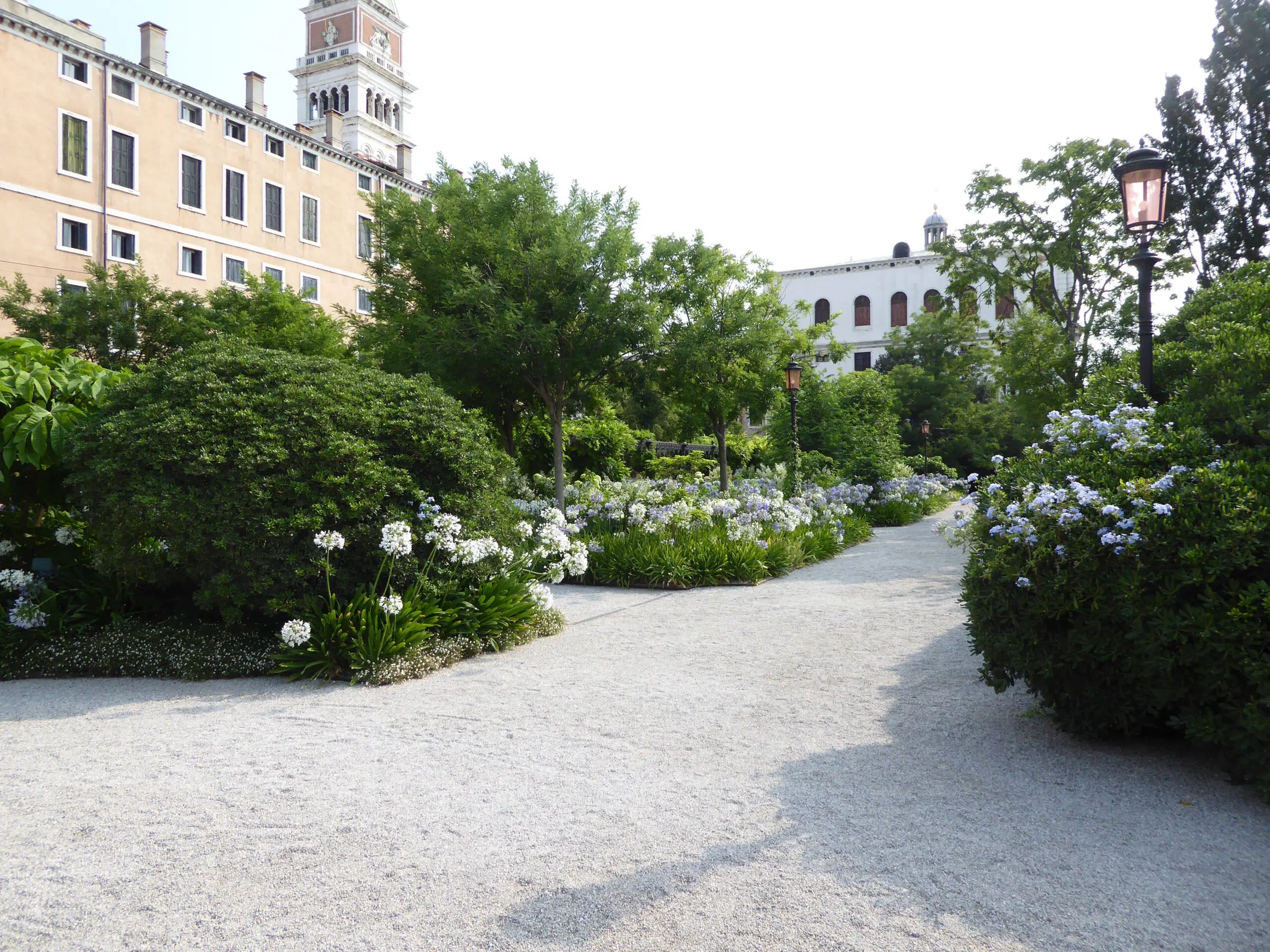
One of Venice’s most accessible demonstrations of its green side is the Giardini Reali, the Royal Gardens near St. Mark’s Square. Their location is almost paradoxical: close to one of the most visited urban spaces in Europe, a planted area offers a very different pace.
The gardens are not a hidden private estate. They are a publicly oriented historic garden that underwent a major restoration and reopened in 2019. Visitors should verify current opening arrangements, particularly because gardens may close for maintenance or weather-related reasons.
The contrast is the experience. A few minutes from monumental stone and crowds, paths and vegetation alter the atmosphere. The Royal Gardens are a useful starting point for understanding why green space matters even in the most famous part of Venice.
What restoration actually involves
A historic garden cannot be conserved by simply repainting a wall. Plants grow, decline, and need ongoing care; drainage, paths, irrigation, and visitor use create practical challenges. Restoration must consider both historic design and the conditions required for a living landscape.
The Venice Gardens Foundation has played a central role in the Royal Gardens restoration and stewardship. Its work illustrates that heritage conservation includes horticulture, maintenance, and public access, not only architectural repair.
For a visitor, the most meaningful detail may be the everyday care that keeps the garden welcoming. A beautiful space is not permanently restored once and for all; it must be maintained season after season.
The Biennale gardens are a different kind of green space
The Giardini della Biennale in Castello have a different history and function from the Royal Gardens. The area is closely associated with Venice’s international art and architecture exhibitions and with national pavilions constructed over time.
Its landscape is part of the experience, but access to exhibition areas is controlled according to the event calendar and ticketing arrangements. It should not be confused with an unrestricted neighborhood park.
For readers curious about the architecture of this cultural landscape, our guide to the Biennale’s Giardini explores the exhibition environment from a different perspective.
The public park of Sant’Elena
At the eastern end of Castello, the Sant’Elena area offers a more open, residential feeling than the central tourist routes. Trees, paths, and waterfront views create opportunities for a pause away from the busiest squares.
The neighborhood is not an undiscovered wilderness. It is part of the lived city, with local routines, families, and public space. Treating it as a secret playground for visitors misses its role in residents’ everyday lives.
For a family or couple wanting time outdoors, this area can be more useful than trying to access a private palace garden. The best experience may be a simple walk with room to slow down.
The garden of the Palazzo Soranzo Cappello
Palazzo Soranzo Cappello in Santa Croce is associated with a historic garden that has attracted cultural interest. Its setting illustrates how substantial greenery can exist behind the street frontage of a palace in a dense urban neighborhood.
Access depends on the building’s institutional use and current arrangements. Do not assume that a garden visible in a photograph is open for casual entry. The distinction between a historically important site and an accessible visitor destination matters.
The site is especially interesting as a reminder that garden history is tied to ownership and adaptation. Buildings change function, and the landscape around them may be preserved, altered, or temporarily inaccessible.
The garden of Ca’ Rezzonico
Ca’ Rezzonico, the museum of eighteenth-century Venice on the Grand Canal, is associated with a garden and courtyard spaces that offer another perspective on domestic architecture. The museum’s setting makes it possible to think about outdoor space as part of a grand residence.
The precise access to the garden and museum facilities can change with exhibitions, conservation, and operational needs. Check the official museum information before planning a visit specifically around the garden.
For an American traveler, the appeal is not simply finding grass in Venice. It is understanding how a wealthy household organized its relationship with water, architecture, privacy, and outdoor life.
Green space does not always mean a lawn
Many Venetian gardens are small, enclosed, or heavily structured. They may contain trees, climbing plants, flower beds, paths, and courtyards rather than expansive lawns. Applying an American suburban definition of a garden can make these places seem less significant than they are.
In a dense city, a single mature tree can transform the character of a courtyard. Shade and vegetation influence how a space feels, while walls provide shelter and separation from nearby streets.
The scale is part of the story. Venice’s greenery often works in intimate fragments rather than in broad continuous parks.
How salt water complicates planting
Venice’s relationship with the lagoon makes soil, drainage, and water management important considerations for gardens. Salt exposure and periodic flooding can challenge some plants, while the precise conditions vary significantly from one site to another.
It would be inaccurate to say that all gardens are regularly submerged or that only a fixed list of species can survive. Elevation, enclosure, soil, drainage, and maintenance all affect what is possible.
The horticultural challenge adds to the significance of surviving gardens. They represent choices about plant selection and ongoing care within an unusual environment.
The importance of rain and freshwater
A garden needs appropriate water and soil conditions, not merely an attractive location. Historically, Venice developed systems for collecting and managing freshwater in a city surrounded by a saline lagoon. Gardening existed within that broader culture of careful resource use.
Modern irrigation and maintenance practices differ by property, and private arrangements should not be guessed at. What can be said is that growing plants in Venice has never been entirely separate from the practical problem of managing water.
This is one reason the city’s green spaces are especially revealing. They bring together environmental conditions, domestic life, and urban engineering.
Trees above the walls of Cannaregio
In quieter parts of Cannaregio, vegetation can appear unexpectedly above walls and between buildings. Such glimpses are reminders that the street network reveals only a fraction of the land behind each facade.
A walk focused on gardens should be observant rather than intrusive. Photographing a treetop from a public street is different from peering into private windows or attempting to enter a locked gate.
Cannaregio is best approached as a living neighborhood, not as a collection of hidden prizes. A slow route through its less crowded streets can reveal layers of domestic life that the central sightseeing circuit misses.
Dorsoduro and the garden-city illusion
Dorsoduro offers a varied urban landscape, from grand waterfront institutions to quiet residential streets. Gardens and planted courtyards contribute to that character, though access varies and many spaces are private.
The district’s charm does not come from greenery alone. It comes from the relationship between light, water, buildings, and a more relaxed pedestrian rhythm in some areas.
For visitors who want a slower afternoon rather than an ambitious checklist, combining public viewpoints with a garden that is officially open can create a balanced itinerary.
A garden can be a form of privacy
Venice’s streets often pass close to domestic windows and doorways. A walled garden creates separation from that public movement. It may offer a household an outdoor place that is protected from passing crowds.
This is particularly important in a city where private space can be limited and tourist activity concentrated. Not every green courtyard should become a visitor attraction simply because it looks appealing.
Respect for private gardens is part of respecting Venice as a residential city. An authentic experience sometimes means appreciating what remains outside public access.
The lagoon’s larger agricultural landscape
The historic center is only one part of Venice’s wider environment. The lagoon includes islands with agricultural traditions and more open land. Sant’Erasmo, in particular, is associated with vegetable cultivation and the supply of produce to Venice.
Its role is different from that of a decorative palace garden. Agricultural fields are working landscapes that connect food production, transport, and island communities.
For a complementary look at this productive green Venice, read how Sant’Erasmo became Venice’s garden island.
What residents gain from neighborhood greenery
Green spaces can offer shade, opportunities for rest, and places for children and neighbors to spend time outdoors. Their value is practical as well as aesthetic, especially in a city where much of the public realm is paved.
The benefits are not distributed evenly. A private palace garden and a public park serve different people. Discussions about urban greenery should therefore include access and maintenance rather than counting every tree as though it were equally available to residents.
For a family living in Venice, the nearest usable public space may matter far more than a famous garden visible only during an occasional cultural opening.
Venice in summer: shade is not a luxury
Summer in Venice can be hot and humid, and long sightseeing days across exposed paved spaces can be tiring. Trees and shaded seating areas can make a meaningful difference to the experience of walking.
A garden visit should still be planned around opening hours and personal comfort. Bring water, take breaks, and do not assume that every green area has public seating or restroom facilities.
The local insight is simple: plan a shaded pause as part of a route, rather than waiting until everyone is exhausted. A public garden near the next attraction can be more valuable than an additional crowded stop.
Autumn changes the character of a garden
The season alters light, foliage, temperature, and the rhythm of public spaces. In autumn, a Venetian garden may feel quieter and more contemplative than during the busiest months, although weather and access remain variable.
November visitors should not expect summer flowers or guaranteed sunshine. The attraction is often the structure of the garden, the relationship with surrounding buildings, and the contrast between greenery and stone.
A well-written itinerary treats gardens as seasonal environments, not permanent photographs. What you see depends on when you visit.
Winter reveals the garden’s architecture
When foliage is reduced, the underlying design of a garden can become easier to read. Paths, walls, gates, and the relationship between a residence and its outdoor space may stand out more clearly.
Not all gardens remain open in winter, and maintenance closures may occur. Checking official information is more reliable than relying on an old travel article that describes access in a different season.
The quieter months can reward travelers who enjoy architecture and atmosphere as much as flowers. A garden does not cease to be interesting when it is not in full bloom.
Spring and the temptation to chase blooms
Spring brings renewed growth and can be a particularly appealing time to explore Venice’s public green spaces. The timing of flowering varies with weather and species, so specific displays should not be promised far in advance.
The best plan is flexible. Choose a neighborhood or cultural visit you already want to make, then add a garden if conditions and access align.
That approach prevents a day from depending on a single photograph seen online. Venice’s garden experience is as much about setting and history as it is about a particular flower.
The difference between a public garden and a private visit
Travel articles often use phrases such as hidden gem without explaining whether readers can actually enter. In Venice this omission is especially frustrating, because a garden may belong to a private residence, institution, or hotel.
A practical guide should distinguish freely accessible public areas, ticketed cultural sites, gardens open for occasional events, and spaces that remain private. Permission is never implied by a photograph or by a map marker.
For private-tour travelers, advance arrangements may sometimes create opportunities, but no operator should guarantee access without confirmation from the property.
How to plan a garden-focused morning
Begin with a garden whose public access can be verified, such as the Royal Gardens near St. Mark’s. Use the visit to understand the contrast between planted space and the surrounding monumental district.
Continue through a neighborhood at a relaxed pace, observing historic walls and treetops without entering private property. If your route includes a museum with a garden, verify whether the outdoor area is included in the ticket and currently accessible.
This makes a coherent half-day without pretending that every interesting garden is open. It also leaves room for coffee, a cultural visit, and the pleasure of getting to know a neighborhood.
How to build a quieter Castello afternoon
Castello offers an alternative route that combines residential streets, waterfront views, and more open public areas toward Sant’Elena. It can be a satisfying choice for visitors who have already spent time around Rialto and St. Mark’s.
Do not confuse the public spaces of the neighborhood with the ticketed Biennale grounds. Check the current exhibition calendar if you intend to enter a pavilion area.
A slower afternoon in Castello is not about collecting secret locations. It is about seeing how public green space supports a neighborhood beyond the visitor economy.
What photographers should notice
Gardens create a different visual language from the usual Venetian reflections and ornate facades. Look for the contrast between leaves and brick, the framing of a path by walls, and the way a tree changes the proportions of a courtyard.
Morning and late-afternoon light can be beautiful, but access rules take precedence over the perfect shot. Avoid photographing private residents through gates or windows, and respect signs about restricted areas.
A natural documentary photograph often tells the story better than heavily processed imagery. The goal is to show Venice as it exists, with its ordinary seasonal light and textures.
Why green Venice matters to the city’s future
Green spaces require maintenance, investment, and decisions about access. In a historic city under pressure from tourism, residential change, and environmental challenges, these decisions affect quality of life.
Protecting a private historic garden and providing a usable neighborhood park are both worthwhile but different objectives. Public discussion benefits from distinguishing heritage conservation from everyday recreational needs.
A sustainable Venice needs more than restored facades. It needs places where residents can rest, children can play, and living landscapes can be cared for over time.
A local guide’s way of reading the city
Igor Scomparin has worked as a licensed Venice guide since 1997. The Tour Leader Venice approach is to treat gardens as part of the city’s lived history, not simply as secret locations to be revealed.
One useful observation is to look for the green canopy above a high wall and then ask what kind of institution or household might have occupied the land. The answer should come from reliable evidence rather than a romantic guess.
The most rewarding garden walk is often the one that changes how you see the surrounding streets. Venice’s hidden greenery teaches patience, curiosity, and respect for the people who live behind its facades.
The city is greener than its postcards
Venice remains a dense historic city of water and stone, but that description does not exhaust its landscape. Public parks, palace gardens, religious enclosures, courtyards, and agricultural islands form a quieter green geography.
Some of those spaces welcome visitors; others are private, seasonal, or accessible only under specific arrangements. The difference matters because the city’s beauty does not cancel its residents’ right to privacy.
The next time a narrow calle seems to offer nothing but walls, look up. A branch above the roofline may be the beginning of another story about how Venice has always made room for life.
Frequently Asked Questions About Venice’s Gardens
Are there public gardens in Venice, Italy?
Yes. The Royal Gardens near St. Mark’s Square and public green areas toward Sant’Elena are examples. Opening arrangements vary, so check current official information before visiting.
Can tourists visit Venice’s secret palace gardens?
Some historic gardens are accessible through museums or special openings, but many belong to private properties. Never assume entry is allowed without official confirmation or permission.
Where can visitors find green space away from Venice’s busiest streets?
Consider public green areas in eastern Castello and Sant’Elena, or the restored Royal Gardens near St. Mark’s. For agricultural landscapes beyond the historic center, explore Sant’Erasmo in the lagoon.
Planning and Photo Credit
Check current access with Venice Gardens Foundation for the Royal Gardens, MUVE for museum sites, and La Biennale di Venezia for exhibition-area access. Featured photograph: Giardini Reali Venice 01, by Abxbay, Wikimedia Commons, CC BY-SA 4.0. No changes to the original image are claimed.