Who named Venice’s streets? Most historic Venetian street names did not originate in a single official naming campaign. They grew from local speech: residents identified places by families, trades, churches, bridges, courtyards, and nearby waterways. Over time those customary names appeared in maps, civic records, and the painted white street signs known as nizioleti. That is why Venice’s map preserves an unusually vivid record of everyday life.
This guide is deliberately different from our existing list of fifteen unusual calli. Instead of repeating individual curiosities, it explains how Venice’s street names were created, who used them, and why they survived. The result is a deeper story about language, property, work, and the neighborhoods that still make Venice a living city.
The answer is older than the signs
Venice’s strange street names were not invented in one grand naming ceremony. They grew from the practical vocabulary of neighborhoods: a family who owned a house, a craft practiced nearby, a church that organized community life, or a landmark everyone knew. A name could be useful long before it was formally painted on a wall.
That is the central distinction between the origin of a place-name and the authority that later recorded it. A modern municipality can maintain an official register, but many of the names it administers preserve habits of speech developed over generations. Asking who named a calle therefore rarely produces a single person’s name.
A useful distinction is between a name that describes something visible today and a name that preserves something no longer present. The first may be easy to understand on the spot; the second requires patience. Neither should be turned into a claim about a precise century without supporting evidence. Venice rewards travelers who ask careful questions rather than accepting the first attractive explanation.
Who had the authority to name a place?
In the Venetian Republic, place-names emerged within a city governed by multiple institutions and shaped by parish communities, property ownership, commerce, and everyday custom. Residents needed to identify bridges, landings, courtyards, and streets long before a standardized modern system of signage existed.
After the republic ended in 1797, successive administrations inherited an already intricate urban vocabulary. Later municipal systems organized addresses and official naming, but they did not erase every older expression. The continuity of local names is one reason Venice still sounds different from cities with predominantly commemorative street grids.
These clues are most valuable when considered together. A family name, an old shop reference, and a nearby church may reflect different periods of the same neighborhood’s development. Reading them as layers prevents the misleading impression that every part of Venice was named at one moment by one authority. It also explains why modern wayfinding can feel irregular yet historically coherent.
The parish as an everyday compass
Churches were more than religious monuments in historic Venice. Parishes gave neighborhoods recognizable identities, and a nearby church was an easy point of reference. Names involving San, Santa, or a church-related location often reflect this close relationship between sacred buildings and urban orientation.
A resident could describe a meeting point through a parish, campo, or bridge without giving a modern-style street address. The local vocabulary worked because neighbors shared knowledge of the surrounding area. Visitors today sometimes find this confusing precisely because they lack the same mental map.
For Americans visiting Venice for the first time, this approach offers an alternative to treating every unfamiliar word as a novelty. The city has a language of place rooted in lived experience. The signs help you navigate, but they also show what past generations considered useful to remember. That is a more meaningful discovery than simply collecting the strangest translations.
Why family names remained on the map
Venetian noble and merchant families occupied houses and palaces that could become enduring reference points. A calle associated with a family might preserve its name after ownership changed, buildings were altered, or the family itself lost prominence.
Such names can reveal a neighborhood’s relationship with property and influence, but they should not be read as proof that the family built every nearby structure. The exact historical connection requires documents, and similar surnames can refer to different branches or periods.
A useful distinction is between a name that describes something visible today and a name that preserves something no longer present. The first may be easy to understand on the spot; the second requires patience. Neither should be turned into a claim about a precise century without supporting evidence. Venice rewards travelers who ask careful questions rather than accepting the first attractive explanation.
Trades were once addresses
Many Venetian place-names preserve occupations. Before standardized business directories, the location of a craft or service could be one of the most useful ways to identify a street. A baker, a butcher, or a specialized workshop might give a corner its recognizable name.
These labels do not guarantee that a particular shop operated there continuously for centuries. Trades moved, businesses closed, and words changed meaning. Yet the persistence of a trade name can preserve the memory of a practical economy that has largely vanished from the modern tourist route.
These clues are most valuable when considered together. A family name, an old shop reference, and a nearby church may reflect different periods of the same neighborhood’s development. Reading them as layers prevents the misleading impression that every part of Venice was named at one moment by one authority. It also explains why modern wayfinding can feel irregular yet historically coherent.
The Venetian language matters
Venetian street names often retain words and spellings that differ from standard Italian. A traveler translating them mechanically through an English-language app may miss dialect vocabulary, older grammatical forms, or local pronunciation.
Venetian has a rich literary and spoken tradition. Its presence in the cityscape is not an ornamental error to be corrected. It is evidence that the language of daily life helped shape the map. The same word may also appear in different spellings across historical records.
For Americans visiting Venice for the first time, this approach offers an alternative to treating every unfamiliar word as a novelty. The city has a language of place rooted in lived experience. The signs help you navigate, but they also show what past generations considered useful to remember. That is a more meaningful discovery than simply collecting the strangest translations.
Nizioleti: the name written on the wall
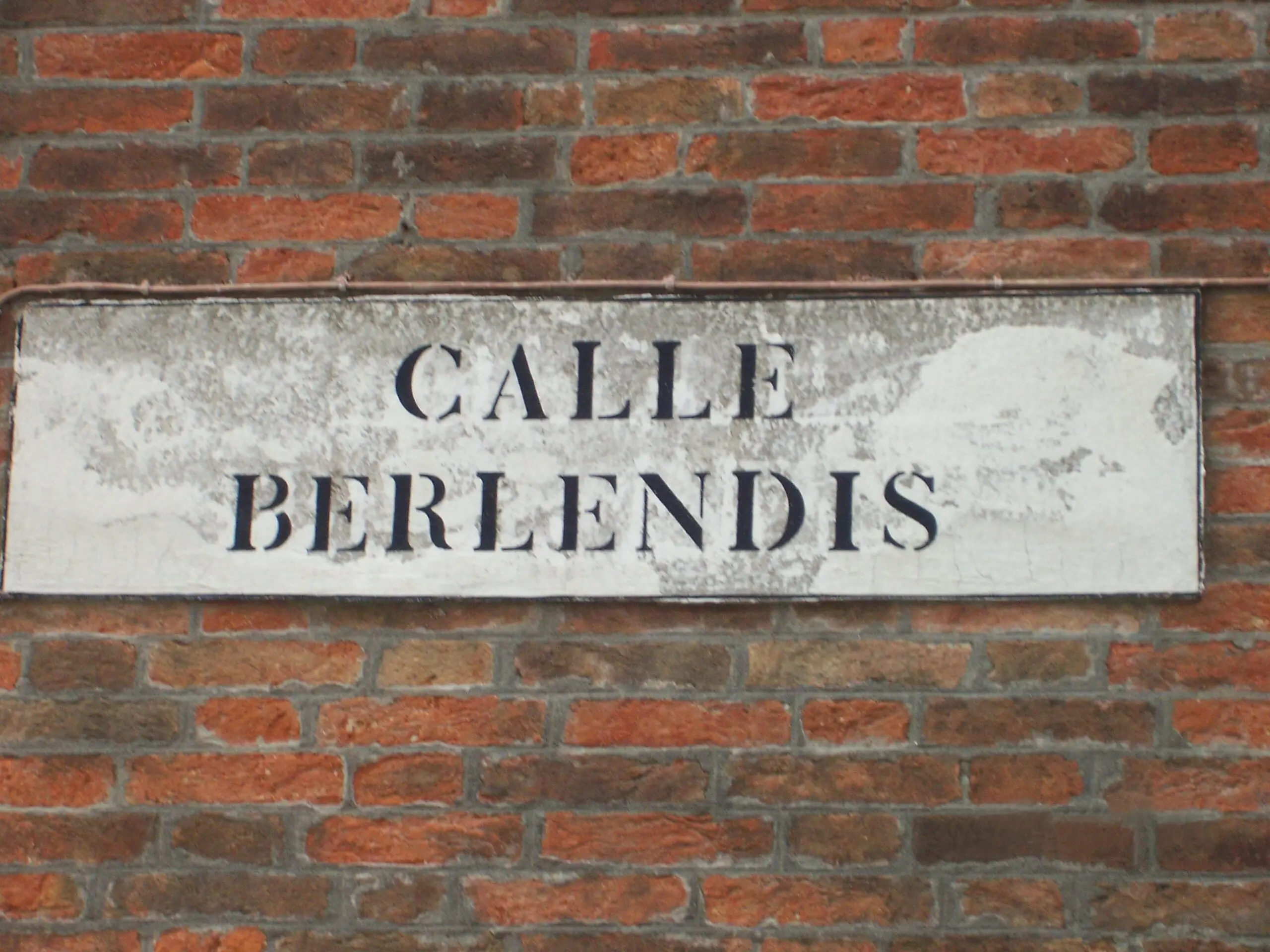
Venice’s characteristic painted street labels are known as nizioleti, a term associated with the appearance of a little white sheet. Their white fields and dark lettering make names visible against the surrounding walls.
The painted sign is not the original moment at which the street received its identity. It is a later public expression of a name, sometimes standardized from a more variable local tradition. This distinction matters because visitors often assume the painted lettering and the name itself must be equally old.
A useful distinction is between a name that describes something visible today and a name that preserves something no longer present. The first may be easy to understand on the spot; the second requires patience. Neither should be turned into a claim about a precise century without supporting evidence. Venice rewards travelers who ask careful questions rather than accepting the first attractive explanation.
Why an old name can outlive its meaning
Urban language is conservative in an interesting way. People continue using a familiar place-name even after the original reason for it has faded. A former workshop becomes an apartment, a landing changes its function, or a family leaves, while the name remains.
This continuity makes Venetian streets valuable historical sources, but it also creates interpretive traps. A modern business located on a calle with an occupational name may have no connection to the original trade. The name is not proof of uninterrupted activity.
These clues are most valuable when considered together. A family name, an old shop reference, and a nearby church may reflect different periods of the same neighborhood’s development. Reading them as layers prevents the misleading impression that every part of Venice was named at one moment by one authority. It also explains why modern wayfinding can feel irregular yet historically coherent.
Why two places may sound alike
Venice contains repeated saints’ names, recurring occupations, and families with similar surnames. Visitors can encounter names that appear almost identical in different sestieri. The pattern reflects the city’s historical development rather than an intention to confuse travelers.
A location may also be identified by a combination of elements: a street type, a nearby parish, or the broader district. Those details help distinguish one place from another. Modern navigation tools sometimes flatten these distinctions, especially when spelling variations are involved.
For Americans visiting Venice for the first time, this approach offers an alternative to treating every unfamiliar word as a novelty. The city has a language of place rooted in lived experience. The signs help you navigate, but they also show what past generations considered useful to remember. That is a more meaningful discovery than simply collecting the strangest translations.
Names of water that became names of land
Venice grew through an intimate relationship between land and water. A street or open space may preserve a reference to a canal, landing, bank, or former waterway even when the physical setting has changed.
Some canals were filled or adapted over time, leaving traces in urban terminology. The resulting names can be a reminder that today’s pedestrian surface may have a different history beneath it. This is a broader urban process, not evidence that every street was once underwater.
A useful distinction is between a name that describes something visible today and a name that preserves something no longer present. The first may be easy to understand on the spot; the second requires patience. Neither should be turned into a claim about a precise century without supporting evidence. Venice rewards travelers who ask careful questions rather than accepting the first attractive explanation.
The importance of a bridge name
A bridge can become a reference point for the surrounding area, and a nearby street can take its name from that bridge or the feature it crosses. This is a reminder that Venetian navigation developed around connections between small islands and neighborhoods.
The names of bridges are not always self-explanatory. A saint, family, institution, or remembered event may lie behind the wording. An appealing folk explanation should not be presented as a documented fact without historical support.
These clues are most valuable when considered together. A family name, an old shop reference, and a nearby church may reflect different periods of the same neighborhood’s development. Reading them as layers prevents the misleading impression that every part of Venice was named at one moment by one authority. It also explains why modern wayfinding can feel irregular yet historically coherent.
Courtyards and the people who shared them
Corti and campielli reflect another scale of Venetian life. These smaller spaces could be closely tied to neighboring households, shared access, wells, and practical domestic arrangements. Their names may preserve local associations invisible from a major thoroughfare.
A tiny courtyard was not necessarily an insignificant place. It might have been central to a cluster of homes, the movement of goods, or the everyday social life of a neighborhood. The name could be meaningful to residents even if outsiders rarely encountered it.
For Americans visiting Venice for the first time, this approach offers an alternative to treating every unfamiliar word as a novelty. The city has a language of place rooted in lived experience. The signs help you navigate, but they also show what past generations considered useful to remember. That is a more meaningful discovery than simply collecting the strangest translations.
Commerce without a modern shopping district
Venice was a major commercial center, but its older economic geography cannot be reduced to a single high street. Shops, warehouses, artisans, and merchants operated across neighborhoods, often in close proximity to homes and water access.
Street names linked to commerce help reveal this dispersed pattern. They suggest how residents recognized specialized activities and how economic identity attached itself to particular corners. The vocabulary is evidence of a city built around working relationships.
A useful distinction is between a name that describes something visible today and a name that preserves something no longer present. The first may be easy to understand on the spot; the second requires patience. Neither should be turned into a claim about a precise century without supporting evidence. Venice rewards travelers who ask careful questions rather than accepting the first attractive explanation.
The limits of legends
Venice is exceptionally good at producing stories. A dramatic name may invite an explanation involving betrayal, ghosts, forbidden romance, or an eccentric nobleman. Some legends are part of the city’s cultural heritage, but they should not automatically be treated as verifiable history.
A rigorous guide asks what can be traced through maps, archival documents, property records, or scholarly toponymy. If the evidence is uncertain, the uncertainty belongs in the story. A legend can still be enjoyable when clearly identified as a legend.
These clues are most valuable when considered together. A family name, an old shop reference, and a nearby church may reflect different periods of the same neighborhood’s development. Reading them as layers prevents the misleading impression that every part of Venice was named at one moment by one authority. It also explains why modern wayfinding can feel irregular yet historically coherent.
How names change over centuries
Place-names can shift in spelling, pronunciation, and official form. A family name may be adapted, a local word may be standardized, or two versions may circulate side by side. Maps produced in different periods may record these differences.
Changes in political administration can also affect the language of official records. Yet the persistence of older names shows that local usage is not easily replaced by decree. Urban memory is maintained by people who repeatedly use the same words.
For Americans visiting Venice for the first time, this approach offers an alternative to treating every unfamiliar word as a novelty. The city has a language of place rooted in lived experience. The signs help you navigate, but they also show what past generations considered useful to remember. That is a more meaningful discovery than simply collecting the strangest translations.
Why house numbers can surprise Americans
Venice’s historic-center addresses generally use a sestiere name and a civic number rather than the familiar American pattern of street name plus building number. A single district can contain a long sequence of numbers that is not intuitive to someone expecting a conventional street grid.
That address system and the informal language of local place-names serve related but distinct purposes. The painted street name helps identify a route, while the civic address identifies a building within an administrative district. A delivery address may therefore look different from what a visitor expects.
A useful distinction is between a name that describes something visible today and a name that preserves something no longer present. The first may be easy to understand on the spot; the second requires patience. Neither should be turned into a claim about a precise century without supporting evidence. Venice rewards travelers who ask careful questions rather than accepting the first attractive explanation.
What an old map can reveal
Historic maps and archival records are powerful tools for researching Venetian names. They show which labels were in use at a particular time and can sometimes clarify whether a name referred to a household, occupation, church, or physical feature.
One famous nineteenth-century reference is Ludovico Ughi’s detailed map of Venice, while later scholarship and municipal resources add further layers of information. No single map can settle every disputed origin. Researchers compare sources and distinguish contemporary usage from earlier forms.
These clues are most valuable when considered together. A family name, an old shop reference, and a nearby church may reflect different periods of the same neighborhood’s development. Reading them as layers prevents the misleading impression that every part of Venice was named at one moment by one authority. It also explains why modern wayfinding can feel irregular yet historically coherent.
What to notice on a slow walk
Choose a residential stretch of Cannaregio, Castello, or Dorsoduro and look at names without trying to collect as many as possible. Ask whether a label points toward a saint, a trade, a family, a bridge, or a physical feature. Then compare the name with what you can actually see.
You may find a direct visual connection, or nothing at all. Both results are meaningful. The absence of a workshop does not make an occupational name false; it may simply show how long the memory has survived.
For Americans visiting Venice for the first time, this approach offers an alternative to treating every unfamiliar word as a novelty. The city has a language of place rooted in lived experience. The signs help you navigate, but they also show what past generations considered useful to remember. That is a more meaningful discovery than simply collecting the strangest translations.
A research method for curious travelers
Begin with the exact spelling visible on the wall, including any Venetian forms. Record the sestiere and a nearby landmark. Next consult a reputable map, a local history reference, or the municipality’s available toponymic material.
Be skeptical of online lists that assign a sensational story to every street. Some explanations may be correct, but others are repeated without citations. When several theories exist, the responsible conclusion may be that the origin is uncertain.
A useful distinction is between a name that describes something visible today and a name that preserves something no longer present. The first may be easy to understand on the spot; the second requires patience. Neither should be turned into a claim about a precise century without supporting evidence. Venice rewards travelers who ask careful questions rather than accepting the first attractive explanation.
Why the topic matters beyond tourism
Street names are a form of intangible heritage. They preserve language, memory, and social relationships even when the original people and businesses are gone. They can also show which groups and activities were important enough to become part of common speech.
That heritage is not frozen. Residents continue to use and reinterpret the city, while official authorities maintain signage and addresses. Preserving old names does not mean Venice should stop changing; it means change can coexist with knowledge of what came before.
These clues are most valuable when considered together. A family name, an old shop reference, and a nearby church may reflect different periods of the same neighborhood’s development. Reading them as layers prevents the misleading impression that every part of Venice was named at one moment by one authority. It also explains why modern wayfinding can feel irregular yet historically coherent.
The city speaks in layers
The strange names of Venice’s streets are not random decorations. They are the result of accumulated local knowledge, family histories, trades, parish identities, and changing geography. Formal signs came later to make those inherited names legible.
The best answer to who named Venice’s streets is therefore both simple and complex: generations of Venetians helped create the vocabulary, while later authorities recorded and administered it. Each name deserves investigation on its own terms rather than a universal legend.
For Americans visiting Venice for the first time, this approach offers an alternative to treating every unfamiliar word as a novelty. The city has a language of place rooted in lived experience. The signs help you navigate, but they also show what past generations considered useful to remember. That is a more meaningful discovery than simply collecting the strangest translations.
Frequently Asked Questions About Venice Street Names
Who originally named the streets in Venice?
Many names developed through local usage, referring to families, occupations, churches, and physical landmarks. Later authorities recorded and standardized names, but no single medieval official invented the entire network.
Why are Venice street names painted on white rectangles?
The distinctive painted signs are called nizioleti. They display names inherited from the city’s urban history; the sign itself is not necessarily as old as the name.
Why do Venice addresses sometimes omit the street name?
Historic-center civic addresses commonly use a sestiere and building number. Street names remain useful for navigation, but the administrative address system differs from the street-and-number pattern familiar in the United States.
Featured image: authentic photograph of the Calle Berlendis street sign by CharlesMartel, public domain, via Wikimedia Commons.