The 40th Venice Marathon takes place on Sunday, October 25, 2026. Even if you are not running, race day can affect your hotel transfer, waterbus journey, walking route, and sightseeing plans. This visitor-focused guide explains what is confirmed, what still needs official verification, and how to enjoy Venice while the city hosts one of its most remarkable sporting events.
Why visitors need a different marathon guide
On Sunday, October 25, 2026, the 40th Venice Marathon will turn parts of the lagoon city into an international running course. The event is a memorable spectacle, but travelers who are not competing face a different question: how do you get to your hotel, museum, boat, or train while thousands of athletes and spectators share the same limited public space? This guide answers that practical question rather than repeating a general introduction to the race.
Venice is unlike a city where runners occupy a few broad avenues and everyone else simply drives around them. The historic center has narrow streets, pedestrian bridges, and waterbus stops. Even a temporary change to one route can have effects several turns away. Planning is not about avoiding the marathon entirely. It is about choosing a sensible itinerary, checking official notices, and allowing the city to celebrate without creating unnecessary stress.
The date and what has been confirmed
The organizer confirms that the 40th Venice Marathon takes place on Sunday, October 25, 2026. The principal 42.195-kilometer race begins at Villa Pisani in Stra, travels along the Riviera del Brenta and through the mainland, and reaches the historic center before finishing at Riva Sette Martiri. The event also includes shorter distances with different starting points.
For visitors, the confirmed route is more useful than a generic description of the marathon as a beautiful race. It indicates which broad corridors may experience disruption. However, the exact street-by-street closure times, waterbus changes, and temporary pedestrian controls should be checked against the 2026 notices issued by organizers, transport operators, and authorities. Do not mistake last year’s traffic plan for this year’s legally applicable instructions.
An important surprise: the clocks change
The night before race day, Italy changes from daylight saving time to standard time. On Sunday, October 25, 2026, clocks move back one hour. The race organizer specifically warns participants about this change. It matters just as much for visitors arranging an early transfer, a hotel pickup, or a meeting with friends running the event.
Phones normally update automatically, but travelers may have watches, alarm clocks, or printed itineraries that do not. Confirm the local time shown on your device and avoid mixing Italian local time with a flight itinerary from another time zone. This is a small detail with disproportionate consequences. A missed meeting at a bridge or pier is difficult to resolve when crowds are moving and access points may be controlled.
The geography behind the disruptions
The marathon connects the mainland with the historic islands by crossing the Ponte della Libertà. Once inside Venice, runners follow a route beside the Giudecca Canal, cross a temporary floating bridge over the Grand Canal, and continue toward the monumental waterfront and the finish. These are not peripheral streets; they are parts of the city’s transport and sightseeing geography.
The crucial planning principle is to think in terms of sides of canals and available crossings. A destination that appears only a few hundred yards away may require a substantial detour if a race corridor interrupts the normal pedestrian route. A waterbus can be useful, but only if its service and stop remain available. Check both the route on the map and the current operating notices.
The 42K course in visitor terms
The full marathon begins at Villa Pisani in Stra, follows the Riviera del Brenta, passes through Marghera and Mestre, crosses San Giuliano Park, and enters Venice via the Ponte della Libertà. In the historic center, the course passes along the Zattere, crosses the Grand Canal on a purpose-built floating bridge, goes through the St. Mark’s area, and finishes at Riva Sette Martiri.
This route description helps travelers identify potentially affected districts, but it does not authorize crossing the course at any point. Temporary barriers, staff, and police instructions determine where pedestrians may pass. Never infer from a digital map that an alley or bridge is open. Race-day movement depends on operational decisions, which can change as different groups of runners reach the city.
The half marathon changes the picture
The 21K starts in Mestre at Piazza Ferretto and joins the wider course toward Venice. The official route crosses the Ponte della Libertà and proceeds through the historic center toward Riva Sette Martiri. Because more than one distance uses parts of the route, it is a mistake to assume that a street becomes normal immediately after the first group passes.
For spectators and hotel guests, the overlapping races are important. A corridor may remain controlled while different waves of athletes arrive. The safe approach is to follow current marshal instructions and published reopening notices. Avoid estimating a reopening time simply by calculating how long a runner should take to cover the distance.
The 10K and the final kilometers
The 10K event begins at San Giuliano Park and follows a course into Venice. The organizer describes the race distance as approximately 10.8 kilometers and includes the Ponte della Libertà, the historic center, the temporary crossing, and the waterfront finish. Visitors should not assume the shorter race stays outside Venice or affects only a small park.
Because the shorter race shares important sections with the longer events, several groups can influence pedestrian access on the same morning. This makes early sightseeing near the finish less predictable than a normal Sunday. If you have a timed museum entry, allow a generous margin or consider a different day for that particular attraction.
The floating bridge across the Grand Canal
One of the marathon’s most remarkable features is a temporary floating bridge over the Grand Canal near Punta della Dogana. The organizer describes it as a structure of nearly 170 meters assembled specifically for the event. It allows runners to cross a waterway that normally requires a boat or a more distant permanent bridge.
For visitors, the bridge is fascinating to see, but it should not be treated as a public shortcut. Access and movement are governed by the event’s rules. A traveler planning to reach Dorsoduro or San Marco must use the ordinary pedestrian and public-transport network as directed. The temporary structure exists to serve the race, not to create a guaranteed additional crossing for sightseeing.
The Zattere waterfront
The marathon’s approach along the Zattere gives runners a striking view of the Giudecca Canal. It is also a waterfront that visitors often use for walks, hotel access, and transfers. A long stretch of active racecourse can change how comfortably pedestrians move through this area.
If your accommodation or restaurant is near the Zattere, ask for race-day access advice in advance. The most direct route from a waterbus stop may not be the best route during the event. Consider whether you can approach from a quieter side of Dorsoduro, but confirm actual openings rather than relying on speculation. A waterfront that looks wide on a map can still become congested.
Punta della Dogana and the crossing
Punta della Dogana is a visually spectacular location where the Grand Canal meets the Giudecca Canal. On marathon day, it is associated with the temporary crossing used by runners. That makes the area appealing for spectators and potentially complicated for people trying to move through it.
The best way to experience the scene is to arrive early, stay outside controlled areas, and accept that officials may redirect spectators. Do not stand at the edge of a narrow passage waiting for a photograph if it obstructs residents or emergency access. The goal is to enjoy the event without turning a working racecourse into a personal viewing platform.
St. Mark’s Square on race day
The marathon route passes through the St. Mark’s area, including the famous setting of the Campanile and Doge’s Palace, subject to operational conditions. This is one of the reasons the race attracts international attention. For visitors, however, the area’s normal crowd pressure can be amplified by runners, spectators, and temporary controls.
If you have a timed ticket for a major attraction, verify access instructions and consider arriving earlier than usual. Do not assume a booked ticket permits you to cross a restricted racecourse. Museums may remain open while surrounding approaches become inconvenient. Confirm with the venue if you are uncertain about the best entrance or the effect of the event on your scheduled visit.
The finish at Riva Sette Martiri
The 2026 marathon finishes at Riva Sette Martiri, near the eastern waterfront and the Biennale Gardens. The finish area is where athletes, supporters, volunteers, and operational staff converge. It can be exciting to watch, but it is also a place where pedestrian movement may be directed for safety.
If you are staying near Castello, ask your hotel about the expected route and access. If you are meeting a runner, agree on a meeting point outside the most congested finish zone rather than promising to find one another immediately at the line. Mobile phones are useful, but crowded conditions and fatigue can make last-minute coordination difficult.
The 14 small bridges in the final section
The official race information notes that runners face 14 small bridges in the final kilometers of the historic center. Wooden ramps are installed to reduce the need to run on steps. These ramps are a striking example of how an international sports event must adapt to Venice’s unique pedestrian environment.
Visitors should remember that ramps and race infrastructure are temporary operational equipment. They are not an invitation to walk onto the course. The presence of a ramp may also change how a familiar bridge looks or how nearby pedestrian movement is managed. Follow signs and staff instructions rather than assuming that your normal route will work exactly as it does on other days.
What happens to waterbuses
Waterbuses remain an essential part of Venice’s transport system, but major events can cause temporary changes to routes, stops, or schedules. The precise 2026 modifications should come from ACTV and the official event notices. The fact that a boat normally serves a stop does not guarantee that it will operate there at the usual time on marathon Sunday.
Check the transport operator’s current alerts shortly before departure and again on the morning of travel. If a stop is suspended, identify an alternative that does not require crossing the racecourse. Keep your hotel informed if you are arriving with luggage. The best alternative route depends on where you start, where you need to go, and the specific restrictions in force.
Airport arrivals and departures
Travelers flying into or out of Venice Marco Polo Airport on October 25 should allow additional flexibility. The airport itself is not the marathon course, but road access, mainland traffic, transfers, and onward movement within the historic center may be affected by the event’s wider footprint.
Do not rely on a normal transfer estimate without checking current road and boat arrangements. If your hotel has water access, ask whether a private boat can reach its usual pier and whether the approach on foot is practical. Some hotels already have difficult boat access because of narrow canals and tides; race-day controls can add another variable. Confirm the plan with your transfer provider rather than improvising at the last minute.
Santa Lucia train station
Venice Santa Lucia is a major arrival point for travelers. The station is not the finish line, but visitors traveling onward to hotels in Dorsoduro, San Marco, or Castello may encounter changes in pedestrian and waterbus routes. A train ticket tells you when you reach Venice; it does not guarantee that the rest of your journey will be unchanged.
Before leaving the station, verify which waterbus lines and stops are operating. If you have heavy luggage, a long detour over bridges can be particularly inconvenient. Share your expected arrival time with your accommodation and ask for specific directions for marathon day. A short written route from the hotel can be more useful than a generic navigation app.
Piazzale Roma and the mainland connection
Piazzale Roma is Venice’s principal road-transport gateway, while Tronchetto is another important access area. The marathon’s mainland route and its crossing of the Ponte della Libertà make road and transit arrangements especially relevant for travelers entering the city from outside.
If arriving by car or bus, check the latest official restrictions rather than assuming normal access to parking facilities. Travelers should also distinguish between closures affecting the racecourse and broader traffic-management measures. The details can change between editions. A notice issued for the 2025 marathon is useful background but not a valid substitute for the 2026 order.
Traveling with children
A marathon can be a wonderful family event, especially when children can cheer runners and experience the atmosphere of a major sporting occasion. Yet crowded waterfronts, temporary barriers, and narrow streets require more preparation than an ordinary Sunday walk. Agree on a meeting point, keep children close, and carry water and snacks.
Avoid choosing a viewing position where children might accidentally enter the course. The organizer explicitly warns against allowing children inside the race route. If the crowd becomes uncomfortable, leave early rather than waiting for the busiest moment. A short, well-planned experience is usually more enjoyable than attempting to follow runners through several congested neighborhoods.
Visitors with limited mobility
Venice’s bridges and uneven surfaces already require careful planning for travelers with limited mobility. Marathon infrastructure may introduce additional barriers or change access to familiar routes. Temporary ramps on the racecourse do not automatically create accessible public crossings.
Contact your hotel, the event organizer, and relevant transport providers for current accessibility information. Avoid relying solely on a standard walking-map route, which may not reflect steps or race-day restrictions. If a destination is essential, identify an accessible alternative and allow extra time. For some travelers, choosing a museum or neighborhood away from the active route may be the most comfortable solution.
How to watch without obstructing the city
Spectators add energy to the marathon, but Venice’s public spaces have limited capacity. Choose a legal viewing area, stay behind barriers, and do not block bridges or shop entrances. Give residents and people working in the city room to pass. If officials ask spectators to move, follow their instructions promptly.
Photographing runners can be enjoyable, but avoid leaning into the course or using equipment that creates a hazard. Remember that some athletes are concentrating intensely and may not expect a visitor to step into their path. The best photographs are made from a safe position where you can enjoy the scene without becoming part of the problem.
Meeting someone who is running
If you are supporting a runner, choose a realistic meeting plan before race day. A precise location outside the controlled finish area is usually better than a vague promise to meet near the waterfront. Share the location in writing, agree on an alternative, and remember that runners may be tired or delayed after finishing.
Do not count on being able to move quickly between several viewing points. The athlete may cover distance faster than you can navigate Venice’s pedestrian network under temporary restrictions. It is often more rewarding to select one good viewing place and one post-race meeting point than to spend the entire morning rushing through crowds.
The role of the weather
Late October in Venice can bring cool mornings, rain, wind, or pleasant sunshine. The event is outdoors, and conditions affect both runners and spectators. Pack a light waterproof layer and shoes suitable for wet stone paving. If you plan to stand outside for a long period, consider how quickly you may feel cold when stationary.
Weather can also influence operations around the waterfront and temporary infrastructure. Follow official updates if conditions become severe. Do not infer from a forecast several days earlier that the route and access arrangements will remain unchanged. A flexible plan is more valuable than a highly detailed itinerary built around one optimistic weather prediction.
Why the Sunday morning feels different
Venice usually has its own Sunday rhythms, with residents heading to appointments, visitors seeking breakfast, and boats continuing essential services. Marathon day introduces a major event into that routine. The city does not stop being a home and workplace simply because the course is spectacular.
This is an important perspective for international visitors. A race can be a source of pride and enjoyment while also creating practical difficulties for people who are not participating. Respecting temporary controls, allowing extra travel time, and avoiding unnecessary crowding are ways to appreciate the event as a guest rather than treating the city as an unrestricted stage.
A sensible itinerary if you are not watching
If the marathon is not part of your travel plans, consider concentrating your sightseeing in a neighborhood away from the active course during the busiest hours. Check official route maps and transport alerts first. An unhurried morning in a less affected area can be more satisfying than repeatedly attempting to cross the route.
Schedule activities requiring exact arrival times with care. If possible, place a flexible walk or relaxed breakfast before a timed museum reservation. Do not assume every district is affected equally. Venice is complex enough that a small change in location can make a substantial difference, but only current official information can confirm which routes remain open.
A sensible itinerary if you want to watch
Choose one part of the course that genuinely interests you, perhaps the waterfront approach or the finish area, and plan your arrival around official spectator instructions. Allow time to find a legal position and avoid trying to chase the race from one side of the Grand Canal to the other.
After watching, consider staying in the same general area for a meal or a quiet walk rather than joining a rush toward another major attraction. This approach reduces stress and gives you a chance to experience the atmosphere without treating every moment as a logistical race of your own. It also leaves room for unexpected changes.
The local logistics lesson
Venice’s transport challenges are often invisible until a major event exposes them. The marathon demonstrates why local knowledge matters: a short distance on a map does not guarantee a short journey, and a private boat is not automatically able to bypass every temporary restriction. The interaction between water routes, pedestrian bridges, and public safety creates constraints that visitors may not anticipate.
Tour Leader Venice’s team, led by licensed guide Igor Scomparin, whose guiding experience dates to 1997, approaches these questions as practical itinerary problems. The useful advice is not to promise magical access. It is to check the current rules, choose a realistic route, and allow enough time that an enjoyable event does not turn into a missed appointment.
Where to verify the latest information
Use the official Venicemarathon website for race details and the current route, ACTV for waterbus and public-transport notices, and the City of Venice for municipal restrictions. Specific closure orders may appear shortly before the event.
The organizer’s 2025 traffic notice provides a useful example of how extensive changes can be, but it must not be copied as the 2026 schedule. The best travel advice is transparent about what is confirmed and what still requires verification. That distinction is especially important when readers may be using the article to arrange a flight, a hotel pickup, or an expensive timed tour.
Related reading on the living city
For a broader explanation of the transport system behind race-day decisions, read why Venice functions without cars. To understand the labor that keeps the city moving, explore the workers who keep Venice running before sunrise.
For an entirely different way to appreciate Venice’s small-scale urban details, read ten hidden details that tell Venice’s real story. These three articles complement the practical marathon guide rather than competing with its event-specific purpose. They also help explain why a major sporting event requires such careful coordination in this unusual city.
The most useful takeaway
The Venice Marathon is a remarkable event precisely because it runs through a living lagoon city rather than a purpose-built stadium. On October 25, 2026, the 40th edition will bring athletes from the Riviera del Brenta into Venice, across a temporary Grand Canal bridge and toward the waterfront finish. Visitors can enjoy that spectacle while still planning responsibly.
Remember the clock change, verify 2026 transport notices, allow extra time, and never assume a temporary race bridge is open for public sightseeing. Whether you cheer at the finish or spend the morning in a quieter neighborhood, a little preparation will make the day more enjoyable. The goal is not to avoid the marathon, but to understand how to share the city with it.
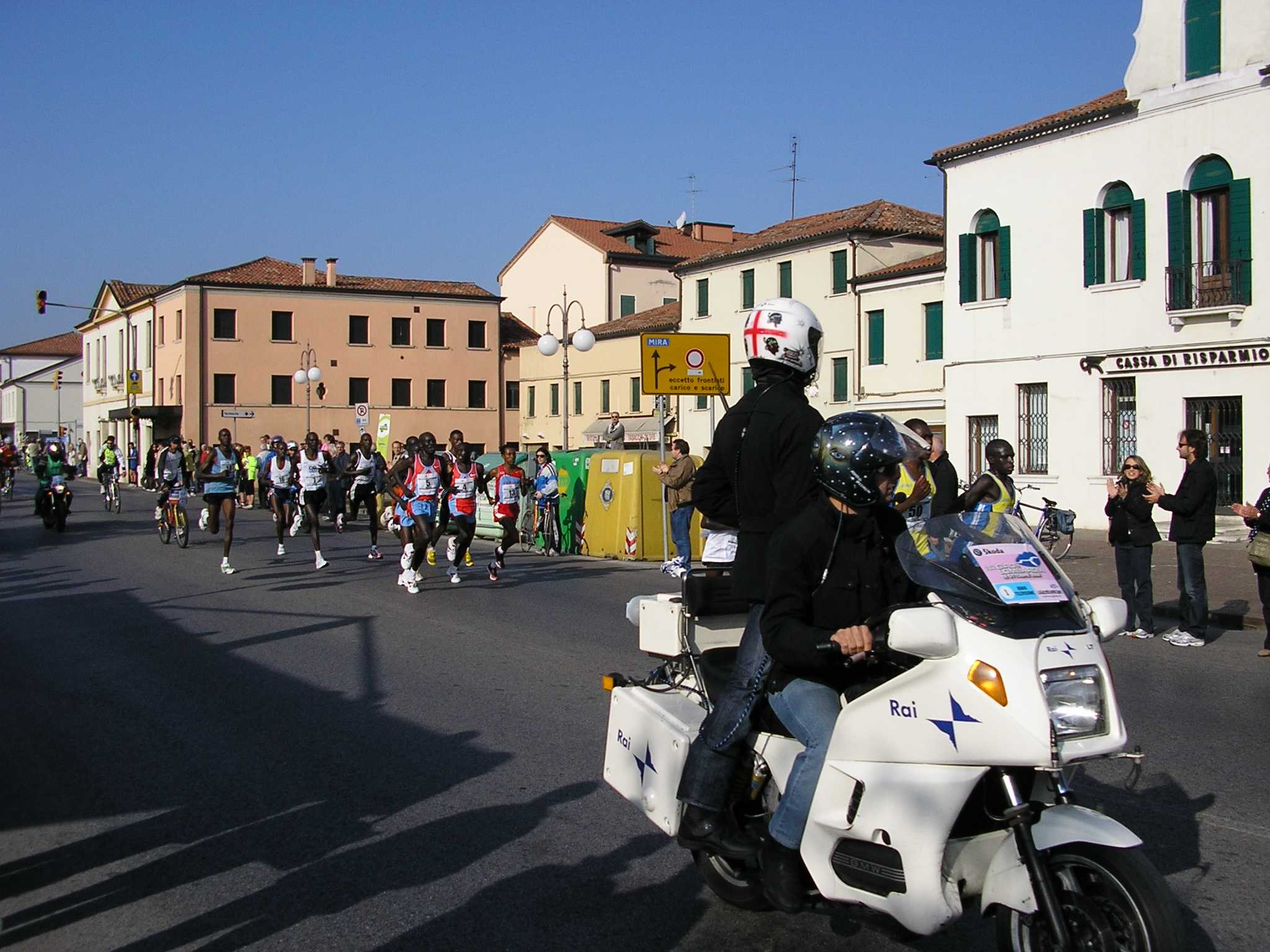
Featured photograph: an authentic image from an earlier Venice Marathon by Dariozo, Wikimedia Commons, CC BY-SA 3.0. It does not depict the 2026 edition.
Explore related Venice stories
To put this subject into a wider Venetian context, explore the different boats that keep Venice moving, the engineering that supports the floating city and Venice’s water entrances and boat access. Each offers a complementary perspective on the city’s history, daily life, or cultural heritage.
More useful Venice reading
Continue with private ways to explore at your own pace; a relaxed walk through Cannaregio. These complementary guides help connect the topic to a broader Venice visit.
Frequently Asked Questions
When is the Venice Marathon 2026?
The 40th Venice Marathon is scheduled for Sunday, October 25, 2026. Italy changes from daylight saving time to standard time overnight before the race, so double-check local clocks.
Will the Venice Marathon affect waterbuses and walking routes?
It can. The race uses major routes through Venice, and transport or pedestrian restrictions may apply. Check official 2026 notices from ACTV, the City of Venice, and the race organizer; do not rely on the previous year’s closure schedule.
Can visitors walk across the Venice Marathon floating bridge?
Do not assume so. The temporary floating bridge across the Grand Canal is installed for the race and is subject to event access and safety controls. Follow official directions and use authorized public crossings.