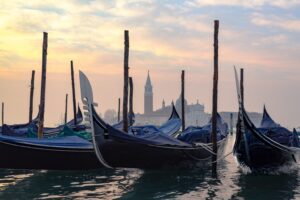
New visitors to Venice usually arrive expecting one boat: the gondola. Within about ten minutes of actually being here, that assumption falls apart — canals are busy with dozens of distinct hull shapes, from long, low working boats to blunt little motorboats loaded with groceries, and almost none of them are gondolas at all. Venice’s “floating traffic” is genuinely its own transportation ecosystem, built up over centuries around one simple fact: a boat here has always had to do a specific job, in specific water, and every hull shape you see is really an answer to that problem.
Beyond the Gondola: The Sandolo Family
If the gondola is Venice’s ceremonial vehicle, the true workhorse of the lagoon has always been the sandolo — not a single boat, but an entire family of related, flat-bottomed craft that’s been essential to ordinary Venetian life since at least the 13th century. Unlike the gondola, a sandolo is symmetrical rather than asymmetrical, simpler in construction, and was historically the boat an ordinary Venetian family could actually afford, used for everything from fishing to hauling market produce to simply getting around. I’ve written in full elsewhere about how a gondola is built and rowed; the sandolo family is really the more interesting story for understanding Venice’s everyday boat traffic, because its many branches each solved a slightly different problem.
The mascareta is the lightest and most agile of the group — small, fast, and low in the water, historically associated with discreet, informal movement around the city (local tradition, only half-serious, traces its name to the masks once worn by courtesans who favored it). Today you’ll mostly see it in women’s rowing regattas, since its light weight and simple construction make it an ideal training boat.
The pupparin, by contrast, was historically the fast car of the lagoon — a sleek, elegant boat once favored by wealthy families for its speed and refined lines, distinguished by a high, sweeping stern. It remains one of the fastest two-oared boats on the water today, second only to the gondola itself in agility, and it’s a regular fixture in Venice’s Regata Storica.
The caorlina, named for its hometown of Caorle on the mainland coast, is the heavy hauler of the family — a broad, symmetrical, flat-bottomed boat historically used to move goods and produce from the lagoon islands into the city, particularly fruit and vegetables destined for the Rialto markets. It’s rowed by as many as six people at once and today appears mainly in ceremonial regattas rather than daily commerce.
The topo rounds out the family as the classic small fishing and utility boat — recognizable by a distinctive hollowed section in the hull, originally designed to bring the day’s catch home without it sitting in rainwater. Its modern motorized descendant, the mototopo, is the single most common working boat you’ll actually see moving through Venice’s canals today — the flat-decked, high-sided little cargo boat that delivers everything from restaurant supplies to furniture, essentially the delivery van of the lagoon.
The Batela — Venice’s Everyday Cargo Boat
Sitting slightly apart from the sandolo family proper is the batela, historically the single most commonly used cargo boat in Venice — a wide, stable, flat-bottomed vessel built for hauling goods rather than speed or elegance. For centuries this was the boat you’d have seen constantly crisscrossing the canals loaded with merchandise, the direct ancestor of the motorized delivery boats that do the same job today. It’s a good reminder that Venice’s romantic reputation for gondolas obscures a much longer, much more practical relationship with boats as simple working transport, no more glamorous than a delivery truck.
The Utility Fleet: Venice’s Everyday Motorboats
Beyond the traditional rowing craft, Venice runs an entire modern working fleet on largely unadorned motorboats, distinguishable mostly by livery and shape rather than hull tradition. The motoscafo is the general term for these motorized boats — used as private water taxis, ambulances, and police launches, each marked with distinctive coloring and insignia that make them easy to identify at a glance once you know to look: ambulance boats typically carry medical crosses and sirens just like their land counterparts, police boats carry official markings, and the city even maintains a dedicated funeral boat, ornately built with a canopied section for a coffin, historically modeled on the hull shape of the caorlina and batelon. I’ve covered water taxis specifically, in far more practical detail, in my dedicated water taxi guide — worth reading if you’re planning to actually use one rather than just spot one from a bridge.
Reading the Traffic Like a Local
Once you know roughly what you’re looking at, watching Venice’s canals stops feeling chaotic and starts feeling like reading a very specific, very old system of traffic. A long, narrow, asymmetrical black boat with a curved steel prow is a gondola, almost certainly carrying tourists rather than locals — I’ve written separately about exactly how those are built and rowed. A flat-decked, high-sided little cargo boat, usually piled with crates or building materials, is very likely a mototopo making a delivery. A lighter, symmetrical rowing boat, especially one with a rower standing rather than seated, is some variant of the sandolo family — and if you happen to catch one during regatta season, cutting fast and low through the water with a rower in colorful racing kit, that’s very likely a mascareta or pupparin competing rather than commuting.
That variety is really the point. Venice never had cars, but it never lacked for transportation options either — it simply built an entire specialized fleet, purpose by purpose, out of wood and water instead of asphalt and rubber. Learning to tell a caorlina from a batela won’t change your trip, but it will change how you watch the canals go by, and after nearly thirty years on this water, that’s still one of my favorite things to point out to a first-time guest.
Seeing the Real Working Lagoon
Most visitors experience exactly one Venetian boat firsthand — the gondola, for a fixed, scenic loop. If you’d like to actually get out on the water in one of these other traditional craft, or simply want a private route that includes a proper look at Venice’s working boatyards and rowing culture, get in touch directly and I’ll build a day around exactly that. And if a full day on open water sounds appealing, a private day trip to the Prosecco Hills trades canal traffic for open countryside, with a very different kind of glass in hand.
What’s the difference between a gondola and a sandolo?
A gondola is asymmetrical, built specifically to be rowed by a single oarsman standing on one side, while a sandolo is symmetrical, simpler in construction, and historically the everyday working boat of ordinary Venetian families rather than a ceremonial craft.
What is the small motorized cargo boat I keep seeing in Venice’s canals?
That’s almost certainly a mototopo, the modern motorized descendant of the traditional topo fishing boat, now used throughout the city for deliveries of everything from restaurant supplies to furniture.
Can visitors ride in any of Venice’s traditional boats besides the gondola?
Yes — several rowing clubs and private guides offer trips in a sandolo, caorlina, or other traditional craft, often as a quieter and more active alternative to a standard gondola ride, and it’s something I can arrange as part of a private tour.