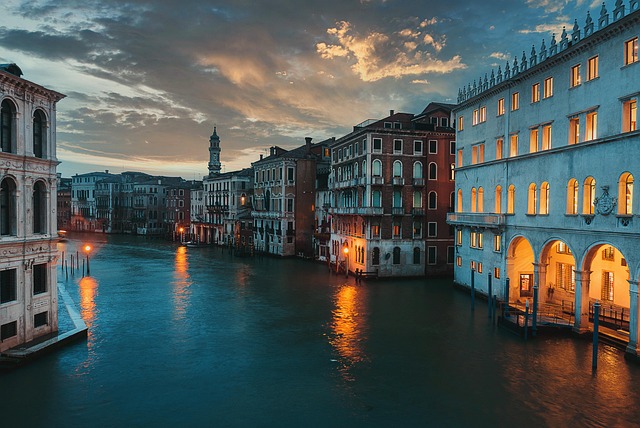
Every visitor asks me the same question at some point during a tour: how does a city just… sit here, in the middle of a lagoon, without sinking? It’s a fair question. Venice looks impossible. And the truth is even more remarkable than most people expect — this city isn’t floating at all. It’s standing, on a forest buried beneath it.
Venice Doesn’t Float — It Stands on a Hidden Forest
The biggest misconception about Venice is right there in its nickname, “the Floating City.” Nothing floats. Every building, every campanile, every palazzo along the Grand Canal is supported by wooden piles driven straight down through soft lagoon mud until they hit a layer of dense, compact clay called caranto. That clay, not the water above it, is what actually bears the weight of the city.
The process itself was extraordinarily labor-intensive. Early Venetian builders drove alder, oak, and larch piles — typically just a few meters long and modest in diameter — into the marshy islands of the lagoon, sometimes packing them so densely that a single building’s foundation could rest on thousands of them. Alder was prized in particular because of a strange, almost counterintuitive property: submerged in oxygen-poor mud, it doesn’t rot. It petrifies. Over centuries, mineral-rich water gradually hardens the wood until it becomes almost stone-like, as durable as the buildings it holds up.
Why the Wood Never Decayed
This is the detail that surprises people most on my tours: wood rots when it’s exposed to both oxygen and water together. Venice’s genius, largely unintentional at first, was burying its foundations in an environment with plenty of water but almost no oxygen. The thick, silty mud of the lagoon sealed the piles off from the air entirely. Without oxygen, the fungi and bacteria that normally break down timber simply can’t survive. The result is foundations that have held for well over a thousand years — quietly mineralizing rather than decaying, growing harder with time instead of weaker.
From Piles to Palaces: The Building Sequence
Once the piles were driven into the clay, builders didn’t construct directly on top of the timber. A typical Venetian foundation followed a careful layering process:
Wooden piles, driven deep into the caranto clay layer
Horizontal wooden planking, laid across the tops of the piles to distribute weight evenly
A layer of Istrian stone, a dense, nearly waterproof limestone quarried from the Istrian peninsula (in modern Croatia), placed as a barrier between the timber and the masonry above
Brick and stone construction, rising from that stone platform to form the building itself
Istrian stone deserves its own mention — it’s the pale, almost luminous material you see along the waterline of nearly every historic building in Venice. Its density made it resistant to the corrosive effects of saltwater, which is precisely why it was used at the base of buildings and along canal edges, where the damage from tides and humidity is most severe.
An Entire City, Sourced From Elsewhere
One detail that genuinely surprises my American clients: Venice has almost no timber of its own. The forests that supplied the millions of piles beneath the city came from the mainland — from the foothills of the Alps, from Istria, and from as far as modern-day Slovenia and Croatia. Logs were floated down rivers and across the Adriatic in vast rafts, an entire supply chain built just to keep a treeless lagoon city standing.
That dependency shaped Venetian law itself. The Republic treated its mainland forests as a strategic resource, regulating logging carefully to make sure the supply of pile-worthy timber wouldn’t run out. In a very real sense, Venice’s survival was tied to forest management centuries before anyone used that term.
The Extreme Case: Santa Maria della Salute
If you want to see this engineering pushed to its absolute limit, stand at the mouth of the Grand Canal and look at Santa Maria della Salute. Built as a votive offering after the plague of 1630, Longhena’s octagonal Baroque church required a staggering number of piles — commonly cited at over one million — driven into the unstable ground of Punta della Dogana before construction could even begin. It took over fifty years to complete, largely because the engineering itself was so demanding. It remains, to this day, one of the most photographed silhouettes in the world — a direct result of foundation work most visitors never think to look for.
A City Built to Move With the Water, Not Against It
What’s easy to miss, standing in a sunlit campo today, is that Venice’s builders weren’t fighting the lagoon — they were working with its logic. Buildings were kept relatively light through the use of brick rather than heavy stone for upper floors, with Istrian stone reserved for the base, where strength against water mattered most. Facades were designed to flex slightly rather than crack under the constant, almost imperceptible settling that happens in soft ground. Even the city’s canal network, often mistaken as an afterthought, was integral to construction — every stone, every timber pile, every brick had to arrive by boat, which shaped how and where the city could physically grow.
This is part of why Venice feels so different from any other historic European city when you walk it slowly. Nothing here was accidental. The engineering is quiet, mostly invisible, and completely load-bearing in every sense.
Why This Still Matters Today
Venice’s foundations have held for centuries, but they weren’t built for the Venice of today — rising sea levels, increased boat traffic, and the slow subsidence of the city into the lagoon are putting real pressure on a system engineered for an entirely different era. Acqua alta events are becoming more frequent, and much of the modern conservation work in Venice, including the MOSE flood barrier system, exists specifically to buy this thousand-year-old engineering more time.
Understanding this history changes how you see the city. It’s not just beautiful — it’s an active, ongoing act of preservation, and every building you walk past is still, quite literally, standing on borrowed forest.
If this kind of detail is what you want from your time in Venice — not just what to photograph, but how and why the city actually works — this is exactly the layer of history I build into my private Venice tours. It’s also worth pairing with a slower day away from the crowds; many of my clients combine their time in the city with a day trip into the Veneto countryside, where you can see the same landscape that once supplied Venice’s timber and stone.
Is Venice actually built on water, or does it just look that way?
Venice stands on solid ground — wooden piles driven through the lagoon’s soft mud into a dense clay layer called caranto. The buildings rest on that clay, not on the water itself.
Why didn’t the wooden foundations rot after hundreds of years?
Wood decays when exposed to both oxygen and water. Venice’s piles are buried in oxygen-poor mud, which prevents the fungi and bacteria that cause rot from surviving — and over time, mineral-rich water actually hardens the wood further.
Where did Venice get enough wood to build an entire city?
Venice had almost no local timber. Piles were sourced from mainland forests in the Alps, Istria, and present-day Slovenia and Croatia, then floated down rivers and across the Adriatic to the lagoon.