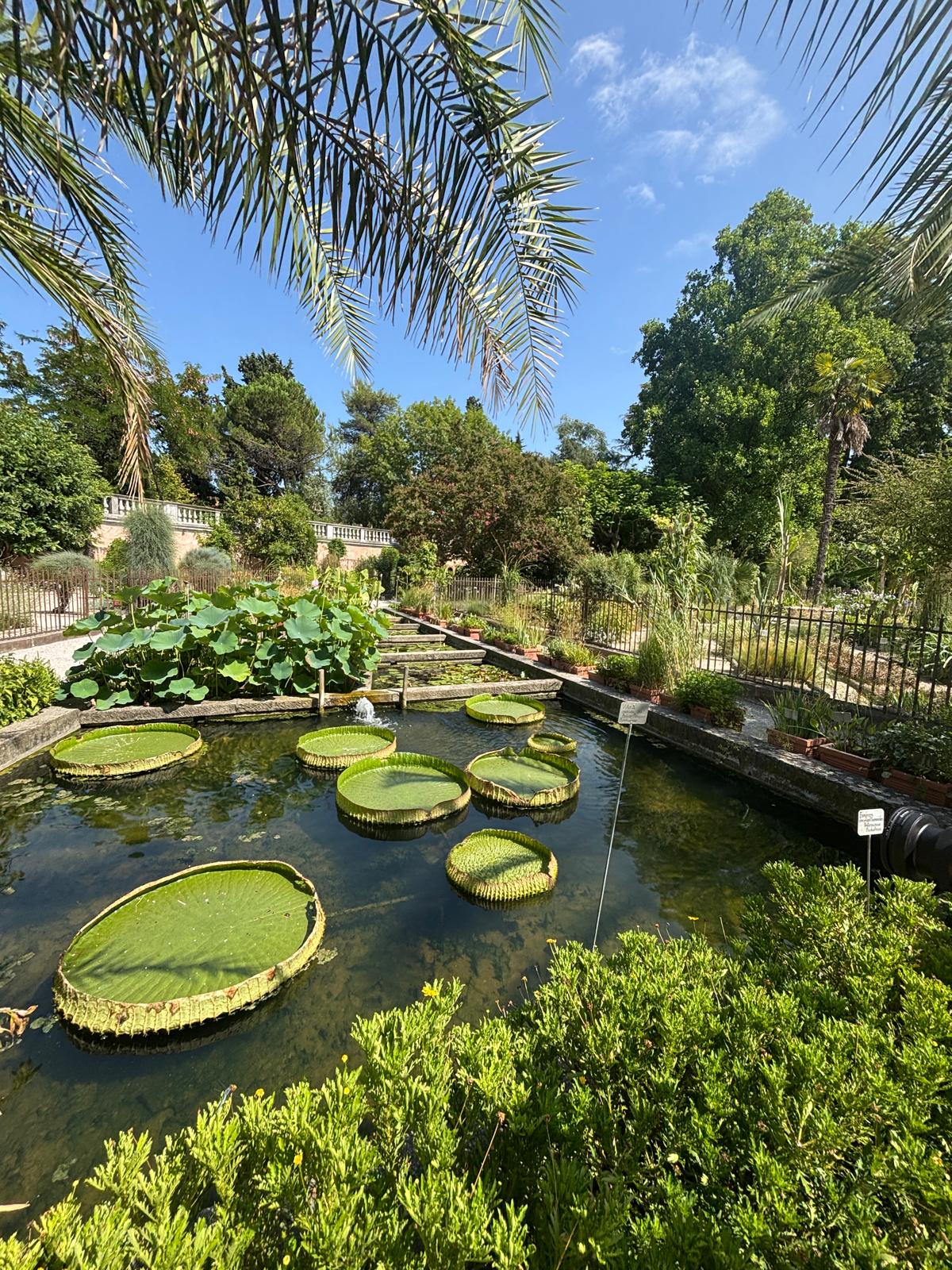
Most visitors who make it to Padua spend their time inside buildings, the Scrovegni Chapel, the Palazzo della Ragione, Palazzo Bo. A short walk from all three, tucked between Prato della Valle and the Basilica of St. Anthony, sits something quieter and, in its own way, just as consequential: a walled circular garden planted in 1545, the oldest university botanical garden anywhere in the world still standing in its original location, still doing essentially the same job it was built for nearly five hundred years ago.
A Garden Built to Stop People From Dying
The Orto Botanico di Padova wasn’t created for beauty, though beauty followed. It was founded in 1545 by the Senate of the Venetian Republic, at the direct request of the University of Padua’s medical faculty, to solve a genuinely life-or-death problem. Medieval and Renaissance medicine relied heavily on “semplici,” medicinal herbs and natural remedies, the Latin root of the English word “simple” in its older sense of a single, unprocessed healing ingredient. The trouble was identification. Many medicinal plants closely resemble toxic look-alikes, and physicians and apothecaries working only from imprecise written descriptions and hand-copied illustrations regularly misidentified them, sometimes fatally. A dedicated garden, where students could study living, correctly labeled specimens in person rather than relying on secondhand text, was a direct, practical response to that danger. For this reason, the garden’s original name wasn’t botanical at all in the modern sense; it was called the Hortus Simplicium, the Garden of Simples.
The garden’s first director, or prefect, was Luigi Squalermo, known by his nickname l’Anguillara, who built the original collection up to roughly 1,800 different plant species, an extraordinary number for the time, gathered specifically to give medical students direct, hands-on exposure to the natural materials their future practice would depend on. It worked well enough, and mattered enough to the wider intellectual world, that the Padua garden quickly became the template every subsequent European university botanical garden would follow.
A Garden Shaped Like the Universe
What makes the Orto Botanico genuinely remarkable, beyond its age, is that it still preserves its original Renaissance layout almost entirely intact, a design that wasn’t simply practical but deliberately cosmological. At the garden’s core sits a circular central plot, symbolizing the world itself, surrounded by a ring of water representing the ocean. Inscribed within that circle is a square, divided into four equal units by orthogonal paths aligned precisely with the cardinal directions. It’s a geometric scheme with genuinely ancient roots, echoing garden and city designs used since antiquity and revived deliberately by Renaissance architects across the 15th and 16th centuries as a way of expressing humanity’s ordered, rational understanding of the natural world, the same intellectual instinct that, just a few streets away, produced the Palazzo della Ragione’s zodiac-covered ceiling and the University’s permanent Anatomical Theatre.
A low perimeter wall originally enclosed the garden, serving two purposes at once: protecting valuable, sometimes toxic specimens from theft or grazing animals, and controlling exactly who had access to plants that, handled incorrectly, could easily cause harm. Over the centuries, additional elements were layered onto that original core without disrupting its fundamental geometry: ornamental gates and stone balustrades added for architectural refinement, along with more practical additions like pumping installations and greenhouses that let the garden’s caretakers cultivate species from climates Padua’s own weather could never naturally support.
Living History: Plants Older Than the United States
Remarkably, several of the garden’s historic plantings are still alive today, genuine living artifacts rather than replaced replicas. The most famous is a dwarf palm planted in 1585, still growing more than four centuries later inside its own dedicated iron-and-glass enclosure, built in the 18th century specifically to shelter it through Padua’s winters. The palm earned lasting fame when Johann Wolfgang von Goethe studied it closely during his visit to Padua in 1786, examining its unusual leaf structure as part of the observations that would later feed directly into his theoretical writing on the underlying unity and transformation of plant forms. It’s still known today, informally but universally, as Goethe’s Palm, a rare case of a single specific tree playing a genuine, documented role in the history of botanical philosophy rather than simply botanical science.
Elsewhere in the garden, an enormous plane tree planted in 1680 has grown into a gnarled, hollow-trunked giant, and a magnolia dating to 1786 ranks among the first specimens of its kind ever cultivated in Europe. Walking past these specific trees means walking past living organisms that were already mature when Galileo’s own students were still being taught a short walk away at Palazzo Bo, a kind of direct, unbroken continuity with the Renaissance that a restored building, however faithfully maintained, simply can’t replicate.
A Garden That Shaped How Science Organizes the Natural World
The Orto Botanico’s influence extends well beyond its own walls. Its careful, systematic approach to organizing, labeling, and exchanging plant specimens with botanical gardens across Europe helped establish practices that fed directly into the broader European scientific tradition of classification, the same intellectual lineage that would culminate, two centuries later, in the formal taxonomic system developed by the Swedish naturalist Carl Linnaeus. Nearly every university botanical garden built in Europe in the centuries following 1545 owes something, directly or indirectly, to the model Padua established first, both in its physical layout and in its underlying purpose: a living collection organized for genuine scientific study rather than purely ornamental display.
That scientific mission never actually stopped. The garden’s herbarium and historical library remain, to this day, among the most significant of their kind anywhere in the world, and the Orto continues to function as an active center for research and plant conservation, a genuinely rare case of an institution built in 1545 still doing recognizably the same job, for recognizably the same reasons, nearly five hundred years later.
UNESCO Recognition
The Orto Botanico di Padova was inscribed on the UNESCO World Heritage List in 1997, recognized under two criteria. The first credits the garden as a source of inspiration for countless other botanical gardens across Italy and Europe, shaping both their architectural design and their scientific and educational approach to studying medicinal plants and related disciplines. The second recognizes the garden’s broader historical role: as the world’s first university botanical garden, it stands at the literal origin point of an entire category of scientific institution, a physical testimony to how the exchange of plants, ideas, and knowledge helped shape the birth of modern botanical science itself.
The Modern Garden: The Biodiversity Garden
The Orto’s most significant recent addition arrived in 2014 with the opening of the Giardino della Biodiversità, the Garden of Biodiversity, a large modern complex of five interconnected greenhouses, each recreating a distinct climate zone found around the planet, from tropical rainforest to arid desert, using contemporary climate-control technology to sustain species the original Renaissance garden could never have supported in Padua’s open air. It’s a thoughtful, complementary addition rather than a distraction from the historic core: the circular Renaissance garden shows visitors how 16th-century science first approached the systematic study of the natural world, while the Biodiversity Garden shows the same institution continuing that exact mission today, adapted to a modern understanding of global plant ecosystems.
Today the garden spans roughly 3.5 hectares in total, home to more than 6,000 individual plant specimens representing over 3,500 species, and draws upward of 180,000 visitors a year, a genuinely significant number for a garden that began, in 1545, as a working teaching tool for a comparatively small circle of medical students.
Visiting the Botanical Garden Today
The Orto Botanico sits within easy walking distance of Prato della Valle and the Basilica of St. Anthony, making it a natural stop to pair with either on a Padua day. Visitors can explore independently, with admission including an audio guide (a dedicated children’s version, AudioPen Kids, is also available), or join a guided tour for a more in-depth walk through the garden’s history and collections. Beyond its permanent collections, the garden hosts an annual spring festival, Risvegli, dedicated to science and nature, along with a rotating calendar of exhibitions and events throughout the year, and combined tickets are available covering the Botanical Garden alongside Palazzo Bo and the university’s Museum of Nature and Man, a sensible pairing given how directly the garden’s founding purpose grew from the same medical faculty responsible for the Anatomical Theatre a short walk away.
Plan your visit: Padua Day Trip from Venice: Why Visit and What to See covers how to build the Botanical Garden into a full Padua itinerary alongside the Scrovegni Chapel, Palazzo Bo, and the city’s other highlights.
Frequently Asked Questions
Why was the Botanical Garden of Padua founded? It was founded in 1545 by the Venetian Republic’s Senate, at the request of the University of Padua’s medical faculty, to let students study medicinal plants, “semplici,” directly and correctly identify them in person, addressing a real, sometimes fatal problem with misidentifying medicinal herbs based on imprecise written descriptions alone.
Is the original 16th-century garden design still visible today? Yes. The garden preserves its original Renaissance layout almost entirely intact: a circular central plot symbolizing the world, surrounded by a ring of water representing the ocean, with a square inscribed inside the circle divided into four sections by paths aligned with the cardinal directions.
How long should I plan for a visit to the Botanical Garden? A focused visit, covering both the historic circular garden and the modern Biodiversity Garden greenhouses, takes about an hour to ninety minutes. It pairs naturally with a visit to the nearby Basilica of St. Anthony or Prato della Valle as part of a broader Padua day.