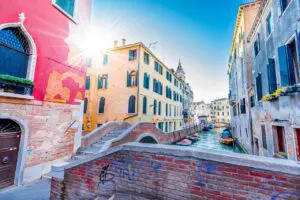
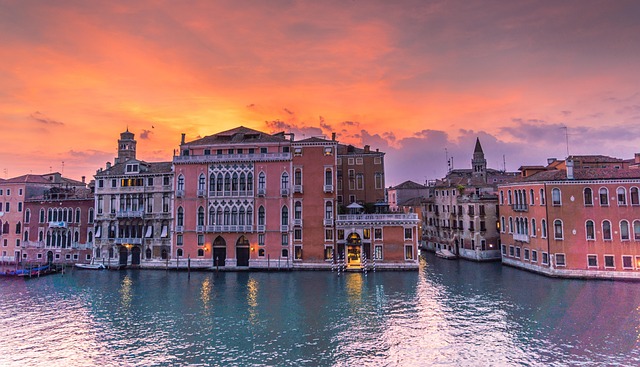
Ask any first-time visitor to read a Venice street sign out loud and you’ll usually get a confused pause, then a laugh. Rio Terà dei Assassini. Calle del Vento. Ponte delle Tette. These aren’t jokes or tourist gimmicks — they’re genuine, centuries-old street names, still used on maps and mail today, and each one is a small fossil of the neighborhood’s actual history. After thirty years of walking these calli, I still enjoy watching a guest’s face change when I tell them what the street they’re standing on is actually named for. Here are fifteen of my favorites.
1. Rio Terà dei Assassini — Street of the Assassins
Near San Marco and near La Fenice, this filled-in former canal carries one of Venice’s most notorious names. In the medieval period, the area was genuinely dangerous after dark — there was no street lighting, and the narrow, poorly lit passage made it a favored spot for robbery and worse, which is exactly how it earned its name. There are, in fact, two streets in Venice bearing this same unsettling title, in different corners of the city, both with similarly grim reputations from the era.
2. Riva del Vin — The Wine Dock
Right along the Grand Canal near the Rialto, Riva del Vin was, quite literally, where wine barrels were unloaded from boats arriving from the mainland and the islands. It’s one of the more straightforward names on this list, but it’s a good reminder that most “riva” and “fondamenta” names started life as functional labels for a specific unloading dock — this one just happened to specialize in wine, and it’s still one of the liveliest waterside spots in the city for a glass today.
3. Calle del Vento — Windy Street
Anyone who’s ever felt a sudden, inexplicable gust funnel through a narrow Venetian alley on an otherwise still day understands exactly how Calle del Vento got its name. Certain calli, thanks to their alignment relative to the surrounding canals and taller buildings, genuinely do create localized wind tunnels — and Venetians, with their usual talent for naming a street after exactly what happens on it, simply called this one what it was.
4. Calle del Forno — Bakery Street
This name almost certainly refers to a bakery that once operated on the street, and it’s part of a huge family of Venetian street names built around a single vanished trade. You’ll find versions of this pattern all over the city — Calle dei Fabbri for the blacksmiths, Calle del Squero for the boat builders, each one a small directory entry for a business that closed centuries ago but whose name never left the map.
5. Frezzaria and Spadaria — Arrow Street and Sword Street
Near Piazza San Marco, two streets sitting close together preserve Venice’s old weapons trade in their names. Spadaria was named for the sword-makers who once worked there, and Frezzaria for the arrow-makers. Standing in the middle of what’s now a very fashionable shopping stretch, it’s worth remembering that this exact corridor once supplied the Republic’s military hardware.
6. Calle del Paradiso — Paradise Street
One of several Venetian street names with a religious origin, Calle del Paradiso likely takes its name from a roadside shrine that once stood along it — the kind of small devotional capitello I’ve written about elsewhere on this site. It sits near a beautifully preserved Gothic archway that still spans the street, making the name feel appropriately grand for what’s actually a fairly modest little calle.
7. Ruga Vecchia San Giovanni — Also Known as Ruga Rialto
A “ruga” was historically a street with compacted, walkable ground and shops lining both sides — essentially Venice’s old high street format — and this particular one, still known locally simply as Ruga Rialto, is one of the most famous surviving examples. It’s been a commercial spine of the city for the better part of a millennium, and it still functions that way today, lined with shops just as it always was.
8. Rio Terà dei Pensieri — Street of Thoughts
One of the more poetic names on any Venetian map, Rio Terà dei Pensieri sits in Dorsoduro, a quiet buried-canal street whose name has never been definitively explained — which somehow only adds to its charm. Whatever the true origin, “the street of thoughts” is exactly the kind of quiet, unhurried lane where the name feels earned regardless of its history.
9. Rio Terà Barba Frutariòl — Uncle Fruit-Seller’s Filled Canal
This wonderfully specific name translates roughly to “canal filled by the fruit vendor uncle,” commemorating, almost certainly, a real local fruit seller whose presence on the street was memorable enough to survive the transformation of the canal into dry land. It’s a small, human-scale example of how casually Venice’s toponymy absorbed ordinary neighborhood characters into its permanent record.
10. Calle degli Specchieri — Mirror-Makers’ Street
Another trade-based name, this one honoring Venice’s mirror-making artisans — a fitting occupation for a city built on Murano glass, whose reflective techniques were, for a period, some of the most closely guarded trade secrets in Europe.
11. Calle della Malvasia — Malmsey Wine Street
Named for the sweet Malmsey wine imported through Venice from Crete and the Greek islands during the Republic’s trading heyday, these streets — there are a few scattered across the city — mark where the taverns selling this particular import once clustered. Malmsey was genuinely prestigious in its day; Venice controlled much of its trade route into Western Europe.
12. Calle dei Preti — Priests’ Street
A common name pattern found near many parish churches, marking streets historically associated with clergy housing or church administration. You’ll find versions of this name scattered through nearly every sestiere, always within a short walk of the relevant church.
13. Sotoportego del Tagiapiera — Stonecutters’ Passage
Tucked beneath a building rather than running between them, this covered passage preserves the memory of the stonecutters — the tagiapiera — who would have worked the very Istrian stone used to build the city around them. It’s a small, easy-to-miss example of a sotoportego, the covered passageways formed when Venetians expanded their homes outward over the street below.
14. Ponte delle Tette — A Name I’ve Told the Full Story Of Elsewhere
I’ve covered the genuinely remarkable history behind this bridge’s name — tied to a specific, state-sanctioned chapter of Venetian social history in the Carampane district — in full detail in my hidden-history walking guide. It’s one of the most-asked-about street names in the city, and it earns every bit of the attention.
15. Ponte dei Pugni — The Fist-Fighting Bridge
Also given its full treatment in that same hidden-history piece, this bridge’s name commemorates the organized, bare-knuckle neighborhood brawls once staged on and around it — a genuinely wild piece of Venetian civic history that I won’t repeat here, but that’s absolutely worth reading if you haven’t already.
Why the Names Are Worth Learning Before You Go
None of these fifteen names appear on a standard tourist map with any context attached — you’ll just see the word, unexplained, on a nizioleto sign as you pass beneath it. But once you know a handful of these stories, an ordinary walk through Venice turns into something closer to reading a very old, very specific diary the city kept about itself. That’s really the heart of what I try to give guests on a private walk: not just where to stand for a photograph, but what the ground beneath them is actually telling them.
If you’d like a walking route built around these kinds of stories — strange names, hidden shrines, forgotten trades — get in touch directly and we’ll design something personal rather than a fixed script. And for a fuller grounding in what the different street types themselves mean, my guide to Venice’s street naming system is a good companion read before you land.
Why does Venice have streets named after assassins and fistfights?
Many Venetian street names simply describe something notable that happened there historically — a crime, a brawl, a trade practiced on the spot — rather than honoring a person or a modern civic decision, which is why the names can feel so vivid and specific.
Are these strange street names still used today?
Yes — Venice’s historic street names are still the official names used on maps, mail, and the nizioleti street signs painted directly onto building walls, unchanged for centuries in most cases.
What’s the best way to actually find these streets while exploring Venice?
A physical or offline map is more reliable than GPS in much of the historic center, since the layout doesn’t follow a grid — but the real reward comes from walking slowly and looking up at the nizioleti themselves rather than rushing between fixed points.