
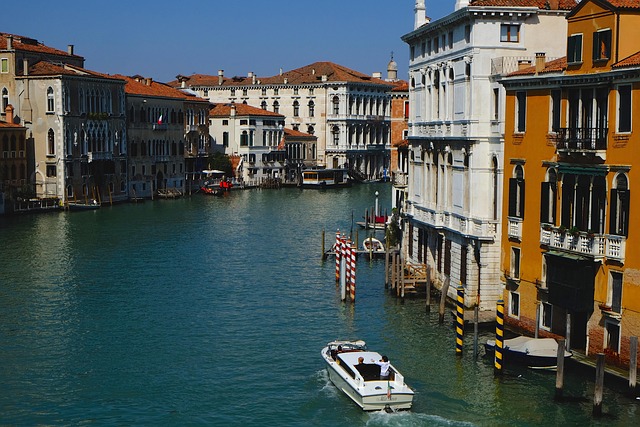
Look down instead of up on almost any Venetian canal and you’ll notice something that rarely makes it into guidebooks: stone steps, descending in short, even flights directly into the water, often stopping at nothing in particular — no door, no landing, just steps disappearing beneath the surface. These are Venice’s watersteps, sometimes called passaggi, and they’re one of the most overlooked pieces of the city’s everyday infrastructure — a feature so ordinary that most visitors walk past dozens of them without ever really seeing them, and so functional that Venetians have depended on them for the better part of a thousand years.
Built for a City With No Sidewalk to Water
The basic engineering logic is simple enough once you notice it: a fondamenta, Venice’s canalside walkway, sits at a fixed height, but the water beside it doesn’t — it rises and falls with the tide by as much as a meter or more over a six-hour cycle. Watersteps exist to bridge that constantly shifting gap, letting a person, a boat, or a bucket reach the water regardless of whether the tide happens to be in or out at that particular hour. Some are set directly into the fondamenta itself; others, studied and mapped in a detailed cataloguing project examining the city’s watersteps, are supported on stone corbels jutting from the canal wall, extending below the normal low-tide line so that during a full drainage or reconstruction project, they can be found hanging in what looks like mid-air until the water returns.
Their most obvious purpose was, and still is, boat access — the easiest and most practical way to reach a moored boat from dry land, especially before Venice developed the extensive network of calli and fondamente most visitors rely on today. But watersteps did considerably more daily work than that.
The Steps That Once Doubled as Plumbing
Here’s the detail that tends to surprise people most: for centuries, Venice’s watersteps were also part of the city’s sanitation system, in a way nobody today would consider remotely pleasant. Before a proper public water supply and modern drainage existed, waste from many buildings was discharged directly into the nearest canal via a channel called a condoto, often built by simply breaking through the ground floor of an existing structure — and the tide itself did the work of flushing the city clean. The tidal exchange in Venice’s lagoon was substantial enough, and understood as essential to public health even in the Republic’s own era, that authorities reportedly paid people to sit in boats around the lagoon specifically to monitor and record tidal flows, treating a properly flushing tide as a genuine sanitation infrastructure rather than a natural curiosity. Watersteps sat right at the center of that system — the everyday point where household life met the canal that quietly carried its waste away.
They were put to gentler uses too. For generations, watersteps were where laundry was rinsed, where buckets of water were drawn for cleaning, and where countless small daily tasks that needed direct water access actually happened — genuine working infrastructure disguised as simple stone stairs.
The Line That Tells You Where the Water Really Sits
Spend enough time looking at Venice’s watersteps and canal walls and you’ll notice a consistent brownish-green band running along the stone at a fairly steady height — algae, marking the zone that’s constantly wetted by tidal movement and then exposed to sunlight, the exact conditions the growth needs to survive. It looks like grime. It’s actually one of the more remarkable natural records in the entire city.
A climate scientist studying sea-level change in Venice ran into a genuine problem: reliable tide-gauge records only go back to 1872, leaving centuries of the city’s relationship with rising water essentially undocumented by instruments. His solution was to turn to Canaletto’s paintings. Canaletto and his contemporaries painted Venice’s canals with such precision that the algae line marking the average sea level of their era is still clearly visible in their canvases today — and because that line sits independent of any single day’s tide, comparing its position across paintings from different centuries against the same identifiable buildings has let researchers reconstruct historic sea levels with genuine scientific credibility, extending the record back well before any gauge existed. It’s a wonderful thought: a slightly slimy stripe of algae on a set of canal steps, ignored by nearly everyone who passes it, turns out to be one of Venice’s most valuable pieces of climate data once you know how to read it.
A Word of Caution Before You Get Curious
If a set of watersteps catches your eye and you’re tempted to get a closer look, a genuine word of caution is worth passing on: that same algae growth that makes the steps scientifically interesting also makes them extremely slippery, and more than a few overconfident visitors have found this out the hard way, particularly at low tide when the algae-covered lower steps are briefly exposed and look deceptively walkable. They’re a lovely detail to notice and photograph from the fondamenta above. They’re not somewhere to climb down for a better angle.
A Small Detail That Explains the Whole City
I love pointing out watersteps to guests precisely because they’re so easy to overlook and so genuinely central to how Venice actually functioned for most of its history — quietly connecting dry land to tidal water at every scale of daily life, from mooring a boat to flushing a household’s waste to marking, in a slow smear of algae, exactly how high the sea has climbed over the centuries. It’s the kind of detail that rewards someone who’s already seen the postcard version of the city and wants to understand how it actually worked underneath.
If you’d like a private walk built around these overlooked pieces of Venice’s everyday engineering — watersteps, water doors, and the quiet relationship between the city and its tides — get in touch directly and I’ll design a route around exactly what interests you. And for a full day away from tidal water entirely, a private day trip to the Prosecco Hills makes a lovely, dry-land contrast.
What are Venice’s canal steps actually called?
They’re often referred to as watersteps or passaggi — stone steps built into a fondamenta or canal wall specifically to provide access to the water regardless of the tide level.
What is the greenish line visible on Venice’s canal steps and walls?
That’s algae, growing in the band constantly wetted by the tide and then exposed to sunlight. Its consistent height has allowed climate scientists to reconstruct historic sea levels using centuries-old paintings, particularly the precise canal views painted by Canaletto.
Is it safe to walk down a set of watersteps in Venice?
It’s best avoided — the algae growth that makes the steps scientifically interesting also makes them genuinely slippery, especially the lower steps exposed at low tide, and falls into the canal are a real risk.