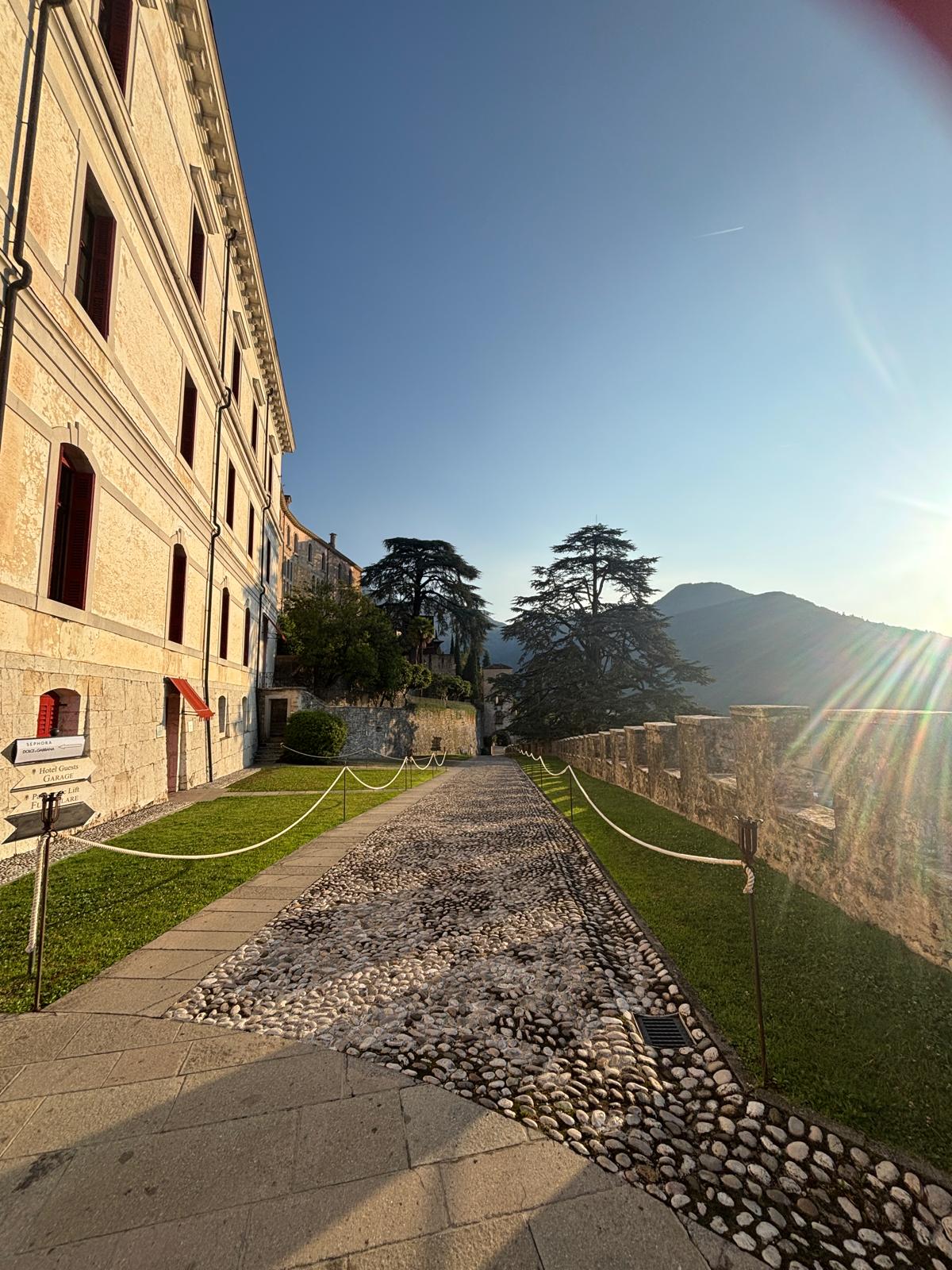
Rising on a dolomite limestone spur above the village of Cison di Valmarino, Castelbrando has watched over this stretch of the Prosecco Hills for genuinely longer than almost anywhere else in the Veneto: a Roman defensive fortress built nearly two thousand years ago, later home to a single noble family for over five centuries, briefly a Salesian retreat, and today one of the largest and most completely restored castle complexes in Italy, functioning as a hotel, spa, museum, and theater all at once. Few single buildings anywhere in the region let you trace this much continuous history under one roof.
Built by Rome to Guard the Alps
Castelbrando’s origins reach back to the Roman era, when the site, then known as Castrum Costae, was built as a defensive fortress around 46 AD, part of a broader network of fortifications protecting the vital communication and trade routes connecting northern Italy with territories across the Alps. Positioned on its dolomite limestone outcrop at roughly 370 meters above sea level, overlooking both Cison di Valmarino and the neighboring settlement of Valmareno, the site offered exactly the kind of commanding, defensible position Roman military planners consistently favored for controlling strategic mountain approaches.
Remarkably, genuine physical traces of that Roman origin survive at Castelbrando today, not simply documented in records but still visible on site. Excavated Roman baths remain part of the complex, now integrated into the castle’s modern spa area, a genuinely striking continuity between ancient and contemporary use of the exact same space. A well-preserved Roman oven survives elsewhere in the complex, and archaeological excavation in the courtyard uncovered the original piping of an ingenious ancient hydraulic system, channeling water from three exceptionally pure natural springs, the same three springs that, remarkably, still supply water to the castle today, nearly two thousand years after Roman engineers first tapped them.
The site’s strategic value didn’t end with Rome’s decline. Archaeological and historical evidence shows the location remained continuously significant through the pre-Roman Paleoveneto period and continued serving as a fortified position through the Ostrogothic and Lombard periods that followed the fall of the Western Roman Empire, each successive power recognizing the same defensive advantages that had drawn Roman engineers here in the first place.
From Roman Ruin to Medieval Stronghold
The fortress that forms the medieval core of today’s Castelbrando took shape toward the end of the 12th century, when a proper military structure was erected on the Roman foundations. The following century, the Da Camino family, powerful feudal lords across this stretch of the Treviso foothills, transformed the site into a genuinely habitable residence, adding a central tower and crenellated defensive walls around the existing structure, works that still form the medieval backbone of the complex visible today.
The Brandolini Dynasty: 523 Years, One Family
The event that defined Castelbrando’s identity for the following five centuries took place in 1436, when the Republic of Venice granted the fiefdom of Valmareno, including the fortress itself, to Brandolino IV and his companion in arms, Erasmo da Narni, better known to history by his nickname Gattamelata, in recognition of their military valor on the battlefield. It’s a name Venice-region travelers may already recognize: Gattamelata went on to become Captain General of the Venetian Republic’s armies, and his equestrian portrait, cast in bronze by Donatello and still standing outside the Basilica of St. Anthony in Padua, remains one of the most significant sculptural monuments of the entire Italian Renaissance. Rather than settling into the fortress himself, Gattamelata, despite being nearly seventy years old at the time, chose to continue his military career on active campaigns, leaving Brandolino to take up residence as count. Brandolino’s family, who took the castle’s name as their own, the Brandolini, and later the Brandolini d’Adda, would go on to own the fortress for an extraordinary 523 consecutive years, until 1959.
Under Brandolini stewardship, the castle grew steadily beyond its purely defensive medieval origins. In the 16th century, the family expanded the fortress considerably, adding a theater and a grand ballroom, the Salone delle Feste, while simultaneously reinforcing the site’s defenses by widening the 13th-century walls originally built by the Da Camino lords. In the 18th century, the Treviso architect Ottavio Scotti added the castle’s monumental grand staircase, the Scalone Reale, still one of the building’s most visually striking interior features, climbing through rooms and salons that together trace roughly three centuries of decorative history, from the 16th through the 18th century, in a single ascending sequence.
A Guest List Spanning Two Thousand Years
Castelbrando’s long, continuous occupation drew a genuinely remarkable cast of historical figures across the centuries, from the Roman emperor Claudius and the medieval Holy Roman Emperor Otto I, through numerous feudal counts and Venetian Republic officials, to Caterina Cornaro, the Venetian noblewoman who became Queen of Cyprus, the sculptor Antonio Canova, and, in the modern era, Queen Margherita of Italy. In 1847, the castle’s romantic medieval atmosphere caught the imagination of the writer Pietro Beltrame, who set his own fictional love story, that of Gilberto and Amelia, within Castelbrando’s walls, a small but telling sign of how thoroughly the castle had already entered regional literary imagination well before its modern restoration.
From Ruin to Retreat to Restoration
The Brandolini family’s long tenure ended in 1959, when the counts sold the property to the Salesian fathers, a Catholic religious order who used the castle for several decades as a center for spiritual study and retreat rather than a noble residence. In 1998, ownership passed again, this time to the Colomban family, led by the entrepreneur Massimo Colomban, who undertook what became a genuinely major restoration project. Colomban, whose broader career involved major architectural and engineering projects worldwide, is credited with rescuing the castle from a real period of decline and recognizing its potential as a living, functioning part of the Veneto’s cultural and natural heritage rather than a fading historic ruin.
That restoration effort reached a significant milestone in May 2023, when Castelbrando was chosen to host the first edition of the Borsa Internazionale Siti Patrimonio Mondiale, an international exchange event dedicated specifically to UNESCO World Heritage sites, a genuinely fitting honor for a castle sitting directly within the boundaries of the Prosecco Hills’ own UNESCO-listed landscape.
Castelbrando Today
Today, Castelbrando functions as one of the largest and most completely restored castle complexes in Italy, home to a four-star hotel, multiple restaurants, a genuinely extensive wellness center, the Princess Spa, spanning roughly 2,000 square meters and including an indoor pool, multiple saunas, a salt cave, and a Roman bath area built directly around the site’s ancient excavated remains, along with museum spaces, a working theater, and halls used for conferences, concerts, and private events. Visitors can reach the castle from the village below via a dedicated funicular railway, a genuinely memorable way to arrive that mirrors, in its own modern form, the same commanding hilltop approach that made this exact spot strategically valuable to Roman military engineers nearly two thousand years ago.
Visiting Castelbrando
Castelbrando sits directly between the villages of Cison di Valmarino and Follina, placing it within easy reach of both the Abbey of Follina and the wider Strada del Prosecco connecting Conegliano and Valdobbiadene, making it a genuinely natural stop, or overnight base, for anyone building a day around the Prosecco Hills. Its position roughly halfway between Venice and the Dolomites also makes it worth considering for travelers planning a longer Veneto loop rather than a single-day excursion.
Plan your visit: Explore the Prosecco Hills covers the wider Conegliano and Valdobbiadene wine country surrounding Castelbrando, and reaching out through our customized private tours page lets us build an itinerary that includes Castelbrando alongside the region’s wineries and hilltop villages.
Frequently Asked Questions
How old is Castelbrando, and what remains from its Roman origins? The site dates back to around 46 AD, when it was built as a Roman defensive fortress called Castrum Costae. Genuine Roman-era remains still survive today, including excavated baths now integrated into the castle’s spa area, a preserved Roman oven, and the original piping of an ancient hydraulic system that still channels water from the same three natural springs the Romans first tapped.
Why is the castle called Castelbrando, and who were the Brandolini family? The name comes from the Brandolini family, who received the fortress and the fiefdom of Valmareno from the Republic of Venice in 1436, granted to Brandolino IV and his companion in arms Gattamelata for their military valor. The Brandolini family owned the castle for 523 consecutive years, until 1959.
Can I visit Castelbrando today, and what facilities does it offer? Yes. Castelbrando today operates as a four-star hotel, museum, and event venue, with an extensive wellness spa built partly around the site’s excavated Roman baths, restaurants, a working theater, and a funicular railway connecting the castle to the village of Cison di Valmarino below.
How old is Castelbrando, and what remains from its Roman origins?
The site dates back to around 46 AD, when it was built as a Roman defensive fortress called Castrum Costae. Genuine Roman-era remains still survive today, including excavated baths now integrated into the castle’s spa area, a preserved Roman oven, and the original piping of an ancient hydraulic system that still channels water from the same three natural springs the Romans first tapped.
Why is the castle called Castelbrando, and who were the Brandolini family?
The name comes from the Brandolini family, who received the fortress and the fiefdom of Valmareno from the Republic of Venice in 1436, granted to Brandolino IV and his companion in arms Gattamelata for their military valor. The Brandolini family owned the castle for 523 consecutive years, until 1959.
Can I visit Castelbrando today, and what facilities does it offer?
Yes. Castelbrando today operates as a four-star hotel, museum, and event venue, with an extensive wellness spa built partly around the site’s excavated Roman baths, restaurants, a working theater, and a funicular railway connecting the castle to the village of Cison di Valmarino below.