Large cruise ships no longer pass through Venice’s San Marco Basin and Giudecca Canal as they once did. Since August 2021, Italy has restricted vessels exceeding specified limits on these protected waterways. Today, cruise passengers may be directed to Fusina, Chioggia, Trieste, or Ravenna. These are four different places, and some are far from Venice. Before booking a transfer, verify your actual terminal—not simply the word “Venice” on the cruise itinerary.
The cruise port question every traveler should ask
The most important detail on a Venice cruise reservation is not the word Venice but the actual embarkation or disembarkation terminal. A ship advertised as departing from Venice may use Fusina, Chioggia, Trieste, or Ravenna. These are different places, and a transfer that works for one can be completely unsuitable for another.
A traveler who books a hotel in the historic center and assumes the ship is a short walk away may discover an entirely different journey. Before arranging flights, private boats, or a sightseeing tour, read the final cruise documents and identify the exact terminal address, check-in time, and whether the cruise company provides its own shuttle.
What changed after the pandemic
The large-ship restriction is often described as a post-COVID change, because it took effect while travel was restarting. The legal reason, however, was not the pandemic itself. Italy introduced restrictions to protect Venice’s culturally important waterways, landscape, and lagoon environment.
From August 1, 2021, ships exceeding specified limits could no longer travel through the San Marco Basin, San Marco Canal, and Giudecca Canal. The change ended the familiar sight of very large cruise ships passing close to St. Mark’s Square. The cruise industry then developed alternative arrangements involving other berths and ports.
The actual legal rule
Italy’s 2021 decree restricted vessels on those protected waterways when they meet any of several criteria: gross tonnage above 25,000 GT, waterline hull length above 180 meters, air draft above 35 meters with a specified exception, or fuel conditions stated in the law. The rule is more precise than saying all cruise ships are banned from Venice.
This distinction matters because smaller eligible vessels may have different access possibilities, and the port network continues to evolve. The correct description is that large ships are prohibited from the protected central waterways, not that all cruising in the Venetian lagoon ceased. The official maritime authority remains the best source for operational updates.
Why the view from St. Mark’s changed
For years, large cruise ships moving through the Giudecca Canal created one of the most controversial images of tourism in Venice. The scale of the vessels contrasted dramatically with the historic skyline. Their passage raised concerns about heritage, environmental effects, navigation, and the character of the lagoon.
The restriction changed that particular route, but it did not make cruise tourism disappear. Ships and passengers have been redistributed through different terminals and ports. For visitors, the consequence is less visual and more logistical: the place where your cruise begins may be far from the historic streets you came to see.
The four names you must not confuse
Fusina is on the mainland lagoon edge within the municipality of Venice. Chioggia is a separate town at the southern end of the lagoon. Trieste is a city in northeastern Italy near the Slovenian border. Ravenna is farther south in the Emilia-Romagna region.
All four may appear in cruise marketing connected with Venice, but they are not interchangeable. The practical route from Marco Polo Airport, Santa Lucia station, or a Venetian hotel depends on which one appears on your ticket. Ask for the terminal name and berth, not merely the destination city printed in a brochure.
Fusina: close to Venice, but not in the historic center
Fusina sits on the mainland side of the lagoon, west of central Venice. It is not a neighborhood where a traveler can simply walk from St. Mark’s Square with suitcases. Its industrial and port setting is very different from the narrow pedestrian streets of the islands.
The Venice port authority inaugurated a new cruise terminal at Fusina in August 2024, reflecting the development of alternative cruise facilities. If your ship uses Fusina, check the precise terminal instructions because passenger processing, shuttle arrangements, and the actual berth can differ by operator and sailing.
How to get from a Venice hotel to Fusina
A traveler staying in the historic center may need a combination of water transport and a road transfer, depending on the cruise company’s procedures and the booked service. The appropriate pickup point is influenced by the hotel’s position, available piers, luggage, and whether a ship-arranged transfer starts elsewhere.
Do not book a generic taxi to ‘Venice port’ without clarifying the terminal. Some arrangements require passengers to report to a separate check-in or shuttle meeting point rather than drive directly to the ship. Tour Leader Venice can help assess private transfer options after reviewing the cruise line’s official embarkation instructions.
Fusina and Marghera are not identical labels
Travelers sometimes see Fusina, Porto Marghera, or Venice cruise terminal used loosely. These refer to related but not identical areas and facilities within the broader port system. A driver sent to the wrong gate may lose valuable time even if the general district is correct.
Always request the exact terminal address, berth, access gate, and any passenger check-in location. A cruise ship’s position may not be the same as the place where independent travelers are allowed to enter. Port security and passenger handling procedures take priority over directions from an ordinary mapping app.
Chioggia: a real lagoon town, not central Venice
Chioggia lies near the southern end of the Venetian lagoon. It is a historic town with canals and a maritime identity of its own, but it is not part of the pedestrian historic center of Venice. Its geography creates a substantially different transfer plan.
If a cruise itinerary says Chioggia, do not assume that the waterbus from St. Mark’s Square will deliver you to the ship. Depending on your starting point, a road transfer may be the more practical option, sometimes combined with a water transfer out of the historic center. Confirm the exact cruise berth and check-in point first.
The Chioggia timing mistake
On a map, Chioggia can appear close to Venice because both touch the lagoon. But the lagoon is not a straight road, and not every water route is suitable for a cruise transfer with luggage. Driving involves the mainland road network, while public transport can require changes.
The most important mistake to avoid is using a distance measured across water as if it were a door-to-door travel time. Allow for the actual route, luggage handling, possible traffic, and cruise check-in requirements. If you have a fixed boarding window, arrange the journey around that deadline rather than around a casual sightseeing estimate.
Trieste: a different city entirely
Trieste is a historic Adriatic port city in northeastern Italy, near Slovenia. It is not an outer district of Venice. Some cruise lines use Trieste for itineraries marketed with Venice as the cultural gateway or as part of a wider northern Adriatic journey.
For a passenger staying in Venice before the cruise, reaching Trieste usually involves a substantial intercity journey. Road transfer and rail may both be relevant depending on the ship’s actual terminal, luggage, and timing. Do not plan to leave your Venice hotel only an hour before check-in simply because the cruise brochure mentions Venice.
From Venice to Trieste by road
A private road transfer can be attractive for couples or families with several suitcases, especially when the ship has a strict check-in window. It avoids the need to handle luggage through train stations and arrange a final connection to the port. The exact journey time depends on traffic, starting point, and the terminal.
If you are staying in the historic center, a road vehicle cannot collect you directly from most hotel doors. You first need to reach a road-access point such as Piazzale Roma or another suitable connection. A coordinated water-and-road transfer can simplify the handoff, but the pickup pier and schedule must be confirmed.
From Venice to Trieste by train
Rail can be a useful alternative for travelers who prefer public transport and are comfortable with luggage. However, a train ticket to Trieste is not necessarily a ticket to the cruise gangway. The station and terminal may require a final transfer.
Check the actual train schedule, possible changes, and how long you will need to reach the port from the station. Do not assume a ship will wait for a delayed independent arrival. For travelers with limited mobility or heavy luggage, the last part of the journey may be more important than the rail fare.
Ravenna: farther south than many guests realize
Ravenna is in Emilia-Romagna, south of Venice along the Adriatic region. It is known for extraordinary early Christian and Byzantine mosaics, but its cruise facilities are not in the historic center of Venice. The port used by cruise ships is generally in the Porto Corsini area, subject to each sailing’s arrangements.
A cruise advertised as ‘Venice (Ravenna)’ should be read literally: the departure or arrival point is Ravenna, not the Venice islands. Travelers should plan an intercity transfer, not a short local taxi. The exact distance and duration vary with the route and the departure point.
From Venice to Ravenna by private transfer
For travelers beginning in a Venice hotel, a private transfer toward Ravenna can combine the first water leg out of the historic center with a road vehicle for the longer journey. The arrangement may be particularly valuable when several guests are traveling together or carrying large suitcases.
The exact price and travel time depend on the pickup location, number of passengers, luggage, vehicle type, and final cruise terminal. Do not trust a fixed online estimate that omits the water transfer. A properly coordinated service should state where guests meet the host, where they change vehicles, and what is included.
From Venice to Ravenna by public transport
Independent travelers can consider rail and other public-transport connections, but these may require changes and a separate final transfer to the cruise terminal. A schedule that looks inexpensive can become stressful when a ship’s boarding deadline is close.
Before choosing public transport, calculate the whole journey from the hotel to the port gate. Include the walk or waterbus to the station, time with luggage, train connections, and any local transport after arrival. If your cruise documents require early check-in, build in enough margin for disruption.
Where Venice Marittima fits today
Venice’s historic cruise facilities at Marittima remain part of the wider passenger-port story, but a traveler must not assume every large ship now uses them in the old way. Some cruise arrangements involve different berths, terminals, and organized passenger transfers.
The port’s operating model has changed over time, and marketing descriptions do not always explain the entire process. If your paperwork says ‘Venezia Terminal Passeggeri,’ look for the precise terminal and meeting point. A general company name is not enough to determine where a driver should take you.
How far are these ports from Venice?
Fusina is on the lagoon’s mainland edge, making it geographically much closer than Trieste or Ravenna. Chioggia is south of the lagoon and requires a distinct route. Trieste and Ravenna involve longer intercity travel, in different directions from Venice.
Instead of giving a universal number of minutes, which would be misleading, request a route estimate for your exact hotel, departure date, and ship terminal. Traffic, bridge access, boarding arrangements, and luggage can change the result. A realistic transfer estimate is door to door, not a straight line drawn on a map.
Marco Polo Airport is not a cruise terminal
Venice Marco Polo Airport is the region’s principal airport for many international arrivals, but it is not the departure point for cruises. If your ship leaves from Trieste or Ravenna, landing at Marco Polo still leaves a significant onward journey.
Check whether your cruise line provides an airport-to-port shuttle and whether it is included in your fare. If not, arrange a transfer independently. For flights arriving on the same day as embarkation, allow for baggage delays and other disruptions. A pre-cruise hotel night can be worth considering when the port is far from the airport.
Treviso Airport and other arrival airports
Some travelers use Treviso Airport, while others arrive through Bologna or Trieste depending on flight availability and the cruise port. The best airport is not necessarily the one whose name is most closely associated with Venice.
Compare the full journey rather than the airfare alone. A cheaper flight can require a longer or more complicated ground transfer. Ask for the ship’s confirmed berth and check-in window before choosing an arrival airport. This is particularly important for American travelers connecting from long-haul flights.
The day before the cruise
A pre-cruise stay in Venice can be wonderful, but it should be planned around the actual port. If the ship departs from Fusina, the logistics are different from a departure in Ravenna. For a distant terminal, you may prefer to travel toward the port the day before or leave with a generous margin on embarkation day.
Use the day before for a relaxed orientation walk, a Grand Canal experience, or an unhurried dinner rather than packing every hour. The next day’s priority is arriving at the correct terminal with all documents and luggage. A beautiful Venice experience is less enjoyable if it ends with a frantic race to the ship.
The day after disembarkation
Disembarkation is not the same as being free to leave the port at a guaranteed minute. Guests may need to clear procedures, collect bags, and reach the authorized pickup point. Large groups leaving at similar times can affect the flow.
If you are transferring to a Venice hotel or airport, share the ship name, port, scheduled arrival, expected disembarkation window, passenger count, and luggage details. Your provider can then propose a realistic pickup arrangement. Do not book a flight that depends on an unrealistically fast exit from a distant cruise port.
Why the ship name is not enough
A ship may use different terminals on different dates, and cruise lines can change operational arrangements. The name of the vessel helps identify the sailing, but it does not replace the final embarkation instructions.
When requesting a quote, provide the cruise line, ship, sailing date, exact terminal, and any transfer instructions supplied by the company. If the terminal is not yet confirmed, say so. A responsible provider should not promise a fixed pickup point without the information required to arrange access.
What to send when requesting a transfer
Tour Leader Venice can evaluate private transfers between Venice hotels, Marco Polo Airport, railway stations, and the relevant cruise ports. To request an accurate proposal, send the date, pickup address, destination terminal, number of adults and children, approximate luggage, and desired arrival time.
Also include the cruise company and ship name, plus the terminal instructions if available. If your Venice hotel has no reliable private boat landing, a guide or host can meet you at the property and help reach an appropriate pier. All arrangements depend on availability, access rules, and a confirmed quotation.
Water taxi, road vehicle, or both?
In the historic center, private water taxis can move guests to suitable road-access points. On the mainland, a private road vehicle can continue toward Fusina, Chioggia, Trieste, or Ravenna. The right combination depends on the actual starting address and the port.
A boat cannot drive to Trieste or Ravenna, and a car cannot pull up to most Venice hotel doors. That sounds obvious, but it is the central logistical problem behind many mistaken cruise transfers. A coordinated itinerary connects the two transport systems instead of treating them as interchangeable.
Families and travelers with limited mobility
Children, strollers, multiple suitcases, and mobility limitations all affect a transfer plan. Venice may require steps between a hotel entrance and a boat, while cruise terminals may have their own luggage and security procedures.
Tell the provider about mobility needs before booking. Do not assume every boat or vehicle is wheelchair accessible. Ask how boarding will work, where the host meets the group, and whether the terminal permits the proposed drop-off. Practical details matter more than an attractive photograph of a vehicle.
What a private transfer can and cannot guarantee
A prearranged private transfer can reduce uncertainty, provide a defined meeting point, and keep your group together. It may also allow a smoother transition between Venice’s water network and mainland roads. But it cannot override port security, road closures, severe weather, or a cruise line’s check-in rules.
A trustworthy proposal should explain the route and its assumptions. If the terminal changes, the service may need to be revised. Do not expect a provider to guarantee a specific pier or driving time under all circumstances. Clear communication before travel is the best protection against unpleasant surprises.
Why the port change matters for Venice tourism
The restrictions on large ships were introduced to protect Venice’s extraordinary historic waterways. Their consequences extend beyond navigation: hotels, transfer providers, tour operators, and visitors have all had to adapt to a more dispersed network of embarkation points.
For the traveler, the issue is not whether cruise tourism is good or bad in the abstract. It is whether a booking has been understood correctly. A responsible travel article can explain the heritage context while still giving practical, unbiased guidance to passengers who want to enjoy Venice and reach their ship safely.
Three complementary Venice readings
For a deeper explanation of the city’s unusual transport geography, see why Venice has no cars and how its logistics work. To understand the workers behind the city’s early transport and delivery system, read how Venice works before sunrise.
For a cultural introduction before or after your cruise, explore ten hidden details that tell Venice’s real story. These three published articles complement this port-specific transfer guide without repeating its primary purpose.
Contact Tour Leader Venice before booking
If your cruise departs from or arrives at Fusina, Chioggia, Trieste, or Ravenna, contact Tour Leader Venice at info@tourleadervenice.com with your sailing details. The team can review the transfer requirements and prepare a private proposal based on the exact route, luggage, and number of guests.
The service is particularly useful for travelers staying in Venice’s historic center who need coordinated water and road transport. Availability and price are confirmed individually; there is no universal fare that fits all four ports. With the right information, a complicated transfer can become a manageable part of the journey rather than an unwelcome surprise.
Official sources and historical photograph
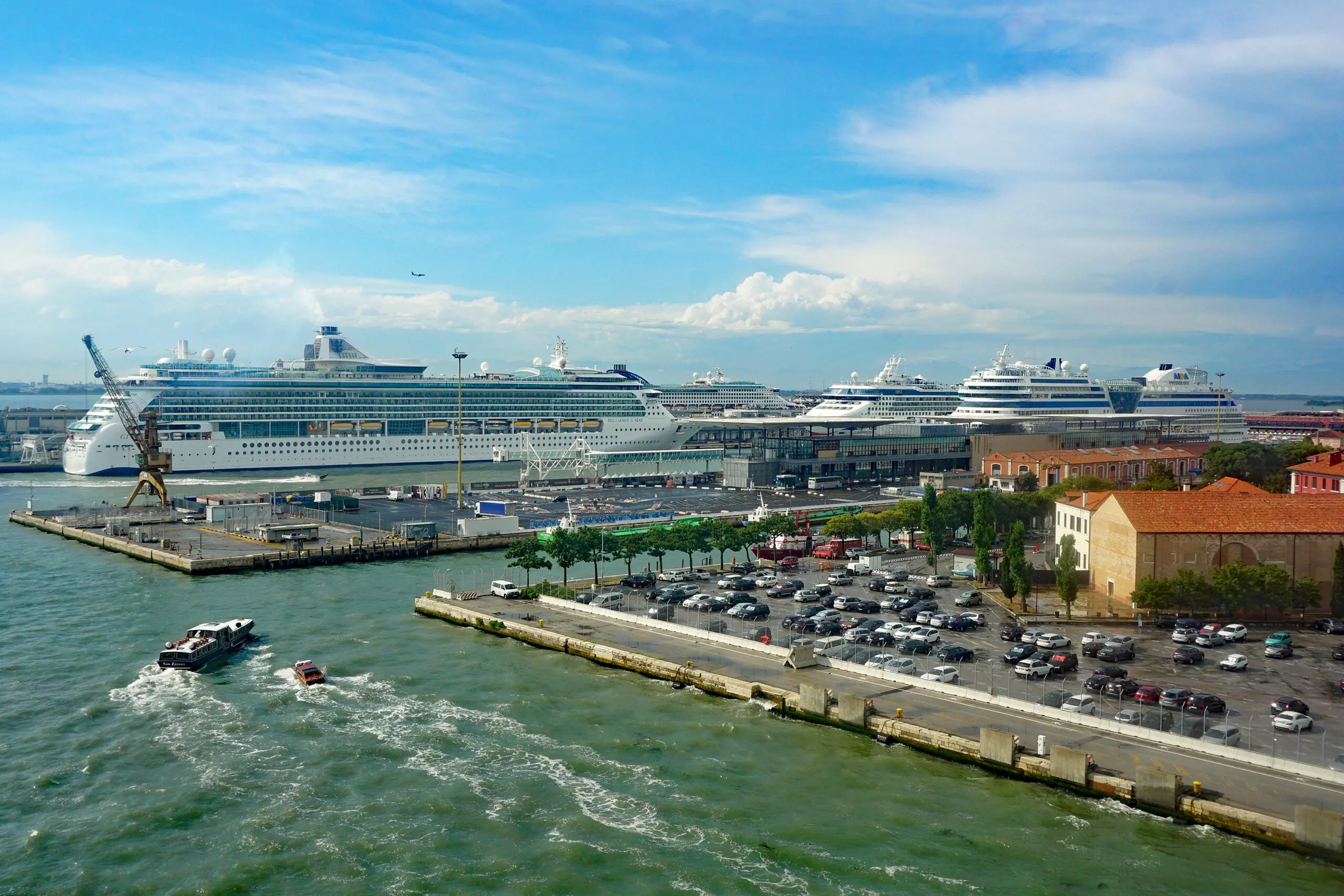
The Italian decree of July 20, 2021 established the large-ship restrictions effective August 1, 2021. The Venice Cruise Commissioner explains the alternative berth program, and the Port of Venice confirms the new Fusina terminal inaugurated in August 2024. The featured photograph shows ships at the old Venice terminal in 2017, before the restrictions; it is an authentic image by Mariordo, Wikimedia Commons, CC BY-SA 4.0. It does not depict present-day cruise operations.
Related Venice guides
To understand the city’s infrastructure and plan with more confidence, read about Venice’s different boats; how Venetian water entrances work; private ways to explore Venice.
Frequently Asked Questions
Do cruise ships still dock in Venice after the 2021 ban?
Cruise operations continue in the region, but large vessels meeting the legal thresholds cannot transit the protected San Marco and Giudecca waterways. Your sailing may use Fusina, Chioggia, Trieste, Ravenna, or another confirmed terminal. Check your cruise documents.
Are Fusina, Chioggia, Trieste, and Ravenna all in Venice?
No. Fusina is on the mainland lagoon edge within Venice’s municipality; Chioggia is a separate town at the southern lagoon; Trieste is a separate northeastern Italian city; Ravenna is farther south in Emilia-Romagna. Transfer plans differ substantially.
Can Tour Leader Venice arrange a private transfer to a cruise port?
Tour Leader Venice can assess private transfers from Venice hotels, airports, or stations to Fusina, Chioggia, Trieste, or Ravenna. Email info@tourleadervenice.com with your ship, sailing date, exact terminal, passenger count, luggage, and pickup address for a tailored quotation.