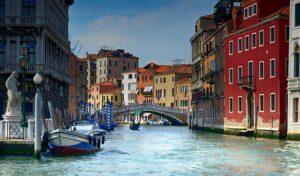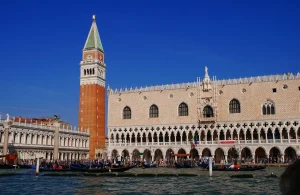
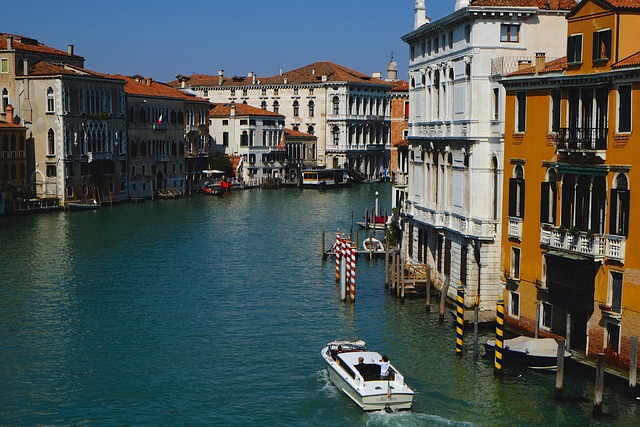
It’s easy to assume Venice has always looked the way it looks today — pale stone arches curving over green canals, worn smooth by footsteps and salt air. But for the first five hundred years of the city’s existence, Venice had no bridges at all. Venetians moved between islands entirely by boat, and when bridges finally did start appearing, they weren’t stone. They were wood — and mostly bad wood, at that, prone to fire, collapse, and constant, expensive rebuilding. The Venice most visitors photograph today is, in a very real sense, the outcome of centuries of Venetians slowly losing patience with timber.
A City That Didn’t Need Bridges — Until It Did
For roughly the city’s first five centuries, there simply were no bridges connecting Venice’s scattered islands. Everything moved by boat, and the calli that later became the city’s pedestrian backbone hadn’t yet developed into the connected network we walk today. The first genuine dry crossing anywhere in the city was a pontoon bridge — a floating line of boats lashed together rather than a true structure — built across the Grand Canal in 1181 by an engineer named Nicolò Barattieri and known as Ponte della Moneta, the Bridge of the Coin, for the toll charged to cross it. It was a clever solution, but a temporary-feeling one, and it marked the real beginning of Venice’s long, difficult relationship with bridge-building.
The Rialto’s Long, Collapsing Wooden Youth
The crossing at Rialto — the busiest, most commercially vital point on the Grand Canal — became the proving ground for Venice’s wooden bridge ambitions, and the results were genuinely rough. By 1255, the pontoon bridge had been replaced with a proper wooden structure featuring two inclined ramps meeting at a central section that could be raised to let taller ships pass beneath — essentially a drawbridge. It didn’t hold up well. The bridge was partially burned during a 1310 revolt, collapsed under the weight of spectators watching a wedding procession in 1444, saw its railings give way under the crush of a crowd watching Holy Roman Emperor Frederick III’s 1468 procession — a disaster that sent dozens of onlookers into the canal and killed several — and finally collapsed entirely in 1524. Each time, Venice rebuilt in wood, because wood was fast and cheap, and each time, the bridge failed again within a matter of decades.
By the early 16th century, the city had had enough. In 1551, prominent architects were formally invited to submit stone bridge proposals, and the eventual competition drew designs from some of the most celebrated names in Italian architecture — Michelangelo, Palladio, Sansovino among them. Palladio’s proposal, a grand three-arch design topped with a temple-like structure, would have been spectacular and was rejected precisely because multiple arches would have obstructed the boat traffic the bridge needed to accommodate. The commission ultimately went to the Venetian engineer Antonio da Ponte, whose single-span stone design — completed in 1591 — is the Rialto Bridge still standing today. It had taken roughly four centuries, and a genuinely exhausting string of disasters, to convince Venice that wood simply wasn’t going to hold.
Why Wood Kept Losing to Fire and Weight
The pattern at Rialto wasn’t unique — it was simply the most dramatic, most public example of a citywide problem. Wooden bridges across Venice shared the same basic vulnerabilities: fire, since so much of the city was built from flammable material packed tightly together; sheer crowd weight, since a bridge over the only practical crossing point in a busy commercial district would inevitably be pressed by more people than its timber frame was ever designed for; and simple decay, since constant exposure to salt air and water is brutal on wood in a way it isn’t on stone. Add to that the fact that many of these early bridges also carried shops directly on their decking — the Rialto’s wooden incarnation reportedly hosted over twenty shops at one point, everything from instrument makers to booksellers — and you have structures under constant mechanical stress well beyond simple foot traffic.
Stone solved these problems decisively, but at real cost and complexity: quarried Istrian limestone had to be imported by boat, foundations needed to be engineered to handle enormously more weight than Venice’s soft lagoon soil was accustomed to bearing, and a single-arch design capable of spanning a real waterway while still allowing boat traffic beneath it was a genuine engineering challenge for the period. That’s exactly why the transition from wood to stone happened gradually, bridge by bridge, over centuries rather than all at once.
The Bridge That Was Only Ever Supposed to Be Temporary
Here’s the detail I love most in this whole story: Venice still has a Grand Canal bridge built entirely of wood today, and it exists purely by accident. The Accademia Bridge began life in 1854 as an iron structure, built by the English engineer Alfred Neville — a modern, industrial design that many Venetians found genuinely out of step with the city’s aesthetic. By the early 20th century, that iron bridge had deteriorated badly, and in 1933, the city commissioned a quick, explicitly temporary wooden replacement while a permanent stone version was planned. Architect Eugenio Miozzi built it in just 37 days.
The permanent stone bridge never happened. Venetians, somewhat to everyone’s surprise, genuinely liked the “temporary” wooden bridge — its warmth, its visual harmony with the surrounding palazzi, its lighter and more organic silhouette compared to the solid mass of the Rialto. It’s been rebuilt and reinforced several times since — most substantially in 1985, and again with a full restoration completed in 2018 — but it has remained wood the entire time, essentially by popular sentiment rather than engineering necessity. As one Venetian saying about the bridge puts it: the temporary lasts. It’s a small, wonderful irony that the closest thing Venice has left to its original wooden bridge-building era survives not because wood won the engineering argument, but because nobody had the heart to finish replacing it with stone.
What Survives of That Era Today
Beyond the Accademia’s accidental survival, the wooden era’s fingerprints are mostly visible in what stone bridges chose to preserve from their timber predecessors. Ponte dei Tre Archi, Venice’s only surviving multi-arch bridge, echoes a structural form that was reportedly more common among the city’s wooden bridges than its later stone ones, most of which settled on the simpler, stronger single-arch design that the Rialto ultimately proved out. And across the city, the vast majority of Venice’s roughly 470-plus bridges today use a rounded Renaissance-style arch rather than the pointed Gothic form — a quiet reminder that Venice’s stone bridge-building boom happened predominantly during and after the Renaissance, once the wooden era’s repeated failures had made the case for permanence impossible to ignore.
Picturing the City Before Stone
It’s worth pausing on this walking through Venice today: nearly every bridge you cross, from the grandest Grand Canal crossing to the smallest calle-to-calle footbridge, has a wooden ancestor somewhere in its history, even if that ancestor collapsed centuries ago and left no visible trace. The Rialto’s dramatic, repeated failures happen to be the best documented, but the same basic story — build in wood, watch it fail, eventually rebuild in stone — played out across the city on a smaller scale, bridge by bridge, for centuries. The Venice you photograph today, solid and permanent-looking, is really the last and most durable draft of a city that spent hundreds of years getting the crossing wrong before it finally got it right.
If you’d like a private walk built around Venice’s engineering history — bridges, foundations, and the centuries of trial and error that shaped the city you see today — get in touch directly and I’ll design a route around exactly what interests you. And for a full day away from canals and crossings entirely, a private day trip to the Prosecco Hills makes a lovely, unhurried contrast.
Why did Venice’s early bridges keep collapsing?
Most were built from wood and carried far more weight than they were designed for — crowds gathering for processions and festivals, shops built directly onto the decking, and constant exposure to fire and salt-air decay — leading to repeated collapses at major crossings like the Rialto.
Is any bridge in Venice today still made of wood?
Yes — the Accademia Bridge over the Grand Canal is built entirely of timber, originally as a quick 1933 temporary replacement for a deteriorating 19th-century iron bridge. It proved popular enough with Venetians that the planned permanent stone replacement was never built.
When did Venice finally shift from wood to stone bridges?
The transition happened gradually over centuries, but the turning point is usually marked by the Rialto Bridge’s stone rebuild, completed in 1591 after roughly four centuries of collapses, fires, and failed wooden predecessors at the same crossing.