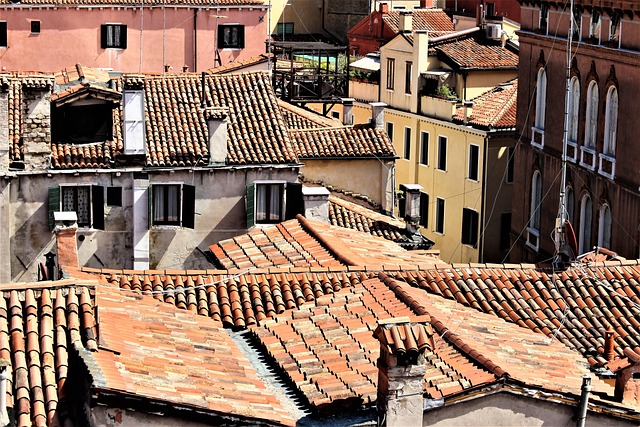
Venice trains you to look down, or straight ahead — at the pavement for the next nizioleto, at a doorway, at the water. Almost nobody arrives already looking up past the roofline, which is a shame, because there’s a whole second Venice living up there: wooden terraces perched above the tiles, quietly hosting private dinners, drying laundry, and holding centuries of very specific, very Venetian history. I always tell guests that this is the last genuinely hidden layer of the city — visible from a bridge or a bell tower if you know to look, invisible from the calle below.
Why Venice Grew a Rooftop World in the First Place
The root cause is simple: space. Most Venetian homes could never claim a courtyard or a private garden — the density of the urban fabric and the sheer presence of canals throughout the city ruled that out almost everywhere. Venetians needed somewhere to actually feel air and light that wasn’t a shadowed calle three floors below, and the only unclaimed space left in a city built edge to edge was straight up. Out of that constraint came the altana — Venice’s wooden rooftop terrace, and one of the most quietly distinctive features of its skyline.
The Altana: Born as a Workaround, Grown Into a Ritual
The word altana comes from the Latin altus, meaning high, and the first written references to these structures date back to the early 13th century, making them a genuinely old feature of Venetian domestic life. Structurally, an altana isn’t really a terrace in the conventional sense — it’s a platform of wooden floorboards, open to sun and wind, resting on a series of small brick or stone pillars above the roofline, usually reached through a narrow attic stairway that guests joke about hitting their heads on. Because the whole structure is an addition sitting on top of an existing building, the wood chosen for it had to satisfy two very specific demands: lightness, so it wouldn’t overburden the roof below, and resistance to salt air — which is exactly why larch, prized for both qualities, became the standard material from the earliest constructions onward.
Their earliest, most practical use was entirely domestic: servants used altane to dry laundry, hanging washing where sun and wind could actually reach it, well above the permanently shaded calli. Over time, the space became something more — Venetian noble women began climbing up to their altane not for chores but for beauty. Sitting for hours in the sun, they’d apply a lightening treatment called acqua di gioventù or simply bionda, then draw their hair up through a wide-brimmed straw hat with the crown cut away — the solana — protecting their pale complexion while their hair bleached in the open sun below. The resulting warm, reddish-gold shade became so closely associated with the city that it’s still called Venetian blonde today, and it’s the exact color you’ll recognize in painting after painting by Titian, Tintoretto, and Veronese — a beauty ritual immortalized, quite literally, in the golden hair of some of the most famous portraits in Western art.
A Structure the City Once Tried to Tear Down
Not every rooftop addition survived Venetian regulation. In 1316, the city’s Major Council ordered the demolition of a related, older type of rooftop and facade structure along the canals — likely on grounds of instability and fire risk, the same anxieties that shaped so much of Venice’s building code over the centuries. The altana, lighter and more contained than its predecessors, survived that purge and went on to become a fixture of ordinary Venetian domestic life for the next seven hundred years, largely unchanged in form.
The Liagò: The Altana’s Grander, Vanished Cousin
Before the altana became the standard rooftop feature, Venetian buildings featured a related but distinctly grander structure called the liagò — a covered loggia, larger and more architecturally ambitious than a simple wooden platform, sometimes built directly into a palace’s main facade rather than perched above the roofline. One of the finest surviving examples sits on Palazzo Falier Canossa, a former residence of doges and bishops, where two liagò loggias stretch out at either end of the Grand Canal-facing facade — genuinely spacious rooms extended out over the water, not merely light wells, offering their noble residents an entire additional living space suspended above the canal. Most liagò have long since vanished from Venice’s skyline, victims of the same 1316-era safety concerns and centuries of renovation, which makes surviving examples like the one at Palazzo Falier Canossa a genuinely rare glimpse at a rooftop tradition older and grander than the altana that eventually replaced it.
The Rooftop World Today
Altane are still very much a part of Venetian life — hundreds survive across the city, and new ones are still occasionally built, blending seamlessly with centuries-old neighbors. Most belong to the family occupying a building’s top floor and aren’t open to casual visitors, though a handful of hotels, bars, and department stores have opened their own altane to guests, offering a rare, genuinely elevated way to see the city’s rooftops and canals from above rather than always looking up at them. Modern Venetians use them much as their predecessors did, minus the hair-bleaching — evening aperitivi, quiet dinners, somewhere to watch the Redentore fireworks or simply sit above the noise of the calli below with a view over the terracotta roofline. And if you tilt your head back while walking almost any Venetian street, you’ll start to notice their outlines against the sky far more often than you’d expect — small wooden platforms, some full of potted flowers, quietly doing the same job they’ve done for the better part of a thousand years.
For the other great fixture of that same skyline — Venice’s famous funnel-shaped chimneys, engineered centuries ago to contain sparks from wood fires — I’ve given that story its own full treatment in my article on Venice’s fumaioli, well worth reading alongside this one if the city’s rooftop details have caught your attention.
Looking Up on Your Own Visit
This is exactly the kind of layer I love building into a private walk — not a monument with a ticket line, but an entire parallel Venice sitting quietly above the one everyone already sees, visible only to people who remember to look up. Once you know what an altana is, you’ll start spotting them everywhere, and the skyline stops being a backdrop and starts feeling like its own small, ongoing story.
If you’d like a private walk that includes the best vantage points for seeing Venice’s rooftop world — bridges, bell towers, and the quieter corners where altane cluster — get in touch directly and I’ll build it around exactly what interests you. And for a day spent under open sky rather than terracotta rooftops, a private day trip to the Prosecco Hills makes a beautiful contrast.
What is an altana in Venice?
An altana is a wooden rooftop terrace, built on pillars above a building’s roofline, historically used for drying laundry and, among noble women, for sun-bleaching hair — a tradition still visible in the golden hair color seen throughout Venetian Renaissance painting.
Can visitors access a Venetian altana?
Most altane are privately owned by the household on a building’s top floor, but a number of hotels, bars, and rooftop restaurants across the city offer public or guest access, giving visitors a rare elevated view over Venice’s rooftops.
What’s the difference between an altana and a liagò?
A liagò is an older, larger covered loggia, sometimes built directly into a palace facade rather than the roofline, offering a full additional room rather than an open platform. Most liagò disappeared centuries ago, making the altana the rooftop feature that survives across Venice today.