Somewhere among the steepest terraced vineyards of the Prosecco Hills, in a hamlet so small it counts exactly four year-round residents, sits a small private sanctuary most guidebooks never mention: walls entirely covered in vivid, almost startling fresco color, the relics of two saints brought here from a Venetian church that no longer exists, and a bell tower rebuilt from a single family’s private vow. It’s the kind of place that never makes it onto a standard wine-tasting itinerary, and it’s exactly the kind of place I like sending guests who’ve already done the standard Prosecco Hills day and want to see something genuinely few outsiders know is there.
A Village of Four People, in the Heart of UNESCO Wine Country
The Sanctuary of the Beata Vergine Addolorata di Collagù sits in the municipality of Farra di Soligo, squarely within the Prosecco Hills of Conegliano and Valdobbiadene, the UNESCO World Heritage cultural landscape inscribed in 2019. The hamlet of Collagù itself is genuinely tiny, its origins lost to time and its current population numbering just four permanent residents, tucked among some of the steepest hand-worked vineyard slopes in the entire protected zone. The sanctuary belongs to, and has belonged to for centuries, the noble Bottari De Castello family, a detail that shapes the entire character of the place: this isn’t a parish church administered by the diocese, but a private family sanctuary, still cared for, quite literally, by descendants of the family that rebuilt it nearly a century ago.
From a Small Chapel to Near-Ruin to a Family’s Vow
The original chapel at Collagù was built in the early 18th century, at a time when the surrounding land belonged to the Zorgnato family. Within a few years, the property passed by inheritance to the Bottari de Castello family, whose descendants remain the sanctuary’s owners today. Over the following century, the small church became a genuine destination for local pilgrimage, with significant devotional gatherings held each August and November, drawing worshippers from across the surrounding hills.
That devotional tradition eventually faded, and the sanctuary fell into a period of real abandonment and disrepair. Its revival came in 1932, when the Bottari De Castello family, acting on a personal vow, undertook a complete reconstruction of the sanctuary, expanding it and adding the bell tower that still marks the site today. It’s a genuinely intimate piece of local history: a private family choosing to rebuild a small, half-forgotten chapel on their own land, for reasons rooted in personal faith rather than any broader institutional plan.
Walls Covered Entirely in Color
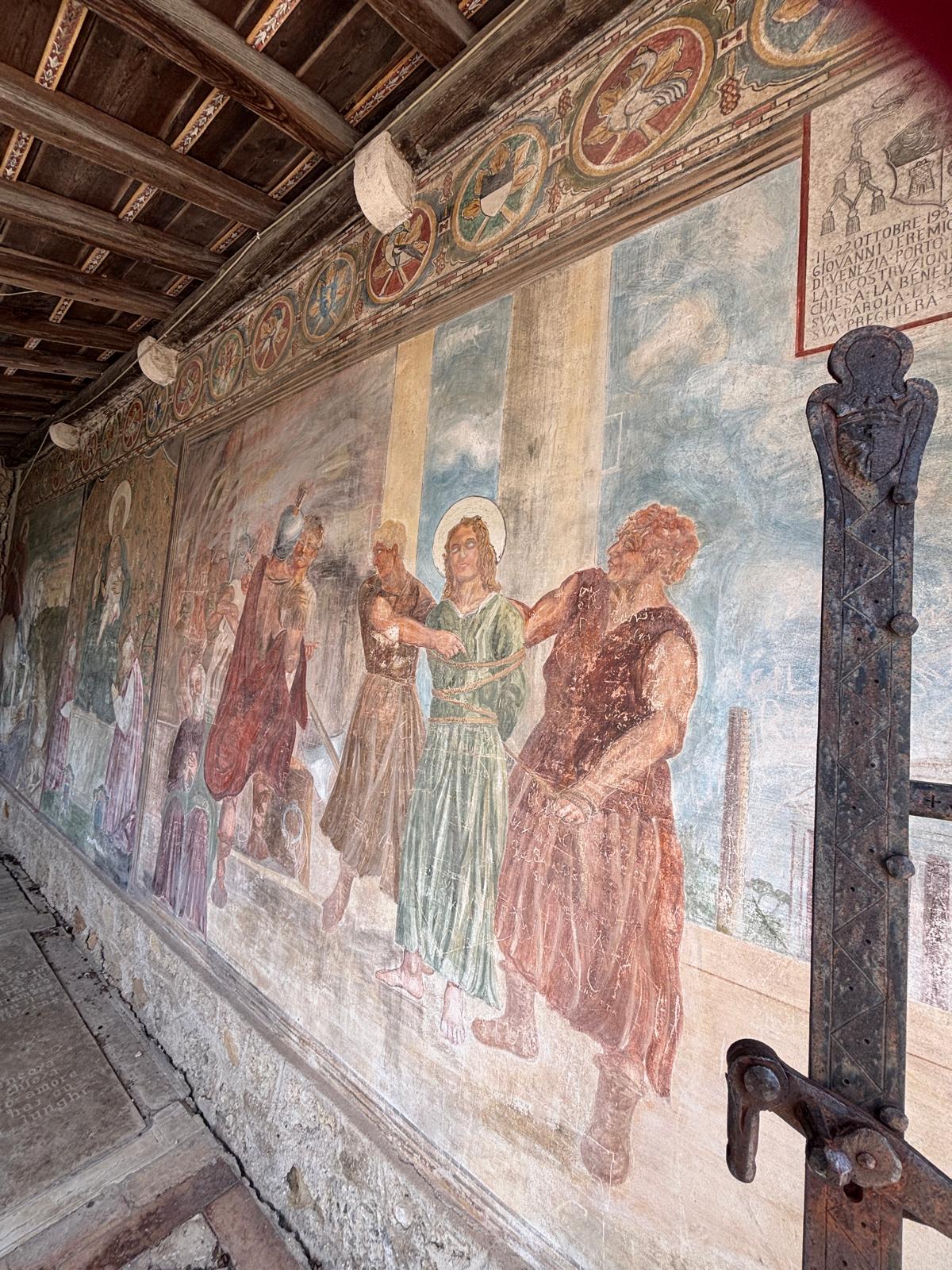
What actually stops visitors in their tracks today isn’t the sanctuary’s modest exterior, a handsome, richly decorated cloister, but its interior. Every wall inside the church is completely covered in fresco, rendered in vivid, almost startlingly bright color by the Friulian artist Ugo Grignaschi. It’s an intensity of decoration genuinely unexpected for such a small, remote rural chapel, and it’s precisely the kind of detail that rewards travelers willing to leave the main Prosecco tasting route for an hour to seek it out.
Relics From a Venetian Church That No Longer Exists
Inside the sanctuary rest the remains of Sant’Emilio, relics the Bottari family had transferred here in 1933 from Venice, where they had been kept for centuries inside the Church of San Giovanni in Laterano, a Venetian place of worship that no longer exists today. More recently, on October 28, 2001, the sanctuary received a second set of relics, those of Santa Florida, also brought directly from Venice by the Bottari family. Together, the two translations tie this small, remote hillside sanctuary directly back to Venice’s own religious history, preserving devotional traditions that might otherwise have been lost entirely once their original Venetian home ceased to exist.
A smaller but genuinely charming detail reinforces that same Venetian connection: the sanctuary’s cross-shaped candelabra is an exact replica, built at a reduced scale, of the candelabra found inside St. Mark’s Basilica in Venice, a quiet, deliberate echo of the lagoon city tucked into a hillside chapel roughly sixty kilometers away.
A Hamlet Brought Back to Life
Collagù today is far from a forgotten ruin. The hamlet has been actively revived thanks to the Comitato Amici di Collagù, a local association dedicated to the site, working alongside Farra di Soligo’s current mayor, Mattia Perencin, who continues his own family’s tradition as the sanctuary’s custodian, personally keeping the keys to the church much as generations before him have done.
Getting There: A Genuine Detour Into the Hills
Reaching the Sanctuary of Collagù is, appropriately, part of the experience. By car, the route follows the SP32 provincial road before turning onto Via Collagù, directly opposite the Agriturismo Villa Panigai. The roads leading in are narrow, winding through wooded hillside for a meaningful stretch of the journey, and genuinely unsuitable for anything larger than a standard car.
For travelers who’d rather walk than drive, two hiking routes lead into Collagù through the surrounding hills and woods, starting from the small church of San Gallo, or via the Sentiero delle Vedette, a genuinely beautiful trail beginning at the chapel of San Vigilio in Col San Martino and threading along the terraced Prosecco vineyards and hill crests. That second route carries its own layer of history worth knowing before you go: during the First World War, this exact high ground served as an Austro-Hungarian army observation point, offering a clear, commanding view over the entire Piave front line below. Tunnels and trenches used by soldiers during that conflict are still visible along stretches of the trail today, a sober historical layer running directly beneath one of the most scenic hiking routes in the entire Prosecco Hills region.
Pairing Collagù With a Prosecco Hills Day
I’d never suggest building an entire day around Collagù alone, it’s too small and too specific for that, but as a genuinely memorable detour woven into a broader Prosecco Hills wine day, it adds something no winery visit can: a small, still-living piece of local devotional history, cared for by the same family for nearly a century, sitting in a landscape most visitors drive straight past without ever knowing it’s there.
Plan your visit: Explore the Prosecco Hills covers the wider Conegliano and Valdobbiadene wine country around Farra di Soligo, and reaching out through our customized private tours page lets us build a specific itinerary that includes a stop at Collagù alongside the region’s wineries.
Frequently Asked Questions
Where exactly is the Sanctuary of Collagù, and is it open to visitors?
The sanctuary sits in the tiny hamlet of Collagù, in the municipality of Farra di Soligo, within the UNESCO-listed Prosecco Hills of Conegliano and Valdobbiadene. It’s a private family sanctuary belonging to the Bottari De Castello family, cared for today by a local custodian who holds the keys, so visits are generally arranged in advance rather than on a fixed public schedule.
What relics are kept inside the Sanctuary of Collagù?
The sanctuary holds the relics of Sant’Emilio, transferred from Venice in 1933, and the relics of Santa Florida, transferred from Venice on October 28, 2001. Both had previously been kept for centuries in Venice’s Church of San Giovanni in Laterano, a place of worship that no longer exists today.
Can I hike to the Sanctuary of Collagù instead of driving?
Yes. Two hiking routes lead into Collagù, one from the small church of San Gallo, and the Sentiero delle Vedette, which begins at the chapel of San Vigilio in Col San Martino and follows the terraced Prosecco vineyards and hill crests, a route that also passes surviving First World War trenches and tunnels once used as an Austro-Hungarian observation post over the Piave front.