Stand in almost any campo in Venice and look past the marble doorways and the Istrian stone trim, and you’ll notice the material doing most of the actual work: brick. Warm, reddish, slightly uneven, covering acre after acre of facade across the city. It’s easy to assume this is simply what old buildings look like — but the choice of brick over stone in Venice wasn’t aesthetic. It was a direct, practical response to building a city on ground that could barely hold weight at all.
A City With No Stone of Its Own
The first thing to understand is a genuine geological problem: Venice sits on a lagoon, and a lagoon has no quarries. Venice, isolated on its islands, had no building stone at hand, which meant that literally every piece of stone used in the city — including the pale Istrian limestone that lines waterfronts and doorframes across Venice — had to be imported by boat, at real expense, from the Istrian coast across the Adriatic. Stone was never going to be a material Venetians could build an entire city out of. It was too expensive, too heavy, and too far away to use as anything more than a structural accent.
Brick solved both problems at once. Clay could be sourced from the riverbeds and floodplains of the Veneto mainland — the Po valley and the areas around the Brenta river — fired locally, and transported to the lagoon far more cheaply and in far greater volume than quarried stone ever could be. It wasn’t the prestige material. It was the practical one, and Venice built almost the entire city out of it.
Light Enough to Float, Structurally Speaking
There’s a second reason brick made sense here that has nothing to do with cost: weight. Venice’s buildings don’t rest on solid ground — they rest on a forest of wooden piles driven into the lagoon’s soft clay, a foundation system genuinely unable to support the same load a mainland building on bedrock could carry. Heavy stone construction, floor after floor, would have overwhelmed that foundation. Brick, far lighter than stone for the same structural volume, let Venetian builders raise genuinely large buildings — churches, palaces, warehouses — without asking the pile foundations beneath them to bear more than they could handle. It’s a detail I’ve covered in full in my piece on how Venice’s wooden foundations actually work, and brick is the material answer to the load problem those foundations create.
This is exactly the reasoning behind one of Venice’s largest Gothic churches. The Basilica di Santa Maria Gloriosa dei Frari, construction on which began in the mid-13th century, adopted the Lombard tradition of building in brick rather than stone specifically to reduce the massive structure’s overall weight. A church of that scale, built in solid stone on Venetian ground, would have been an engineer.
Two Brick Giants: The Frari and San Zanipolo
If you want to see Venetian brick architecture at its most monumental, two churches define the tradition. The Frari, constructed between roughly 1250 and 1338 with a building history stretching to 1492, is one of only three churches in Venice that still retain the full character of Venetian Gothic architecture, its walls built from red brick with structural and decorative details picked out in pale Istrian stone — the exterior kept deliberately plain, reflecting the Franciscan order’s vow of poverty, a restraint that also throws the church’s genuinely spectacular interior artwork — including Titian’s altarpiece — into sharper relief by contrast.
Across the city in Castello stands its rival in scale and ambition: the Basilica dei Santi Giovanni e Paolo, known locally as San Zanipolo, begun by the Dominican order in the 1240s and expanded through the 14th century as the order’s prestige grew — rivaled only by the Frari for Gothic grandeur in Venice. Inside, soft light through the church’s rare surviving original stained glass plays across the contrast between raw brick walls and white stone accents, and the building carries its own structural signature born from the same unstable ground: unstable soil required the addition of cross-beams to reinforce the vaults, and rather than disguise them, Venetian builders decorated them openly, turning a structural necessity into a visible design feature — a very Venetian habit, solving an engineering problem and calling it style.
Why the Color Varies So Much Across the City
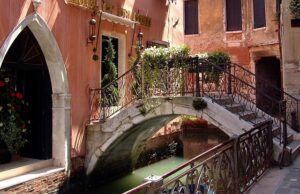
Look closely as you walk, and you’ll notice Venetian brick isn’t a single uniform shade — it ranges from a deep brick-red to a warmer, almost apricot terracotta, sometimes on the same facade. That variation comes down to firing: terracotta, literally “fired earth,” describes clay fired at temperatures that can vary significantly depending on the kiln, the duration of firing, and the specific clay bed it came from, and Venice’s brick supply, sourced from multiple riverbank clay deposits across the mainland over many centuries of continuous construction, was never going to fire to one single, standardized color. That inconsistency is part of what gives the Venetian skyline its particular warmth — no two stretches of brick facade are ever quite the same red.
Plastered Over, Then Rediscovered
It’s worth knowing that exposed brick wasn’t always considered fashionable, even in Venice. Across much of Europe, exposed brick walls fell out of favor during the Renaissance and Baroque periods, with brickwork commonly plastered over, before regaining popularity only in the mid-18th century. Venice followed something like this pattern too — many of the city’s grander palaces plastered and painted their brick facades rather than leaving the material visible, reserving the honest, exposed-brick look largely for churches like the Frari and San Zanipolo, where the material itself was part of the architectural statement rather than something to be dressed up.
What to Actually Look For
Once you know the story, Venetian brick stops being background texture and starts reading as a genuine engineering decision, still visible on every facade you pass. Look for the contrast at church exteriors especially — raw red brick doing the structural heavy lifting, pale Istrian stone marking the doorframes, window surrounds, and structural edges where saltwater damage and stress concentrate most. That combination, brick body and stone trim, is close to the visual signature of the entire city.
I love pointing this out on a walk because it reframes something guests have been looking at all day without quite seeing — Venice’s warm, reddish color isn’t a stylistic choice made for beauty’s sake, even though it is beautiful. It’s a direct, practical answer to a city that had no stone of its own and couldn’t have supported the weight of one if it did.
If you’d like a private walk built around the engineering and material history hiding in Venice’s most famous buildings, get in touch directly and I’ll design a route around exactly what interests you. And for a full day away from brick and stone entirely, a private day trip to the Prosecco Hills trades Venice’s red facades for green vineyard country.
Why did Venice use brick instead of stone for most of its buildings?
Venice had no local stone quarries, and all imported stone had to arrive by boat from Istria at real expense. Brick, made from mainland clay, was cheaper, more available, and — critically — far lighter, which mattered enormously given the limited weight Venice’s wooden pile foundations could bear.
What are the best examples of brick architecture in Venice?
The Basilica di Santa Maria Gloriosa dei Frari and the Basilica dei Santi Giovanni e Paolo (San Zanipolo) are Venice’s two largest and most significant brick Gothic churches, both combining raw red brick with Istrian stone accents.
Why does Venetian brick vary so much in color?
The color depends on the clay source and firing temperature, both of which varied across the many kilns and centuries that supplied Venice’s construction — resulting in shades ranging from deep red to warm terracotta, sometimes within the same facade.