Most visitors driving through the Prosecco Hills toward Valdobbiadene are chasing vineyards and wine cellars. A short detour north, tucked into a sheltered valley at the foot of the Treviso Prealps, sits something considerably older and considerably quieter: a working Cistercian abbey nearly nine hundred years old, home to one of the finest surviving Romanesque cloisters in the entire Veneto, and still, today, an active religious community rather than a purely historical monument.
A Monastery Older Than Its Own Founding Legend
The Abbey of Santa Maria di Follina, sometimes called Sanavalle (Sanavallis) in older records, sits in the village of Follina, in a valley historically known as the Valsana, close to the mountain passes of Praderadego and San Boldo, a location that made it a natural, necessary stop for pilgrims traveling through this stretch of the Treviso foothills for centuries. Its earliest documented reference dates to 1127, a surviving parchment recording the sale of three fields by an Abbot Bernardo of Follina to a man named Arpone, a document that proves a genuine monastic community already existed here well before the traditionally cited founding date. That earlier community was most likely Benedictine, dependent on the monastery of San Fermo in Verona, and centered around the veneration of an ancient statue of the Madonna already housed at the site.
The popularly cited founding date of 1146, when Cistercian monks are traditionally said to have arrived and taken over the site, isn’t actually well supported by surviving historical sources, and some scholars point instead to a formal affiliation with the Cistercian Order closer to 1194. What’s clear is that sometime across the second half of the 12th century, the site’s identity shifted decisively from a smaller Benedictine foundation to a full Cistercian monastery, and the monks who took over the valley brought with them the order’s distinctive approach to monastic architecture: a preference for secluded valleys, careful water management, and a close integration between religious life and the surrounding agricultural landscape, principles you can still read directly into Follina’s setting today.
The Cloister: Nearly Nine Centuries of Carved Stone
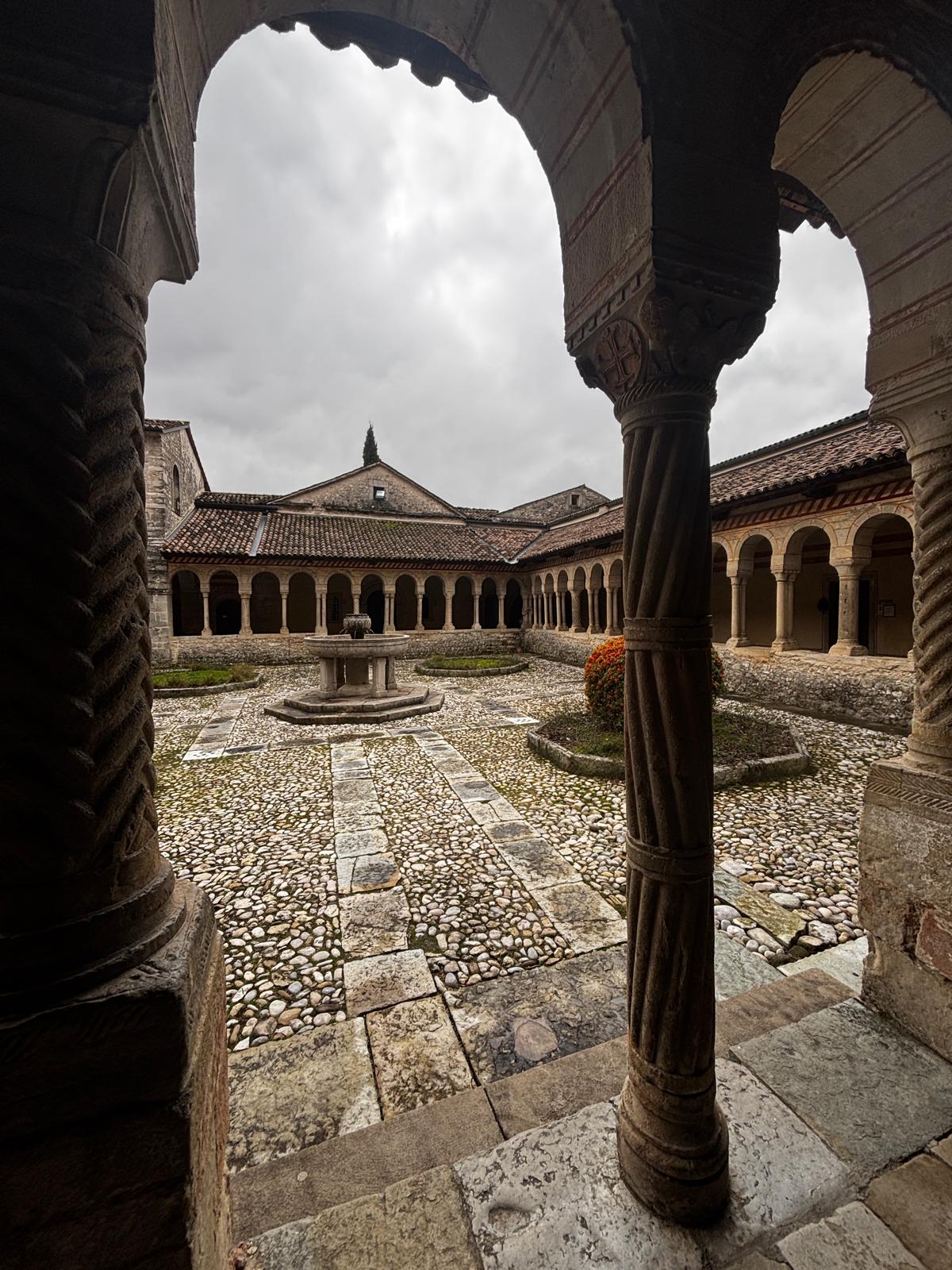
The abbey’s single most celebrated feature is its cloister, completed in 1268 under Abbot Tarino, and widely considered one of the finest and best-preserved Romanesque cloisters anywhere in the Veneto region. Arranged in a perfect square around a central fountain, the cloister’s arcade is carried on paired marble columns, deliberately varied in form, twisted, paired, plain, or knotted, each capped with elaborately carved capitals depicting foliage, animals, and human figures, no two quite alike. It’s genuinely rare to find a cloister of this age surviving in such complete condition, and architectural historians consistently single it out as an outstanding example of Romanesque decorative stone carving in the region. Around the cloister’s perimeter sit the abbey’s working monastic rooms: the sacristy, the chapter hall where the community once gathered for daily business, and a great refectory, now repurposed as a memorial to the fallen of the First World War, a quiet, deliberate layering of medieval architecture and modern remembrance within the same space.
A Gothic Basilica Built Over Two Generations
The abbey church itself, standing beside the cloister, was constructed largely across the early 14th century, work carried out under Abbot Gualtiero da Lodi starting around 1305 and continuing under Abbot Nordio di Treviso through 1335. Its facade is considered one of the finest examples of Cistercian Gothic architecture anywhere in the Veneto: a stepped roofline emphasized by slender stone pilasters and grey stone framing standing out crisply against the whitewashed wall surfaces, with three arched portals, deliberately austere in decoration, consistent with the Cistercian order’s characteristic preference for restraint over ornamentation. Following strict Cistercian symbolic convention, the church’s facade faces west while its apse faces east, the same orientation followed by Cistercian churches across Europe.
Inside, the basilica follows a Latin cross plan across three naves connected by five grand arches, its interior austere and harmoniously proportioned in the Romanesque-Gothic style typical of the order, a pointed-arch colonnade dividing the naves beneath a frescoed band running along the central nave and triumphal arch, its decorative elements interspersed with painted abbatial coats of arms. The wooden portals leading into the church depict the seven founding saints of the Servite order, and above them sits a handsome central rose window. Notable surviving frescoes inside include a work attributed to Francesco da Milano depicting the Madonna and Child with saints and the church’s patron, and, along the left nave, a mid-15th-century fresco of Saint Thomas Aquinas holding his treatise on the Blessed Sacrament. Above the main altar stands the abbey’s most venerated object: a monumental gilded Gothic ancona (altarpiece) at whose center sits a small, genuinely ancient statue known as the Madonna del Sacro Calice, an object of continuous devotion since the early 11th century, predating even the earliest documented monastic community on the site by more than a century.
Suppression, Sale, and War
The abbey’s fortunes shifted considerably after the medieval period. In 1578, the community passed from Cistercian to Camaldolese hands, and remained so until a formal suppression in 1771, after which the abbey’s buildings were sold off and divided among several private families, who built residential additions directly against the church, significantly altering and encroaching on the historic cloister in the process. The complex suffered further, serious damage during the First World War, its position in this stretch of the Treviso foothills placing it within reach of the fighting that swept across the region.
Restoration and a New Religious Community
The abbey’s modern revival began in 1915, when the Order of the Servants of Mary, the Servites, took over the site, and a genuinely significant restoration campaign followed between 1919 and 1921, repairing war damage and reversing much of the residential encroachment accumulated since the 18th-century suppression. The driving force behind that restoration was Father Anacleto Maria Milani, a Servite priest remembered as a paternal figure for the entire Follina community and a passionate advocate for the abbey’s architectural recovery. His efforts secured the church’s elevation to the rank of minor basilica in 1921, formal designation as a National Monument, and a solemn coronation of the abbey’s venerated Madonna statue performed personally by the Patriarch of Venice, a genuinely significant ecclesiastical honor tying the abbey directly back to the seat of the Venetian Church. A formal parish had already taken shape around the abbey in 1819, and that dual identity, working parish church and restored historic monument, still defines Follina today.
A Living Monastery, Not a Museum
What genuinely distinguishes Follina from many of the historic religious sites scattered across the Veneto is that it never actually stopped functioning as a religious community. The abbey remains, to this day, home to the Servite friars, who, together with a dedicated group of lay volunteers, continue to welcome pilgrims and visitors through the abbey’s own guesthouse, the Foresteria, and manage the ongoing care and maintenance of the entire historic complex. Standing in the cloister today means standing in a space that has been in continuous, evolving religious use for nearly nine centuries, not a preserved fragment of the past but a genuinely living heritage site.
Visiting the Abbey Today
Follina sits roughly 30 kilometers north of Treviso and around 70 kilometers north of Venice, well within the heart of the UNESCO-listed Prosecco Hills of Conegliano and Valdobbiadene, making it a genuinely easy and rewarding addition to a day already built around wine touring in the surrounding hills. The church itself is generally open daily for regular liturgical hours, while cloister visiting times vary and are worth checking directly with the abbey before planning a visit around them specifically.
Plan your visit: Explore the Prosecco Hills covers the wider Conegliano and Valdobbiadene wine country surrounding Follina, and reaching out through our customized private tours page lets us build a specific itinerary that pairs a visit to the abbey with the region’s wineries.
Frequently Asked Questions
How old is the Abbey of Follina, and is it still an active religious community?
The earliest documented reference to a monastic community at Follina dates to 1127, with Cistercian monks arriving sometime across the second half of the 12th century. Yes, it remains active today: the Servite friars, who took over the site in 1915, still live and work there, welcoming pilgrims and visitors through the abbey’s own guesthouse.
What makes the Abbey of Follina’s cloister so significant?
Completed in 1268, it’s widely considered one of the finest and best-preserved Romanesque cloisters in the Veneto, built with paired marble columns in varied twisted, plain, and knotted forms, each topped with individually carved capitals depicting foliage, animals, and human figures, arranged around a central fountain.
How far is Follina from Venice, and can it be combined with Prosecco Hills wine touring?
Follina sits roughly 70 kilometers north of Venice and about 30 kilometers north of Treviso, directly within the UNESCO-listed Prosecco Hills of Conegliano and Valdobbiadene, making it an easy, natural addition to a day built around wine tasting in the surrounding hills.