By Igor Scomparin, founder of Tour Leader Venice.
Palazzo Grimani Venice rewards travelers who enjoy looking closely. Near Campo Santa Maria Formosa, this museum offers a different encounter with the city: a Renaissance home in which architecture, painted decoration, and ancient sculpture belong to one carefully imagined setting.
The reason to visit is not simply that the palace is less familiar than the Doge’s Palace. It asks a different question. How did a Venetian collector want visitors to experience art inside his own home? Following that question through the rooms is more rewarding than treating the museum as another address to check off.
Which Palazzo Grimani are you looking for?
Venetian family names recur across the city. When planning this visit, search for the Museo di Palazzo Grimani at Santa Maria Formosa, in Castello, rather than assuming every building called Grimani is the same place.
The museum’s official website identifies the approach through the Rugagiuffa area near Campo Santa Maria Formosa. Save the museum’s own location before setting out. In Venice, choosing the correct destination matters more than trusting a familiar surname on a map.
This is a good visit for travelers interested in interiors and collecting. It is also a useful alternative when you have already seen Venice’s best-known attractions and want a focused museum experience without repeating your first trip.
Why Palazzo Grimani feels different
The palace brings Venetian traditions into conversation with the architecture of Renaissance Rome. The regional museum authority describes a building shaped by the ambitions of Vettore and Giovanni Grimani, combining different artistic cultures within a Venetian residence.
That mixture gives you a useful starting point. Instead of asking whether the building is “typically Venetian,” ask where it follows familiar local patterns and where it chooses something different. Notice the relationship between the courtyard, the principal floor, and the rooms beyond.
A museum visit becomes easier to remember when it has a clear thread. Here, the thread is how a home can become a statement of learning, status, and artistic taste.
The Grimani family and the idea of collecting
The museum occupies the former home of the Grimani branch associated with Santa Maria Formosa. Its official history connects Antonio Grimani’s acquisition of the palace with the later patronage of Vettore and Giovanni. Giovanni’s antiquities are central to understanding the house.
For a visitor, the interesting point is that collecting is an active process. Choosing an object is only the beginning. A collector also decides what should surround it, which sightline introduces it, and how one work changes the meaning of another.
Keep that in mind as you walk. A sculpture placed above your head does something different from a sculpture displayed at eye level. A figure seen through a doorway can become the visual destination of an entire room.
Start with the courtyard
Allow a few minutes before concentrating on individual works. Stand where you can read the courtyard as a whole. Look for proportion, repetition, changes of light, and the transition from the surrounding neighborhood into the palace.
You do not need architectural vocabulary to enjoy this exercise. Ask simple questions: Where does the building direct my eyes? Which openings feel inviting? What becomes visible only when I move?
This first pause helps establish a slower pace. If you arrive directly from a busy walk through central Venice, it can take a little time to stop scanning the room for the next famous object.
The staircase: look up without rushing
The Ministry of Culture identifies Federico Zuccari with the richly decorated monumental staircase. This is an introduction to the palace’s visual ambition, not just a route between floors.
Stop only where it is safe and where you are not obstructing other visitors. Notice how painted and sculpted decoration responds to the architecture. Consider how the experience changes as you ascend, rather than trying to capture everything in a single photograph.
If you are visiting with children, make this a short observation game: find one human figure, one animal form, and one decorative detail that seems to imitate something three-dimensional. Keep the activity quiet and let the room provide the surprise.
The Tribuna: the room worth slowing down for
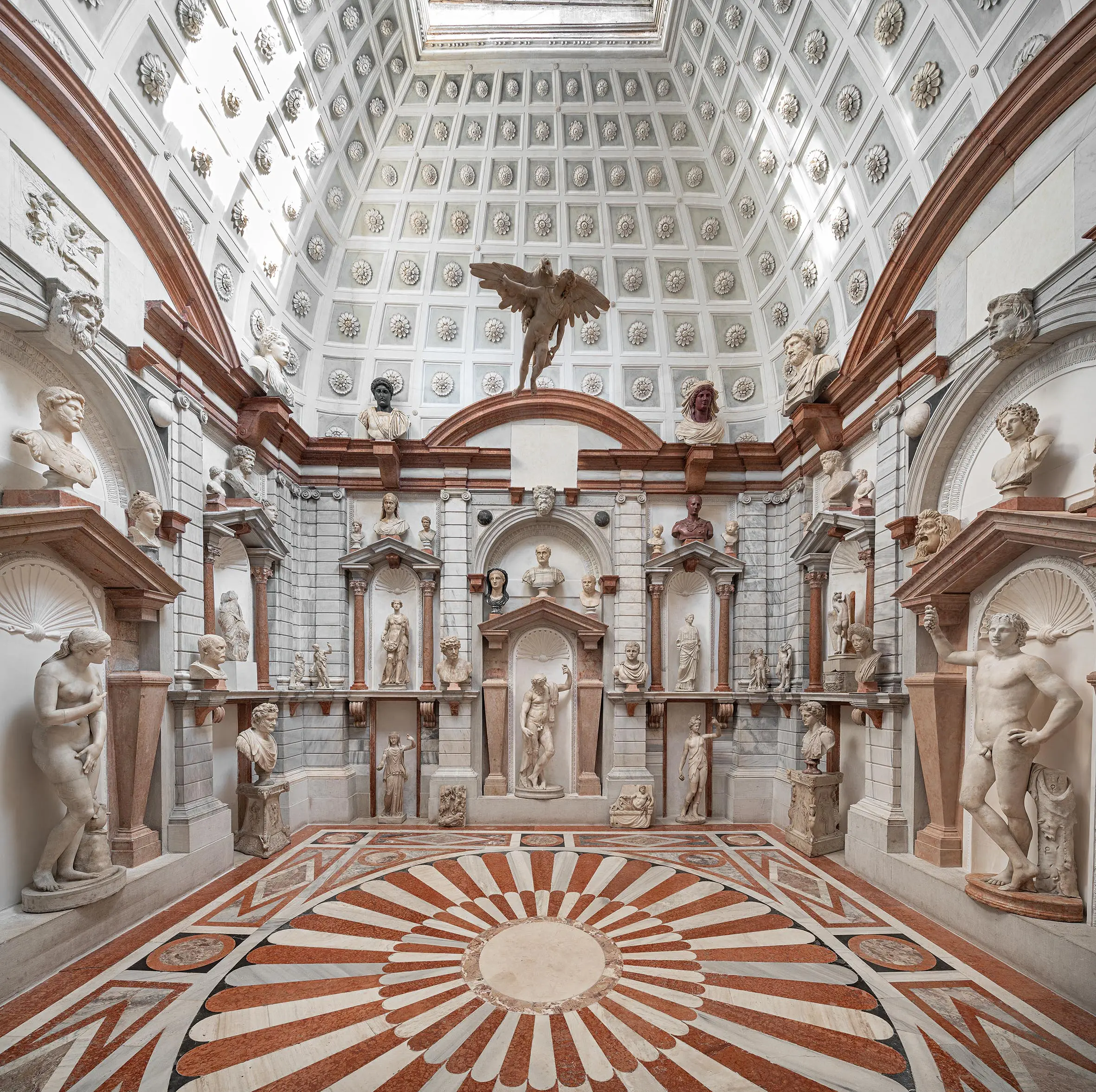
The Tribuna of Palazzo Grimani is the palace’s most distinctive space. Its niches, surfaces, and overhead light were conceived around the presentation of antiquities. The architecture does not simply contain the collection; it participates in the display.
Enter, look across the room, and then look upward. Take a second circuit with your attention on the relationship between the figures and the spaces around them. The experience changes when you stop looking for a single “main” work and begin reading the room as an ensemble.
The current museum presentation reconnects sculpture with the historic setting. For the precise identification and status of individual objects, use the labels and current museum information. Historic interiors evolve, and a photograph from a previous visit may not show the arrangement you encounter.
A simple way to read the Tribuna
- Look at the room without taking a photograph. Give yourself time to register its height and proportions.
- Choose one sculpture. Notice the direction of its face, limbs, and movement.
- Look at its setting. Ask why that position works visually.
- Step back. See how the same work participates in the larger composition.
- Look upward once more. The vertical arrangement is part of the room’s effect.
This approach works even if you have never studied classical sculpture. You are looking at choices that can be understood through attention rather than memorized names.
Painted ceilings and the pleasure of small details
Do not let the Tribuna consume your entire attention. The palace’s decorated rooms invite another kind of looking: slower, closer, and less dependent on a dramatic overall view.
In the room known for its foliage decoration, the museum authority identifies Camillo Mantovano’s world of plants and animals. Spend a few minutes finding how natural forms turn into an organized interior surface.
There is an enjoyable difference between noticing a subject and noticing its treatment. You may first recognize a bird or a branch. Then look at rhythm, repeated shapes, and the way decoration crosses or respects architectural divisions.
For couples or families, agree to choose one detail each and explain the choice afterward. That small conversation often creates a more personal memory than a long sequence of photographs.
How long should you allow?
As a planning suggestion, allow roughly 75 to 90 minutes for an unhurried first visit, with extra time if the current exhibitions particularly interest you. This is an itinerary recommendation, not a required museum duration.
A shorter visit can still work if you keep your expectations focused. Prioritize the courtyard, staircase, decorated rooms, and Tribuna. Avoid combining a hurried palace visit with another major museum immediately afterward unless that pace suits everyone in your party.
If your group contains both enthusiastic art lovers and people with a lighter interest, build a pause into the wider neighborhood walk. The museum should be the day’s highlight for those who love it, without making the rest of the party feel trapped in an endurance test.
Opening information and tickets
At the time of checking, the official Palazzo Grimani museum website lists Tuesday through Sunday opening from 10 a.m. to 7 p.m., with last admission at 6 p.m., and Monday closure. Holiday arrangements and temporary changes should be checked directly.
The museum identifies its ticket office and the Musei Italiani channels as the authorized purchase routes. Check the current ticket conditions and exhibition information before paying. This guide does not promise that a particular ticket, discount, or temporary exhibition will remain available.
For mobility needs, contact the museum with specific questions about your intended route, lifts, steps, and any temporary restrictions. A general description of a historic palace is not enough to determine whether the visit will be comfortable for a particular traveler.
A relaxed neighborhood pairing
Combine Palazzo Grimani with time around Campo Santa Maria Formosa rather than immediately crossing the city for another appointment. Begin with the square, visit the palace, and leave room afterward for a nearby café or a gentle continuation through Castello.
The aim is to let the interior and its surroundings illuminate each other. Outside, you return to canals, bridges, shops, and everyday movement. Inside, you have seen how a powerful family shaped a highly controlled artistic environment.
A private guide can connect those experiences without turning the day into an art-history lecture. Your interests might be architecture, the social meaning of collecting, or simply learning how to notice more.
Palazzo Grimani or the Doge’s Palace?
Choose according to the experience you want. The Doge’s Palace belongs to a first introduction to the institutions and public imagery of the Venetian Republic. Palazzo Grimani offers a more concentrated encounter with a family residence, collecting, and Renaissance interiors.
Travelers on a first short visit may prefer to establish the larger historical framework first. Returning visitors, or those who already know they love palace interiors, may find Grimani especially satisfying.
There is no need to turn the choice into a competition. A successful itinerary gives each place enough space to communicate what makes it interesting.
Photography and museum etiquette
Ask about the current photography rules and follow the signs in each room. Permission for casual photography does not automatically imply permission for flash, tripods, commercial shoots, or images of every temporary exhibition.
When photographing a room, keep doorways clear and avoid backing toward objects while looking at your screen. Take the picture, then put the phone away long enough to experience the space.
Our featured image is a real photograph taken in 2019. It documents the Tribuna’s display at that time and should not be read as a guarantee that every sculpture will be in exactly the same position during your visit.
Frequently asked questions
Is Palazzo Grimani worth visiting?
Yes, particularly if you enjoy Renaissance interiors, ancient sculpture, and the history of collecting. The visit works best when you have time to study the relationship between the works and their architectural setting.
Where is the Palazzo Grimani museum?
It is near Campo Santa Maria Formosa in Castello. Use the official museum’s location for Palazzo Grimani at Santa Maria Formosa, because the Grimani name appears at more than one Venetian address.
Can Palazzo Grimani be included in a private Venice tour?
It can be considered for a tailored itinerary, subject to opening hours, admissions, and your interests. Museum tickets and any special arrangements should be confirmed separately.
Explore our private Venice tours, browse private lagoon experiences, or see the full selection of Tour Leader Venice experiences to build a visit around your interests.
Sources: Museo di Palazzo Grimani; regional museum authority; Ministry of Culture museum information. Practical information checked October 29, 2026.
Featured photograph: Palgri, “La Tribuna di Palazzo Grimani con le sculture,” April 15, 2019, Wikimedia Commons, CC BY-SA 4.0. Real photograph, not AI-generated.