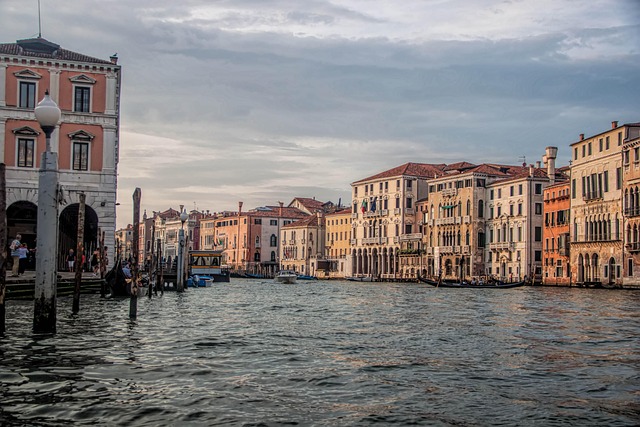
Walk along almost any minor canal in Venice, away from the Grand Canal’s palazzi, and you’ll notice something that would look completely absurd anywhere else in the world: ordinary front doors, on ordinary houses, opening directly onto open water with no step, no path, no dry ground of any kind between the threshold and the canal. Some are handsome and freshly painted. Many more are cracked, waterlogged, and clearly unopened in years. All of them are called the porta d’acqua — the water door — and together they tell you something essential about how this city actually worked for most of its history.
A Boat Garage, Not a Front Door
The easiest way to understand a porta d’acqua is to think of it exactly like a garage door on a mainland house — because functionally, that’s precisely what it is. Step through one and you don’t land on a hallway floor; you land in water, with steps leading upward toward the living space above, and often just enough room inside to moor and lock away a private boat, the same way a car would be kept behind a garage door on dry land. For centuries, when a boat was the only realistic way to get people and goods to your front step, this wasn’t an eccentric architectural flourish. It was the single most practical entrance a Venetian building could have.
Many of these doors come in pairs — a double water door, wide enough to accommodate a boat passing directly through into a private, sheltered mooring inside the building itself, out of the weather and out of sight. It’s a genuinely elegant solution to a problem no other city in the world has quite had to solve: how do you give a boat, not a car, secure indoor parking?
Why Every Building Needed One
For most of Venice’s history, there simply wasn’t a practical alternative. The canal was the road, long before the network of calli and fondamente most visitors now think of as Venice’s “real” streets had fully developed into the primary way people and goods moved around the city. A house without water access was a house cut off from deliveries, from visitors, from the market boats bringing produce each morning — genuinely disadvantaged in a way that’s hard for a modern visitor, arriving by train or plane, to intuitively grasp. The water door wasn’t the back entrance. For centuries, in a very real sense, it was the front one.
What Happened as Foot Traffic Took Over
That balance shifted, gradually, as Venice’s pedestrian street network expanded and became the way most residents and visitors actually experienced the city day to day. Land entrances, once secondary, became the practical front door for most households, while the water door slipped into a quieter, more occasional role — used for deliveries, for a private boat, or not used at all. That shift is exactly why so many porta d’acqua you’ll notice today look genuinely neglected: some stand partially walled up, their original function sacrificed for a bit of extra interior space; others are simply left to weather where they sit, doors rotting gently at the waterline, no longer opened by anyone. It’s one of the more quietly poignant details in the city, if you know to look for it — a door that used to be someone’s entire connection to the outside world, now just a slightly damp, disused wall.
Plenty are still very much in use, though, especially among households and businesses that keep a private boat. For those Venetians, the water door still does exactly the job it always did: a secure, private mooring, tucked directly into the ground floor of the house.
Living With a Door at Water Level
Building your entrance directly at the waterline comes with an obvious complication in a city where the water itself regularly rises. During acqua alta events, the seasonal high tides that periodically flood parts of the city between autumn and spring, ground-floor spaces behind a porta d’acqua are naturally the first to take on water — which is exactly why so many Venetian ground floors were historically treated as working, floodable space rather than living space, with the real domestic rooms kept one floor above, safely out of reach of all but the most extreme tides. Some buildings have raised their water-door thresholds over the centuries in a slow, ongoing negotiation with the rising water level; others simply accept that the ground floor floods periodically and always has. It’s part of why, if you ever get the chance to see genuine acqua alta in person, you’ll notice water rising calmly through these same doors and doorways rather than crashing in — this is a design the city built around from the very start, not a flaw exposed by the water.
What to Look For on Your Own Walk
Once you start noticing porta d’acqua, you’ll see them constantly — on quiet residential canals in Cannaregio and Castello especially, where the buildings are humbler than the Grand Canal’s great palazzi and the water doors are correspondingly plainer: a simple arched stone frame, a pair of weathered wooden doors, steps disappearing straight down into green canal water. They’re some of the most honestly functional pieces of architecture in the entire city, and unlike almost everything else in Venice, they were never meant to impress anyone. They were meant to let a boat in.
If you’d like a private walk built around Venice’s working architecture — water doors, boat culture, and the quieter canals where daily life is still visible rather than staged — get in touch directly and I’ll design a route around exactly what interests you. And for a full day on open water rather than narrow canals, a private day trip to the Prosecco Hills makes a lovely, land-bound contrast.
What is a porta d’acqua?
It’s a Venetian water door — a building entrance that opens directly onto a canal, historically used the way a garage is used elsewhere, allowing a boat to moor securely inside the building itself.
Why do so many water doors in Venice look abandoned?
As Venice’s pedestrian street network grew in importance, land entrances became the primary way most residents accessed their homes, and many water doors fell out of daily use — some are now partially bricked up, while others are simply left weathered and unopened.
Do water doors flood during acqua alta?
Yes, often first — ground-floor spaces behind a porta d’acqua are typically the lowest point of a building and the first to take on water during high tide events, which is part of why Venetian households historically kept their main living spaces one floor above ground level.