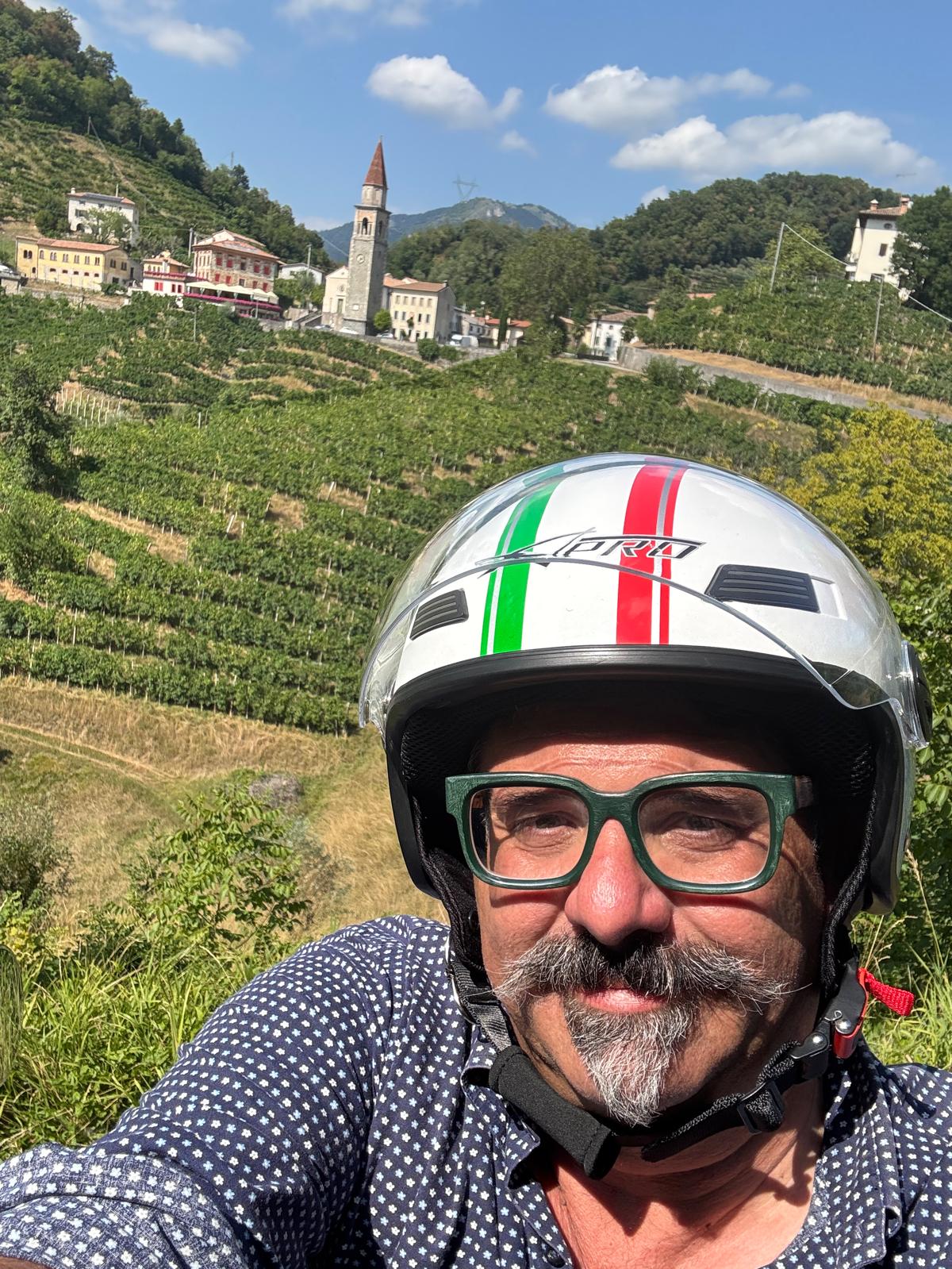
Somewhere along the Strada del Prosecco, the winding road connecting Conegliano to Valdobbiadene, the hills fold themselves into a natural amphitheater and, tucked inside it, sits a village so small and so quietly perfect that Italy’s national trust for the environment chose it, in 2004, as the very first village in the entire country to receive its formal protection. That village is Rolle, and if you’ve ever seen a postcard of impossibly steep, terraced Prosecco vineyards climbing toward a cluster of stone houses with red tile roofs, there’s a genuine chance you were looking at this exact place.
A Name With Two Competing Theories
Rolle, a hamlet within the municipality of Cison di Valmarino in the province of Treviso, was recorded in antiquity as Arrollis, and its exact origin remains genuinely debated. One theory traces the name to the Latin rubus, meaning brambles, or alternatively to a description of landslide-prone terrain, a plausible enough origin given the steepness of the surrounding hillsides. A more imaginative theory connects it instead to olla, referencing the production of terracotta pottery, a craft that remained genuinely significant to the local economy well into the last century. Neither explanation is definitively settled, and I rather like that a village this small still carries a small mystery about where its own name actually comes from.
The First Village FAI Ever Protected
In 2004, Rolle became the first Italian village ever placed under the protection of the Fondo per l’Ambiente Italiano, FAI, the country’s leading environmental and heritage trust, an organization more typically associated with protecting individual historic buildings, gardens, or estates rather than an entire inhabited village. That designation reflects something genuinely rare about Rolle: a landscape of steep, hand-worked “heroic” vineyards, the same term used across the wider Prosecco Superiore DOCG zone for slopes too steep for any mechanized farming, wrapped directly around a still-inhabited historic settlement, rather than a preserved landscape emptied of its people.
Benedictine Roots and a Church on a Rise
Rolle’s documented history stretches back to the 13th century, when the settlement’s fortunes became closely tied to a Benedictine monastic community established here, part of whose original monastery structure survives within the village today. At the heart of the small borgo, reached by its own short staircase and set on a slight rise above the surrounding houses, stands the village church, dedicated to Saints James and Philip, substantially reworked during the 18th century and still housing artwork from that period of renovation. The church’s elevated position, overlooking the tight cluster of stone houses below, remains the village’s visual and spiritual anchor, exactly as it likely has been since the Benedictine community first shaped the settlement’s layout centuries ago.
A Village That Kept Shrinking, and Kept Being Loved Anyway
Rolle’s population has declined dramatically over the past century, from roughly eight hundred residents in its more populous era down to a small fraction of that today, a handful of year-round households remaining alongside a similarly small number of families running the village’s few guesthouses. One longtime resident, describing the shift in local dialect, put it about as plainly as it can be put: only a few actual villagers left, and about as many innkeepers. It’s a genuinely common story across small rural villages throughout the Veneto hills, but Rolle’s particular version of that story has a distinguishing feature most similarly shrinking villages don’t get: it’s been sung about by one of Italy’s most significant 20th-century poets.
“A Postcard Sent by the Gods”
Andrea Zanzotto, one of the most important Italian poets of the postwar era and a native of this exact stretch of the Treviso foothills, returned to Rolle repeatedly in his own writing, and in a 2009 text described the village, in a phrase that’s since become genuinely inseparable from how the place is talked about, as “a postcard sent by the gods.” Locals add their own, equally memorable folk explanation for why the setting feels this specifically blessed, pointing to the distinctive mountain silhouette overlooking the village, known as La Bella che Dorme, “the Sleeping Beauty,” whose ridgeline genuinely resembles a reclining woman’s profile against the sky. Ask why Rolle feels this specifically beautiful and you’re as likely to get a shrug and a smile as an actual explanation; some local charm, the same conversations suggest, simply doesn’t need one.
Steep Vines and a Natural Amphitheater
What makes Rolle visually distinct even within the already dramatic Prosecco Hills landscape is its setting: the village sits nestled inside a natural amphitheater of hills, vineyards climbing the surrounding slopes in tight, terraced rows that seem to disappear over the ridgeline in every direction. These are the same steep, hand-worked hillsides, farmed without machinery because the gradient simply doesn’t allow it, that earned the wider Conegliano Valdobbiadene landscape its 2019 UNESCO World Heritage status, and Rolle sits close enough to the heart of that protected zone that a visit here doubles as one of the most visually direct ways to actually understand what that UNESCO listing protects, rather than simply reading about hillside terracing in the abstract.
Cison di Valmarino: Rolle’s Larger Neighbor
Rolle belongs administratively to Cison di Valmarino, itself recognized as one of Italy’s official “Borghi più Belli d’Italia,” the Most Beautiful Villages of Italy, and awarded the Bandiera Arancione, the Orange Flag, by the Touring Club Italiano in recognition of its quality tourism and environmental care. Cison’s own historic center, centered on Piazza Roma, sits beneath Castelbrando, a genuinely striking medieval castle offering sweeping views back down over the valley and the surrounding Prosecco Hills. A network of walking paths radiates out from the town, including the Via dell’Acqua, tracing the Rujo stream past old water mills and other pieces of agro-industrial archaeology, and the historic Strada dei 100 Giorni, a mountain road climbing from the valley floor up to the Passo San Boldo, a pass sitting over 700 meters above sea level with its own layered history as a strategic wartime supply route.
Visiting Rolle
Rolle rewards exactly the kind of unhurried visit its own scale invites: there’s no major monument to check off a list, simply a short walk up through the village’s stone lanes to the church, a look back down over the amphitheater of vineyards, and, if the timing allows, a genuinely warm conversation with one of the small number of remaining residents, many of whom, by local account, still leave their doors open and happily step out for a chat with visitors and passing cyclists who stop at the village’s single fountain. It’s best experienced as a deliberate stop along a broader Prosecco Hills day, rather than a standalone destination, ideally paired with Cison di Valmarino itself and a proper winery visit somewhere along the surrounding Strada del Prosecco.
Plan your visit: Explore the Prosecco Hills covers the wider Conegliano and Valdobbiadene wine country, and reaching out through our customized private tours page lets us build an itinerary that includes a stop in Rolle and Cison di Valmarino alongside the region’s wineries.
Frequently Asked Questions
Why was Rolle the first village protected by FAI, Italy’s national trust?
In 2004, FAI (Fondo per l’Ambiente Italiano) designated Rolle as the first entire village under its protection, recognizing its rare combination of steep, hand-worked “heroic” vineyards wrapped directly around a still-inhabited historic settlement, rather than a landscape preserved separately from the people who actually live in it.
How many people still live in Rolle?
The village’s population has declined sharply over the past century, from roughly eight hundred residents historically to a small handful of year-round households today, alongside a similarly small number of families running the village’s guesthouses.
What is “La Bella che Dorme,” and why do locals mention it?
La Bella che Dorme, “the Sleeping Beauty,” is the local name for the mountain ridge overlooking Rolle, whose silhouette resembles a reclining woman’s profile. Locals often point to it, alongside the poet Andrea Zanzotto’s description of Rolle as “a postcard sent by the gods,” as part of the village’s distinctive, hard-to-explain charm.