Most Americans who’ve had a glass of Prosecco have no idea it comes from a UNESCO World Heritage Site. That’s a genuinely strange gap, because the hills north of Venice where the best of it is grown carry exactly the same global recognition as the Doge’s Palace, the Pyramids, or the Great Barrier Reef. It’s one of the only vineyard landscapes on Earth to earn that status, and once you understand why, it changes how you think about the wine in your glass, and about what a day trip into these hills actually means.
What UNESCO Actually Recognized, and Why It’s Unusual
In July 2019, “The Prosecco Hills of Conegliano and Valdobbiadene” were inscribed on the UNESCO World Heritage List, becoming Italy’s 55th site. What makes the listing genuinely unusual is its category: UNESCO didn’t recognize a single monument, church, or town center here. It recognized an entire agricultural landscape as a “cultural landscape,” a category reserved for places where centuries of human labor and a specific natural terrain have combined to produce something with what UNESCO calls “outstanding universal value,” not because of what was built, but because of how the land itself was shaped and continues to be worked.
That’s a meaningfully different kind of recognition than most of the Veneto’s other UNESCO sites. Venice earned its status for an entire city built against impossible odds. Vicenza earned its status for one architect’s singular vision. The Prosecco Hills earned theirs for something closer to a slow, collective inheritance: generations of local farmers hand-shaping impossibly steep terrain into something that produces not just a marketable wine, but a genuinely distinctive landscape found nowhere else in the world.
Hogbacks and Ciglioni: A Landscape Built by Hand
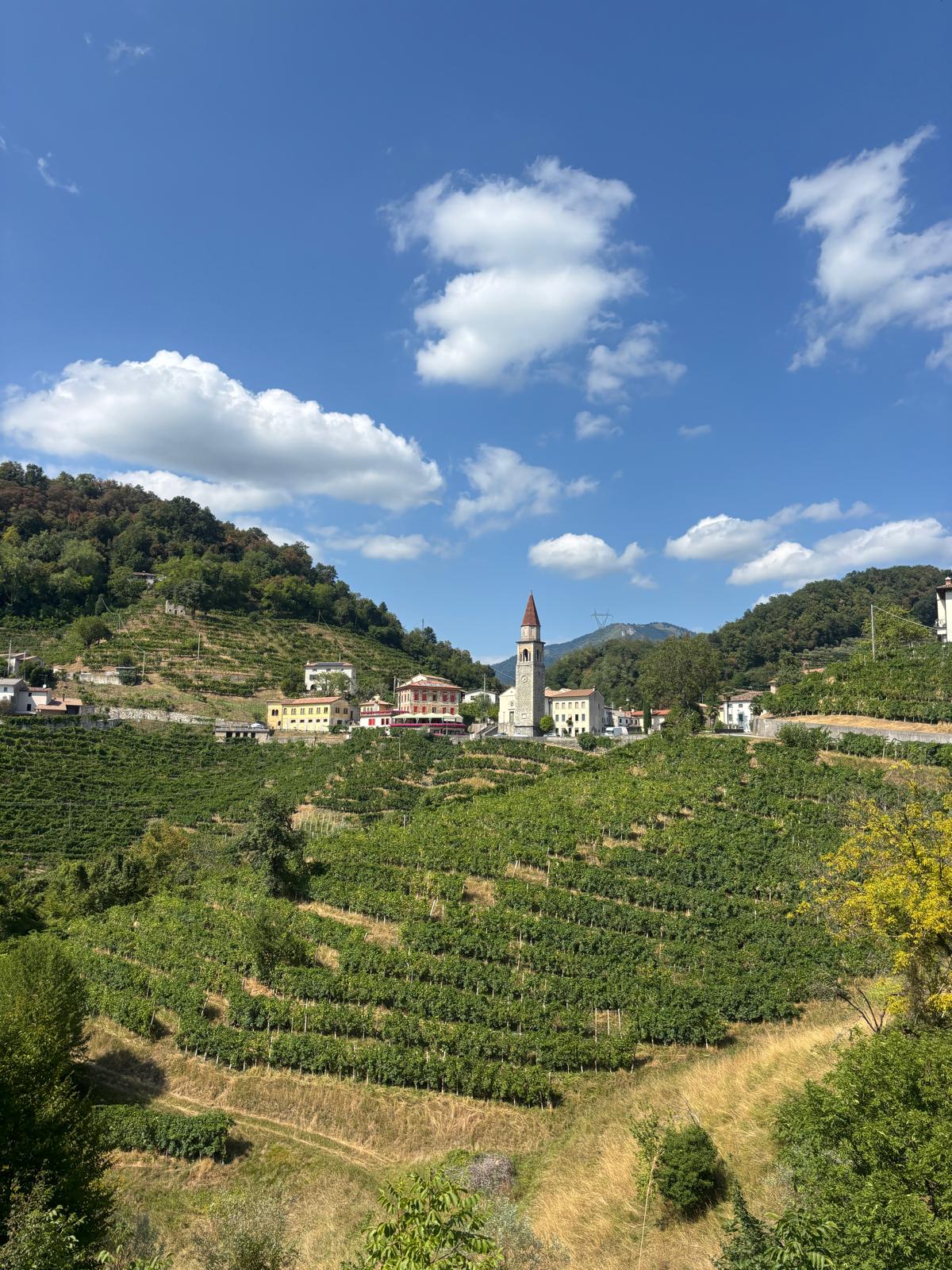
The geography here is the whole story, so it’s worth understanding precisely what makes it unusual. The protected zone covers the hills stretching between the towns of Conegliano and Valdobbiadene in the province of Treviso, a landscape geologists describe using the term “hogback”: narrow, steep-sided ridges running roughly east to west, separated by small, tight parallel valleys, a terrain shape that looks almost combed from above, nothing like the broad, gentle rolling hills most Americans picture when they imagine wine country.
That steepness is precisely the problem local farmers spent centuries solving. Slopes this sharp are simply too steep for tractors or any mechanized farm equipment, meaning every stage of cultivation here, planting, pruning, spraying, and above all harvesting, is still done entirely by hand today, exactly as it has been for generations. To make cultivation possible at all, generations of growers carved the hillsides into ciglioni, narrow, grassy terraces that follow the natural contour of each ridge, holding the soil in place against erosion and giving vines a stable foothold on gradients that would otherwise simply wash away with the first heavy rain. Walking or driving through the hills today, these terraced ridges are the single most visually distinctive feature of the landscape, a rippling, almost sculptural pattern of green that looks handmade because it genuinely is, shaped by hand tools and human labor rather than machinery, harvest after harvest, for longer than anyone currently working the land can trace back with certainty.
UNESCO’s own description of the site calls it a priceless illustration of the interaction between people and landscape, and I think that phrase undersells it slightly. This isn’t a landscape that people simply live within; it’s one that wouldn’t exist in its current form at all without an unbroken chain of specifically human decisions, made slope by slope, generation after generation, about exactly where and how to plant.
From Everyday Bubbly to a Protected Landscape: Understanding the Wine Hierarchy
Here’s something worth knowing before you go, because it reframes what you’ll actually be tasting: not all Prosecco comes from this UNESCO-protected landscape, and the distinction matters more than most casual drinkers realize.
The broad, familiar Prosecco most Americans encounter, the affordable bottle at a grocery store or a brunch table, comes from Prosecco DOC, a large, flat, easily mechanized growing zone stretching across nine provinces from Treviso all the way to Trieste, producing hundreds of millions of bottles a year. There’s nothing wrong with it; it’s simply not the wine, or the landscape, that earned UNESCO recognition.
The wine that comes specifically from the UNESCO-protected hills carries a stricter designation: Conegliano Valdobbiadene Prosecco Superiore DOCG, governed by considerably tighter rules than the broader DOC zone, lower yields per hectare, stricter quality controls, and grapes that must come exclusively from those defined hillside slopes between the two namesake towns. The word “Superiore” itself was formally established in 2009, specifically to give drinkers a clear way to distinguish the hillside original from the much larger everyday version. Within that already elevated tier sits an even smaller, more prized sub-zone: Cartizze, a roughly 260-acre pocket of especially prized hillside within the Valdobbiadene area, often called the “grand cru” of Prosecco, and Rive, individual, named single-vineyard sites across 43 different villages within the DOCG zone, each producing wine with its own specific, hyper-local character. A short distance west, a separate but related zone, Asolo Prosecco Superiore DOCG, produces its own distinct, typically crisper wines from hills around the historic town of Asolo.
Understanding this hierarchy isn’t wine snobbery for its own sake; it’s the difference between drinking a pleasant, mass-produced bubbly and drinking the specific, hand-farmed product of the exact UNESCO-protected slopes described above. Tasting both side by side, ideally at a small family winery actually standing on one of those steep terraced ridges, is usually the moment guests tell me they finally understand why this particular patch of countryside earned the same designation as a Renaissance church or an ancient ruin.
The Towns That Anchor the Landscape
Conegliano, the eastern anchor of the protected zone, is a genuinely handsome historic town in its own right, its main street lined with 15th- to 18th-century palaces, several carrying frescoed facades in the Venetian Gothic style, a legacy of the town’s long-standing prosperity as a wine and trading center under the Venetian Republic. It’s also home to Italy’s oldest dedicated school of oenology, founded in 1876, a detail that underscores just how long this specific area has treated winemaking as a serious, systematically studied discipline rather than simple rural tradition.
Valdobbiadene, the western anchor and generally considered the historic heart of Prosecco Superiore production, sits closer to the steepest, most dramatic stretches of hogback terrain, including the Cartizze zone itself. It’s a smaller, quieter town than Conegliano, built almost entirely around the wine economy that surrounds it, and it functions as the natural base for exploring the most visually striking sections of the UNESCO landscape.
Connecting the two, and continuing on toward the smaller town of Vittorio Veneto, runs the Strada del Prosecco, the Prosecco Road, a scenic route of roughly 50 kilometers first established in the 1960s as one of Italy’s earliest dedicated wine routes, winding through vineyards, small medieval hill villages, and a steady succession of family wineries and tasting rooms. It remains the single best way to actually experience the UNESCO landscape at ground level, rather than simply reading about it, since the road itself threads directly through the hogback ridges and ciglioni terraces that earned the area its status.
A Landscape Meant to Be Tasted, Not Just Viewed
What makes the Prosecco Hills genuinely different from every other UNESCO site in this guide is that the recognized landscape is also, quite literally, an active production system you can taste the direct output of. Visiting a small family winery here, one where the same family has worked the same steep slopes for generations, and tasting a glass of Prosecco Superiore made from grapes hand-harvested off the exact ridge in front of you, is a genuinely different experience from admiring a fresco or a fortress wall. The landscape isn’t just something to look at; it’s something you can drink, a rare, direct link between a UNESCO-protected terrain and a specific, tangible product most American guests already know by name long before they understand where, or how, it’s actually made.
I’ll be honest about who this trip serves best: if wine, landscape, and a slower, more rural pace genuinely interest you, a day in the Prosecco Hills is one of the most consistently rewarding excursions I run out of Venice, precisely because it offers something the city itself simply can’t, open space, quiet, and a rural Veneto entirely unlike the lagoon. If wine isn’t a genuine interest and you’re considering it mainly because it “sounds Italian,” the hills are still beautiful, but a different Veneto day trip may serve your actual interests better.
Getting There and Planning Your Visit
The Prosecco Hills sit roughly 50 to 60 kilometers north of Venice, about an hour to ninety minutes by car depending on traffic and your exact starting point. Public transport can get you partway: a train to Conegliano takes about 50 minutes from Venice, but the wineries themselves are scattered across the hillsides with sparse local transport connecting them, meaning a taxi or pre-arranged transfer becomes necessary once you arrive. Given the region’s narrow, winding roads and the fact that any genuine visit involves tasting at more than one winery, a private driver is, in practical terms, close to essential for anyone planning to actually taste rather than simply drive through and look.
Harvest season, typically September into early October, is spectacular but genuinely busy with local agricultural traffic around the wineries themselves; late spring offers similarly green, dramatic hillsides with considerably more breathing room. Either way, a full day is the right amount of time to properly experience the region, enough for two or three winery visits, a relaxed lunch at a farmhouse trattoria along the Strada del Prosecco, and enough unhurried driving through the hogback ridges to actually understand the terrain UNESCO recognized, rather than rushing between tasting rooms.
Plan your visit: Explore the Prosecco Hills takes you from Venice through Conegliano and Valdobbiadene with private winery visits and tastings built around the exact UNESCO-protected landscape described here. For an entirely different perspective on the same hills, our helicopter tours over the Dolomites and Prosecco Hills let you see the hogback ridges and terraced ciglioni from above, a genuinely striking way to understand the geometry of the landscape that ground-level touring simply can’t show you.
Frequently Asked Questions
When were the Prosecco Hills inscribed as a UNESCO World Heritage Site, and why?
No. Most Prosecco sold internationally comes from the much larger, flatter Prosecco DOC zone spanning nine provinces. Wine specifically from the UNESCO-protected hillside landscape carries the stricter Conegliano Valdobbiadene Prosecco Superiore DOCG designation, with an even smaller, especially prized sub-zone called Cartizze representing the most exclusive tier.
Is all Prosecco made in the UNESCO-protected hills?
No. Most Prosecco sold internationally comes from the much larger, flatter Prosecco DOC zone spanning nine provinces. Wine specifically from the UNESCO-protected hillside landscape carries the stricter Conegliano Valdobbiadene Prosecco Superiore DOCG designation, with an even smaller, especially prized sub-zone called Cartizze representing the most exclusive tier.
How far are the Prosecco Hills from Venice, and can I visit in a day?
The hills sit roughly 50 to 60 kilometers north of Venice, about an hour to ninety minutes by car. A full day trip is entirely realistic and is one of the most common ways travelers experience the region, typically including two or three winery visits and lunch, though a private driver is strongly recommended given the area’s scattered wineries and limited public transport between them.