Ask a first-time visitor to find Calle dei Fabbri on a map and you’ll usually get a confused look — not because the street is hard to find, but because “calle” isn’t a word most people have ever needed before. Then they’ll spot a salizada, a ruga, a rio terà, and a fondamenta, sometimes all within a five-minute walk, and the confusion multiplies. Nowhere else in Italy do street names work quite like this. In Rome, Florence, or Milan, nearly everything is a via or a strada. In Venice, the street type isn’t just a label — it’s a small piece of the city’s history, encoded directly into the signage.
I’ve spent nearly thirty years walking these streets as a licensed guide, and I still enjoy pointing out to visitors that the name on the wall above their heads is quietly telling them something true about the ground beneath their feet. Here’s what each of these terms actually means, where they came from, and why understanding them will change the way you experience the city.
Why Venice Never Adopted “Via” or “Strada”
Venice was never built the way other Italian cities were built. There was no Roman grid to inherit, no wide avenues laid out for carts and carriages, because for most of its history, the city had no carts or carriages — everything moved by boat or on foot. The street network that developed was improvised, organic, and shaped entirely by where solid ground existed between canals, marshes, and reclaimed land. That improvisation shows up directly in the vocabulary. Rather than a single generic word for “street,” Venetians developed specific terms describing what a street actually was: paved or unpaved, alongside water or built over it, residential or commercial.
These words — calle, salizada, fondamenta — aren’t part of standard Italian at all; they belong specifically to Venice. That’s part of why GPS navigation struggles here and why even confident travelers find themselves turned around: the logic isn’t wrong, it’s just a different logic than the one most cities use.
Calle: The Default Venetian Street
The calle (plural calli) is the baseline unit of Venetian geography — a narrow lane flanked by buildings on both sides, with no water in sight. The word comes from Venetian dialect and literally means “narrow street”. There are roughly 3,000 of them across the city, and most were never designed as thoroughfares in the modern sense — they’re the gaps left between buildings that grew up organically over centuries, wide enough for foot traffic and little else.
Calli are rarely named for their width or shape. Instead, most preserve a memory of what once stood there. Many reference the trade once practiced on that street — Calle dei Fabbri for the blacksmiths, Calle del Forner for the bakers — while others are named for a nearby church, a notable resident, or a half-remembered local story. Walking a calle in Venice is, in a small way, walking through an old city directory.
Salizada: The City’s Oldest Paved Streets
A salizada (plural salizade) marks something specific: this was among the first generation of Venetian streets to be paved in stone, at a time when most calli were still packed earth or improvised planking. The name derives from the Venetian word for the paving stone itself — “salizzo,” related to flint. Streets like Salizada San Lio and Salizada San Pantalon carry that distinction directly in their name — centuries after the fact, they’re still identified as the early-paved exceptions to the rule.
It’s a small detail, but it’s the kind of thing that reframes how you see a street. You’re not just walking on stone — you’re walking on some of the oldest deliberately paved ground in the city.
Ruga: Streets Built for Commerce
A ruga (plural rughe) was historically a wider, more important street lined with shops on both sides — a place where, as the old description goes, you could walk without dirtying your shoes. The name is thought to derive from the French “rue,” a linguistic fingerprint left over from Venice’s extensive trading contact with France and the wider medieval commercial world. Ruga Vecchia San Giovanni, still known to locals simply as Ruga Rialto, is the most famous surviving example — a reminder that this street has been a commercial spine of the city for the better part of a millennium.
If a calle is the connective tissue of Venice, a ruga was its high street: built wider, built for foot traffic and trade, and often still lined with shops today.
Rio Terà: A Canal Hiding Beneath a Street
This is the one that tends to surprise people the most. A rio terà (plural rii terà) is a street built directly over what used to be a canal. “Terà” means buried — and the name isn’t a metaphor. Canals in Venice have been filled in since the earliest periods of the city’s development, and when a new road replaced the water, it simply kept the old canal’s name with “terà” appended — so Rio Terà di San Leonardo, for example, was originally Rio di San Leonardo before it was filled.
Some of these transformations are genuinely old — Rio Terà San Vio in Dorsoduro dates to just before 1408, and Rio Terà della Maddalena in Cannaregio to 1498 — while others happened much later, often to create more usable pedestrian space as the city’s population and foot traffic grew. Interestingly, the water in many of these buried canals hasn’t actually disappeared; it often still flows beneath the road surface hidden but not gone. Every rio terà you cross in Venice is, quite literally, a street with a canal running underneath it.
Fondamenta: Where the City Meets the Water
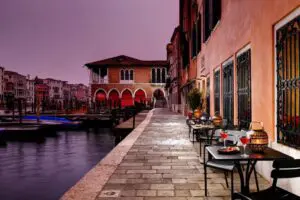
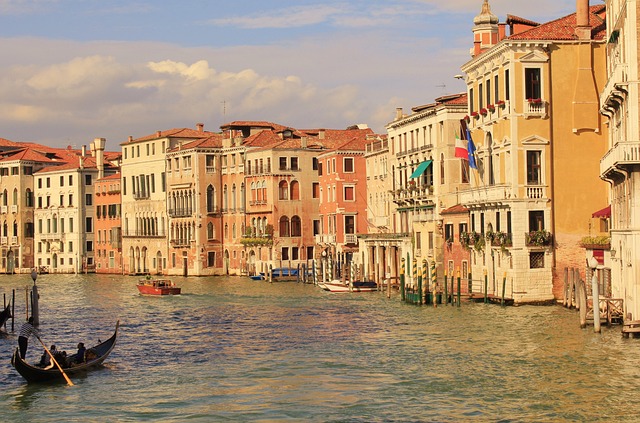
A fondamenta (plural fondamente) is the term for a walkway running directly alongside a canal, with buildings on one side and open water on the other. It’s essentially a calle bathed in water down one edge — and these streets tend to be some of the most atmospheric in the city, since they offer the view that most people picture when they imagine Venice: boats moored along stone steps, laundry strung between windows, the water doing double duty as both border and mirror. Many fondamente are genuinely vibrant, lined with the shops, bacari, and homes that make up daily Venetian life, not just scenery for visitors.
The Smaller Categories Worth Knowing
Beyond the five main types, a handful of rarer terms show up on Venice’s street signs and are worth recognizing if you want to read the city like a local:
Ramo — a short branch or offshoot leading off a larger calle
Corte — an enclosed courtyard, usually reached through an archway
Riva — technically the mooring point where a fondamenta meets the water, though in a few grand locations (Riva degli Schiavoni, for instance) it now describes a wide waterfront promenade
Sotoportego — a covered passage running directly underneath a building, created when Venetians needed to expand their homes outward over the street below
These names appear on white stone signs with black lettering — the famous nizioleti — sometimes accompanied by a small image tied to the street’s history. Once you know what you’re looking at, they stop being decoration and start being a functioning historical archive, updated centuries ago and never rewritten.
Why This Actually Matters for Getting Around
None of this is trivia for its own sake — it’s practically useful. Once you understand that a fondamenta means water on one side, a rio terà means you’re walking over what used to be a canal, and a ruga means you’ve found one of the city’s historic commercial spines, the nizioleti stop being confusing wallpaper and start functioning as real navigational information. It won’t replace a map, but it will make the map make more sense — and it’s part of why even seasoned travelers benefit from walking with someone who already knows how to read the city rather than just follow a pin.
This is also, honestly, where a private guide earns their keep. Italian law restricts guided access to Venice’s major monuments to licensed professionals, and after nearly thirty years working these streets, I don’t just know where things are — I know why they’re called what they’re called, and I can build a walking route around whatever actually interests you, whether that’s medieval commerce, hidden courtyards, or the quiet fondamente most tour groups never reach. If you’d like to design a private walk through the city with someone who reads these signs the way you’d read a street directory back home, get in touch directly and we’ll put together something personal. For a curated list of specific streets worth seeking out, my guide to the 25 most beautiful streets in Venice is a good companion piece. And if you’re extending your stay, pairing a Venice street wander with a private day trip to the Prosecco Hills makes for a nice contrast — dense medieval alleyways one day, open vineyard country the next.
What’s the difference between a calle and a fondamenta in Venice?
A calle is a narrow lane with buildings on both sides and no water. A fondamenta is essentially the same kind of street, but with a canal running along one side instead of a building — it’s Venice’s version of a waterfront walkway.
Why do some Venice streets seem to be built over water?
Because in some cases they literally are. A rio terà is a street created by filling in a former canal, and the water often still flows beneath the surface even though it’s no longer visible.
Do I need to know these terms to navigate Venice?
Not strictly, but it helps enormously. Recognizing a salizada, ruga, or rio terà on a nizioleto street sign gives you real information about the street ahead — whether it’s a former commercial hub, a paved historic route, or a filled-in canal — which makes Venice’s notoriously confusing layout noticeably easier to read.