Most Americans planning a trip to Venice don’t realize that two hours north of the lagoon, the flat Veneto plain suddenly stops and the land shoots straight up into some of the most dramatic mountain scenery in Europe. The Dolomites feel like a different country entirely from the Venice you flew in for, pale limestone spires instead of canals, alpine meadows instead of piazzas, and yet they belong to the exact same Italian region, and they carry their own, entirely separate UNESCO World Heritage status. If Venice shows you what human ingenuity can build against impossible odds, the Dolomites show you what geology can build given 240 million years and no help from anyone.
What UNESCO Actually Recognized
The Dolomites were inscribed on the UNESCO World Heritage List on June 26, 2009, recognized purely as a natural site, no buildings, no monuments, just geology and landscape judged to have “outstanding universal value” in their own right. The listing covers 141,903 hectares, divided into nine separate, non-contiguous mountain systems spread across five Italian provinces, Belluno, Bolzano, Trento, Udine, and Pordenone, and three regions, Veneto, Trentino-Alto Adige, and Friuli-Venezia Giulia. It’s a genuinely unusual “serial property,” meaning UNESCO didn’t protect one continuous mountain range but rather nine separate clusters, chosen specifically because each contains the most geologically significant and visually striking formations, while the developed valleys and towns between them remain outside the formal boundary.
Getting to that final nine-system structure took real effort on Italy’s part. An initial 2006 nomination, covering 22 sections and all four possible natural-site criteria, was deferred by UNESCO’s committee over concerns about excessive fragmentation and an incomplete management plan. Italy went back, narrowed the nomination to two specific criteria and nine consolidated systems, and resubmitted in 2007, finally winning inscription in 2009 at a World Heritage Committee session in Seville. The Dolomites joined the Aeolian Islands as only the second Italian natural site on the list, a genuinely rare distinction in a country whose UNESCO recognition otherwise runs almost entirely through cities, churches, and cultural landscapes.
The two criteria UNESCO ultimately recognized are both purely geological. Criterion (vii) covers exceptional natural beauty, the dramatic vertical walls, sheer cliffs, and pale, sculptural peaks that make the range instantly recognizable even to people who’ve never visited. Criterion (viii) covers the site’s importance as a record of Earth’s history, and this is where the Dolomites become genuinely remarkable on a scientific level, not just a scenic one.
Why the Mountains Are Pale: A Quarter-Billion Years in the Rock
Here’s the detail that changes how most guests see the Dolomites once they understand it: these mountains aren’t simply eroded rock, they’re fossilized coral reefs, lifted more than three kilometers into the sky.
Roughly 240 million years ago, during the Triassic period, the area that’s now northeastern Italy sat submerged beneath a warm tropical sea. Marine organisms built enormous limestone and dolomite reef structures along that ancient seafloor, forming atolls with internal lagoons separated by channels sometimes over a thousand meters deep, essentially a fossil version of the Pacific coral reefs you’d recognize today. Over tens of millions of years, as tectonic forces gradually pushed the African and European continental plates together, that ancient seabed was thrust upward, folded, cracked, and slowly carved by ice, water, and wind into the vertical spires and cliff faces you see today. What looks like dramatic, almost architectural mountain sculpture is, geologically speaking, a fossilized tropical reef system turned inside out and lifted into the sky.
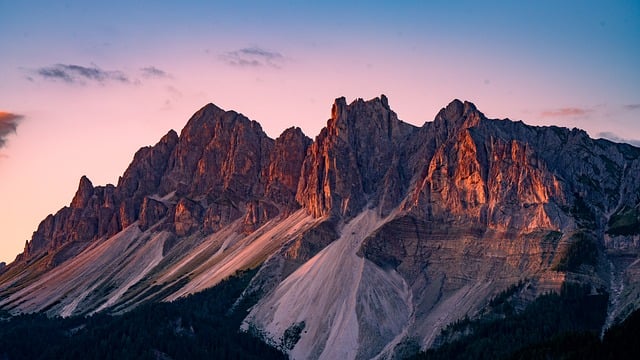
That origin is also why the rock itself carries such a distinctive pale color, and why the range earned its specific name. The mineral dolomite, a calcium-magnesium carbonate rock distinct from ordinary limestone, was first scientifically described in the late 18th century by the French geologist Déodat de Dolomieu, and the mountains built substantially from it were eventually named for him. It’s this specific mineral composition, combined with the particular way the rock catches low-angle sunlight, that produces the phenomenon known locally as enrosadira, the mountains glowing pink, orange, and red at sunrise and sunset, a genuinely striking visual effect that draws photographers to the same viewpoints, evening after evening, throughout the year.
The Nine Systems, and Which Ones Matter for a Trip from Venice
Because the Dolomites UNESCO site is a serial property rather than one continuous park, it helps to know roughly which of the nine systems you’ll actually be looking at on a trip from Venice, since several sit much further west, closer to Trento and Bolzano, genuinely out of range for anything but a multi-day mountain trip.
For a Venice-based traveler, three systems matter most. Pelmo and Croda da Lago, sitting between the Cadore, Zoldano, and Ampezzo valleys, anchors the southern approach most day-trip routes actually drive through. Marmolada, straddling the border between the Veneto and Trentino regions, holds the highest peak in the entire Dolomites at 3,343 meters along with the range’s largest surviving glacier, though visiting it specifically requires venturing further west than most single-day itineraries cover. And Dolomiti Settentrionali, the Northern Dolomites, is the system most day-trip visitors from Venice actually experience directly, since it includes the Cadini peaks, the Sesto Dolomites, and the Ampezzo Dolomites surrounding Cortina, home to the range’s single most photographed formation: the Tre Cime di Lavaredo, three sheer limestone towers rising dramatically above the surrounding alpine plateau, visible from viewpoints around Lake Misurina and among the most recognizable mountain silhouettes anywhere in Europe.
Cortina d’Ampezzo: The Pearl of the Dolomites
If the Dolomites have a capital for visitors, it’s Cortina d’Ampezzo, a genuinely elegant mountain resort town nicknamed la Regina delle Dolomiti, the Queen of the Dolomites, cradled in the Ampezzo Valley and ringed by peaks including the Tofane, Cristallo, and Sorapiss ranges. Cortina made international history hosting the 1956 Winter Olympics, an event that transformed a quiet alpine town into a genuine global destination, and it’s set to co-host the 2026 Winter Olympics alongside Milan, putting it back in the international spotlight seventy years later.
What makes Cortina worth building a day, or several days, around isn’t just its Olympic pedigree; it’s the combination of genuine alpine culture, Ladin-speaking mountain communities with their own distinct language and traditions, and a level of polish, boutique shopping, elegant cafés, refined restaurants, that feels closer to a sophisticated ski resort than a rugged mountain outpost. Spend an afternoon here and you’ll understand why it’s remained Italy’s most glamorous mountain town for the better part of a century, and why, four Italian regions all having their own distinct linguistic and cultural character, even Cortina’s specific corner of the Dolomites has its own local identity, shaped by centuries as a border zone between Italian and Austrian-Tyrolean influence.
Lake Misurina and the Tre Cime di Lavaredo
A short drive from Cortina, Lake Misurina sits framed by dense pine and larch forest, its still surface reflecting the surrounding peaks with a clarity that makes it one of the most photographed alpine lakes in Italy. From viewpoints around the lake, and more dramatically from the Col de Varda cable car or a walking approach further into the Sesto Dolomites, the Tre Cime di Lavaredo come into view: three distinct limestone towers rising almost vertically from the surrounding plateau, instantly recognizable and, for many visitors, the single image that defines the entire Dolomites range in their mind before they’ve even arrived.
Nearby Lake Auronzo and, further north toward the Austrian border, the intensely turquoise Lake Braies round out the region’s small collection of genuinely postcard-worthy alpine lakes, each with its own distinct character and each easily reachable as part of a longer Dolomites day.
Pieve di Cadore: The Mountains That Shaped a Renaissance Painter
On the drive north from Venice toward Cortina, most itineraries pass through Pieve di Cadore, a small mountain village with an outsized claim to art history: it’s the birthplace of Titian, one of the most important painters of the entire Venetian Renaissance. Walking its cobbled streets and alpine architecture, it’s genuinely easy to see how this specific landscape, sharp peaks, luminous mountain light, dramatic shifting weather, worked its way into the atmospheric backgrounds of some of Titian’s most celebrated paintings, a direct visual link between the Dolomites and the same Venetian art history most guests come to see in the city itself.
Getting There and Planning Your Day
The Dolomites sit roughly two to two and a half hours north of Venice by car, making a genuine, well-paced day trip realistic rather than a rushed compromise, provided you leave early enough to make the most of the daylight, particularly given the driving time involved on both ends. Public transport can technically get you partway, but connections into the mountains themselves are limited and slow enough that a private driver or guide is, in practical terms, the only way to see Cortina, Lake Misurina, and the Tre Cime comfortably in a single day without losing most of it to transit and confusing schedules.
The Dolomites reward visiting in every season, each in a genuinely different way. Summer offers the fullest access to hiking trails and open cable cars, with long daylight hours to cover the most ground. Winter transforms the range into one of Europe’s premier ski destinations, and driving through snow-covered peaks is, for many first-time visitors, an entirely different kind of magic than the summer green. Late spring and early autumn split the difference, offering fewer crowds and, in autumn especially, larch forests turning a genuinely striking gold against the pale rock.
My honest advice for a first Dolomites trip from Venice: don’t treat it as a box to check alongside three other day trips in the same week. The contrast between Venice’s lagoon and this alpine landscape is part of what makes it worth doing, and it lands best when you give the day its own space, rather than squeezing it in as an afterthought on the way to somewhere else.
Plan your visit: Tour of the Dolomites: A Journey Through Italy’s Most Breathtaking Mountains covers exactly this route, Pieve di Cadore, Cortina d’Ampezzo, and Lake Misurina with views of the Tre Cime, all with a private driver-guide handling the logistics door to door from Venice. For a genuinely different vantage point on the same UNESCO landscape, our helicopter tours over the Dolomites and Prosecco Hills let you see the scale of these peaks from above, a perspective ground-level touring simply can’t offer.
Frequently Asked Questions
Why are the Dolomites a UNESCO World Heritage Site? The Dolomites were inscribed in 2009 as a natural site, recognized under two criteria: their exceptional natural beauty, dramatic vertical walls and pale, sculptural peaks, and their outstanding geological value as a fossilized record of Earth’s history, formed from ancient tropical reef systems roughly 240 million years ago and later thrust upward by tectonic movement.
Can I visit the Dolomites as a day trip from Venice? Yes. The Dolomites sit roughly two to two and a half hours north of Venice by car, making a full day trip realistic, typically covering Cortina d’Ampezzo, Lake Misurina, and views of the Tre Cime di Lavaredo. Given limited public transport into the mountains themselves, a private driver-guide is the most practical way to see the highlights comfortably in a single day.
What’s the best time of year to visit the Dolomites? Each season offers something different: summer for full hiking and cable car access with long daylight hours, winter for skiing and snow-covered alpine scenery, and late spring or early autumn for fewer crowds, with autumn larch forests turning gold against the pale limestone. There’s genuinely no wrong season, only a different Dolomites depending on when you go.