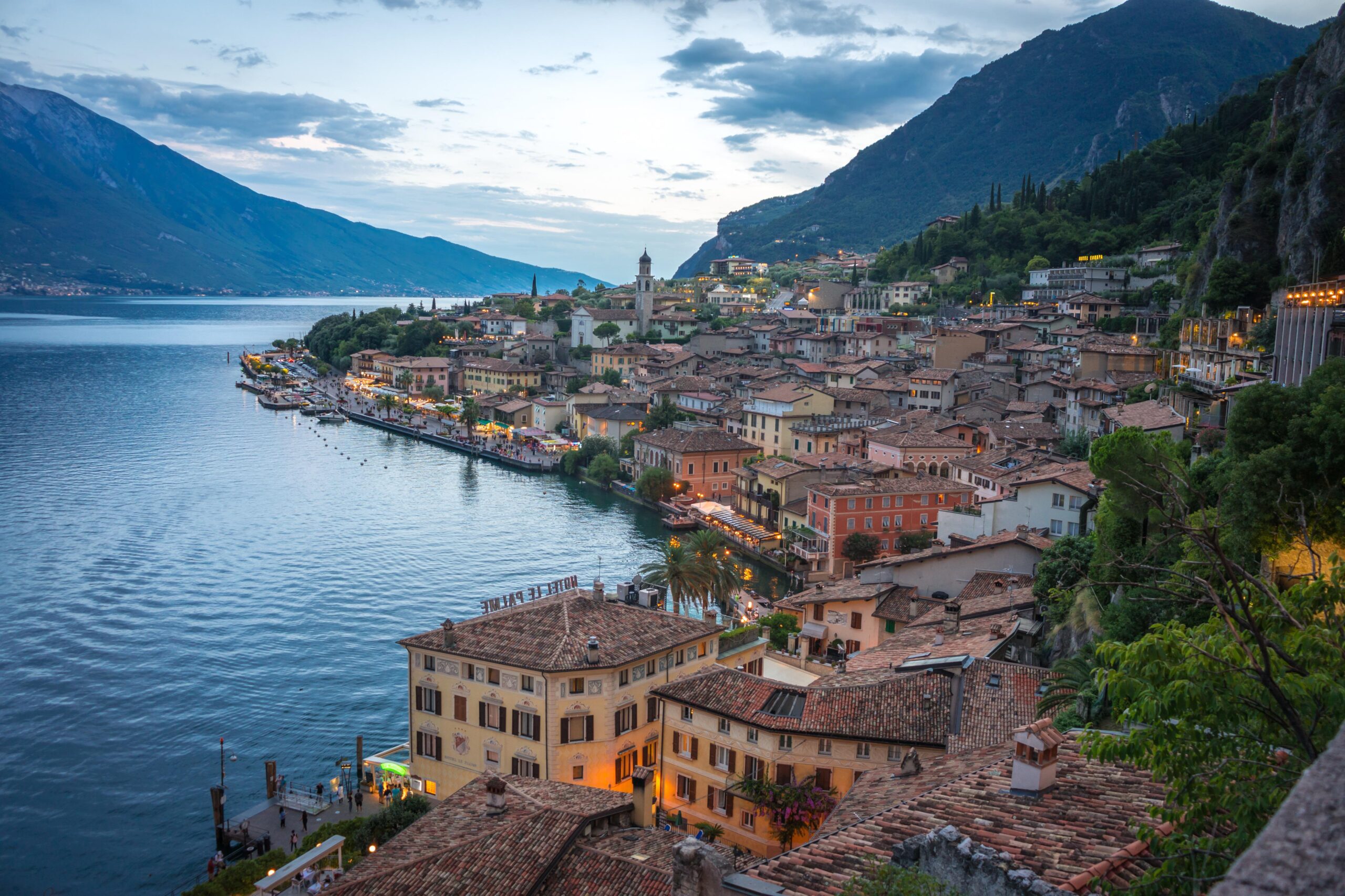
Most Americans planning a trip to Venice have never heard of Lake Garda, and that’s a genuine oversight, because it sits less than two hours west of the lagoon and offers something Venice simply can’t: open water, mountains, medieval castles standing directly in the lake itself, and a landscape that shifts so dramatically from one end to the other that it’s genuinely hard to believe you’re still looking at the same body of water. Here’s a full guide to Italy’s largest lake and the specific places worth building a day, or several, around.
The Basics: Why This Lake Feels So Different Shore to Shore
Lake Garda is Italy’s largest lake by surface area, formed by glacial action during the last Ice Age, when a massive glacier descending from the Alps carved out the long, narrow basin the lake now fills. It stretches across three separate regions, Veneto to the east and south, Lombardy to the west and south, and Trentino-Alto Adige at its northern tip, an unusual three-way administrative split that reflects just how large and geographically varied the lake genuinely is.
That variety is the single most important thing to understand before planning a visit. The northern end of the lake, hemmed in by steep alpine terrain near Riva del Garda and Torbole, feels almost mountainous, dramatic cliffs, cooler air, and strong, remarkably consistent daily winds, the Ora blowing up the lake from the south each afternoon, the Peler blowing down from the north each morning, that have made this stretch one of the most celebrated sailing and windsurfing destinations in all of Europe. The southern end of the lake, by contrast, opens into a much gentler landscape: broader beaches, softer hills, and a genuinely Mediterranean microclimate, complete with olive groves and even lemon trees this far north, made possible by the lake’s own moderating effect on the surrounding air. Very few lakes anywhere let you experience two such different climates and landscapes within a single afternoon’s drive.
The South: Sirmione, Desenzano, and Family-Friendly Ease
The lake’s southern shore is its most accessible and most visited stretch, anchored by Sirmione, a town built along a narrow peninsula jutting dramatically out into the water. Sirmione’s skyline is dominated by the Rocca Scaligera, a beautifully preserved 14th-century castle built directly over the water by the Della Scala family of Verona, its moat filled by the lake itself. At the very tip of the peninsula sit the Grotte di Catullo, the sprawling ruins of a Roman-era villa complex traditionally associated with the Roman poet Catullus, whose own writing referenced Sirmione directly, describing it in one surviving poem as the jewel of all peninsulas and islands. Walking the ruins today, scattered olive groves framing fragments of ancient columns and walls with the open lake visible on nearly every side, remains one of the most genuinely evocative Roman sites anywhere in northern Italy. Sirmione is also home to natural thermal springs, feeding spa facilities like the modern Aquaria Thermal Spa, a detail that connects directly back to the town’s importance since Roman times, when its warm mineral waters were already prized for their healing properties.
A short drive away, Desenzano del Garda offers a livelier, more workaday lakeside town: a genuine harbor promenade, a lively Tuesday market, and its own small archaeological museum, along with easy ferry connections to towns across the southern lake. Together, Sirmione and Desenzano make an easy, well-connected base for a first visit, and both sit close to Peschiera del Garda’s own Venetian fortress walls, an easy add-on for anyone approaching the lake from Verona or Venice.
The East: Bardolino, Lazise, Garda, and Malcesine
Moving north along the lake’s eastern shore takes you through the Veneto side of Garda, a stretch defined by medieval villages, vineyards, and olive groves. Bardolino gives its name to a light, easy-drinking red wine produced across the surrounding hills, alongside its increasingly popular rosé cousin, Bardolino Chiaretto, a genuinely refreshing local specialty worth seeking out over a lakeside lunch. Nearby Lazise retains an intact circuit of medieval walls and a small fortified harbor, one of the best-preserved lakeside villages anywhere on Garda, with a Wednesday market and a genuinely relaxed evening atmosphere along its promenade.
Further north, the town of Garda itself, which lends its name to the entire lake, offers an easy, pleasant stop worth combining with either Bardolino or Malcesine. And Malcesine, further north still, is where the eastern shore turns genuinely dramatic: its own Castello Scaligero rises directly above the town’s small harbor, mountains pressing close behind it, a setting considerably more alpine than anything found further south. Beyond the castle, Malcesine functions as the primary gateway to Monte Baldo, a mountain rising steeply from the lake’s edge, reachable by a rotating cable car whose cabins slowly turn during the ascent, giving every passenger a full 360-degree view as the landscape transitions from Mediterranean lakeside vegetation to genuine alpine terrain in the span of a single cable car ride. At the summit, hiking trails, and in some seasons paragliding launches, reward visitors with sweeping views back down over the entire lake.
The West: Limone, Gargnano, and the Road That Locals Warn You About
The lake’s western, Lombard shore has its own distinct, rugged character, steep cliffs plunging directly into the water and a genuinely dramatic coastal road connecting a string of smaller, quieter villages. Limone sul Garda is the best known of these, famous for its terraced “lemon houses,” historic greenhouse structures once used to cultivate citrus trees this far north, a tradition dating back centuries and reflecting the same unusually mild microclimate found on the lake’s southern shore. Limone has also become a genuine draw for cyclists, thanks to a cliffside cycling path built directly over the water along the base of the cliffs, a genuinely thrilling ride suspended above the lake itself.
Further south, Gargnano and Salò offer a quieter, more residential version of the western shore, and Salò specifically holds one more genuinely significant stop: the Vittoriale degli Italiani, the eccentric, sprawling estate built by the Italian poet and political figure Gabriele D’Annunzio in the early 20th century, now preserved as a museum documenting one of the more colorful and controversial figures in modern Italian cultural history.
The North: Riva del Garda, Torbole, and the Wind
At the lake’s northern tip, where Trentino-Alto Adige takes over, Riva del Garda and neighboring Torbole anchor the region’s most alpine stretch of shoreline, and its most active. This is where those daily Ora and Peler winds make their presence felt most consistently, drawing sailors and windsurfers from across Europe for genuinely reliable, world-class conditions, alongside a dedicated cycling path connecting the two towns along the water. It’s a noticeably different atmosphere from the softer, slower southern shore, more athletic, more outdoors-focused, framed by some of the most dramatic mountain scenery anywhere on the lake.
Isola del Garda: The Lake’s Largest Island
Just off the western shore near Salò floats Isola del Garda, the largest island on the lake, privately owned and home to a genuinely striking Venetian neo-Gothic villa surrounded by elaborate Italian gardens. The island isn’t freely accessible; visits require a guided boat tour departing from several lakeside towns, but for anyone with time to spare, it offers a genuinely different, quieter perspective on the lake, seen from the water looking back toward the surrounding shores rather than the other way around.
What to Eat, and What’s Worth Doing on the Water
Lake Garda’s food culture leans heavily on freshwater fish rarely found on menus further from the lake: grilled lavaret, a delicate whitefish native to the lake; carpione, small fish prepared in a traditional sweet-and-sour marinade; and Garda trout, all typically paired with a glass of Bardolino or its rosé Chiaretto from the surrounding eastern hills. Beyond eating, the lake itself is the main event: ferries connect towns across the water in every direction, sailing and windsurfing dominate the northern end, cycling paths run along significant stretches of both the eastern and western shores, and simply taking a scenic boat trip between two or three towns, watching the landscape shift as you move, is often the single best way to actually understand how different this lake feels from one end to the other.
Planning a Realistic Visit
Here’s my honest, practical advice, the same thing I tell every guest asking about a Lake Garda day trip: don’t try to circle the entire lake in a single day. It’s considerably larger than most first-time visitors expect, and a rushed loop trying to hit Sirmione, Bardolino, Malcesine, and Limone in one day tends to leave you seeing all of them through a car window and none of them properly. Pick one cluster instead. Sirmione paired with a castle visit and a spa afternoon makes an easy, relaxed day on its own. Malcesine paired with the Monte Baldo cable car makes for a more active, scenery-focused day. Combining Peschiera’s fortress with either Sirmione to the west or Bardolino to the east lets you pair genuine Venetian military history with a proper taste of the lake itself, without overextending a single day’s itinerary.
Getting There From Venice
Lake Garda sits roughly two to two and a half hours from Venice by car, and Peschiera del Garda, on the lake’s southeastern shore, has its own direct train connection from Venice’s Santa Lucia station, roughly ninety minutes away, making it the easiest single entry point onto the lake for travelers without a car. From Peschiera, local buses and lake ferries connect onward to Sirmione, Bardolino, and the rest of the eastern and southern shore. Lake Garda also combines naturally with a Verona day trip, since Verona sits roughly 45 minutes from Peschiera by car, letting travelers pair the lake with one of the Veneto’s most significant UNESCO cities in a single, well-paced overnight or extended day.
Plan your visit: Verona & Amarone Wine: A Perfect Day Trip from Venice covers how to combine Verona with a stop on Lake Garda’s southern shore, and our guide to Peschiera del Garda’s walls and the lake covers the fortress town that makes the easiest, best-connected gateway onto Garda itself.
Frequently Asked Questions
How big is Lake Garda, and how long would it take to drive around it? Lake Garda is Italy’s largest lake by surface area, stretching across three regions, Veneto, Lombardy, and Trentino-Alto Adige. Driving the full perimeter typically takes a full day on its own without stops, which is exactly why most visitors focus on one shore or one cluster of towns rather than attempting to circle the entire lake.
What’s the best town to visit if I only have one day on Lake Garda? It depends on what you want. Sirmione offers the easiest, most complete single stop: a medieval castle, Roman ruins, and thermal spas all within walking distance of each other. Malcesine, paired with the Monte Baldo cable car, is the better choice for dramatic mountain scenery and a more active day.
Can I visit Lake Garda as a day trip from Venice? Yes, though it requires a genuinely full day given the roughly two-hour travel time each way. Peschiera del Garda, with its own direct train from Venice, is the easiest entry point, and combining a Lake Garda stop with nearby Verona, roughly 45 minutes further by car, is a common and rewarding way to structure a longer day trip or overnight excursion.
How big is Lake Garda, and how long would it take to drive around it?
Lake Garda is Italy’s largest lake by surface area, stretching across three regions, Veneto, Lombardy, and Trentino-Alto Adige. Driving the full perimeter typically takes a full day on its own without stops, which is exactly why most visitors focus o
What’s the best town to visit if I only have one day on Lake Garda?
It depends on what you want. Sirmione offers the easiest, most complete single stop: a medieval castle, Roman ruins, and thermal spas all within walking distance of each other. Malcesine, paired with the Monte Baldo cable car, is the better choice for dramatic mountain scenery and a more active day.
Can I visit Lake Garda as a day trip from Venice?
Yes, though it requires a genuinely full day given the roughly two-hour travel time each way. Peschiera del Garda, with its own direct train from Venice, is the easiest entry point, and combining a Lake Garda stop with nearby Verona, roughly 45 minutes further by car, is a common and rewarding way to structure a longer day trip or overnight excursion.