Fifteen minutes. That’s roughly how long you get inside the Scrovegni Chapel once your timed entry slot arrives, and it’s genuinely one of the most intense fifteen minutes available anywhere in Italian art. Behind a plain, almost deliberately unremarkable brick exterior sits a small rectangular room where, between 1303 and 1305, a single painter changed the direction of Western art, and where a wealthy banker tried, quite literally, to paint his way out of eternal damnation. Here’s the full story of both.
A Chapel Built to Buy Forgiveness
The Scrovegni Chapel exists because of guilt, and specifically because of a very calculated attempt to escape it. Enrico Scrovegni, a wealthy Paduan banker, purchased the plot of land on February 6, 1300, adjoining his own family palace, with the explicit intention of building a private chapel and funerary monument for his family. Most historians read the commission as an act of penance for the sin of usury, moneylending at interest, a practice the medieval Church condemned outright, and one Enrico’s own father, Reginaldo Scrovegni, had built the family fortune on. Dante Alighieri, writing his Inferno during roughly this same period, placed Reginaldo among the usurers suffering in the seventh circle of Hell, a detail that reframes Enrico’s chapel less as simple piety and more as a son publicly, expensively distancing himself, and his soul, from his father’s reputation.
The chapel’s location carried its own symbolic weight. The plot sat on the ruins of an ancient Roman arena, which is why the building is sometimes still called the Arena Chapel, and its curved outer boundary still traces the footprint of that vanished amphitheater today. The bishop of Padua authorized construction before 1302, and the chapel received its first consecration on March 25, 1303, the Feast of the Annunciation, deliberately chosen given the building’s dedication to Santa Maria della Carità, Saint Mary of Charity.
What happened next reveals just how much attention the chapel had already attracted. On March 1, 1304, Pope Benedict XI granted an indulgence to anyone who visited the chapel, opening it to much wider public devotion than a purely private family oratory would normally receive. The Augustinian friars of the neighboring Eremitani monastery, alarmed at a private commission suddenly drawing this kind of public religious traffic right next door, protested, and as a result Enrico was forced to scale back some of his originally planned extensions to the building’s eastern end. The chapel received its final, definitive consecration exactly one year later, on March 25, 1305. Giotto’s entire fresco campaign, one of the most consequential two years in the history of painting, falls precisely within that narrow window between the two consecrations.
Hiring the Most Dangerous Painter in Italy
Enrico Scrovegni’s genuinely consequential decision wasn’t the chapel’s location or its dedication; it was his choice of painter. Giotto di Bondone was already, by 1300, recognized as the most innovative artist working in Italy, and what he produced inside this small Paduan chapel over the following two years is now widely considered one of the true turning points in the entire history of Western art.
Medieval painting before Giotto worked largely in symbols: flat, stylized figures, gold backgrounds standing in for an abstract heaven, faces conveying religious status rather than lived emotion. Giotto broke from nearly all of it at once. His figures carry genuine weight and volume, occupying believable three-dimensional space rather than floating against a flat gold field. Their faces show specific, legible emotion, grief, tenderness, fear, rendered with a psychological intimacy medieval painting simply hadn’t attempted before. It’s the difference between a symbol of a person and a believable depiction of one, and it’s the reason art historians consistently describe the Scrovegni Chapel as the moment fresco painting first reached toward the naturalism that would define the Renaissance a full century later.
Inside the Chapel: How the Story Is Told
The chapel’s interior is a genuinely small space, a single nave roughly 21 meters long, 8.4 meters wide, and 12.65 meters high, and Giotto and his workshop covered essentially every surface of it. The narrative program unfolds across three horizontal registers wrapping continuously around the side walls, roughly 39 to 40 individual scenes in total, each panel around 200 by 185 centimeters, telling a single continuous story that begins with Joachim being driven from the Temple, moves through the lives of Joachim and Anna (Mary’s parents), then the life of the Virgin Mary herself, and finally the life, Passion, and Resurrection of Christ, ending with the descent of the Holy Spirit at Pentecost.
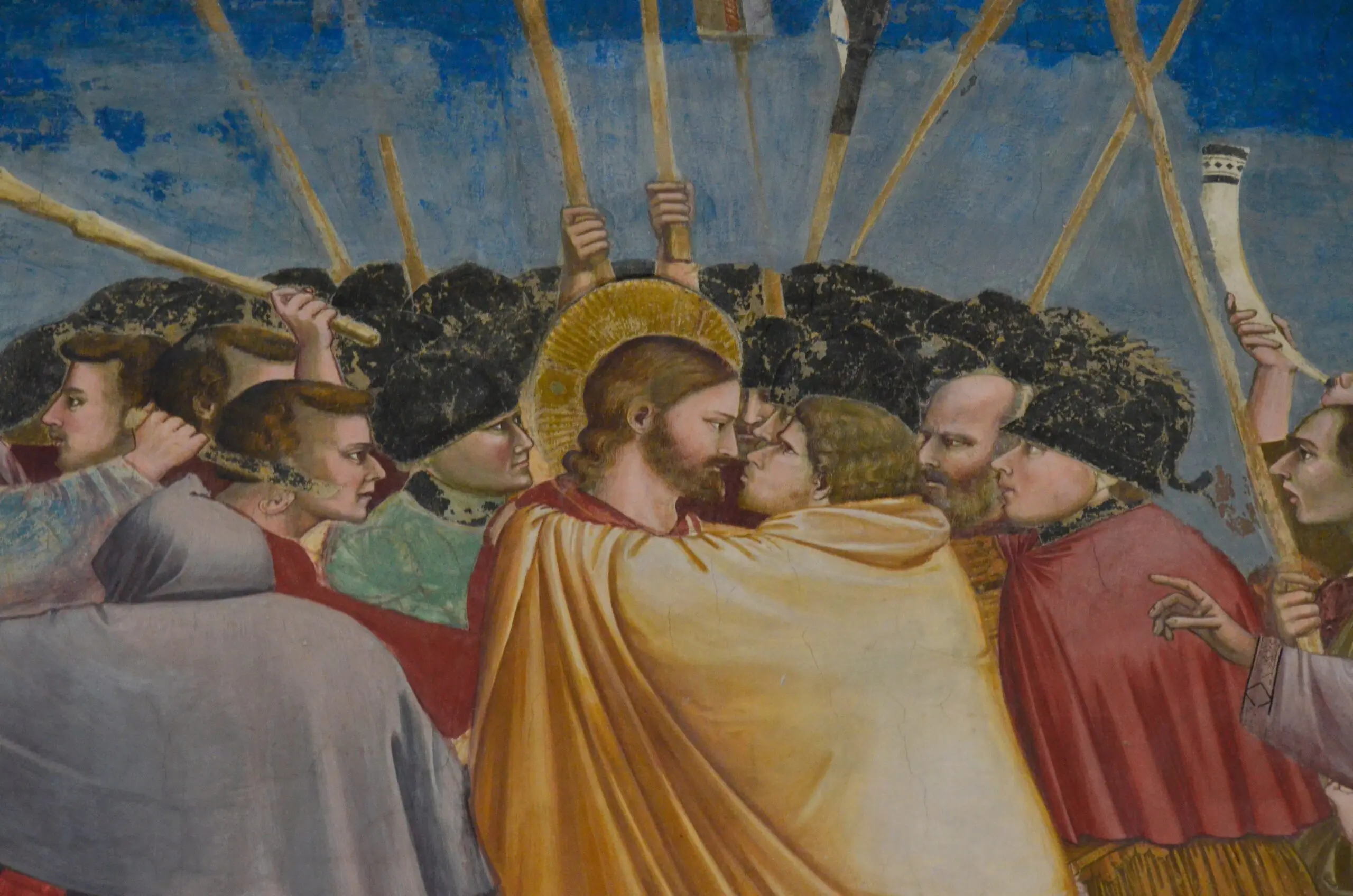
A handful of individual scenes are worth knowing by name before your fifteen minutes begin, since the visit moves quickly and it helps to know exactly what to look for. The Kiss of Judas, showing the moment of Christ’s betrayal, is frequently singled out as the cycle’s emotional high point: Judas’s cloak physically envelops Christ as their eyes lock in a moment of profound, legible sorrow and tension that simply didn’t exist in painting before this. The Lamentation, showing mourners gathered around Christ’s body after the Crucifixion, is often cited as one of the most emotionally direct images in the entire history of Western art, with grieving angels overhead twisting in visible anguish. And the Massacre of the Innocents shows a cluster of desperate mothers, their grief rendered with such specificity that it took the major restoration completed in 2002 to fully reveal, beneath centuries of accumulated grime, individual tears on their faces, believed to be the very first tears ever depicted in the history of Western painting.
One detail consistently surprises science-minded guests: in the Adoration of the Magi panel, the Star of Bethlehem streaking above the stable isn’t rendered as a conventional symbolic star at all. Giotto modeled it directly on Halley’s Comet, which he had personally observed blazing across the sky in 1301, just two years before beginning work on the chapel, making this quite possibly the earliest depiction of a comet in the history of Western art, and a small, genuinely striking example of Giotto grounding even his most symbolic imagery in something he’d actually witnessed with his own eyes.
The Vices, the Virtues, and the Last Judgment
Beneath the main narrative registers, running along the base of both side walls, Giotto painted fourteen grisaille panels, monochrome figures rendered to look like carved stone rather than full color, depicting the Virtues on one wall facing the Vices on the other: Prudence, Fortitude, Temperance, Justice, Faith, Charity, and Hope opposite Foolishness, Inconstancy, Wrath, Injustice, Infidelity, Envy, and Despair. The pairing isn’t arbitrary decoration; it’s a deliberate moral roadmap that resolves directly into the chapel’s final, overwhelming image.
Covering the entire entrance wall, the wall you face as you leave rather than enter, is Giotto’s monumental Last Judgment, Christ enthroned at the center, the blessed rising toward Paradise on one side, the condemned descending into Hell on the other, each side of the composition deliberately aligned with the corresponding Virtues or Vices painted along the nave below. Tucked into the composition, kneeling and offering a painted model of the very chapel you’re standing inside, is a small figure of Enrico Scrovegni himself, presenting his life’s most expensive act of penance directly to the Virgin Mary, a final, unmistakable plea for exactly the forgiveness the entire building was built to secure.
Above it all, the barrel-vaulted ceiling is painted a deep, luminous blue and scattered with gold eight-pointed stars, organized into bands containing roundels of Christ, the Virgin, and prophets or evangelists, designed to evoke a genuine night sky rather than the flat gold heaven of earlier medieval convention, another small but radical choice that makes the whole chapel feel less like a symbolic space and more like a believable, inhabited world.
What Happened After Giotto
The chapel’s survival across seven centuries wasn’t guaranteed. The adjoining Scrovegni family palace, still standing well into the 19th century, was demolished in 1827, its materials sold off and reused to make way for new residential construction, a genuinely close call that left the chapel itself standing but increasingly vulnerable and isolated from its original architectural context. The Municipality of Padua purchased the chapel in 1880, beginning a long, ongoing process of protection and study that continues today. The most significant recent intervention, a major restoration completed in 2002, didn’t just clean centuries of grime from the frescoes; it also introduced the climate-controlled anteroom system every visitor now passes through before entering the chapel itself, a direct, practical response to just how fragile Giotto’s pigments have become after seven hundred years.
In 2021, the chapel became one of eight building complexes recognized together as “Padua’s Fourteenth-Century Fresco Cycles,” Padua’s second UNESCO World Heritage listing, standing alongside the Eremitani Church next door, the Palazzo della Ragione, the Baptistery, the Carrara Chapel, the Basilica of St. Anthony, and the Oratories of San Giorgio and San Michele.
Visiting the Chapel Today
Because Giotto’s frescoes are extraordinarily sensitive to humidity, dust, and the simple carbon dioxide exhaled by visitors, access is tightly controlled and genuinely non-negotiable. Every visitor passes first through a climate-controlled anteroom, typically for about fifteen minutes, allowing humidity levels carried in on clothing to settle before the chapel doors open, often paired with a short multimedia introduction to the frescoes while you wait. The visit inside the chapel itself is then limited to a fixed window, historically around fifteen minutes, in a capped group size.
Tickets must be booked in advance, frequently weeks ahead during spring, summer, and early autumn, and there is no reliable way to simply walk up and gain same-day entry during busy periods. My honest advice, the same thing I tell every guest planning a Padua day: if the Scrovegni Chapel is the reason you’re making the trip, and for most visitors it should be one of the primary reasons, book that specific reservation before finalizing anything else on your itinerary, since every other stop in Padua can flex around it far more easily than the chapel’s own strict schedule can flex around you.
Once inside, resist the urge to methodically identify every individual scene during your fifteen minutes. Let yourself simply stand in the middle of the small room and take in the whole space at once, the blue starlit ceiling, the wrapped narrative bands, the overwhelming Last Judgment on the wall behind you, before your eye starts working through individual panels. You can study the scenes in detail in a book afterward. You can only stand inside that specific room, under that specific painted sky, once.
Plan your visit: Padua Day Trip from Venice: Why Visit and What to See covers how to build a Scrovegni Chapel reservation into a full Padua day alongside the Palazzo della Ragione, the University, and the city’s other highlights, with the timed-entry logistics handled as part of the planning.
Frequently Asked Questions
Why is advance booking required to visit the Scrovegni Chapel?
Giotto’s frescoes are extremely sensitive to humidity, dust, and visitor traffic, so entry is limited to small groups on a strict timed schedule, preceded by a mandatory wait in a climate-controlled anteroom. Tickets, especially for popular time slots in peak season, can sell out weeks in advance, and same-day walk-up entry is not a reliable option.
How long did Giotto take to paint the Scrovegni Chapel, and when was it completed?
Giotto and his workshop painted the chapel’s entire fresco cycle between March 1303 and March 1305, the exact window between the chapel’s first and final consecrations, both held on March 25, the Feast of the Annunciation. It remains, at roughly two years, an extraordinarily fast timeline for a fresco program of this scale and ambition.
Is the Scrovegni Chapel part of Padua’s UNESCO World Heritage status?
Yes. Since 2021, it’s one of eight building complexes recognized together as “Padua’s Fourteenth-Century Fresco Cycles,” alongside the neighboring Eremitani Church, the Palazzo della Ragione, the Cathedral Baptistery, the Carrara Chapel, the Basilica of St. Anthony, and the Oratories of San Giorgio and San Michele.