I’ve spent nearly thirty years walking Venetian streets with visitors, and there’s a moment that happens almost every single tour: someone stops mid-sentence, looks up at a blank stretch of wall they’d normally ignore, and says, “Wait — has that always been there?”
It has. Venice hides more sculpture in plain sight than almost any city I know. Not the famous stuff — not the Basilica’s horses or the Doge’s Palace facade everyone photographs — but the smaller carvings tucked into corners, wedged above doorways, and set into walls that thousands of tourists brush past every single day without a second glance. Scholars have catalogued 386 of these reliefs within Venice proper, with another 40 scattered across the lagoon islands (Wikidot) . That’s a genuine open-air museum that costs nothing to see, if you know where to look.
Let me show you a few of my favorites.
The Patere: Venice’s Byzantine Fingerprints
Look up at almost any old facade in Venice — church, palazzo, humble house — and you’ll eventually spot a small circular disc set into the stone, usually carved with an animal or a pair of interlaced creatures. These are patere, and they’re one of the strangest, most overlooked layers of Venetian history.
They’re old. Most date to the 11th through 13th centuries (History Walks in Venice) , carved during the era when Venice’s commercial and cultural ties to Constantinople were at their strongest, and Byzantine style dominated local architecture (History Walks in Venice) . Many were cut from Greek marble, sometimes recycled from older Roman monuments, and typically run 20 to 40 centimeters across (History Walks in Venice) . Nobody agrees on exactly how many survive — estimates range from roughly a thousand originals (Images of Venice) to upwards of twelve hundred (History Walks in Venice) — which is itself part of the mystery. Historians call them “erratic sculptures” precisely because so many were salvaged from demolished buildings and reset into newer facades (Images of Venice) , so a patera’s location often tells you nothing about the age of the wall it’s mounted on.
What do they mean? That’s the fun part — nobody’s entirely sure. The most common motif by far is an eagle pecking at the head of a rabbit or hare, generally read as a symbol of virtue triumphing over vice (Images of Venice) . Another recurring image shows two flamingos with necks intertwined, drinking from a shared fountain (Wikidot) — a symbol scholars connect to harmony. One theory I find especially compelling is that merchant families used these carvings as a kind of visual signature on their facades, readable to the many nationalities passing through Venice’s docks (Images of Venice) , since the same animal motifs turn up on buildings from the Mediterranean all the way to Asia. Out of roughly 150 recurring design types (Wikidot) , you start to recognize the “greatest hits” once you know what you’re looking for.
One of the best places to see a cluster of them together is the north door of the church of Santa Maria dei Carmini in Dorsoduro, where five 12th-century Greek marble pateras depict an eagle pecking a hare, a gryphon doing the same, and a pelican spearing a fish (Images of Venice) — all within a few feet of each other.
The Moors of Campo dei Mori
Tucked into a quiet corner of Cannaregio, well off the standard Rialto-to-San Marco route, stands one of Venice’s strangest legends carved in stone. Four robed figures in turbans are set into the walls of Campo dei Mori — three on the main facade and a fourth, believed to be a servant, facing the canal.
The story goes that these were three merchant brothers who arrived in Venice from the Peloponnese in 1112 (Guidedtoursinvenice) and settled in the area. They weren’t beloved neighbors — local legend paints them as unscrupulous traders who overcharged for shoddy cloth and spices (Guidedtoursinvenice) , until Mary Magdalene herself supposedly turned them to stone as punishment. The most famous of the four, nicknamed Signor Rioba, became something of a local mascot; he even lost his stone nose in the 19th century and had it replaced with a crude iron substitute (Guidedtoursinvenice) , which is still there today. A few steps away, the same family’s former home — Palazzo Mastelli — carries its own quirky carving: a camel in bas-relief, which is how the building earned the nickname “Palace of the Camel.” (Guidedtoursinvenice)
This is exactly the kind of spot I love bringing guests to on our private walking tours — it’s two minutes off a busy calle, but almost nobody wanders in unless they know to look.
The Hunchback Who Held Up Venice’s Justice
Near the Rialto, tucked against the church of San Giacomo di Rialto, is a small crouched granite figure that visitors walk past constantly without noticing: Il Gobbo di Rialto, “the Hunchback of Rialto.” He’s been supporting a short flight of stone steps on his back for centuries, and his story is grimmer than his cartoonish nickname suggests. This was historically the spot where public sentences were read out and minor punishments concluded — and criminals who’d completed their sentence would kiss the stone at his feet as a symbolic gesture of freedom (Guidedtoursinvenice) . The ritual became so popular that Venetian authorities eventually worried the Gobbo was being treated with too much reverence, so in the 1540s they added a carved cross and winged lion nearby to redirect the symbolism toward the state rather than the statue itself.
The Old Lady Who Saved a Doge
A few steps from Piazza San Marco, near the Clock Tower, look up and you’ll find a small relief of a woman leaning out a window holding what appears to be a heavy stone mortar, about to drop it. This is Giustina Rossi, and the carving commemorates a real moment of civic drama: in 1310, during a conspiracy against the ruling Doge, the story goes that her mortar accidentally slipped from her windowsill and struck (and possibly killed) the conspirators’ standard-bearer marching below — disrupting the plot at a critical moment. Whether the tale is entirely accurate or embellished by grateful Venetians afterward, the city rewarded her, and this small relief has kept her story alive in stone for over 700 years.
Hidden in the Doge’s Palace Itself
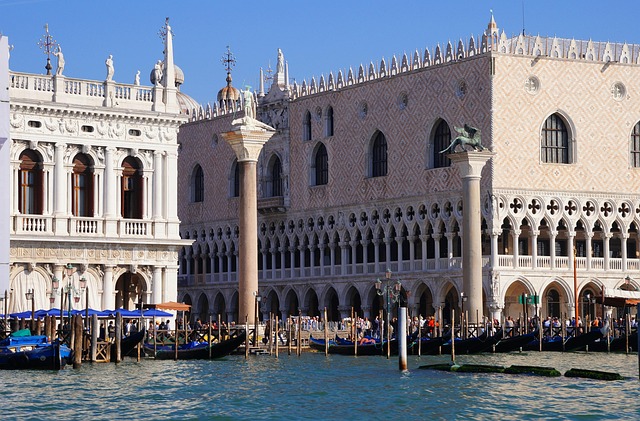
Even at Venice’s most-visited monument, most tourists walk right past the sculpture that matters most. At the corners of the Doge’s Palace, where the facades meet, three high-relief carvings mark pivotal moments of Biblical justice — deliberately placed there to remind visitors what the Republic claimed to stand for. Near the old entrance, you’ll find King Solomon deciding between two women claiming the same child (Guidedtoursinvenice) , his face carved with deliberate blankness against the real mother’s visible grief. Around the next corner is Adam and Eve at the moment of the Fall (Guidedtoursinvenice) — look closely among the fig leaves and you can spot a hidden face watching the scene. And at the third corner, a drunken Noah, shielded by two of his sons while a third looks away in discomfort (Guidedtoursinvenice) . These aren’t decoration; they’re a 15th-century public sermon on justice and shame, carved for a population that mostly couldn’t read.
The Salamander That Hid for Centuries
Not every Venetian sculpture was meant to be found. During a restoration at Palazzo Grimani, workers uncovered a carved salamander tucked behind a fireplace wall (SeeVenice) — a 16th-century piece that had been deliberately concealed, for reasons nobody has fully explained. The salamander was a European symbol of resurrection and resilience, famously associated with the French king Francis I. Why someone hid it rather than displayed it remains one of the small unsolved mysteries of Venetian art, and it’s a good reminder that even after centuries of cataloguing, the city still has secrets left to give up.
Are the hidden sculptures of Venice free to see?
Yes — nearly everything covered here (patere, the Moors of Campo dei Mori, the Gobbo di Rialto, Giustina Rossi’s relief) is on an exterior wall in a public street or campo, so there’s no ticket required. The exception is the Doge’s Palace corner reliefs and the Palazzo Grimani salamander, which sit on or inside ticketed sites.
How do I find these on my own without a guide?
Some, like the Moors and the Gobbo, are marked on detailed city maps. Most patere, though, have no signage at all — spotting them takes knowing which streets and building types to watch, which is honestly where a private guide earns their keep on a first visit.
Is this a good activity for kids or first-time visitors?
Very much so. Kids in particular respond well to the legend-driven pieces — the Moors turned to stone, the hunchback’s punishment ritual, the mortar-dropping old lady — since they’re essentially ghost stories carved into buildings. I often weave a few of these into family-friendly walking tours as a way of keeping younger travelers engaged between bigger sights.