By Igor Scomparin, licensed Venice tour guide since 1997, Tour Leader Venice
Introduction
Most Americans land in Venice, spend two or three days getting gloriously lost in the calli, take a gondola ride, eat more pasta than they planned to, and fly home thinking they’ve “done” the Veneto. I understand why. Venice is overwhelming in the best way, and it swallows most of a traveler’s attention span before they even think to look at a map of what surrounds it.
But here’s what I tell every guest who asks me, on their last morning in Venice, “what did we miss?”: you missed almost all of it.
Venice sits inside a region called the Veneto, and the Veneto happens to be one of the most UNESCO-dense corners of planet Earth. Within about ninety minutes of St. Mark’s Square, you can stand in front of buildings designed by the man who literally invented the architectural language of the White House. You can walk through hills so improbably beautiful that UNESCO decided a wine region deserved the same protection as the Pyramids. You can climb into mountains that look like they were carved by a sculptor having a very good day. And you can do all of it as a series of day trips, or as a slower, multi-day loop, without ever having to fully say goodbye to your Venice hotel room.
I’ve been guiding travelers around this region since 1997. I’ve watched Verona’s Arena fill up for opera under a summer sky, I’ve driven Vespas through Prosecco vineyards with guests who’d never ridden a scooter in their life, and I’ve watched grown adults go quiet in front of Palladio’s Villa Rotonda because nothing prepared them for how it would feel to stand in a building that shaped the way half of Washington D.C. looks. This guide is my attempt to put all of that in one place: the nine UNESCO World Heritage Sites of the Veneto region, the hidden gems that don’t have a UNESCO plaque but deserve one, and a practical map of how to see it all without wasting a single vacation day on logistics.
What follows isn’t a list ranked by fame or by how many UNESCO criteria a site satisfies. It’s organized the way I’d actually plan a trip for you if you sat down across from me and asked, “okay, we’ve got a few extra days, where do we go?” That means honest notes on how to get to each place, when to go, how long to spend there, and, just as importantly, when a site isn’t worth the detour for your particular trip. I’d rather you skip one of these places and enjoy the rest fully than try to cram all nine into a week and remember none of them clearly.
Let’s get into it.
The Philosophy Behind This Guide
If you’ve read anything else on this site, you already know I don’t do the breathless “hidden gem” travel-writing voice where every town is “magical” and every meal is “unforgettable.” I’d rather tell you who a place is actually good for, and who it will disappoint, than sell you a fantasy you’ll resent me for once you’re standing in it.
That approach guides everything in this article, and it comes down to three ideas.
First: Venice is not the Veneto, and treating it as the whole story does a disservice to both. Venice is a city-state frozen mid-sentence, an extraordinary and strange place that rewards slow wandering. But the Republic that built Venice also built defensive walls in Peschiera, villas in the countryside around Vicenza, and shipped Prosecco down from hillside vineyards for centuries before it became an export hit. Seeing only Venice is like reading the introduction of a novel and closing the book.
Second: proximity is not the same as accessibility. A place can be ninety minutes from Venice and still be functionally invisible to an American traveler who doesn’t read Italian train timetables for fun, doesn’t know which bus goes where, and has five days in Italy, not five weeks. Part of what I try to do, both on tour and in what I write here, is close that gap: not by dumbing down the region, but by giving people an honest, workable plan.
Third: the UNESCO label is a starting point, not the whole point. UNESCO inscribes sites because of “outstanding universal value,” which is a wonderfully bureaucratic way of saying “this matters to all of humanity, not just to the people who live near it.” I take that seriously. But some of the best things I’ll show you in this guide, a particular bend in the road through the Euganean Hills, the way the light hits Lake Garda at 6pm in September, aren’t on any UNESCO list at all. They’re just true, and worth your time, and I’d be doing you a disservice if I only wrote about the sites with official plaques.
With that in mind, here’s the map.
A Map of the Veneto: How It All Connects
Picture Venice at the eastern edge of the region, sitting in its lagoon. From there, the Veneto fans out to the west and north in a rough arc, and almost everything in this guide sits within a two-hour drive of the city, most of it within one hour.
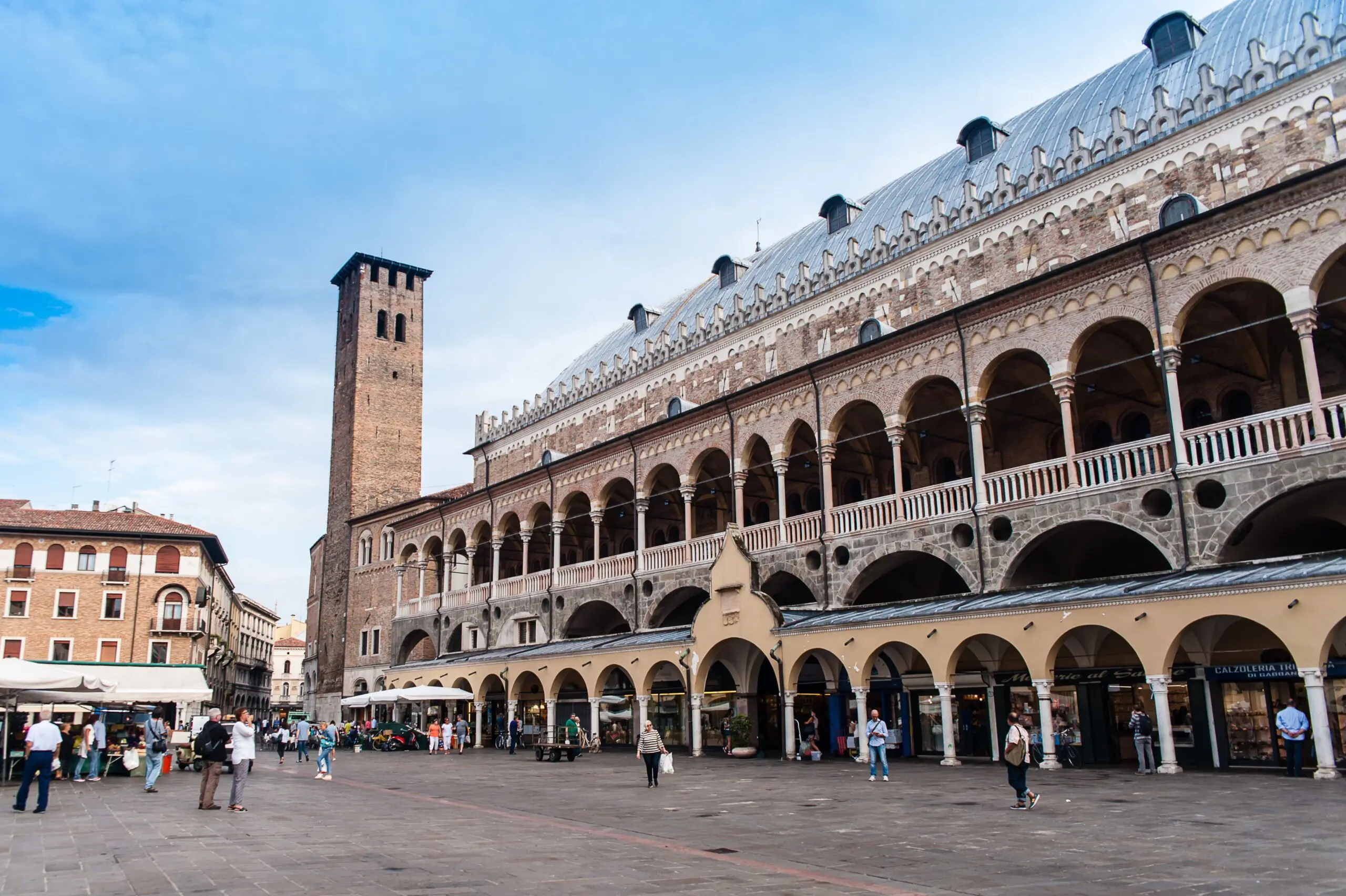
Heading west along the mainland, you first hit Padua (35–45 minutes by train), home to Giotto’s frescoes and the world’s oldest university botanical garden. Continue west and you reach Vicenza (about an hour by train), Palladio’s adopted city, and the springboard for the Palladian villas scattered through the surrounding countryside. Keep going west and the land opens into Lake Garda, Italy’s largest lake, with Peschiera del Garda anchoring its southeastern shore behind star-shaped Renaissance walls (roughly 1.5–2 hours from Venice). Just north and slightly east of Garda sits Verona, the city of the Arena and, fictionally, of Romeo and Juliet (about 1 hour 15 minutes by train from Venice, and easily combined with Garda in one trip).
North of Venice, in the province of Treviso, the land rises into the Prosecco Hills around Conegliano and Valdobbiadene (about 1 hour to Conegliano by train, longer into the hills themselves by car). And south of Padua, tucked between the city and the Adriatic plain, the Euganean Hills (Colli Euganei) rise unexpectedly out of flat farmland, volcanic in origin, dotted with thermal spa towns, medieval hill villages, and vineyards.
Further north still, well beyond a day trip but within the same region administratively and spiritually, the Dolomites complete the picture: a UNESCO natural site so different from the lagoon that it’s hard to believe they’re part of the same territory.
I recommend most American travelers think of this as three possible “arms” radiating from Venice, and pick based on how many days they have:
- The short arm (half a day to a full day): Padua, or the Euganean Hills.
- The medium arm (one full day, or an overnight): Vicenza, or the Prosecco Hills.
- The long arm (one to two full days, ideally an overnight): Verona combined with Lake Garda and Peschiera.
If you have four or more days beyond Venice itself, you can string these together into a loop: Venice to Padua to Vicenza to Verona to Lake Garda, then back through the Prosecco Hills before returning to Venice. I’ve guided this exact loop more times than I can count, and it works beautifully by car, less beautifully but still workably by a combination of trains and local drivers or guides for the stretches public transport doesn’t reach well.
Now let’s go through each of these places one at a time.
Venice and Its Lagoon
UNESCO status: Inscribed in 1987, one of the earliest Italian sites on the list.
I’ll keep this section shorter than it deserves, since the rest of this website is essentially one long love letter to Venice already. But it’s worth pausing on why UNESCO inscribed the lagoon, not just the city, because most visitors miss this entirely. The listing covers Venice and its lagoon as a single, inseparable ecosystem: the historic center, yes, but also Murano, Burano, Torcello, and the fragile hydraulic balance that has kept a city built on wooden pilings standing in salt water for over a thousand years.
That framing matters practically. If you only walk the city center, you’re seeing perhaps a third of what the inscription actually protects. A lagoon boat trip, whether a half-day tour to the islands or a slower private excursion into the quieter northern lagoon, shows you the other two-thirds: the fishing traditions, the bird-filled marshes, the medieval settlement of Torcello that predates Venice itself as the region’s power center.
For American travelers with limited time, my honest advice is this: give the city itself at least two full days before you head anywhere else on this list. Everything that follows is worth seeing, but Venice rewards unhurried time in a way that no day trip can replace, and rushing through it to “check the box” on Verona or Lake Garda is the single most common regret I hear from repeat guests.
There’s also a practical reason the lagoon deserves more attention than it usually gets: it’s the hinge that connects everything else in this guide. The same Republic that dredged canals and drove wooden piles into the mud to build Venice also drained marshes, fortified river crossings, and irrigated hillsides across the mainland territories you’re about to read about. Understanding the lagoon first, the ingenuity it took just to make the city physically possible, changes how you see the villas, the fortresses, and even the vineyards that follow. Nothing in the Veneto happened in isolation from Venice’s relationship with water and land, and that thread runs through every single site on this list.
Getting there and when to go: You’re already there if you’re reading this in Venice. For the best lagoon light and the fewest crowds on Burano and Torcello, aim for a weekday morning departure, arriving back in the city center before the afternoon cruise-ship crowds peak around the main sights.
The Euganean Hills (Colli Euganei)
UNESCO status: Not independently inscribed, though the area contains one of the region’s UNESCO Prehistoric Pile-Dwelling sites near Arquà Petrarca, and sits a short drive from Padua’s two UNESCO listings.
The Euganean Hills are the region’s best-kept secret from American travelers, and I mean that literally: in nearly three decades of guiding, I’ve had a fraction of the requests for Colli Euganei that I’ve had for Verona or Lake Garda, despite the fact that guests who do make it here almost always tell me it was a highlight.
Geologically, the hills are volcanic in origin, an unexpected cluster of conical, forested peaks rising out of the flat Po Valley plain south of Padua. That geology produced two things Americans tend to love once they discover them: excellent wine, particularly from indigenous grape varieties you won’t find on a typical Chianti-focused Italy trip, and natural thermal springs that have made towns like Abano Terme and Montegrotto Terme spa destinations since Roman times.
The medieval hill village of Arquà Petrarca, where the poet Petrarch spent his final years and where his house still stands, is the area’s cultural centerpiece, and it’s also near one of the region’s lesser-known UNESCO inscriptions: a Bronze Age pile-dwelling site at Laghetto della Costa, part of a broader, multi-country UNESCO listing of prehistoric stilt settlements around the Alps. Most visitors never notice it’s there, which tells you something about how quietly this region carries its history.
I generally recommend the Euganean Hills as a half-day or full-day add-on for travelers based in Padua or Venice who want wine country without the crowds of Tuscany, or for anyone combining a spa afternoon with genuine medieval atmosphere. It’s not a site that needs three days; it’s a site that rewards one unhurried afternoon far more than most itineraries give it.
What surprises most American guests is how quickly the landscape changes once you leave the Po Valley plain. One moment you’re driving past flat farmland that could pass for parts of the American Midwest, and ten minutes later you’re winding through forested volcanic cones with vineyards clinging to the slopes and stone farmhouses tucked into the folds of the hills. It doesn’t look like anywhere else in the Veneto, and that contrast is exactly why I keep sending guests here even though it rarely shows up in a standard guidebook itinerary.
Getting there and when to go: Regional trains connect Venice to Padua in under an hour; from there, the hills themselves require a car, a driver, or a local tour, since public transport into the villages is sparse. Spring and early autumn are ideal, when the thermal towns are quiet and the hillside vineyards are either blooming or being harvested.
Vicenza and the Palladian Villas
UNESCO status: Inscribed in 1994 (the historic center of Vicenza, with 23 Palladian buildings) and expanded in 1996 to include 21 additional villas across the wider Veneto countryside, for a total of 47 Palladian structures on the list.
If you’ve ever admired a building in the United States with a columned portico and a symmetrical, temple-like facade, from a stately home to a state capitol to the White House itself, you’ve admired the influence of one architect: Andrea Palladio, who did almost all of his defining work in and around Vicenza in the 16th century.
The city’s historic center is essentially an open-air Palladio museum. The Basilica Palladiana, with its distinctive double-tiered loggia, dominates the main square. The Teatro Olimpico, the oldest surviving indoor theater in the world, still uses Palladio’s original stage set, a permanent trompe-l’oeil cityscape that creates an illusion of streets receding into the distance. And just outside the city walls sits Villa Almerico Capra, better known as La Rotonda, the villa that essentially became the template for Palladian architecture worldwide, copied from Monticello to countless American courthouses.
Beyond the city itself, the wider UNESCO listing includes villas scattered across the Veneto countryside: Villa Barbaro in Maser, with frescoes by Veronese, and Villa Emo, among others. You don’t need to see all 47 buildings to understand Palladio; two or three, paired with a walk through Vicenza’s center, will do it.
For American guests, I’ve found Vicenza works best as a focused half-day or full-day trip, ideally combined with a broader Palladian villa route if architecture is a genuine interest rather than a box to check. It’s an easy train ride from Venice, and it’s the single most underrated stop on this entire list relative to how effortlessly it delivers a “wow” moment.
I often explain Palladio’s influence to American guests this way: he wasn’t just designing beautiful buildings, he was writing a rulebook, published as illustrated treatises, that architects on the other side of the Atlantic would still be following two centuries later without ever having set foot in Vicenza. Thomas Jefferson owned and annotated a copy of Palladio’s writings while designing Monticello. Standing in front of La Rotonda, guests often tell me it feels oddly familiar, and it should: they’ve likely seen its descendants their entire lives without knowing the source.
Getting there and when to go: Trains from Venice to Vicenza take about an hour and run frequently throughout the day, making this one of the easiest and most flexible day trips on this list. The historic center is compact and fully walkable; a car is only useful if you plan to chase down the outlying villas, several of which keep limited opening days, so check ahead if a specific villa is the reason for your trip.
Verona
UNESCO status: Inscribed in 2000, the historic city of Verona.
Verona carries two thousand years of continuous urban history compressed into a walkable center, and it’s the site on this list that most closely rivals Venice for name recognition among American travelers, mostly thanks to Shakespeare. Romeo and Juliet were never real people and “Juliet’s balcony” is a 20th-century tourist invention, and I’ll tell any guest this directly rather than play along, but that doesn’t make Verona less worth visiting. It makes the real history more interesting by comparison.
The Arena di Verona, a first-century Roman amphitheater, is the city’s anchor, still hosting opera performances on summer nights in a way that makes ancient stone feel entirely alive rather than roped-off. The medieval Piazza delle Erbe occupies the site of the original Roman forum, layering two thousand years of civic life on the same few hundred square meters. And the Scaliger family’s fortified bridges and tombs, along with a well-preserved medieval street plan, are exactly why UNESCO inscribed the whole historic center rather than a single monument.
Verona pairs naturally with Lake Garda, since they’re roughly forty-five minutes apart by car and the two together make an excellent full-day or overnight trip from Venice. I generally suggest travelers not rush Verona into a half-day squeezed between a Venice morning and a Garda evening; the city has enough layered history to fill a relaxed full day on its own.
If your visit happens to fall between late June and early September, the Arena’s open-air opera season is worth building your entire schedule around. Watching an opera performed in a two-thousand-year-old Roman amphitheater, under a genuinely dark Italian sky, is one of those experiences that sounds like a cliché in a brochure and then turns out to be exactly as good as advertised once you’re actually sitting in the stone seats with ten thousand other people falling silent as the lights go down.
Getting there and when to go: Direct trains run from Venice to Verona in roughly an hour to ninety minutes depending on the service. The historic center is walkable end to end, though the hills above the city, home to the Castel San Pietro viewpoint, are a worthwhile short climb or funicular ride for the best overview of the Adige river bend that shaped the city’s original layout.
Lake Garda and Peschiera del Garda
UNESCO status: Peschiera del Garda is part of the “Venetian Works of Defence between the 16th and 17th Centuries,” a multi-country UNESCO listing (inscribed 2017) that also includes fortifications in Croatia and Montenegro. Lake Garda itself is not a UNESCO site, but it anchors this section of the region and is one of the most rewarding stretches to explore by boat and by scooter.
Lake Garda is Italy’s largest lake, and its southeastern shore is where the Venetian Republic once built one of its most sophisticated defensive works: the star-shaped fortress town of Peschiera del Garda. The pentagon-shaped walls, designed by the military architect Guidobaldo della Rovere and built under Michele Sanmicheli, one of the most significant military engineers of the Renaissance, are remarkably intact, and walking them gives a very different picture of the Venetian Republic than the one most travelers get from gondolas and glassblowing demonstrations: this was a state that had to defend a vast and contested territory, not just a city of canals.
Beyond the fortress, Lake Garda itself is simply one of the most beautiful bodies of water in Italy, with a personality that shifts dramatically as you move around its shore: mountainous and dramatic in the north, mild and Mediterranean-feeling in the south, dotted with lemon groves that feel almost out of place this far north in Italy. I always encourage guests to see at least part of it from the water; the lake genuinely is best understood from a boat, where you can watch the landscape change from one end to the other in the space of an hour.
For American travelers, Garda works well as an overnight stop within a longer Veneto loop, or as a full-day trip from Verona if you’re short on time. I don’t recommend trying to combine Verona and a meaningful Garda visit into a single day trip from Venice itself; the driving and train logistics eat too much of the day, and you’ll end up seeing both places through a car window rather than actually experiencing either one.
I’ll also say this plainly, because I think honesty matters more than enthusiasm: Garda’s southern shore towns, Sirmione especially, can get genuinely crowded in July and August, to the point where the experience starts to work against you. If your schedule is flexible, late spring or September gives you the same lake, the same light, the same fortress walls at Peschiera, with a fraction of the tour buses.
Getting there and when to go: Peschiera del Garda has its own train station, roughly ninety minutes from Venice on a direct regional or intercity service, making the fortress town itself surprisingly easy to reach without a car. Exploring the wider lake shore by boat is the best way to see how the landscape shifts from one end of the lake to the other, and it’s best arranged through a local operator, since public ferry schedules move slowly and don’t reach every cove worth seeing.
The Prosecco Hills of Conegliano and Valdobbiadene
UNESCO status: Inscribed in 2019 as a cultural landscape, Italy’s 55th UNESCO site.
I’ve saved one of my personal favorites for near the end. The Prosecco Hills, in the province of Treviso north of Venice, earned their UNESCO inscription not for a monument but for an entire landscape: steep, narrow ridges called hogback formations, worked by hand for centuries because the slopes are too steep for machinery, terraced into grassy ledges called ciglioni that follow the natural contours of the land. It took more than a decade of documentation for UNESCO to formally recognize what the growers there had known all along: that this is one of the most distinctive wine landscapes on Earth, a rare case where human agricultural labor and a difficult terrain produced something genuinely beautiful rather than merely productive.
I always tell guests that a scooter, not a car, is the right way to see it. The roads through the hills between Conegliano and Valdobbiadene are narrow, winding, and largely free of the tour-bus traffic that clogs routes elsewhere in Italy, which makes them ideal for a Vespa or a slow drive with frequent stops. Medieval hill villages punctuate the vineyards, and the wineries themselves range from small family operations that have worked the same slopes for generations to larger, more polished producers offering full tasting experiences.
I treat the Prosecco Hills as an ideal full-day or overnight trip for travelers who want wine country without leaving the Veneto, and it’s consistently one of the most requested experiences among guests who’ve already spent a few days in Venice and are ready for something slower and greener. It’s also, not coincidentally, one of the areas Tour Leader Treviso focuses on specifically, since Treviso itself makes an excellent, far less crowded base for exploring these hills than Venice does.
One detail I make a point of sharing with American guests, because it usually reframes how they think about the wine itself: the UNESCO listing specifically protects the ciglioni, the hand-built grassy terraces that let growers cultivate slopes too steep for any machine. That labor hasn’t been automated away in the decades since; it’s still done largely by hand today, exactly as it was generations ago. Every bottle of true Conegliano Valdobbiadene Prosecco Superiore you drink represents that same manual effort, which is a very different story than the mass-market Prosecco most Americans have encountered at home.
Getting there and when to go: Trains from Venice to Conegliano take about an hour, but the hills themselves, and the villages, wineries, and viewpoints scattered through them, require a car, a scooter, or a guided tour to explore properly. Early autumn, during the grape harvest, is spectacular but busy with local traffic around the wineries; late spring offers similarly green hillsides with far more breathing room.
Two More Sites Worth Knowing: The Dolomites and Padua
Two more UNESCO sites round out the Veneto’s nine total listings, and they’re worth knowing about if you’re building a longer itinerary.
Padua, roughly thirty-five minutes from Venice by train, holds two separate UNESCO inscriptions: the Botanical Garden of Padua, the oldest university botanical garden in the world still in its original location, dating to 1545, and the 14th-Century Fresco Cycles, a set of eight fresco cycles across the city, most famously Giotto’s Scrovegni Chapel, recognized in 2021 as one of the foundational moments in the development of Western painting. Padua is close enough to Venice that it works comfortably as a half-day or full-day trip, and I consider it one of the most underrated stops in the entire region for travelers with any interest in art history.
The Dolomites, inscribed in 2009 for their extraordinary geology, sit at the far northern edge of the Veneto and spill into neighboring Trentino-Alto Adige. They’re a different kind of trip entirely: not a day excursion from Venice, but a multi-day mountain journey best planned as its own leg of an Italy itinerary, ideally in summer for hiking or winter for skiing. I mention them here mainly because guests are often surprised to learn that the same region containing Venice’s canals also contains some of Europe’s most dramatic peaks, a contrast that says a lot about how much variety the Veneto actually holds.
Planning Your Own Veneto Beyond Venice Itinerary
If you’re trying to translate all of this into an actual trip, here’s the honest, practical framework I give guests who ask.
If you have 3–4 days beyond Venice: Pick one “long arm” (Verona plus Lake Garda and Peschiera, as an overnight) and one “short arm” (Padua, or the Euganean Hills, as a half day). Don’t try to do more; you’ll spend your trip in transit instead of in these places.
If you have 5–7 days beyond Venice: Run the full loop: Padua, Vicenza, Verona, Lake Garda and Peschiera, back through the Prosecco Hills, and return to Venice. This is genuinely doable at a comfortable, non-exhausting pace, and it’s the itinerary I build most often for repeat visitors who’ve already done Venice properly on a previous trip.
If you’re short on time and can only add one thing to a Venice-based trip: Choose based on interest, not obligation. Architecture and history lovers should go to Vicenza. Wine lovers should go to the Prosecco Hills. Travelers who want a classic, dramatic Italian city should go to Verona. And travelers who want to slow down and do less, not more, should consider the Euganean Hills, which is the one place on this list built for doing almost nothing at all, and doing it very well.
Public transport handles Padua, Vicenza, and Verona comfortably on your own. Lake Garda, Peschiera, the Prosecco Hills, and the Euganean Hills are all considerably easier, and more enjoyable, with a private driver or guide, simply because the best parts of each are outside the train-accessible town centers.
Best Time of Year to Explore the Veneto Beyond Venice
Timing changes this region more than most travelers expect, and it’s worth planning around rather than leaving to chance.
Spring (April–May) is, in my opinion, the single best window for this entire itinerary. The Prosecco Hills are at their greenest, the Euganean Hills’ thermal towns are quiet, wildflowers are out across the Palladian villa gardens near Vicenza, and daytime temperatures are comfortable enough for a full day of walking in Verona or Vicenza without the summer heat that builds by June. Lake Garda hasn’t yet filled with peak-season crowds, and hotel rates across the mainland are noticeably lower than in July and August.
Summer (June–August) brings the Arena’s opera season in Verona, genuinely one of the best cultural experiences available anywhere in the region, but it also brings heat, crowds, and higher prices, especially around Lake Garda’s southern shore. If you’re traveling in summer, I generally suggest front-loading outdoor activity into the early morning, reserving Lake Garda towns like Sirmione for early morning or evening visits, and treating the opera itself as the reason to accept the trade-off.
Early autumn (September–October) is a close second to spring, and in some ways it’s better for wine lovers specifically, since it coincides with the grape harvest in the Prosecco Hills. The light across the whole region turns a deeper gold in the late afternoon, which is part of why so much of this territory photographs so well in early autumn. Crowds thin out noticeably after the first week of September, particularly once American school schedules pull families home.
Winter (November–March) is the quietest window by far, and it’s genuinely underrated for the cities on this list: Verona, Vicenza, and Padua all remain fully open and often more atmospheric with fewer visitors, though some rural wineries and villa properties reduce their hours or close for the season. The Dolomites, of course, come into their own in winter for skiing, an entirely different kind of Veneto trip.
My honest recommendation for most first-time American visitors planning a Venice-plus-Veneto trip: aim for late April through early June, or mid-September through mid-October. You’ll get comfortable weather, manageable crowds outside of Venice itself, and full access to everything described in this guide.
Frequently Asked Questions
How many UNESCO World Heritage Sites are in the Veneto region?
The Veneto region has nine UNESCO World Heritage Sites: Venice and its Lagoon, the City of Vicenza and the Palladian Villas, the Botanical Garden of Padua, the City of Verona, the Dolomites, the Prehistoric Pile-Dwelling Sites around the Alps, the Venetian Works of Defence (including Peschiera del Garda), the Prosecco Hills of Conegliano and Valdobbiadene, and Padua’s 14th-Century Fresco Cycles.
Can I visit Verona, Lake Garda, and the Prosecco Hills as day trips from Venice?
Verona and the Prosecco Hills can each work as a long but manageable day trip from Venice by train, though you’ll see them faster than you’d like. Lake Garda and Peschiera are better as an overnight stop, or combined with Verona over two days, since the drive and train connections from Venice eat a significant part of a single day.
What’s the best way to see the Prosecco Hills and the Euganean Hills without a car?
Both areas are genuinely difficult to explore well using public transport alone, since the best villages, viewpoints, and wineries sit outside the train-served towns. A private driver-guide or a small-group tour is by far the most efficient option, and it’s the approach I recommend to almost every guest heading into either area.