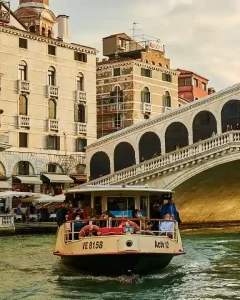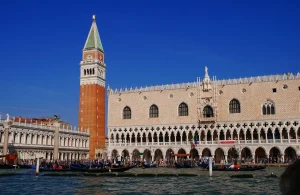
Every time I bring a client along the Grand Canal, someone eventually asks the same question, standing in front of one of the great palazzi: “How do people actually live in there?” It’s a fair question, because from the water, a Venetian palace reads as pure spectacle — lace-like stone tracery, tall arched windows, centuries of wealth stacked into a single facade. What almost nobody realizes, until I walk them through one, is that every single element of that facade was solving a specific, practical problem. Venetian palaces aren’t just beautiful. They’re some of the cleverest buildings in European history, and most of their best secrets are hiding in plain sight.
The Palace That Was Also a Warehouse
The first thing I explain to clients is that a Venetian palazzo was never simply a home. The earliest grand houses, known as casa-fondaco, were built to be both residence and business headquarters simultaneously — because in Venice, the nobility and the merchant class were often the same people. A senator by title might spend his mornings brokering spice shipments from the ground floor of his own house.
That dual identity shaped the entire layout. The main entrance always faced the water, not the street, because boats — not carriages — were how goods and guests arrived. Step through a palace’s water gate and you’d land in the andron, a long ground-floor hall used for loading and unloading merchandise straight off the boats, flanked by storage rooms on either side. This space flooded periodically and was never meant to be glamorous — it was the working engine room of the house.
The Real Show Floor Was Upstairs
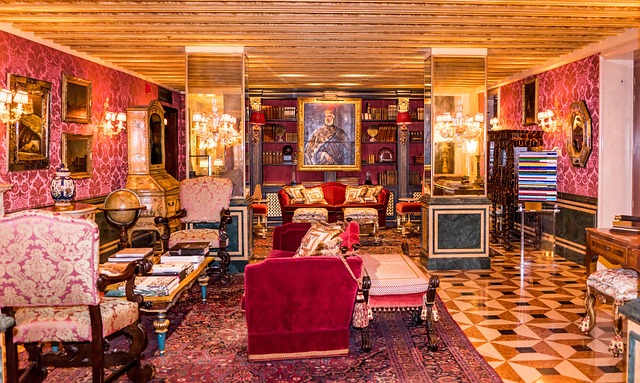
The grandeur everyone associates with Venetian palaces doesn’t happen on the ground floor at all — it happens one flight up, on what’s called the piano nobile, the “noble floor.” This is where the real architecture lives: soaring ceilings with exposed painted beams, walls of Murano glass and gilded stucco, and a long central hall called the portego that ran the full depth of the building, lit at both ends by the ornate windows you see from the canal.
Originally, the portego doubled as a showroom, where merchant families would display imported silks, spices, and luxury goods to potential buyers before it evolved into a room purely for entertaining. That’s why the most spectacular window clusters on any palazzo facade — the ones with the pointed Gothic arches or Byzantine-influenced curves — almost always mark the piano nobile, not the ground floor. When you’re gondola-gazing at a palace facade, the windows are effectively a floor plan, telling you exactly where the important room is hiding.
A City Too Poor in Land, and Too Rich in Style, to Build Gardens
Unlike palaces in Florence or Rome, Venetian palazzi almost never had sprawling courtyards or gardens. There simply wasn’t room — every square meter of a Venetian island was worth defending, so families built up rather than out, creating tall, narrow buildings instead of sprawling estates. What space they did have was compressed into a small rear courtyard, just large enough for an external staircase and one particular object that hides one of the city’s cleverest secrets: the well.
Venice’s Wells Aren’t Actually Wells
This is the detail I save for last, because it always gets the best reaction. Nearly every palace courtyard in Venice has an ornate stone well-head at its center — and almost none of them lead down to actual groundwater. Venice sits in a saltwater lagoon; drilling straight down gets you nothing but brine. What looks like a well is, in reality, the visible cap of an enormous underground cistern engineered specifically to capture and filter rainwater.
The system was remarkably sophisticated. Rain falling across the courtyard and rooftops drained toward the well-head through gently sloped paving and stone gutters. From there, it filtered down through graded layers of sand and gravel, sitting inside a chamber sealed with a half-meter-thick layer of impermeable clay to keep the surrounding saltwater out. Only after passing through all of that would the water reach the central brick shaft, where a bucket could finally draw it up. At its peak, this network numbered close to 6,000 cisterns spread across the city, and it remained Venice’s primary source of drinking water until an aqueduct finally arrived in the 1880s. Every ornamental well-head you photograph in a quiet campo or a palace courtyard is really the cap of a small, buried water-treatment plant, centuries ahead of its time.
Built Light on Purpose
Venetian palaces also hide their engineering logic in their materials. Because the entire city rests on timber piles driven into soft lagoon mud, builders deliberately avoided heavy stone vaulting inside — the kind you’d find in a Roman or Florentine palazzo — in favor of lighter timber-beamed flat ceilings, which settled more forgivingly as the building shifted over centuries. Interior walls were typically finished in marmorino, a stucco made from ground limestone, brick, and terracotta rather than solid marble, cutting weight without sacrificing shine. And where other Italian palaces used costly, defensible stone facades with minimal glazing, Venetian palaces embraced enormous glass windows — a choice made possible by the enormous, and enormously cheap, glassmaking industry just across the lagoon on Murano. Defense, in a city surrounded by water and largely safe from siege, simply wasn’t the priority it was elsewhere in Italy — so builders let the light in instead.
A Skyline Hiding a Second City
Look up at the rooftops from a bridge on a clear evening and you’ll notice small wooden terraces perched above the tile roofline — the altana. These rooftop platforms served a specific and very Venetian purpose: sun-drying laundry and, for centuries, bleaching hair, since Venetian women famously used the sun and specific dyes on these terraces to achieve the golden-blonde shade later immortalized in Titian’s paintings. Practically invisible from the street or canal below, the altane form a kind of secret, elevated second city, and I always try to time a private itinerary so a client gets to stand on one at sunset — it’s one of the few vantage points in Venice that most visitors never even know exists.
Facades That Read Like a Trade Route
One last secret worth knowing: a Venetian palace facade is essentially a physical record of who the city traded with. The pointed arches are pure Gothic, imported from Northern Europe, but the inflected, almost onion-shaped curves layered on top of them come from Islamic and Byzantine architecture, absorbed directly through Venice’s centuries of trade with Constantinople and the Near East. No other Italian city blends these influences quite so openly, because no other Italian city built its entire economy on being the hinge point between Europe and the East. Reading a palazzo facade correctly means reading Venice’s trade routes.
Why a Guided Look Changes Everything
None of this is visible if you’re simply photographing palaces from a gondola or a crowded vaporetto. Understanding a Venetian palace means understanding the specific problems its builders were solving — no fresh water, no land, no defensible position, an economy built entirely on trade — and how each one produced an architectural solution disguised as beauty. That’s the kind of layered, unhurried explanation a rushed group tour never has time for, and it’s exactly what I build into every private Venice tour that includes a palace visit.
Why do Venetian palaces face the water instead of the street?
Because for most of the city’s history, boats were the primary way people and goods arrived. The water-facing side was the true main entrance and received the most elaborate decoration, while the street-facing rear of the building was typically much plainer.
Are the wells in Venetian courtyards real wells?
No — drilling into Venice’s ground produces only salt water. What looks like a well is actually the visible cap of an underground rainwater cistern, engineered with layers of sand and clay to filter and store fresh rainwater, since Venice had no natural freshwater source of its own.
What is the piano nobile, and why does it matter?
The piano nobile is the main upper floor of a Venetian palazzo, traditionally the first floor, and it’s where the family lived, entertained, and displayed its wealth. It’s also almost always where you’ll find a palace’s most elaborate windows, since the facade design directly reflects which floor held the important rooms inside.