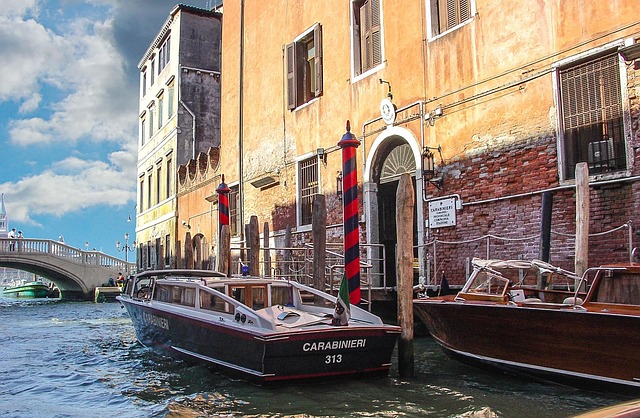
You don’t need a reservation to experience some of Venice’s grandest interiors. Several of the city’s historic hotels occupy genuine Renaissance and Gothic palazzi, and most welcome non-guests into their bars, restaurants, and public salons — which means a coffee, a spritz, or a well-timed walk-through can get you the same marble staircases and frescoed ceilings as an overnight guest, for the price of a drink. Here are the three I most often send guests to see, whether or not they’re sleeping there.
Hotel Danieli: Venice’s Grandest Address
I’ve written a full history of the Danieli elsewhere on this site, so I’ll keep this section brief — but no list of Venice’s great historic hotels is complete without it. The hotel occupies the fourteenth-century Palazzo Dandolo, once home to the same noble family that produced Doge Enrico Dandolo, and it’s been receiving guests in some form since a Neapolitan prince and his retinue of forty-four stayed there in 1498. It became a hotel in 1822 under Giuseppe Dal Niel — Venetians shortened his name to “Danieli,” and it stuck — and has hosted everyone from Charles Dickens and Richard Wagner to Coco Chanel and George Clooney since.
Even if you’re not staying: the lobby alone, with its Gothic staircase and gilded columns, is open to anyone who walks in for a coffee at the bar, and the rooftop Terrazza Danieli restaurant offers one of the best paid views over St. Mark’s Basin in the city. For the full story — the Dandolo family history, the hotel’s WWII requisition, and its complete guest list — read the full Danieli piece here.
The Gritti Palace: A Doge’s Private Residence on the Grand Canal
Like the Danieli, the Gritti Palace already has its own dedicated feature on this site, so I’ll summarize rather than repeat myself. Built in 1475 by the Pisani family and expanded in 1525 as the private residence of Doge Andrea Gritti, the palazzo sits directly on the Grand Canal facing the Basilica della Salute. It became a hotel in 1895 and is perhaps best known today as Ernest Hemingway’s Venice base — he wrote much of Across the River and Into the Trees here, and the hotel’s Hemingway Suite and Longhi Bar both trade on that legacy.
Even if you’re not staying: the Longhi Bar, named for the eighteenth-century Venetian painter Pietro Longhi, welcomes walk-ins for an aperitivo on the canal-side terrace — genuinely one of my favorite quiet splurges to recommend to guests who want the Gritti experience without the room rate. For the complete history, read the full Gritti Palace piece here.
Ca’ Sagredo: The Palazzo That’s Half Museum, Half Hotel
The third hotel on this list gets the fullest treatment here, because I haven’t written about it elsewhere — and it deserves more attention than it usually gets.
Ca’ Sagredo occupies a fourteenth-century Byzantine-Gothic palazzo on the Grand Canal, wedged between the Rialto Bridge and Ca’ d’Oro, directly across from the Rialto Market. It was the ancestral home of the Sagredo family, one of the wealthy patrician families who helped govern the Republic — Doge Nicolò Sagredo, elected in 1675, gave his name to one of the hotel’s grandest rooms. Unlike most historic hotel conversions, which strip a building down to its bones before rebuilding it as a hotel, Ca’ Sagredo was restored specifically to preserve what was already there: the family’s original collection of frescoes, stuccowork, and paintings, largely left in place rather than sold off or dispersed, which is part of why guidebooks sometimes describe it as half hotel, half museum.
The centerpiece is the two-flight marble staircase, designed by the architect Andrea Tirali in the 1730s and lined with a dramatic fresco cycle, The Fall of the Giants, painted by Pietro Longhi — the same artist behind the Gritti Palace’s bar namesake, which tells you something about how small and interconnected Venice’s artistic and aristocratic circles genuinely were. Upstairs, the breakfast rooms carry their own pedigree: the Sala del Doge, named for Nicolò Sagredo, and the Sala del Tiepolo, where the ceiling holds a fresco by Giambattista Tiepolo himself, one of the last of his works still in its original Sagredo family setting rather than sold to a museum or private collector abroad.
Even if you’re not staying: Ca’ Sagredo’s ground-floor restaurant and canal-facing terrace are open to non-guests for lunch or dinner, and it’s one of the few places in the city where a meal gets you a direct, unhurried view of both a Grand Canal frontage and genuine eighteenth-century ceiling frescoes at the same time — no ticket, no timed entry, just a reservation.
Can I visit these hotels without staying overnight?
Yes — all three welcome non-guests into their bars or restaurants, which is the easiest way to see the interiors without booking a room. It’s worth calling ahead for a table, especially in peak season.
Which of these three hotels is easiest to combine with sightseeing?
Ca’ Sagredo sits right across from the Rialto Market, making it easy to pair with a morning at Rialto; the Danieli and Gritti are both a short walk from Piazza San Marco, so all three can realistically be visited in one unhurried day.
Do I need a reservation to have a drink at these hotel bars?
It’s not always required, but it’s strongly recommended during peak season, particularly for canal-facing tables at the Gritti’s Longhi Bar and Ca’ Sagredo’s terrace, which fill up quickly at sunset.