Venice has more than a hundred campanili — bell towers — rising out of the rooftops, and after thirty years of walking this city with visitors, I’ve climbed most of the ones you’re allowed to climb. Every campanile tells you something different about Venice: one about ambition, one about faith and view, one about the sheer stubbornness of building a city on mud. Out of all of them, three stand above the rest — literally and in what they reveal about this place. Here’s why I bring almost every client to see all three, and which one I’d choose if you only have time for one.
1. St Mark’s Campanile — the one that fell down and came back
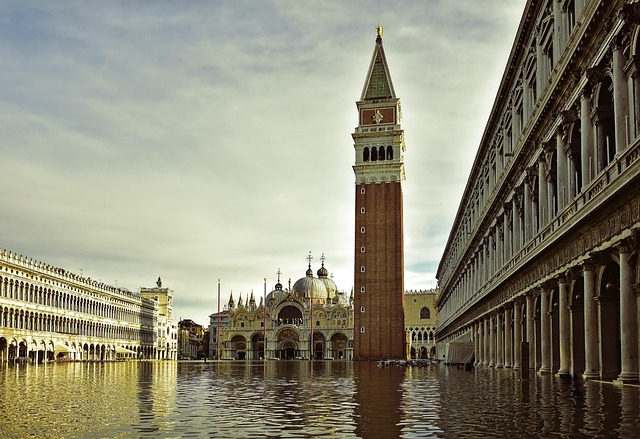
You can’t miss it. At 98.6 metres, it’s the tallest structure in Venice (Wikipedia) , and Venetians still call it “el paròn de casa” — the master of the house. It anchors Piazza San Marco and, from the top, gives you the one view every visitor actually wants: the whole city, the lagoon, the Alps on a clear day, and the rooftops of Venice laid out like a puzzle.
What most tourists standing at its base don’t know is that the tower they’re looking at is a replica. The original stood for centuries before collapsing in 1902, and the current structure is a faithful reconstruction completed in 1912. The collapse happened on the morning of July 14th, and — this is the detail I love telling clients — the only casualty was reportedly the custodian’s cat . Venice rebuilt it “dov’era e com’era” — where it was and how it was — brick for brick, to the original design.
The tower’s roots go back much further than 1912, though. Part of its foundation still belongs to the original structure from 1173, and its origins as a watchtower and lighthouse stretch to the early 10th century. It wasn’t always just decorative, either — its bells once marked the start and end of the working day, called government assemblies into session, and even announced public executions. And if you want a proper “wow” fact for your travel companions: tradition holds that Galileo demonstrated his telescope from this very tower to the Venetian Senate.
Why visit: it’s the single best panoramic view in Venice, it’s the fastest way up (modern elevator, no stairs), and it puts every other landmark you’re about to see — Doge’s Palace, the Basilica, the Grand Canal — into geographic context before you set off on foot.
2. San Giorgio Maggiore — the view that includes San Marco itself
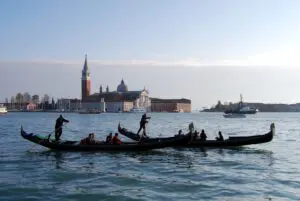
Here’s the trick I let my clients in on: the best photo of St Mark’s Campanile is not taken from St Mark’s Campanile. It’s taken from across the water, from the bell tower of San Giorgio Maggiore, on the small island directly opposite the Piazzetta.
This campanile has its own dramatic history. The first tower collapsed in 1442 after strong winds, was rebuilt, and then collapsed again on February 27, 1774 — this time killing a monk and damaging the abbey’s dormitory. The tower standing today, designed by the Bolognese monk-architect Fra Benedetto Buratti in a neoclassical style with a brick shaft, Istrian stone accents, and a green copper spire, was finished on Christmas Eve, 1791. At roughly 75 metres, it’s not far behind San Marco’s in height, but it gives you something San Marco’s cannot: San Marco’s tower in the picture.
I always send couples and photographers here specifically for that reason — from the top, you look out over the Doge’s Palace, the Campanile di San Marco, and the Church of the Salute all at once, with none of the queues. The church beneath it was Andrea Palladio’s first full church design, and standing at its base, you’re standing in front of one of the most photographed skyline compositions in the world without knowing it yet.
Why visit: it’s quieter, it’s faster to access, and it’s the only spot in Venice where you can photograph the city’s most famous silhouette from outside it.
3. Santo Stefano — the tower Venice never quite straightened out
The third tower is the one most visitors walk right past — which is exactly why I like showing it to people who’ve already “done” Venice once before. Tucked behind Campo Sant’Angelo, the bell tower of the church of Santo Stefano leans. Genuinely, visibly leans, the way Pisa’s does, just without the postcard fame.
At around 66 metres, this campanile is among the tallest in the city, and it leans over by as much as two metres — a lean best appreciated from the Campo below, where you can see the whole tower tilt against the sky. The tower’s current form dates to the 15th century, after a devastating fire destroyed the upper bell chamber and melted the bells beyond repair. In one of my favorite pieces of only-in-Venice trivia, the replacement bells came from a very specific source: four bells acquired from England, salvaged from Catholic churches being dismantled under Queen Elizabeth I. Even the clock has an odd origin story — after the fire took it too, it was eventually funded by Venice’s lawyers, who were tired of missing court appointments without a working clock in that part of the city.
The lean itself is structural, not decorative — a result of the same unstable lagoon foundations that every Venetian building fights against. The base was reinforced between 1902 and 1906 after an earthquake worsened the tilt, and it’s held steady since. Why visit: it’s the tower that tells you the truth about building on water — that even Venice’s engineers didn’t win every round against the mud — and it sits in one of the calmest, least touristed squares in the sestiere of San Marco.
Which one should you actually climb?
If you have one morning: go up San Marco’s campanile first for orientation, then walk to San Giorgio Maggiore in the afternoon for the photograph everyone else missed. Santo Stefano you don’t climb — you simply stand in Campo Sant’Angelo, look up, and let it unsettle you a little. That’s its whole purpose.
This is the kind of route I build differently depending on who’s traveling — photographers get a different order than families with kids who won’t wait in an elevator line. If you’d like help sequencing this alongside the rest of your day (and want to skip the ticket queues most visitors don’t know how to avoid), you can see how access and entry fees currently work in my complete guide to Venice entry fees for 2026, or simply get in touch and I’ll build the whole itinerary around it.
Are all three bell towers open to climb?
San Marco’s and San Giorgio Maggiore’s both have elevators to the top and are open to visitors. Santo Stefano’s leaning tower is not open for climbing — it’s best experienced from Campo Sant’Angelo at its base, where the lean is most visible.
Is the San Marco Campanile the original medieval tower?
No. The tower collapsed in 1902 and the version standing today is a reconstruction completed in 1912, rebuilt to match the original design exactly.
Which bell tower has the best view of Venice?
San Marco’s is the tallest and most complete panorama. But if you want St Mark’s own silhouette in your photo, San Giorgio Maggiore’s tower across the water is the one to climb instead.