In January 1514, a devastating fire struck Venice’s Rialto commercial quarter. The reconstruction that followed helped shape the market buildings visitors see today. This guide explains why the disaster mattered, how the Venetian Republic responded, and where to find the surviving architectural clues on a thoughtful walk through Rialto.
A market that mattered more than a monument
Rialto was the commercial heart of the Venetian Republic long before it became a sightseeing landmark. Here merchants negotiated, bankers recorded obligations, porters moved goods, and public officials monitored trade. The district was not a decorative backdrop to the Grand Canal. It was a machine for turning ships, credit, warehouses, and human labor into a functioning international economy.
That is why the fire of 1514 matters. It was not simply an architectural disaster. Flames struck a dense commercial environment whose daily activities supported the city and connected Venice to distant markets. To understand the rebuilding, imagine what happens when a major financial and wholesale district suddenly loses streets, offices, shops, and storage space. Venice had to rebuild the physical setting while protecting confidence in the market.
What happened in January 1514
In January 1514 a devastating fire swept through the Rialto commercial district. Historical accounts identify it as a turning point in the area’s development. Buildings used by merchants and traders were destroyed, and the government confronted a practical question: should the quarter be recreated as before, or reorganized to serve a changing city?
The fire should not be confused with the better-known sequence of fires that damaged the Doge’s Palace in other centuries. Rialto’s catastrophe concerned the city’s mercantile infrastructure. The disaster became an opportunity to reshape a district whose commercial importance required more than improvised repairs. This distinction is useful when travelers encounter several different stories of Venetian fires and assume they describe the same event.
Why a fire could spread through Rialto
The early sixteenth-century market occupied a closely built environment. Shops, warehouses, wooden elements, domestic spaces, and commercial activity shared a compact urban footprint. Fire in such conditions threatened more than the structure where it began. The movement of people and goods through narrow routes could make response and evacuation especially difficult.
We should be cautious about inventing a dramatic minute-by-minute reconstruction. Surviving histories tell us the scale and significance of the disaster, but a modern writer cannot know the thoughts of every merchant or the exact path of every flame. The more revealing story is what the fire exposed: a trading capital needed resilient public space and administrative coordination, not just profitable individual buildings.
Venice’s economy was built on trust
Merchants depended on the belief that contracts would be honored, cargo could be delivered, and accounts could be settled. Buildings around Rialto supported that trust by concentrating expertise and institutions in a recognizable place. Losing physical premises did not erase financial obligations, but it complicated the everyday work through which obligations were recorded and fulfilled.
The rebuilding therefore carried a message. Venice needed to demonstrate that commerce would continue and that the state remained capable of organizing a reliable marketplace. Travelers who see the elegant stone façades today should remember that they were part of an economic response to crisis. Their orderly appearance was not merely a matter of Renaissance taste.
The role of the Venetian government
The Republic of Venice was deeply involved in the management of its trading center. Officials could not simply wait for individual owners to reconstruct the market however they wished. Public circulation, access to waterfront landings, and the arrangement of shops mattered to the whole city. Rebuilding a major market was an exercise in civic planning.
The relationship between public authority and private enterprise is one of Rialto’s most interesting historical lessons. The republic celebrated commerce, but commerce depended on regulation and infrastructure. Streets, markets, weights, measures, and institutions created a framework within which merchants could operate. The post-fire district made this interdependence especially visible.
Antonio Abbondi and the rebuilt market
The rebuilding of the Rialto market is associated with the architect Antonio Abbondi, known as Scarpagnino. His work helped give the district a more organized Renaissance character after the destruction. The Fabbriche Vecchie, whose long façade still marks the market side of the Grand Canal, are central to this story.
Abbondi is less familiar to many international visitors than Palladio or Sansovino. Yet his contribution illustrates a different kind of architectural achievement. A trading city needs buildings that can accommodate repetitive daily work, storage, circulation, and shops. Designing those spaces well may be less glamorous than designing a church, but it can influence urban life for centuries.
What the Fabbriche Vecchie reveal
The Fabbriche Vecchie are not a single merchant’s grand residence. Their appearance expresses a collective commercial purpose. The regular rhythm of openings and the elongated façade suggest the need to organize multiple activities within one coherent architectural framework. That makes them especially valuable for understanding the post-fire reconstruction.
When you stand near the market, look for the difference between a palace designed to proclaim a family’s prestige and a commercial building designed to accommodate many transactions. The latter may seem visually restrained, but its history is just as rich. Architecture can tell us not only who possessed wealth, but also how a city made wealth circulate.
Do not confuse the Fabbriche Vecchie and Fabbriche Nuove
The names can mislead visitors. The Fabbriche Vecchie belong to the reconstruction associated with the early sixteenth century, while the Fabbriche Nuove were built later in the century to a design by Jacopo Sansovino. Together they reveal that Rialto’s transformation unfolded over time rather than in one instant after the fire.
This chronological distinction is an excellent antidote to simplified travel writing. Venice did not finish rebuilding its commercial heart in a single dramatic campaign and then freeze it forever. New buildings answered later needs and reflected evolving architectural ideas. Reading the market as a sequence of interventions gives a more accurate picture of how the city changed.
The market before the modern souvenir economy
Rialto’s commercial identity is much older than its current tourist traffic. Historically, the district connected wholesale and retail activity with the broader maritime economy. Foodstuffs, spices, textiles, and other goods passed through systems of merchants, brokers, transporters, and officials. Some were destined for local consumption; others belonged to far-reaching trading networks.
Today the area’s appearance can make it difficult to imagine those overlapping functions. A traveler may see restaurant menus, souvenir displays, and the famous bridge, then conclude that Rialto has always been primarily a visitor attraction. The history of the fire reminds us that this was a workplace first, and that the survival of the city depended on its effectiveness.
How goods arrived by water
Venice’s commercial geography makes sense only when viewed from the water. Boats brought goods into the city, and quayside activity connected cargo with storage, sale, and distribution. Rialto’s position on the Grand Canal gave the district access to the transportation network that made its market possible.
A practical way to understand this is to pause at the waterfront and watch how modern boats use landing points. Their cargoes and purposes differ from those of the sixteenth century, but the basic logistical challenge remains: goods and people must move through a city without road vehicles in its historic center. The lagoon and canals are infrastructure, not scenery.
The labor behind a wealthy republic
The phrase ‘merchant republic’ can make Venetian prosperity sound like a story about wealthy businessmen alone. Yet every transaction depended on people who unloaded boats, carried baskets, maintained warehouses, swept streets, repaired buildings, and kept supplies moving. These workers are less visible in many historical narratives because surviving records often focus on institutions and elites.
Rialto’s fire and reconstruction invite us to think about those less celebrated lives. A market rebuilding project affected the people who earned their living there, not only those who owned property. When describing the disaster, it is important not to invent personal testimony. We can nevertheless recognize that the commercial quarter was a densely inhabited and labor-intensive environment.
The banks and the idea of a financial district
Rialto was closely associated with exchange, credit, and financial services. The expression ‘bank’ has deep roots in the commercial practices of Italian cities, and Venice’s traders relied on sophisticated arrangements for payments and accounts. The market quarter brought together activities that modern travelers might expect to find in separate financial and retail districts.
A historical walk can therefore compare Rialto with the commercial centers of New York or London, while remembering that the institutions and legal systems were different. The comparison is useful because it changes the visitor’s mental image. Rialto was not merely a bridge and a produce market; it was a place where information, reputation, and money moved.
The Rialto Bridge belongs to a later chapter
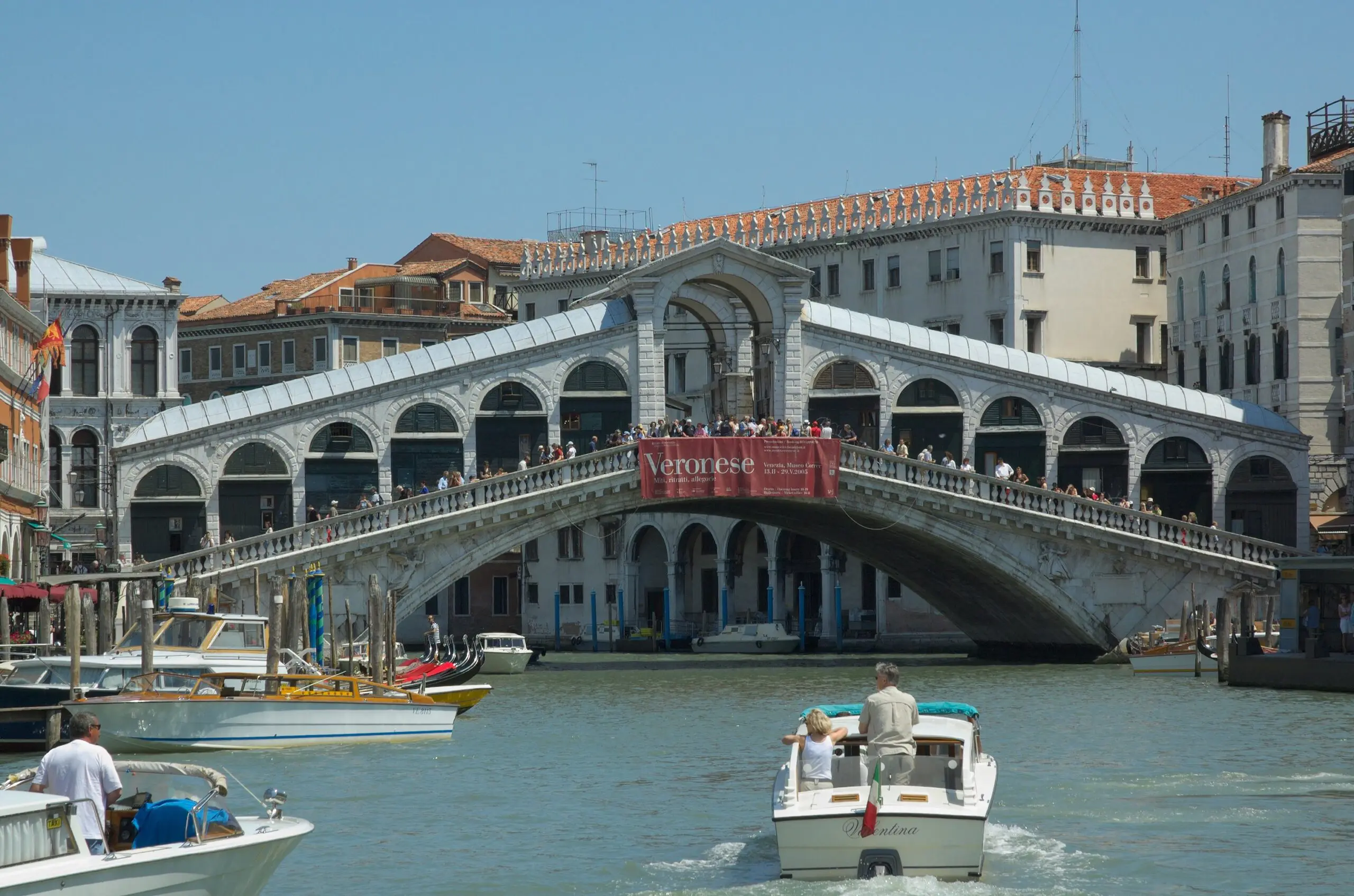
The stone Rialto Bridge that visitors photograph today was completed at the end of the sixteenth century, decades after the 1514 fire. Designed by Antonio da Ponte, it replaced earlier crossings and became an enduring emblem of the city. Its chronology should not be collapsed into the immediate post-fire reconstruction.
This is a common source of confusion. A photograph of the modern bridge can illustrate the setting, but it does not show what merchants saw in 1514. The market’s rebuilding and the eventual construction of the stone bridge are connected parts of Rialto’s long evolution, not one simultaneous project. Keeping dates separate makes the history more compelling, not less.
A district of public institutions
The historic commercial quarter also housed public offices that supported and regulated trade. These institutions mattered because transactions required oversight, documentation, and enforceable rules. Venice’s reputation as a trading power depended on its ability to manage complexity across languages, currencies, and jurisdictions.
For visitors, the lesson is to look beyond the most photogenic façades. Ask what work each building enabled. Did it house a private family, a collective market, a public office, or a place of worship? The answer changes how the architecture should be read. Rialto’s identity emerged from the proximity of these different functions.
The church of San Giacomo di Rialto
San Giacomo di Rialto stands close to the market and is traditionally associated with the area’s commercial history. Its prominent clock and small square make it a memorable stop on foot. Popular stories sometimes describe the church as Venice’s oldest, but the documentary history of its fabric is more complicated than a simple founding legend.
What matters for this walk is the relationship between worship and commerce. Religious buildings were not isolated from everyday economic life. They stood among shops, stalls, and offices, anchoring communities that worked in the district. The proximity of a church to a market reveals the mixed character of historical Venetian neighborhoods.
The danger of repeating charming legends
Rialto attracts memorable stories, and not all of them can be verified. Travelers may hear that a single person predicted the fire, that every merchant lost everything, or that one building miraculously survived for a particular supernatural reason. Such anecdotes can be entertaining, but they should never be presented as documented history without a credible source.
An authoritative guide separates archival evidence, long-standing tradition, and modern embellishment. That approach does not make Venice less mysterious. It allows the genuinely surprising facts to stand on their own. A district devastated by fire and deliberately rebuilt as a commercial center is already a remarkable story.
What the reconstruction says about Renaissance Venice
Renaissance architecture is often taught through churches, villas, and palaces. Rialto adds another dimension: the design of everyday economic infrastructure. Regular façades, coordinated building campaigns, and the organization of circulation show that architectural ideas also shaped markets and workplaces.
The market buildings invite a broader definition of beauty. Their value lies partly in how they fit into a complex urban system. A successful commercial district had to remain legible and functional despite heavy use. In a city where every square foot of land was valuable, this was a serious design problem.
A walk from the bridge to the market
Begin on the market side of the Rialto Bridge, but resist stopping at the first viewpoint. Move away from the densest souvenir displays toward the streets and open spaces associated with the historic market. Notice the changes in building scale and the way routes lead back to the waterfront.
The most useful approach is slow and observational. Do not attempt to cover every lane at once. Find the church of San Giacomo di Rialto, study the façades of the market buildings, and look for places where goods can be moved between boats and the street. The walk works best when the goal is understanding a district rather than collecting photographs.
How to read the market façade
Stand far enough back to see the repetition of architectural elements rather than one doorway. Ask why a building intended for many commercial users might need a consistent exterior. Then compare that rhythm with the more individualized decoration of nearby private palaces.
The exercise is simple but revealing. Venice’s buildings often express social purpose through form. A palace may announce family identity, while a market structure prioritizes continuity and access. Looking for those differences turns an ordinary stroll into an architectural investigation.
The fish and produce markets today
Rialto remains associated with food commerce, including the well-known fish and produce market areas. Opening patterns and individual stall activity can change, so visitors should verify current schedules rather than rely on a timeless promise that every counter will be busy on any morning.
When stalls are operating, keep pathways clear and remember that vendors are working. Avoid touching products without permission, and do not block customers for photographs. A respectful visit reveals something more valuable than a staged food-tour scene: the continuity of a commercial district whose purpose has evolved but not vanished.
Why early morning can help
Morning is often the best time to appreciate the market’s working character, though exact activity depends on the day. The light, delivery movements, and relative absence of large sightseeing groups can make it easier to see how the waterfront functions. This is a practical observation rather than a guarantee of empty streets.
If your goal is history rather than shopping, you can also visit when the market is quiet. The façades remain and the urban layout is easier to study. The two experiences answer different questions: a working morning shows present-day commerce, while a quieter visit gives you time to consider the district’s long architectural development.
What the fire teaches about resilience
The 1514 disaster did not end Rialto’s commercial role. Instead, rebuilding helped preserve the district as a central part of Venetian life. That outcome should not be romanticized as if recovery were easy or universally beneficial. Fires destroy livelihoods as well as structures, and rebuilding inevitably creates winners, losers, and new rules.
Still, the survival of the market’s identity is historically significant. Venice was capable of reorganizing a critical district while maintaining its position in regional and international commerce. The story complicates the popular image of a city preserved unchanged from its golden age. Venice endured precisely because it could adapt.
A more useful way to describe the city
Travel writing often calls Venice a fragile museum, but that phrase overlooks centuries of deliberate adaptation. Rialto’s reconstruction is one of many examples of a city responding to danger through engineering, administration, and architecture. It also reminds us that beauty and functionality were never separate categories.
A traveler who notices only the bridge misses the broader lesson. The buildings around it tell a story of risk management, commercial ambition, and public decision-making. This is why historical context matters: it turns a famous landmark into a landscape of choices made by real communities over time.
How this story differs from the history of wooden bridges
Venice’s bridges changed repeatedly as materials and engineering improved. The wooden crossings at Rialto belong to a long history of transportation across the Grand Canal. The 1514 fire, however, concerns the wider commercial quarter and the reconstruction of market buildings. These topics overlap geographically but answer different questions.
Keeping them distinct helps visitors build a clearer timeline. First ask how people crossed the canal, then how merchants used the surrounding district, and finally how the republic rebuilt after disaster. Each question deserves its own evidence. A well-planned walk can connect the answers without confusing them.
A practical itinerary for curious travelers
Allow approximately an hour to explore the historic market area at a measured pace, with extra time if you want to shop or study architecture. Start at the Rialto Bridge, continue toward San Giacomo di Rialto, examine the market-side façades, and return to the waterfront for a final look at the movement of boats.
The route is compact but can be crowded, especially near the bridge. Wear comfortable shoes, watch for steps and uneven paving, and keep access routes clear. If traveling with children, ask them to identify which buildings look like homes and which look like shared workplaces. It is an engaging way to turn architectural observation into a family activity.
An overlooked lesson in commercial geography
The market’s location was not accidental. Rialto stood at a point where water transport, pedestrian routes, public institutions, and merchants could converge. The concentration of activity made the district powerful, but also vulnerable when a disaster struck. Rebuilding had to preserve the advantages of that location while reducing the chaos of an overcrowded commercial environment.
Modern cities still confront similar dilemmas when a central market or business district is damaged. Where should commerce return? How much should government coordinate? Which structures deserve preservation, and which need redesign? Rialto’s sixteenth-century answers were specific to Venice, but the underlying questions remain recognizable.
Where to go next
For a complementary explanation of Venice’s logistical ingenuity, read why Venice works without cars. To understand the hidden details that surround major landmarks, explore the overlooked clues that tell Venice’s real story. And for a broader view of the city as a workplace, see how Venice functions before sunrise.
These three perspectives complement the Rialto fire without repeating its central subject. They also help visitors recognize a consistent theme: Venetian history is not only about famous artists and rulers. It is about the daily systems that allowed a community to survive and prosper in a demanding environment.
What a local guide adds
A guide who knows Venice can help distinguish buildings from different phases of the market’s development and explain why a commercial façade deserves as much attention as a palace. The practical value lies in choosing viewpoints, understanding the relationship between canals and streets, and avoiding claims that are more romantic than accurate.
Tour Leader Venice draws on the experience of licensed guide Igor Scomparin, guiding since 1997, and a team familiar with the city’s everyday logistics. The goal of a private historical walk is not to recite dates as quickly as possible. It is to help travelers notice evidence that they can continue to recognize after the tour ends.
The enduring legacy of the 1514 fire
Rialto’s story is ultimately one of continuity through change. The district was central to Venetian commerce before the fire, suffered catastrophic damage, and emerged with buildings and urban arrangements that helped define its later appearance. The elegant façades visible today are evidence of decisions made under pressure.
Next time you cross the Rialto Bridge, look beyond the crowded steps and familiar photographs. The market buildings nearby preserve the memory of a commercial crisis and a carefully managed recovery. Understanding that history makes the neighborhood feel less like a backdrop and more like what it has always been: one of the places where Venice learned how to function.
Explore related Venice stories
To put this subject into a wider Venetian context, explore Venice’s historic floating markets, historic shop signs and commercial streets and the merchant houses of historic Venice. Each offers a complementary perspective on the city’s history, daily life, or cultural heritage.
Discover connected Venice stories
Explore the history of Venice’s bacari. These articles offer additional historical and cultural perspectives.
Frequently Asked Questions
What happened at Rialto in 1514?
A major fire devastated Venice’s historic Rialto commercial quarter in January 1514. Reconstruction reshaped the market area, including the buildings later known as the Fabbriche Vecchie.
Were the Rialto Bridge and market rebuilt at the same time?
No. The market district was rebuilt after the 1514 fire, while the present stone Rialto Bridge was completed much later, in 1591, to a design by Antonio da Ponte.
What can visitors see from the rebuilding today?
Explore the market-side buildings, especially the Fabbriche Vecchie, and compare them with the later Fabbriche Nuove. Visit San Giacomo di Rialto and observe the waterfront’s working geography.