By Igor Scomparin, founder of Tour Leader Venice.
Venice drinking fountains are a practical detail that can make a walking day easier. A refillable bottle, a reliable map, and a little awareness of your route help you spend less time buying disposable water and more time enjoying the city.
This is a guide to using the modern public drinking-water system. It is not a history of Venice’s ancient wells, and the distinction matters: an attractive stone wellhead in a square is not an invitation to collect water.
For visitors, the useful questions are straightforward. Where can you refill? Which source should you trust? What should you do if a fountain is closed? And how can you fit refills into the day without turning a simple habit into a complicated itinerary?
Can you drink the water from Venice’s public fountains?
Veritas, the local water-service provider, describes public fountain water as free, checked, and safe to drink. Its water-service information explains that the drinking-water supply is monitored and distinguishes it from the lagoon environment around the city.
Use functioning public drinking fountains and obey any posted local notices or temporary restrictions. If a point is labeled non-potable, closed, or out of service, choose another source.
The canal is not the source you should be using. Nor should you assume that every decorative feature with water flowing through it is a drinking-water point. The practical rule is to identify the intended public supply rather than making a judgment from appearance alone.
Use the official Venice drinking fountains map
The most useful starting point is the Veritas fountains page, which links to a map covering Venice and its islands. It organizes points across the districts and islands, helping you look for a refill near your actual route.
Veritas notes that the municipality manages the opening and closing of the fountains. A point on a map should therefore be treated as a place to check, not a guarantee that water is flowing at that exact moment.
Save the map before you leave your accommodation. If mobile data is unreliable, keep a screenshot of the section around your planned walk and identify a backup option.
Do not rely exclusively on a social-media list compiled years earlier. A photograph can show where a fountain once stood, but it cannot confirm its current operating condition.
A public fountain is different from an ancient wellhead
Venice’s stone wellheads are among the details visitors love to photograph. They belong to a different story from the modern supply you use to refill a bottle.
For practical purposes, look for an identified drinking-water outlet on the current map. Do not try to open historic structures, lower a container through a cover, or use decorative basins.
This distinction is also useful when walking with children. You can explain that the city has inherited visible traces of older systems while relying on modern infrastructure for today’s daily needs.
If history interests you, make that a separate part of the walk. For a refill, keep the task simple and use the intended public facility.
How to refill without getting in anyone’s way
- Approach from a clear space. Avoid stopping the whole party in a narrow passage.
- Read any notice. Respect closure signs and temporary instructions.
- Keep the bottle mouth clear of the outlet. Avoid touching shared surfaces with the part you drink from.
- Fill what you need. Do not block the point for an extended photo session.
- Move aside before reorganizing your bag. Let the next person reach the fountain.
These small habits make public facilities easier for everyone to use. The same place may serve residents, workers, and other travelers throughout the day.
A drinking fountain is not a place for washing shoes, cleaning dishes, or creating a puddle for a staged photograph. Use it for its intended purpose and leave the surroundings as you found them.
Choosing a bottle for a Venice walking day
Choose a bottle you are comfortable carrying for several hours. The best size depends on your pace, the weather, your bag, and how often you expect to refill.
A very large bottle can become an unnecessary burden, especially when combined with camera equipment and shopping. A very small bottle may mean frequent stops. Aim for something practical that you will actually use.
A secure cap matters when your bag is being moved on and off a boat. An accessible pocket makes refills easier than packing the bottle underneath everything else.
Keep your own needs and any personal guidance you follow in mind. This article is about city logistics, not a prescribed drinking quantity.
Build refills into your existing route
You do not need a separate “fountain tour.” Check the official map while planning a walk you already want to take. Look for one point near the start, another near a natural pause, and a backup if one is unavailable.
For example, if you are spending time around St. Mark’s, investigate the mapped points in that area before walking elsewhere. If the day takes you into Dorsoduro or Cannaregio, change the map view to the neighborhood where you will actually be.
Map distances should not be treated as walking distances. A fountain across a canal may require a bridge and a longer approach than it appears to on the screen.
When guiding a family, it is often easier to combine a refill with a wider pause. One person can fill bottles while the others stand comfortably out of the pedestrian flow.
An example near the Biennale area
The official Venezia Unica description of Viale Garibaldi Gardens identifies two drinking-water fountains along the tree-lined stretch between Via Garibaldi and the Biennale gardens area.
That makes the area worth checking when your day already includes this part of Castello. As with any public facility, read current signs and use a backup plan if a point is closed.
A refill stop can be a useful transition between concentrated cultural viewing and an outdoor walk. It gives the group a moment to reset without needing to turn every break into a full meal.
What about the Royal Gardens?
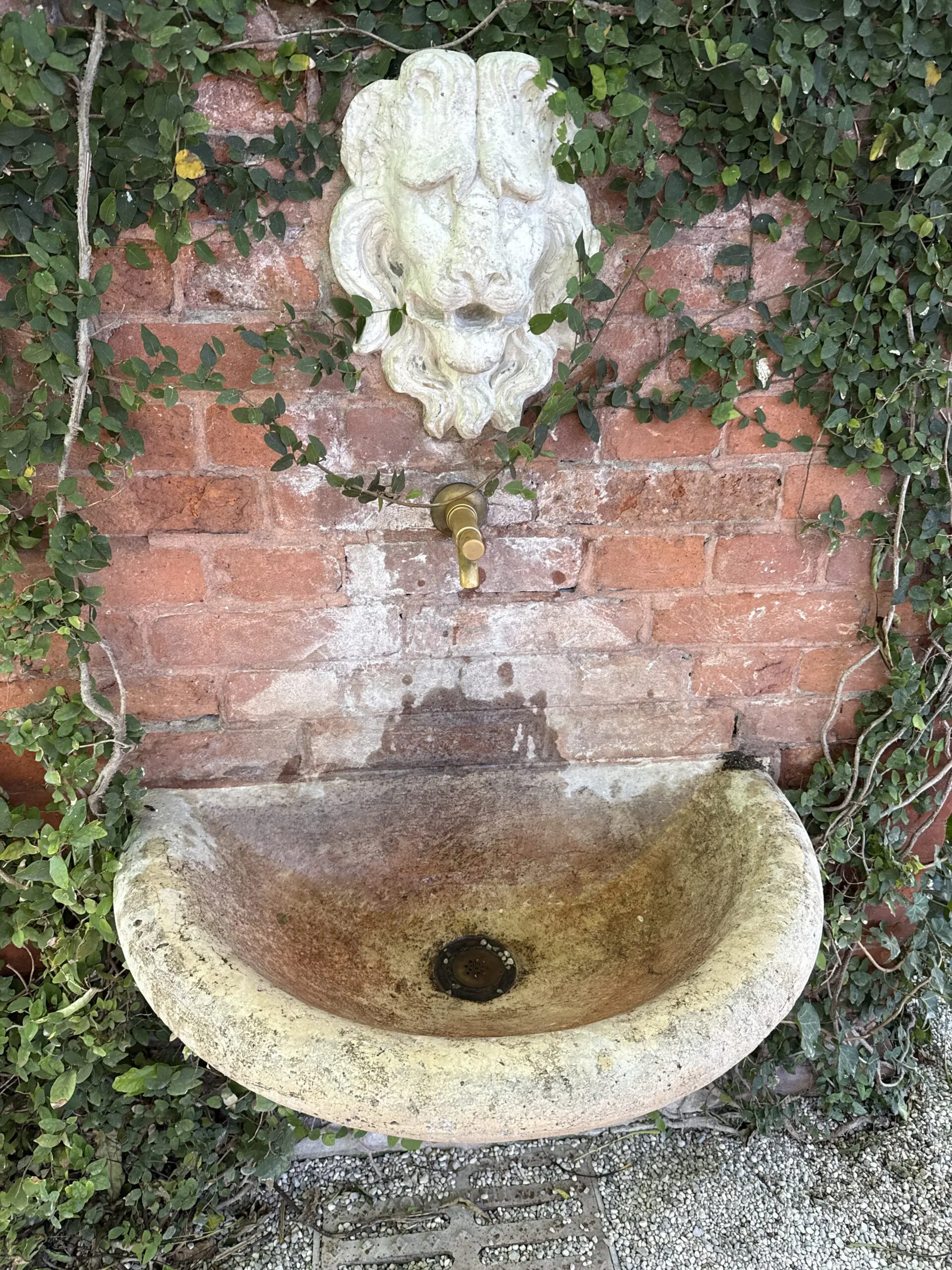
The real photograph accompanying this article shows a drinking fountain inside the Giardini Reali, photographed in August 2026. It illustrates the kind of public facility a visitor may encounter near a major sightseeing area.
The image is not a live operating report. Check the current map, garden access, and any notice at the point itself rather than assuming that a dated photograph guarantees availability.
This distinction applies to all travel images. A photograph can document a real place very well while still being unable to answer the practical question, “Can I use it this afternoon?”
What to do if a fountain is not working
Do not force a fitting or attempt to remove a cover. Consult the map for another point, ask your accommodation or guide about nearby options, or buy water if that is the simplest solution.
A closed fountain should not derail the day. Carry enough at the start that you are not depending on a single outlet at an exact time.
If you are taking an island excursion, consider the structure of that particular outing. A boat segment, waiting time, or change of route may make a refill less convenient than it would be during a central walking tour.
For a private excursion, ask in advance whether refreshments are included. Do not infer that every boat booking provides bottled water or other drinks.
Summer and cooler-season habits
In warm weather, planning refills before a long outdoor stretch can make the day more comfortable. Include shade and breaks in the wider itinerary rather than expecting one bottle to solve the discomfort of an overambitious schedule.
In cooler months, the bottle still has a place in your day bag. At the same time, seasonal conditions and maintenance may affect individual points. Check rather than assuming that a summer experience will be identical later in the year.
The right approach is flexible: begin prepared, refill when convenient, and adjust the route to the people in your party.
Refilling as a small act of care for Venice
Using the public supply can reduce the number of disposable bottles you carry and discard. Veritas explicitly connects drinking from taps and fountains with reducing waste.
The benefit is practical as well as environmental. Fewer bottles mean less packaging in your bag and fewer moments spent looking for a place to dispose of it.
If you are staying in an apartment, ask the host about the applicable waste arrangements. Do not leave bags beside a public bin or on the street because you have seen someone else do so.
Responsible travel becomes easier when it is built into ordinary habits. A bottle, a checked map, and attention to shared space are modest choices that fit naturally into a good day.
Planning a private walk around real comfort
When arranging a private tour, tell your guide what makes a day comfortable for you. Relevant details might include a slower walking pace, frequent pauses, children, or a preference for a shorter route.
Water refills can be part of that discussion, alongside restrooms, seating, and the distance to the next stop. These details rarely appear in a glamorous travel photograph, but they often determine how much people enjoy the experience.
Browse our private walking experiences in Venice if you would like a route tailored to your pace. For a water-based day, explore our private lagoon tours and confirm practical inclusions before booking. The full experience collection can help you compare approaches.
Frequently asked questions
Are Venice drinking fountains free?
Veritas describes the public fountain water as free. Use functioning drinking-water points and follow any current notices or temporary restrictions.
Where can I find an official map of Venice fountains?
The Veritas website links to its Venice and islands fountain map. It is a useful starting point, but a mapped location does not guarantee that a particular fountain is open at the moment you arrive.
Can I refill from Venice’s historic wellheads?
No. Use the designated modern drinking-water outlets. Historic wellheads and decorative basins should not be treated as refill points.
Sources: Veritas fountain map information; Veritas water-service information; Veritas public hygiene guidance; Venezia Unica Viale Garibaldi visitor information. Checked October 29, 2026.
Featured photograph: Gather24, “Drinking fountain inside Giardini Reali,” August 7, 2026, Wikimedia Commons, CC0 public domain dedication. Real photograph; not AI-generated.