Ask most visitors what a Venetian palace was for, and they’ll picture something purely residential — a noble family’s grand home, full of frescoed ceilings and Murano chandeliers. That’s true of many of Venice’s palazzi, but the city’s earliest and most economically important buildings weren’t residences that happened to do business on the side. They were fondaci — a genuinely unusual hybrid of warehouse, customs office, hotel, and family home, all stacked into a single structure, built around the simple fact that in Venice, business and domestic life were never really separated by walls the way they are almost everywhere else.
A Word Borrowed From Arabic, and a Model Borrowed From the East
The word fondaco itself gives away where the idea came from: it derives from the Arabic funduq, itself rooted in the Greek pandokeion — an inn, a place where a traveler could sleep, store goods, and do business all under one roof. Venice didn’t invent this model; it imported it directly from its trading relationships across the Eastern Mediterranean, where Venetian merchants themselves had long operated their own funduqs in cities like Constantinople and Alexandria. The system worked so well that the Venetian government eventually turned it around, establishing formal fonteghi — the local dialect version of the word — for the various foreign merchant communities operating inside Venice itself.
This wasn’t an informal arrangement. Each fondaco was assigned to a specific foreign community — the Fondaco dei Tedeschi for merchants from Germany and the wider northern European world, the Fondaco dei Turchi for Ottoman traders — and each operated under real legal restrictions imposed by the state: no weapons, no gambling, no prostitutes permitted inside, in exchange for the freedom to trade. Living and working inside a fondaco meant accepting Venice’s terms in exchange for guaranteed access to the most important trading city in the Mediterranean.
The Fondaco dei Tedeschi: A Building That Was Also a Small Foreign Embassy
The best-documented example of this system, and the one worth understanding in real depth, is the Fondaco dei Tedeschi, sitting directly beside the Rialto Bridge in exactly the spot where records first mention a German trading house as early as 1225. What stood there for centuries functioned as an entire self-contained world for the city’s German merchant community — warehouse space on the ground floor for storing imported goods, offices for negotiating trade, private rooms for merchants living there for months or years at a stretch, and, according to some accounts, even a dedicated chapel and tavern catering specifically to the tastes and customs of its resident foreign community. A central courtyard served as genuinely neutral ground, the place where Venetian hosts and German guests could meet and negotiate on terms that suited both sides — a working compromise between Venetian commercial law and northern European trading practice, all happening inside a single Grand Canal building.
The building burned down in a devastating fire in 1505, and what rose in its place — designed with input from the Venetian state’s own official architect, Antonio Scarpagnino — was even grander than what it replaced. The Republic commissioned two young painters to decorate its exterior facing the Grand Canal: Giorgione and a then-emerging Titian, whose allegorical frescoes once covered the building’s outer walls with symbolic imagery asserting Venice’s own power and independence. Almost none of that painted decoration survives today, worn away by weather in the same slow process that erased so much of Venice’s exterior fresco work, but the building itself endured — cycling afterward through service as a customs house under Napoleon, then Venice’s central post office for much of the 20th century, before its 2016 transformation into a luxury department store, its original warehouse function echoed, in a strange full-circle way, by the retail floors that fill it today.
The Casa-Fondaco: When Venetian Families Did the Same Thing at Home
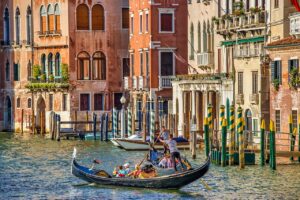
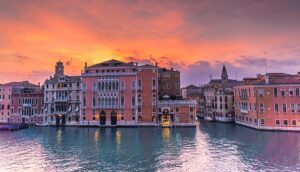
The fondaco model wasn’t reserved for foreign merchants alone — Venice’s own noble families built along nearly identical lines, in a form historians call the casa-fondaco: house and warehouse combined, designed so that a family’s own trading business could operate directly beneath the rooms where they actually lived. I’ve written elsewhere about Ca’ da Mosto in Cannaregio, one of the oldest surviving examples of this style on the Grand Canal, and about the general architecture of Venetian palace interiors — the ground-floor andron functioning as a loading hall, goods hoisted up through the building, the family’s real living quarters kept safely on the piano nobile above.
What’s worth adding here is the underlying logic that made this arrangement so distinctly Venetian: for a merchant family, there was no meaningful separation between “going to work” and “being home.” The same water door that let a boat deliver a shipment of spice or cloth also served as the family’s own front entrance. The same building that stored a season’s worth of imported goods on its ground floor hosted formal receptions for trading partners one floor up. Venice’s nobility weren’t landowners who happened to also trade — trade was the family business, conducted from the family home, generation after generation, with the architecture itself built to support exactly that blurred line.
Why This Model Made Sense for Venice Specifically
This arrangement wasn’t an accident of taste — it solved a real practical problem. Venice had no countryside villas for its merchant nobility to retreat to, no separate district set aside purely for commerce the way many mainland cities eventually developed. Space was scarce, land was expensive, and a family’s fortune typically depended on tightly monitoring shipments, negotiations, and storage in person, on a near-daily basis. Combining home and business into a single building wasn’t a compromise — it was the most efficient way to run a trading empire from a city with no room to spare.
A Building Type Worth Seeking Out Deliberately
Most visitors walk past the Fondaco dei Tedeschi today assuming it’s simply an elegant, oversized department store beside the Rialto Bridge — which, in the most literal sense, it now is. Knowing what it actually was for five centuries changes that walk entirely: this was once the closest thing Venice had to a foreign embassy, a hotel, and a customs house rolled into one, home to merchants who might spend years of their lives inside its walls without ever fully becoming Venetian. And the same logic, at a smaller domestic scale, shaped nearly every grand family palace lining the Grand Canal — buildings that were never simply homes, but the physical machinery of the trading empire that built them.
If you’d like a private walk built around Venice’s mercantile history — the fondaci, the family palaces, and the trading logic that shaped this entire city — get in touch directly and I’ll design a route around exactly what interests you. And for a full day tracing where some of that trade eventually led, a private day trip to the Prosecco Hills makes a beautiful complement to a morning spent among Venice’s old trading houses.
What does “fondaco” actually mean?
It comes from the Arabic word funduq, meaning a combined inn and warehouse — a model Venice adopted from its trading relationships across the Eastern Mediterranean and formalized for its own resident foreign merchant communities.
What is the Fondaco dei Tedeschi used for today?
After centuries as a German trading house, a Napoleonic customs house, and Venice’s central post office, the building reopened in 2016 as a luxury department store, though its Renaissance structure and Grand Canal-facing rooftop terrace remain open to visit.
What’s the difference between a fondaco and a casa-fondaco?
A fondaco was a state-regulated trading house assigned to a specific foreign merchant community, like the Germans or the Ottomans. A casa-fondaco was the equivalent model used by Venetian noble families themselves — combining warehouse and residence in one building for their own trading business, as seen at Ca’ da Mosto on the Grand Canal