Step off the Cinque Torri chairlift at 2,255 meters and you’re standing directly in front of Rifugio Scoiattoli, a mountain hut with one of the best views in the entire Cortina area and a name that carries considerably more history than most visitors realize. “Scoiattoli” means squirrels, and the hut isn’t named for the local wildlife. It’s named after one of the most storied mountaineering clubs in Italian history, a connection worth understanding before you sit down for lunch on its panoramic terrace.
A Hut Built Facing the Towers
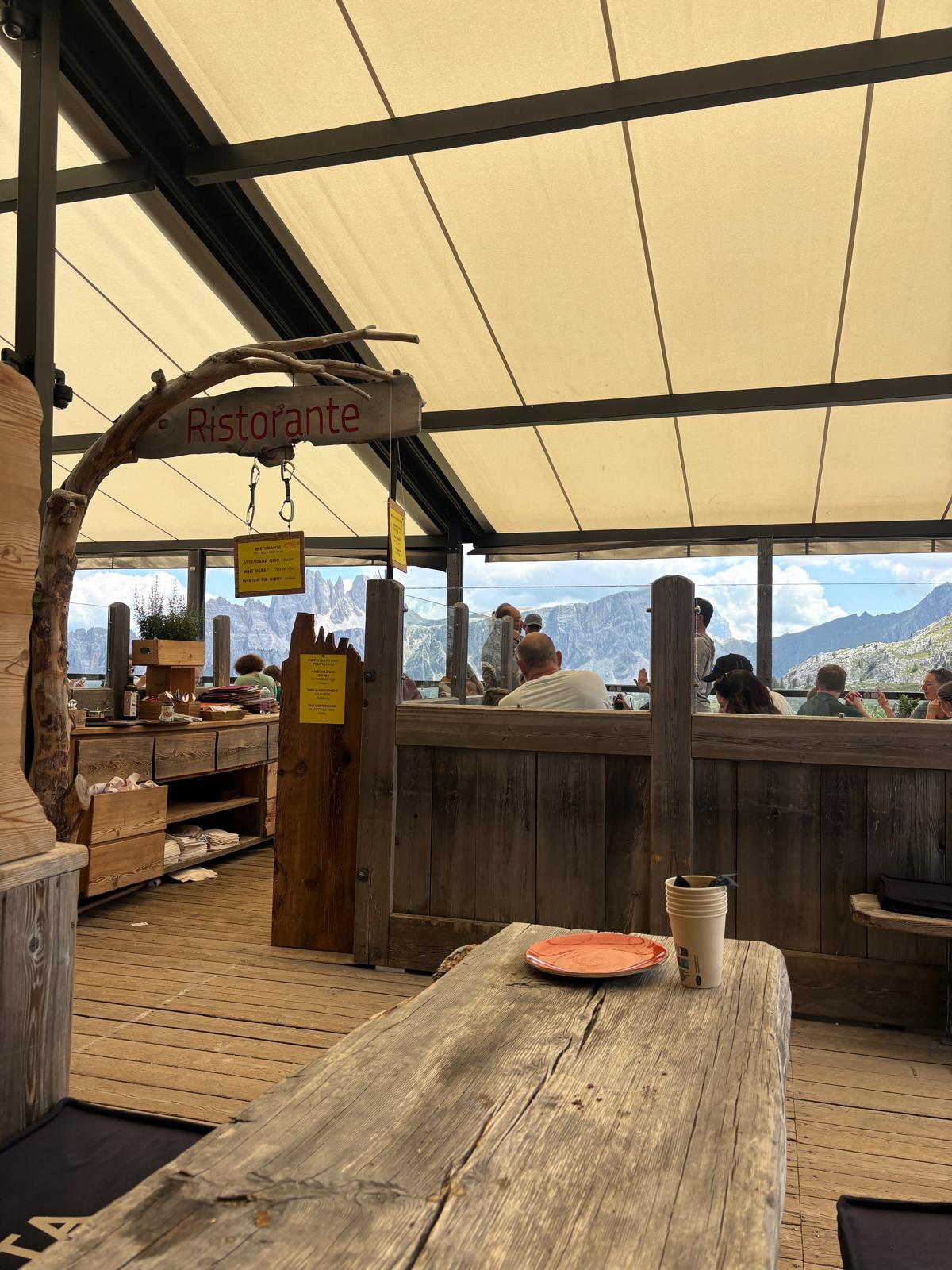
Rifugio Scoiattoli was built in 1969 by the mountain guide Lorenzo Lorenzi, and it remains, more than half a century later, still run by his own family, a genuine continuity of ownership that’s increasingly rare among mountain refuges across the Dolomites. Positioned at 2,255 meters, directly at the top of the Cinque Torri chairlift, the hut faces the five limestone towers head-on, and its panoramic terrace has become one of the best vantage points anywhere in the area for watching climbers actually working their way up the surrounding rock faces in real time, a genuinely engaging way to spend an hour over lunch even if you have no intention of climbing yourself.
Why It’s Named “Scoiattoli”
The name honors the Gruppo Scoiattoli Cortina, the “Cortina Squirrels,” founded on July 1, 1939, by ten young men from the Ampezzo valley: Albino Alverà, Silvio Alverà, Luigi Ghedina, Romano Apollonio, Angelo Bernardi, Ettore Costantini, Siro Dandrea, Giuseppe Ghedina, and Bortolo Pompanin, sharing a common passion for mountaineering and sport climbing. Membership carried two strict original requirements: you had to be born in Cortina and still resident there, and you had to be a skier, reflecting the group’s original name, the Società Rocciatori e Sciatori gli Scoiattoli, the Squirrels’ Rock Climbers and Skiers Club. Members are still recognized today by their distinctive emblem, a white squirrel embroidered on the left sleeve of a red sweater, a symbol that’s become genuinely inseparable from Cortina’s own identity over the following eight decades.
The Scoiattoli are widely considered the oldest mountaineering club in Italy, and, alongside the Ragni di Lecco, one of the two most celebrated alpine climbing associations in the entire country. Their achievements extend well beyond the Dolomites themselves: over the decades, Scoiattoli members have opened hundreds of new climbing routes across mountain ranges as far-flung as Greenland, the Andes, the Atlas Mountains of Africa, and the Himalayas. Their single most famous moment in mountaineering history came on July 31, 1954, when Scoiattoli member Lino Lacedelli, alongside climbing partner Achille Compagnoni, became the first person to reach the summit of K2, the world’s second-highest mountain and, at the time, one of the last great unclimbed Himalayan giants, a genuinely landmark achievement in the history of world mountaineering that brought the group international recognition far beyond their home valley. The group’s founding generation included accomplished Olympic skiers too: the Alverà brothers, Albino and Silvio, both competed at Olympic level, and fellow Scoiattolo Carletto Alverà remarkably represented Italy across three separate winter disciplines, alpine skiing, cross-country skiing, and ski jumping.
Today the Gruppo Scoiattoli counts more than ninety members, and continues its founding activities largely unchanged: promoting mountaineering, running volunteer alpine rescue services, and organizing sporting events across the Ampezzo valley, a living, active tradition rather than a purely historical footnote, which makes eating lunch at a hut carrying their name feel considerably more meaningful once you know the story behind it.
What You’ll Find at the Hut
Beyond its panoramic terrace and direct front-row view of the Cinque Torri themselves, Rifugio Scoiattoli serves genuinely traditional Ampezzo cuisine, worth planning a meal around rather than treating as a quick snack stop. The kitchen’s casunziei, crescent-shaped ravioli traditionally filled with red beetroot, and a properly made ricotta strudel are both regional specialties worth seeking out, and the hut’s location, right beside the ski slopes and directly adjacent to the Cinque Torri’s WWI open-air museum, makes it a natural gathering point whether you’ve arrived to hike, climb, ski, or simply explore the restored trenches a short walk away. Throughout the year, the hut also hosts a rotating calendar of events organized through Cortina’s local tourism consortium, high-altitude concerts, terrace parties, historical reenactments tied to the Great War museum, and themed dinners, adding a genuinely lively social dimension to what might otherwise be treated as a purely scenic rest stop.
Getting There
Most visitors reach Rifugio Scoiattoli via the Cinque Torri chairlift, which departs from the base station at Baita Bai de Dones on the SR48 road, roughly 25 minutes west of Cortina d’Ampezzo. The ride carries visitors directly to the hut’s doorstep, making it accessible regardless of hiking experience or fitness level. For those who’d rather walk, a steep trail runs directly beneath the chairlift line, taking roughly an hour one way, a demanding but manageable climb for reasonably fit hikers who’d prefer to earn the view rather than ride to it.
A longer, more scenic approach starts from the Passo Giau rather than Bai de Dones: following trail markers past the Berghotel Passo Giau and along Trail No. 452 toward the Forcella Nuvolau, the route continues to Rifugio Averau at 2,413 meters, with the option of a short, steep detour up to Rifugio Nuvolau at 2,575 meters, the oldest mountain refuge in the entire Dolomites, rewarded with a genuine 360-degree panorama over the surrounding peaks. From Rifugio Nuvolau, Trail No. 439 descends back down to Rifugio Scoiattoli itself, completing a moderately demanding circuit of roughly 4.5 kilometers each way with 200 to 300 meters of elevation gain, typically taking around two hours to walk up. It’s a genuinely rewarding route for hikers who want to combine Cinque Torri with a broader taste of the surrounding high-altitude refuge network rather than visiting it in isolation.
From Rifugio Scoiattoli itself, it’s a further, easy thirty-minute walk down to Rifugio Cinque Torri, closer to the base of the towers and their restored WWI trenches, meaning the two huts function well together as bookends for a single, unhurried day rather than requiring a choice between them.
Open in Two Seasons
Rifugio Scoiattoli generally operates across two distinct seasonal windows, roughly July through September in summer, and December through Easter in winter, when it sits directly on the panoramic Super8 Ski Tour circuit connecting several of the area’s ski runs. Exact opening and closing dates shift somewhat year to year depending on weather and snow conditions, so it’s worth confirming current dates before building a specific day around it, particularly at the edges of each season.
Visiting Rifugio Scoiattoli
Given its position directly at the top of the Cinque Torri chairlift, a stop at Rifugio Scoiattoli fits naturally into almost any visit to the towers themselves, whether you’re there primarily for the WWI open-air museum, the climbing routes, or simply the scenery. I’d genuinely recommend building in enough time for a proper sit-down meal on the terrace rather than treating the hut purely as a chairlift waypoint; watching climbers work their way up the surrounding towers while eating a plate of casunziei is exactly the kind of unhurried, specifically Dolomite experience that’s easy to rush past if you’re only thinking about the hike itself.
Plan your visit: Tour of the Dolomites: A Journey Through Italy’s Most Breathtaking Mountains covers the Cortina area as part of a full day trip from Venice, and reaching out through our customized private tours page lets us build in dedicated time at Cinque Torri and Rifugio Scoiattoli for travelers with a specific interest in hiking, climbing, or WWI history.
Frequently Asked Questions
Who does Rifugio Scoiattoli’s name refer to
The hut is named after the Gruppo Scoiattoli Cortina, a mountaineering club founded in 1939 by ten young men from the Ampezzo valley, widely considered the oldest climbing club in Italy. Member Lino Lacedelli achieved international fame as part of the first successful ascent of K2 in 1954.
How do I get to Rifugio Scoiattoli?
The easiest route is the Cinque Torri chairlift from Baita Bai de Dones, roughly 25 minutes west of Cortina d’Ampezzo, which arrives directly at the hut. Hikers can also climb a steep trail beneath the chairlift (about an hour one way) or approach via a longer circuit from Passo Giau through Rifugio Averau and Rifugio Nuvolau.
When is Rifugio Scoiattoli open?
The hut generally operates in two seasonal windows: roughly July through September in summer, and December through Easter in winter, when it sits on the Super8 Ski Tour panoramic ski circuit. Exact dates vary by year depending on weather and snow conditions.