Most visitors who fall in love with Titian’s paintings in Venice, the glowing color of the Assumption inside the Frari, the warm flesh tones of the Venus of Urbino, never make it to the small mountain town where the artist himself was actually born. Pieve di Cadore sits roughly two hours north of Venice, in the Dolomite foothills of the Belluno province, and the modest stone house where Tiziano Vecellio came into the world still stands there today, a genuinely direct physical link to the childhood of the man who would go on to become the single most sought-after painter in 16th-century Europe.
A Mountain Childhood Before the Lagoon
Titian was born in Pieve di Cadore, a mountain town a short distance from what’s now Cortina d’Ampezzo, the second son of Gregorio Vecellio, a respected local figure who served in both notarial and military capacities, a family with genuine local standing rather than the kind of aristocratic pedigree many of Titian’s future patrons could claim. His exact birth year remains, even today, a matter of real scholarly disagreement, with estimates ranging anywhere from 1477 to as late as 1490; most modern historians favor a date somewhere around 1488 to 1490, considerably later than the artist himself sometimes claimed in his own later correspondence, when a more advanced age at the time of his earliest documented commissions may have suited his own professional reputation.
Titian’s childhood in Pieve di Cadore was shared with his older brother Francesco, who would himself go on to work as a painter, and three sisters, Orsa (or Orsola), Caterina, and Dorotea. Like many mountain families of genuine local standing but modest means, the Vecellio household sent their sons out early to build their futures elsewhere, and Titian left for Venice as a boy, probably somewhere around the age of nine or ten, to begin the artistic training that would eventually make his name recognized across the whole of Renaissance Europe.
The House Itself: A Cadore Family Home That Survived War
The house where Titian was born still stands on Via Arsenale in Pieve di Cadore, a solid, characteristically Cadorine 15th-century building that, at the time of its construction, represented the typical residence of a locally distinguished family, one whose members over the generations included notaries, timber merchants, and local civic officials, exactly the kind of respectable, practically-minded family background Gregorio Vecellio’s own son emerged from. Remarkably, the house survived the devastation and reprisals visited on this region by German mercenary troops during the Cambrai Wars in the early 16th century, a period of real regional destruction that many neighboring structures didn’t survive intact.
The building’s history after Titian’s own lifetime involves a genuinely tangled chain of ownership. Following the painter’s death, the house passed to his son Pomponio, who sold it, along with its adjoining land, only a few years later to a local buyer named Giovanni de Cesco. Several further changes of ownership followed across the subsequent centuries, until the property passed, in the 18th century, to a Giacomo Vecellio who, having no children of his own, named a certain Osvaldo Tabacchi as his universal heir. It was Tabacchi, needing more space for his own large family, who built a substantial front addition onto the historic house, an expansion that had the unfortunate effect of completely obscuring the building’s original 15th-century facade for the better part of two centuries. The addition became such a fixture that by the early 19th century, some scholars genuinely believed the original house no longer existed at all, its authentic historic core hidden entirely behind Tabacchi’s later construction.
Rediscovery and Restoration
The house’s true status as a national monument was formally recognized on December 17, 1922, by royal decree. Restoration work, commissioned by the Magnifica Comunità di Cadore, which had acquired the property in 1926, began under the direction of the engineer Giuseppe Palatini of Pieve di Cadore in the late 1920s and continued through 1930, centering on the deliberate demolition of Tabacchi’s 18th-century front addition. That demolition brought the original 15th-century doors and windows, modest in scale and genuinely characteristic of the period, back into the light for the first time in nearly two hundred years. The fully restored house museum was formally inaugurated on August 7, 1932, under the presidency of the lawyer Celso Fabbro, with an official ceremony attended by representatives of the Royal Academy of Italy, including the writer Ugo Ojetti, who delivered the commemorative address later published in print.
Walking Through the House Today
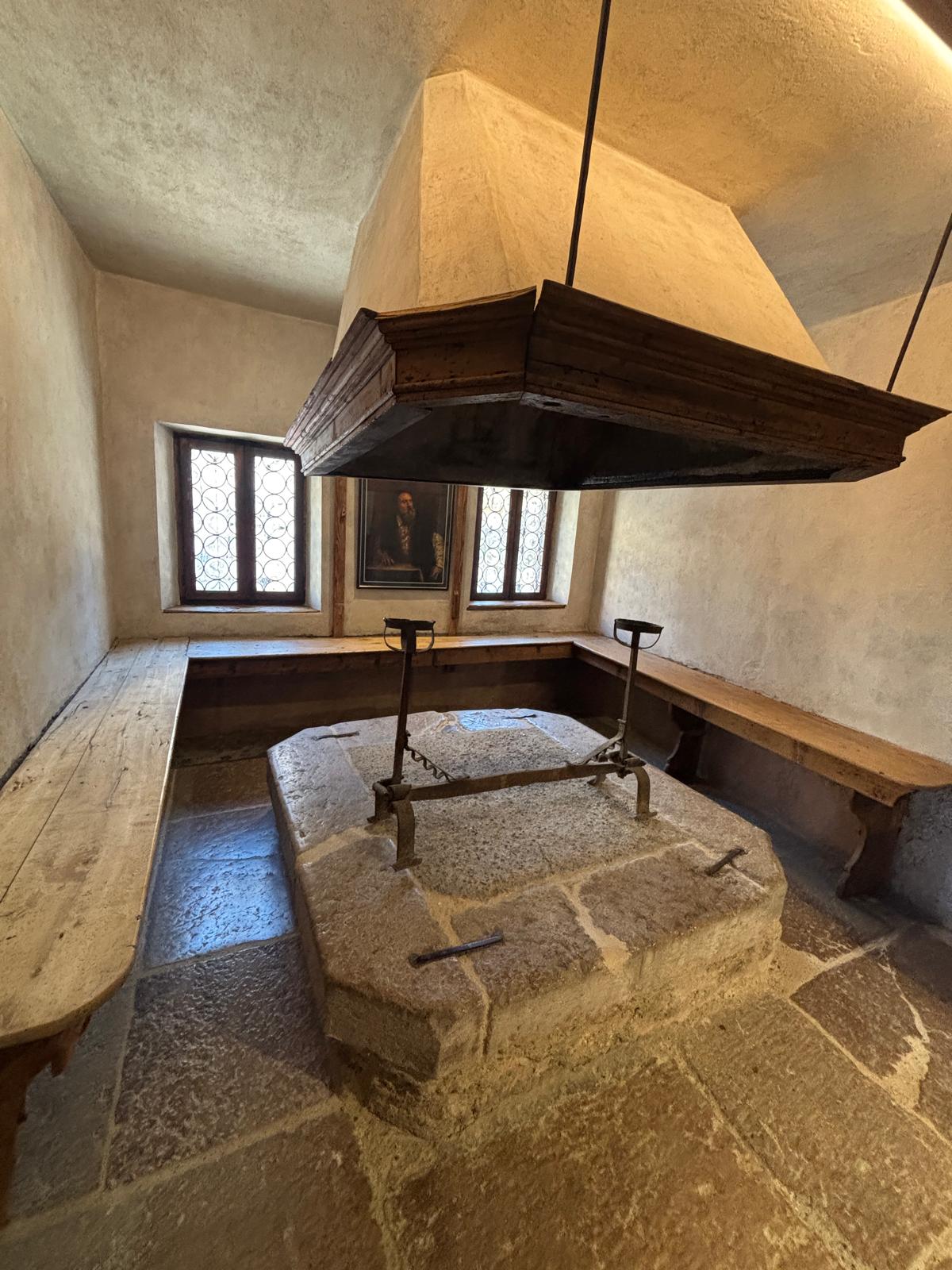
The house museum today spans two floors connected by a wooden staircase, its walls in places entirely lined in wood, its furnishings deliberately rustic, evoking the genuine atmosphere of a distinguished but practical mountain family home rather than anything resembling aristocratic grandeur. The ground floor greets visitors with a spacious room, its floor laid in small wooden blocks and its walls similarly wood-paneled, displaying reproductions of Titian’s own drawings held today in Florence’s Uffizi Gallery alongside copies of his surviving autographed letters. Climbing the steep wooden staircase leads to the upper floor, where five characteristic rooms occupy the space where Titian most likely spent his own childhood, and where he continued to stay whenever he returned to his native Cadore throughout his later life in Venice. The kitchen, with its stone floor, still holds a traditional open hearth, complete with a copper cooking pot hanging from its original chain, and the stua, a wood-paneled room with a rustic coffered ceiling, displays further copies of Titian’s personal correspondence.
From Apprentice to the Republic’s Official Painter
Once in Venice, the young Titian trained first under Gentile Bellini and then under his considerably more influential brother, Giovanni Bellini, the leading Venetian painter of the previous generation, whose workshop shaped an entire cohort of Venetian Renaissance artists. Titian’s early career was closely intertwined with that of Giorgione, another young painter working in Bellini’s orbit, and the two collaborated directly on the now largely lost fresco decoration of the Fondaco dei Tedeschi, Venice’s trading house for German merchants, a commission that helped establish Titian’s own independent reputation alongside his older, more established colleague.
Titian’s decisive rise came in 1516, when, following Giovanni Bellini’s death, he was appointed official painter to the Venetian Republic, a position that placed him at the absolute center of the city’s artistic and political life for the remainder of his exceptionally long career. Working from this position, Titian built a body of work that came to define an entire era of Venetian painting: the monumental Assumption of the Virgin and the Pesaro Madonna, both still hanging today in the Basilica dei Frari exactly where Titian originally placed them, alongside the sensuous Venus of Urbino, the mythological Bacchus and Ariadne, and Sacred and Profane Love, works that together demonstrate the technique for which Titian became most celebrated: a revolutionary emphasis on color itself, applied in dense, vibrant, almost tactile brushwork, as the fundamental building block of a painting’s form, a genuine departure from the more linear, drawing-based tradition dominant in Florence and Rome during the same period.
A Painter for Popes and Emperors
Titian’s reputation eventually extended far beyond Venice itself, drawing commissions from some of the most powerful patrons in all of Europe. Alfonso d’Este, Duke of Ferrara, and Federico Gonzaga of Mantua both secured major works from the artist, and Pope Paul III sat for a series of genuinely penetrating portraits during Titian’s extended stay in Rome. Most remarkably, the Holy Roman Emperor Charles V became one of Titian’s most devoted patrons, granting the painter the extraordinary title of Count Palatine and Knight of the Golden Spur, an almost unprecedented honor for an artist at the time, reflecting genuine imperial regard rather than simple patronage. Titian’s relationship with Spanish royal patronage continued under Charles V’s son, King Philip II, for whom Titian produced the celebrated poesie, a series of large-scale mythological paintings including several depictions of Danaë, among the most sensuous and technically daring works of his entire late career.
Titian died in Venice in 1576, during a devastating outbreak of plague that swept through the city, and was buried inside the Basilica dei Frari, the same church that still holds two of his most significant altarpieces, a fitting final resting place for an artist whose career had been so thoroughly shaped by, and had so thoroughly shaped in turn, the artistic identity of Venice itself.
Cadore Never Left Him
Despite building his entire professional life around Venice, Titian never fully severed his ties to his native Cadore. He returned periodically throughout his life, staying in the family home in Pieve di Cadore during these visits, and he left a lasting mark on his hometown’s own religious art: the parish church of Pieve di Cadore still holds an altarpiece painted by Titian himself, a genuine, if less famous, counterpart to the grander commissions he produced for Venice’s own churches and Europe’s royal courts.
Visiting Pieve di Cadore Today
Beyond the house museum itself, Pieve di Cadore’s central piazza, fittingly named Piazza Tiziano, holds a statue of the painter alongside the Palazzo della Magnifica Comunità di Cadore, and the town’s parish church displays the altarpiece Titian painted for his own hometown. The town is also home to the Museo dell’Occhiale, tracing the region’s long history of eyewear manufacturing, a genuinely distinct but locally significant industry that developed in Cadore beginning in the late 19th century. Pieve di Cadore’s own mountain setting, ringed by Dolomite peaks, makes it a natural stop for travelers already building a day around Cortina d’Ampezzo and the wider Dolomites, adding a genuine art-historical dimension to what’s otherwise typically treated as a purely scenic mountain excursion.
Plan your visit: Tour of the Dolomites: A Journey Through Italy’s Most Breathtaking Mountains already passes through Pieve di Cadore on the route north from Venice toward Cortina, and reaching out through our customized private tours page lets us build in dedicated time at Titian’s birthplace alongside the wider Dolomites itinerary.
Frequently Asked Questions
When was Titian born, and why is the exact date uncertain? Titian’s birth year remains genuinely disputed among historians, with estimates ranging from 1477 to as late as 1490; most modern scholars favor a date around 1488 to 1490. The uncertainty partly stems from inconsistencies in the artist’s own later correspondence, where he sometimes implied an earlier birth year, possibly to enhance his professional standing at the time.
Can I still visit the house where Titian was born? Yes. The Casa Natale di Tiziano Vecellio in Pieve di Cadore is open to the public as a house museum, generally during the summer season, holidays, and by reservation. It’s recognized as an Italian national monument and was fully restored and reopened in its current form in 1932.
How far is Pieve di Cadore from Venice, and can it be combined with a Dolomites trip? Pieve di Cadore sits roughly two hours north of Venice by car, on the route toward Cortina d’Ampezzo, making it a natural, easy addition to a broader Dolomites day trip or overnight excursion rather than a separate standalone journey.
When was Titian born, and why is the exact date uncertain?
Titian’s birth year remains genuinely disputed among historians, with estimates ranging from 1477 to as late as 1490; most modern scholars favor a date around 1488 to 1490. The uncertainty partly stems from inconsistencies in the artist’s own later correspondence, where he sometimes implied an earlier birth year, possibly to enhance his professional standing at the time.
Can I still visit the house where Titian was born?
Yes. The Casa Natale di Tiziano Vecellio in Pieve di Cadore is open to the public as a house museum, generally during the summer season, holidays, and by reservation. It’s recognized as an Italian national monument and was fully restored and reopened in its current form in 1932.
How far is Pieve di Cadore from Venice, and can it be combined with a Dolomites trip?
Pieve di Cadore sits roughly two hours north of Venice by car, on the route toward Cortina d’Ampezzo, making it a natural, easy addition to a broader Dolomites day trip or overnight excursion rather than a separate standalone journey.